
The QSEN competencies are six areas of practice every nursing graduate is expected to master: patient-centered care, teamwork and collaboration, evidence-based practice, quality improvement, safety, and informatics. QSEN stands for Quality and Safety Education for Nurses. You will meet these six terms in your syllabus, your clinical evaluations and your exam questions, so the goal is to understand each one well enough to apply it to a patient scenario, not just to list it. This guide does that, and then shows how to practice it with rationale-based questions, which is what we build at Nursing School Pro.
TL;DR
- QSEN defines six competencies: patient-centered care, teamwork and collaboration, evidence-based practice, quality improvement, safety and informatics.
- Each one is broken into knowledge, skills and attitudes (KSAs) that you are expected to show by graduation.
- Safety is the one students are tested on most visibly: think handoffs, fall risk, medication rights and error reporting.
- Bloom's taxonomy explains why exam questions ask you to apply and analyze, not just recall.
- The fastest way to learn the framework is to practice scenario questions and read every rationale until you can explain the why.
Table of Contents
- What QSEN is and why your program uses it
- The six QSEN competencies at a glance
- The six competencies in plain language
- Knowledge, skills and attitudes: how each competency is built
- QSEN safety competency examples
- Bloom's taxonomy and nursing: why it matters for QSEN
- How to study QSEN competencies for exams and clinicals
- How QSEN shows up on HESI A2, TEAS and NCLEX
- Our perspective
- Practice QSEN-style questions with rationales
- FAQ
- Sources
What QSEN is and why your program uses it
QSEN began as a project to bring quality and safety content into nursing curricula. Its faculty adapted the Institute of Medicine's competencies for nursing and proposed definitions and target KSAs for each one. The Institute of Medicine (now the National Academy of Medicine) is the independent body whose 2003 report set out the aims for safer health care. According to the American Academy of Ambulatory Care Nursing, those six aims are the foundation for QSEN's six competencies.
In practice, schools use the framework in two ways. First, it shapes course objectives: a syllabus may ask you to describe the QSEN competencies and outline how they improve nursing practice. Second, it shapes clinical evaluation. Programs use the framework to measure safety and readiness, and evaluation tools track your progress by showing how you incorporate each competency into practice.
So the framework is not trivia. It is the language your instructors use to judge whether you think like a safe nurse.
The six QSEN competencies at a glance
| Competency | What it asks of you | Quick example |
|---|---|---|
| Patient-centered care | Treat the patient as a partner whose values, preferences and needs guide care | Asking a patient what matters to them before planning discharge teaching |
| Teamwork and collaboration | Communicate and work well with the patient, family and the rest of the care team | Giving a clear SBAR handoff at shift change |
| Evidence-based practice | Combine the best current research with clinical expertise and patient preferences | Following a hand hygiene protocol grounded in peer-reviewed research |
| Quality improvement | Use data to monitor outcomes and help improve care processes | Joining a unit discussion on fall rates |
| Safety | Minimize risk of harm to patients and providers | Checking the medication rights before every dose |
| Informatics | Use information technology to communicate, manage knowledge and support decisions | Entering a fall risk assessment into the electronic health record |
The next sections explain each in the way an exam question or a clinical instructor would frame it.
The six competencies in plain language
Patient-centered care
This competency puts the patient, not the task list, at the center. You recognize that patients and families bring their own values, culture and preferences, and you build the plan of care with them. On a test, the correct answer to a patient-centered question usually involves asking, listening or involving the patient before acting.
Teamwork and collaboration
Nurses rarely work alone. This competency covers communicating clearly with physicians, therapists, pharmacists and other nurses, respecting each role, and handing off information accurately. SBAR (Situation, Background, Assessment, Recommendation) is a structured format for this, and it appears again and again in safety questions.
Evidence-based practice
Evidence-based practice means your care rests on the best available research, your clinical judgment and the patient's preferences, not on "how we have always done it." In exam terms, if two answers seem reasonable, the one that matches current evidence and standards is usually the better pick.
Quality improvement
Quality improvement is about using data to see how care is going and then changing the process, not blaming the person. A student-level skill listed in the Nursing Made Incredibly Easy article on QSEN is to participate in a root cause analysis of a sentinel event. A sentinel event is a serious, unexpected event that causes death or major harm, and a root cause analysis looks for the system failures behind it.
Safety
Safety is defined by QSEN as minimizing risk of harm to patients and providers through both system effectiveness and individual performance. The QSEN faculty considered a separate safety competency crucial because it covers system effectiveness and reliability in addition to individual performance. We cover it in detail below because it is the one most often tested.
Informatics
Informatics is the use of technology, such as the electronic health record (EHR), barcode medication scanning and decision-support alerts, to support safe, accurate care. You are expected to document correctly, protect patient information and use the data in front of you to make decisions.
Knowledge, skills and attitudes: how each competency is built
Every QSEN competency is broken into three parts. Knowledge is understanding, skills are implementation, and attitudes are values, and expectations in each are set for the time you graduate. The official pre-licensure KSAs list them in full. Using safety as the model:
- Knowledge: examine human factors and safety design principles, describe the benefits and limitations of safety-enhancing technologies, and describe the factors that create a culture of safety.
- Skills: use technology and standardized practices correctly, use strategies that reduce reliance on memory (forcing functions and checklists), and use your organization's error reporting system.
- Attitudes: value standardization and reliability, appreciate the cognitive and physical limits of human performance, value your own role in preventing errors, and use root cause analysis rather than blame when errors occur.
A forcing function is a design feature that makes the wrong action hard or impossible, such as a pump that will not run until a dose is confirmed. Understanding that attitude piece matters: many exam questions are really asking whether you respond to an error with reporting and system thinking or with blame.
QSEN safety competency examples
Students searching for QSEN examples are usually looking at safety. Here are examples that show the competency in everyday work, drawn from the Nursing CE Central QSEN overview:
- Cleaning your stethoscope before and after use
- Disposing of needles in a sharps container
- Checking the room before you leave: call light within reach, obstacles cleared, spills cleaned up
- Using the rights of medication administration to reduce medication errors
The same source breaks two common topics across several competencies:
Fall prevention. You conduct a fall risk assessment (safety), give an accurate SBAR handoff (teamwork), search for peer-reviewed research on fall prevention (evidence-based practice), join a fall prevention committee (quality improvement), and enter the assessment results in the EHR (informatics).
Infection prevention. You assess what the patient and family know about how infections spread (patient-centered care), follow facility standardized handwashing practices based on peer-reviewed research (evidence-based practice), participate in debriefing sessions when protocols are updated (teamwork), and review EHR data on catheter-associated urinary tract infection (CAUTI) rates (informatics).

Notice the pattern. One clinical topic touches all six competencies. That is exactly how case-based exam questions are written, so when you study a topic, ask yourself which competency each action represents.
Faculty are encouraged to introduce safety early and build on it. The Online Journal of Issues in Nursing recommends that patient safety content start early and be emphasized in intermediate and advanced phases, including The Joint Commission National Patient Safety Goals. Its suggested activities include practicing SBAR during handoff in a medical-surgical rotation and attending a root cause analysis during a capstone clinical. If your program offers any of these, treat them as practice for the exam as well as for the job.
Bloom's taxonomy and nursing: why it matters for QSEN
Bloom's taxonomy is a way of ranking thinking from simple to complex. The revised version has six levels: remembering, understanding, applying, analyzing, evaluating and creating. Nursing education uses it to line up what is taught, how it is taught and how it is tested.
It connects to QSEN neatly. The cognitive, affective and psychomotor domains of Bloom's taxonomy mirror the knowledge, attitudes and skills nursing students need to provide safe care. Some nursing organizations use both together: one orientation redesign wrote its competency statements using Bloom's taxonomy and sorted them by QSEN competency.
Here is what that means for your studying:
| Bloom's level | What it looks like in nursing | Exam question style |
|---|---|---|
| Remember | Recall the six QSEN competencies | "Which of these is a QSEN competency?" |
| Understand | Explain why checklists reduce reliance on memory | "Which statement shows understanding of..." |
| Apply | Use the medication rights with a specific patient | "Which action should the nurse take first?" |
| Analyze | Compare a patient's findings and spot the priority | "Which finding requires follow-up?" |
| Evaluate | Judge whether an intervention worked | "Which response indicates teaching was effective?" |
This matters because the majority of NCLEX-RN items are reported to be written at the application level or higher. Memorizing the six names gets you the first row only. Passing questions come from the lower rows of that table. If you want a deeper look at turning those levels into a study routine, this Bloom's taxonomy study guide walks through it for students.
How to study QSEN competencies for exams and clinicals
A workable routine has five steps. At each one we show where it tends to go wrong.
- Learn the six names and one sentence each. Use the table above. The common mistake is stopping here, because recall alone does not prepare you for application-level questions.
- Attach each competency to a real action. Take a topic you are studying, such as falls, and write which action belongs to which competency. The common mistake is learning definitions in the abstract, where they will not come back to you under time pressure.
- Practice scenario questions. Answer questions that ask what the nurse should do first or next. The common mistake is rushing to see whether you were right. A right answer by luck teaches nothing. Nursing School Pro gives practice questions for every nursing class, with an instant rationale on each answer, so you see why the right choice is right and why the others are not.
- Read every rationale, including the ones you got right. Rationales are where the competency language shows up: culture of safety, handoff, evidence, patient preference. Our guides on how to study NCLEX rationales and on practice with rationales show a method for this.
- Track weak areas and revisit them. If you keep missing handoff or error-reporting questions, that is a teamwork or safety gap, not bad luck. Nursing School Pro uses real-time analytics to track your progress and highlight weak areas, so your next session targets them instead of what you already know.
For clinicals, add a reflection habit. Reflective assignments let you look at clinical experiences through a quality and safety lens, which bridges classroom theory and bedside practice. After each shift, write down one thing you did that matched each competency, even if it was small. Evaluators look for exactly this kind of concrete example.
If you are heading toward the licensing exam, see how the question formats work in our guide to NCLEX question types and the Next Generation NCLEX, and practice with NGN-style case studies, which are built around multi-step clinical judgment. Handoff tools can also help you practice the teamwork competency, such as a nursing report sheet template.
How QSEN shows up on HESI A2, TEAS and NCLEX
The HESI A2 and TEAS are entrance exams. They test academic content such as math, reading, science and English, so you will not be asked to list the QSEN competencies on them. What they do is begin building the habit of reasoning carefully under time pressure, which QSEN-style questions later demand. Once you are in a program, QSEN language appears in course exams and in the NCLEX, where questions on delegation, prioritization, medication safety, infection control and communication each map to one or more of the six competencies. Even though the exam does not label the questions by competency, a student who thinks in these categories reads scenarios faster and more accurately.
Some examples of how the mapping works:
- A question about which client to see first is testing safety and prioritization.
- A question about what to say to a family member who is anxious is testing patient-centered care and communication.
- A question about what to do after finding a medication error is testing safety culture, reporting and quality improvement.
- A question about documenting an assessment is testing informatics.
Medication safety is a large share of this. If you want to put numbers on that, our pharmacology study guide explains the share of the exam it covers and how to practice it, and the NCLEX changes guide covers what is new in the current exam.
Our perspective
We built Nursing School Pro around one belief: knowing the right answer is not the same as knowing why it is right. The six QSEN competencies are a good example. A student can recite them in thirty seconds and still miss a question about a handoff, because the question never uses the word "teamwork."
That is why every answer on our platform comes with an instant rationale. The rationale is where you learn to see the competency hiding inside the scenario. Our analytics then show which kinds of questions keep costing you points, so you spend your hours on those and not on what you have already mastered.
Our content is aligned with respected nursing textbooks and national standards, because quality and safety are not a separate subject you study once. They run through fundamentals, pharmacology, med-surg and every clinical you will do. We think the best way to learn them is to practice them from your first class until graduation.
Autumn
Practice QSEN-style questions with rationales
Nursing School Pro is an online platform with practice questions for every nursing class and for HESI A2, TEAS and NCLEX preparation. Each answer comes with an instant rationale, and real-time analytics show your weak areas so you can study them first. It costs $20 per month after a 48-hour free trial, and you can start on the Nursing School Pro pricing page or look around the Study Center first.
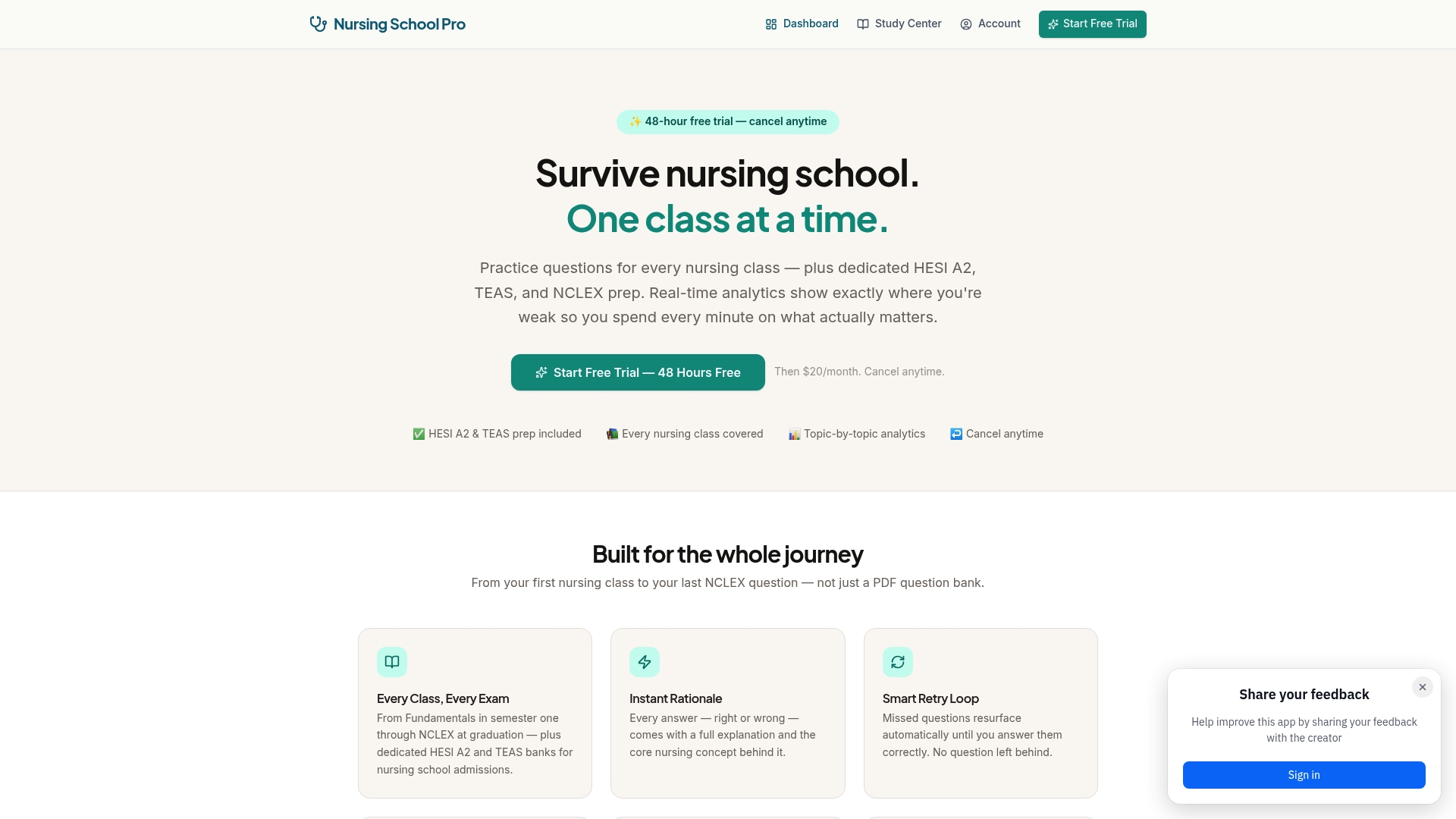
If you are earlier in the journey, the main site lists the HESI A2 and TEAS preparation, and our guide to adaptive NCLEX practice explains how practice that adjusts to you works, and NCLEX scoring explains how the exam decides pass or fail.
FAQ
What are the six QSEN competencies?
They are patient-centered care, teamwork and collaboration, evidence-based practice, quality improvement, safety and informatics. QSEN defines them for pre-licensure and graduate nursing programs. Each has its own knowledge, skills and attitudes that you should show by graduation.
What is the QSEN safety competency?
Safety means minimizing the risk of harm to patients and providers through both how systems are designed and how individuals perform. In practice that includes the rights of medication administration, fall risk assessments, checklists, handoffs and reporting errors without blame. Its attitudes include valuing your own role in preventing errors and using root cause analysis rather than blame.
What are some examples of QSEN competencies in practice?
Giving an SBAR handoff shows teamwork. Completing a fall risk assessment shows safety. Following a hand hygiene protocol grounded in research shows evidence-based practice. Entering assessment results in the EHR shows informatics. One topic, such as fall prevention, can involve all six at once.
How does Bloom's taxonomy relate to QSEN and nursing exams?
Bloom's taxonomy ranks thinking from remembering to creating, and its domains mirror the knowledge, skills and attitudes that QSEN uses. Most NCLEX-RN items are reported to be written at the application level or higher, so you need to practice using the competencies in scenarios, not just naming them.
Sources
- Competencies | QSEN
- QSEN Pre-Licensure KSAs
- Quality and Safety Education for Nurses (Cronenwett et al., 2007)
- Enhancing Quality and Safety Nursing Competencies in Ambulatory Care Practice (AAACN)
- QSEN Competencies: A Bridge to Practice (Nursing Made Incredibly Easy)
- Teaching the Culture of Safety (OJIN)
- QSEN Competencies: Set the Tone of Your Shift
- Evidentiary and theoretical foundations for virtual simulation (PMC)
- Utilizing the QSEN Framework to Redesign Nursing Orientation Competencies
- A framework for increasing pass rates on high stakes exams
- NRSG 292.50: Study Techniques for Nursing
- What Is QSEN in Nursing? | University of Phoenix
- Bloom's Taxonomy Studying: A Practical Guide for Students