
Your fastest path to a higher NCLEX pass probability is regular practice with Next Generation NCLEX style questions paired with full, teach-to-clinical-judgment rationales, not just answer keys. Start today: pull one mixed NGN-style timed set and, for every item you miss or guess on, read the rationale twice before moving on. Nursingschoolpro's study center offers this format with a 48-hour free trial, and you can supplement early on with free banks like Nurseslabs and RegisteredNursing.org for extra volume while you build your routine.
Key Takeaways
Practicing NGN-style questions with full rationales, logging every missed cue, and simulating CAT conditions before test day is the most reliable way to convert study time into a pass.
- Practice mixed NGN-style sets regularly rather than drilling one category at a time.
- Read and mentally rewrite the rationale for every missed or flagged item, not just the ones you got wrong outright.
- Keep a missed-cue log with topic, item type, and error category to spot repeating weak spots.
- Run at least two full-length timed simulations before your test date to get comfortable with CAT pacing.
- Try Nursingschoolpro's free trial alongside free banks like Nurseslabs or RegisteredNursing.org to see which format fits your study style before committing.
| Point | Details |
|---|---|
| Rationale depth over volume | Full explanations of every distractor teach clinical judgment better than terse answer keys. |
| Match practice to Test Plan | Cover all four Client Needs categories and every NGN item type, not just familiar formats. |
| Scoring changes your strategy | Plus/minus items punish over-selection; 0/1 dyads require every linked part correct. |
| Missed-cue logging | Track topic, error type, and item format to find and fix repeating weak spots. |
| Nursingschoolpro fit | Offers NGN-aligned sets, instant rationales, CAT simulation, and analytics via a 48-hour free trial. |
Table of Contents
- Why NCLEX Practice With Rationales Beats Answer-Only Drilling
- What to Practice: Test Plan Categories and NGN Item Types
- How CAT and NGN Scoring Actually Work
- A Study Workflow That Turns Missed Questions Into Clinical Judgment
- Sample NCLEX Practice Questions With Full Rationales
- Free Resources vs. Premium Question Banks: How to Choose
- How Nursingschoolpro Supports NCLEX Practice With Rationales
- Turning Practice Into a Real Exam-Day Advantage
- What the Research Actually Supports About NCLEX Prep
- Try Nursingschoolpro's NCLEX Question Bank Free for 48 Hours
- Frequently Asked Questions
- Sources
Why NCLEX Practice With Rationales Beats Answer-Only Drilling
A question you answer correctly by guessing teaches you nothing. A question you miss, then dissect through its rationale, teaches you exactly where your reasoning broke down. That gap explains why rationale quality matters more than raw question count when you're prepping for an exam built around clinical judgment rather than memorization.
The Next Generation NCLEX shifted the exam toward the NCSBN Clinical Judgment Measurement Model, a six-step framework: recognize cues, analyze cues, prioritize hypotheses, generate solutions, take action, and evaluate outcomes. A terse rationale that just states "the answer is C" skips every one of those steps. A strong rationale walks you through which cues mattered, why the correct option addressed the priority problem, and why each distractor represents a specific reasoning error rather than just being "wrong."
That distinction changes what a rationale needs to do. It should function less like an answer key and more like a short clinical debrief.
- Missed cue: Did you overlook a vital sign trend, a lab value, or a patient statement that should have redirected your thinking?
- Scope error: Did you pick an intervention outside your scope, or skip delegation when delegation was the correct move?
- Prioritization error: Did you choose a correct but lower-priority action over the one addressing the most urgent physiological or safety need?
- Distractor logic: Does the rationale explain why the wrong options are plausible, not just incorrect?
Pro Tip: If a rationale only tells you why the right answer is right, it's doing half the job. The best question banks explain why every wrong option tempts you, because that's the exact trap the real exam sets.
What to Practice: Test Plan Categories and NGN Item Types
Your practice sets should mirror the 2023 RN Test Plan, which organizes the exam into four Client Needs categories. Skipping any of them leaves a blind spot on test day.
Safe and Effective Care Environment covers Management of Care and Safety and Infection Control, the delegation, prioritization, and infection-prevention questions many students underrate until they see how often they appear. Health Promotion and Maintenance tests developmental stages, screening, and patient teaching. Psychosocial Integrity covers coping, grief, abuse recognition, and therapeutic communication. Physiological Integrity is the largest category and splits into Basic Care and Comfort, Pharmacological and Parenteral Therapies, Reduction of Risk Potential, and Physiological Adaptation.
Layered on top of those categories are the NGN item types, each built to test a specific slice of clinical judgment.
| Item Type | What It Tests | Common Scoring Rule |
|---|---|---|
| Extended multiple response | Recognizing multiple relevant cues or actions | +/- (deducts for wrong selections) |
| Matrix/grid | Organizing findings by category or urgency | 0/1 per row, all-or-nothing |
| Drag-and-drop (cloze) | Sequencing or prioritizing actions | Rationale scoring, paired all-or-nothing |
| Hotspot/highlight | Identifying relevant text or image findings | 0/1 per item |
| Bowtie/trend items | Linking cues to actions to outcomes | Partial credit per zone |
| Unfolding case studies | Applying the full NCJMM across a changing patient scenario | Mixed, scored per embedded item |
Notice how many of these use partial-credit scoring. That single fact should change how you practice, because getting comfortable with the scoring logic is as important as knowing the content.
How CAT and NGN Scoring Actually Work
The NCLEX runs on Computerized Adaptive Testing, which means the exam selects your next item based on how you performed on the last one. Every candidate gets between 85 and 150 items, and the exam ends once the system reaches 95% confidence that your performance sits clearly above or below the passing standard. If the system can't reach that confidence level by the maximum length, you hit the Run-Out-Of-Time rule, where your final ability estimate across the last several items determines pass or fail. That's why consistency in the final stretch of practice sessions matters as much as your first fifty questions.
Scoring adds another layer you need to internalize before test day. NCSBN identifies three scoring models currently in use on NGN items: plus/minus scoring, which awards a point per correct selection and deducts one per incorrect selection; zero/one scoring, which is all-or-nothing across an entire item or matrix row; and rationale scoring, used on paired items where you must get both the action and its justification correct to earn any credit.
By the numbers: Many NGN item types award partial credit rather than requiring a perfect response, which means a near-miss on a matrix or extended multiple-response item still counts for something, according to NCSBN's scoring model documentation. That's a meaningful shift from the all-or-nothing mentality most students bring in from nursing school exams.
The practical takeaway: on a plus/minus item, selecting every option to "cover your bases" actively hurts your score, since each wrong pick subtracts a point. On a zero/one dyad, you need to answer every linked component correctly, so skipping half of a paired item guarantees zero credit even if the half you answered was right. Practicing under this logic, not just practicing content, is what separates students who freeze on NGN formats from those who move through them efficiently.
A Study Workflow That Turns Missed Questions Into Clinical Judgment
Random review sessions waste time. A repeatable sequence, run consistently, is what actually raises your score over a few weeks of prep.
- Pull a mixed NGN-style set of 20 to 30 items that spans at least two Client Needs categories, so you're not fooling yourself with narrow, easy repetition.
- Simulate timed conditions. Give yourself roughly one minute per item and don't pause to look anything up mid-set.
- Flag uncertain answers as you go, even ones you technically got right. A lucky guess deserves the same scrutiny as a wrong answer.
- Read the full rationale for every missed or flagged item, not a skim. Note specifically which NCJMM step broke down.
- Log the missed cue in a dedicated tracker: the topic, the specific cue you missed, the error type (recognition, prioritization, scope), and the correct reasoning path.
- Build a five-question micro-drill targeting that exact weak spot before your next full set.
Your missed-cue log doesn't need to be complicated. A simple spreadsheet with columns for date, topic, item type, error category, and a one-sentence rationale summary is enough to reveal patterns after a week or two. Most students find the same two or three error types repeating across categories, and that repetition is the signal to prioritize.
Pro Tip: Don't mix categories every single session. Alternate: two mixed sessions per week to mirror exam-day randomness, and one focused session drilling whatever category your missed-cue log flags as weakest.

A realistic weekly rhythm looks like four practice sessions of 25 to 40 questions, two of them mixed-category and timed, one focused on your weakest Client Needs area, and one full-length simulation every other week once you're within a month of your test date.
Sample NCLEX Practice Questions With Full Rationales
Here are representative items across major categories, formatted the way a strong practice bank should present them.
Management of Care (Safe and Effective Care Environment)
A nurse is assigning tasks to a licensed practical nurse (LPN) and a nursing assistant. Which task should the nurse assign to the LPN rather than the nursing assistant? A) Assisting a stable patient with ambulation B) Reinforcing teaching about a low-sodium diet C) Recording a patient's oral intake D) Administering a scheduled oral antihypertensive
Correct answer: D. LPNs can administer many oral and some injectable medications depending on state scope of practice, while nursing assistants cannot administer medications under any circumstance. Options A and C fall within nursing assistant scope. Option B is a teaching task, which requires an RN because initial patient education involves independent judgment an LPN's scope doesn't cover. The distractor logic here hinges on scope of practice, one of the most heavily tested Management of Care concepts.

Pharmacological Therapies (Physiological Integrity)
A patient receiving intravenous vancomycin reports facial flushing and itching during the infusion. What should the nurse do first? A) Stop the infusion and assess the patient B) Administer diphenhydramine C) Slow the infusion rate D) Notify the provider immediately
Correct answer: A. Flushing and itching during vancomycin infusion suggest "red man syndrome," a rate-related reaction rather than a true allergy. The first action must always be to stop the infusion and assess, because you need current data before choosing an intervention. Slowing the rate (C) is a reasonable second step, but you can't decide on rate adjustment before assessing. Diphenhydramine (B) and notifying the provider (D) may follow, but neither is the priority action. This rationale illustrates a classic "assess before you act" prioritization error.
Extended Multiple Response, Reduction of Risk Potential
Select all findings that indicate a patient is at risk for postoperative deep vein thrombosis.
Correct selections: Age 68, history of oral contraceptive use, prolonged immobility, BMI of 31. This is scored plus/minus, so selecting "ambulates independently" or the normal A1c costs you a point each, since neither represents a DVT risk factor. The rationale for this item type has to name every correct risk factor individually and explain why the two incorrect selections are actively reassuring findings, not neutral ones. That's the nuance most terse answer keys skip, and it's exactly why plus/minus items punish the "select everything plausible" habit.
Free Resources vs. Premium Question Banks: How to Choose
Free question banks are genuinely useful early in your prep. Sites like Nurseslabs and the Nurse Plus question library give you volume for pattern recognition and basic content review at no cost, and RegisteredNursing.org organizes practice by content area in a way that's helpful when you're still mapping out weak subjects. The limitation shows up once your errors stop being about content gaps and start being about clinical reasoning under NGN-style conditions.
Look for these features before committing time to any bank, free or paid:
- NGN alignment across item types, not just traditional four-option multiple choice.
- Full rationales that explain every distractor, not just the correct answer.
- A CAT-mode simulator that mimics the 85 to 150 item adaptive range and enforces realistic timing.
- Partial-credit scoring fidelity on matrix, extended multiple response, and dyad items, so your practice scores mean something.
- Analytics that track missed-cue patterns across categories, not just a raw percentage correct.
- Clinical credentials behind the content, ideally RN or BSN-level authorship and review.
| Feature | Typical Free Resource | What to Look for at the Paid Tier |
|---|---|---|
| Question volume | High, often unlimited | Moderate to high, curated by category |
| Rationale depth | Varies, often brief | Full teach-to-clinical-judgment detail |
| NGN item variety | Partial, growing | Full range including matrix and case studies |
| CAT simulation | Rare | Standard feature |
| Weak-area analytics | Minimal or none | Detailed, cue-level tracking |
The decision flow is simple. If you're still building foundational content knowledge, free volume from Nurseslabs, RegisteredNursing.org, or the Nurse Plus bank is a reasonable place to start. Once your errors cluster around NGN formats specifically, or once you need a genuine CAT simulation before your test date, that's your signal to move to a paid tool built for exactly that gap.
How Nursingschoolpro Supports NCLEX Practice With Rationales
Nursingschoolpro built its NCLEX prep around the exact workflow described above rather than around raw question volume. Every item comes with an instant, full rationale, and the platform tracks your missed cues automatically so you're not building a spreadsheet by hand.
- NGN-aligned question sets covering all four Client Needs categories and the current item types, including matrix, extended multiple response, and unfolding case studies.
- Instant, teach-to-clinical-judgment rationales for every question, explaining both the correct choice and why each distractor fails.
- CAT-style simulation that mirrors adaptive timing and item-count behavior so exam day doesn't feel unfamiliar.
- Real-time analytics that flag which Client Needs category and which error type (missed cue, prioritization, scope) you keep repeating.
- Downloadable templates aligned with leading nursing textbooks and national standards, useful for building your own missed-cue log alongside the platform's built-in tracking.
Content is reviewed for alignment with the NCSBN Test Plan, so what you practice maps to what's actually tested rather than to a generic multiple-choice format. Start with the 48-hour free trial, and on day one, take one timed mixed set of 25 to 30 questions across at least three categories. Your first analytics report will already show you which category needs the next micro-drill.
Turning Practice Into a Real Exam-Day Advantage
Practice questions only translate into a pass if your last few weeks include conditions that resemble the actual test. Run at least two full-length simulations, 85 to 150 items, under real time pressure, in a quiet room at the same time of day your actual exam is scheduled.
- Match your simulation environment to your test center conditions: same rough time of day, minimal noise, no phone nearby, and a single allowed break if your test center permits one.
- Set a pacing rule before you start: roughly one minute per item, and if you can't narrow a question to two options within 90 seconds, mark your best guess and move on. NGN items, especially case studies, can eat far more time than you expect if you let them.
- Build a short pre-exam ritual the morning of test day: consistent sleep the two nights before (not just the night before), a normal breakfast, and a 20 to 30 item mixed warm-up set with rationales to activate clinical reasoning without inducing fatigue.
- Confirm logistics 48 hours ahead, including your testing center check-in requirements, acceptable ID, and arrival window, so nothing administrative adds stress on test morning.
- Follow a simple do/don't list once you're seated: do use elimination systematically on multiple-response items rather than trying to recall the "complete" answer from memory; don't reread a stem five times when anxious, since NGN stems are written precisely and a second calm read usually confirms your first instinct rather than changing it.
The goal of simulation isn't to memorize more content in the final week. It's to make the CAT format, the timing pressure, and the NGN item types feel routine, so nothing about the actual test day is a surprise.
What the Research Actually Supports About NCLEX Prep
Most NCLEX advice online still treats the exam like a content test you can out-memorize with enough flashcards. That's outdated. The NGN was built specifically to measure clinical judgment through the NCJMM framework, which means the students who struggle most on test day usually aren't the ones with content gaps. They're the ones who never practiced under real scoring conditions, so a matrix item or an extended multiple-response question catches them off guard in a way pure memorization never would.
The conventional wisdom of "just do a thousand questions" undersells how much the rationale, not the question, does the actual teaching. A thousand shallow answer checks build false confidence. Two hundred questions with rationales you actually sit with, especially the ones explaining why a distractor is wrong, build the reasoning skill the exam is designed to measure.
If there's one place readers should prioritize their limited study hours, it's here: stop counting questions answered and start counting rationales genuinely understood. That's a harder number to track, which is exactly why a missed-cue log and analytics that flag error patterns matter more than a raw score percentage. The exam doesn't care how many questions you've seen. It cares whether you can reason through the next one it shows you.
Try Nursingschoolpro's NCLEX Question Bank Free for 48 Hours
If you've been piecing together free banks and generic question sets, you already know the gap: volume is everywhere, but full rationales that actually teach clinical judgment are harder to find, and CAT-style simulation is rarer still. Nursingschoolpro builds all three into one place, so you're not toggling between three different websites to cover content, rationales, and timed practice.
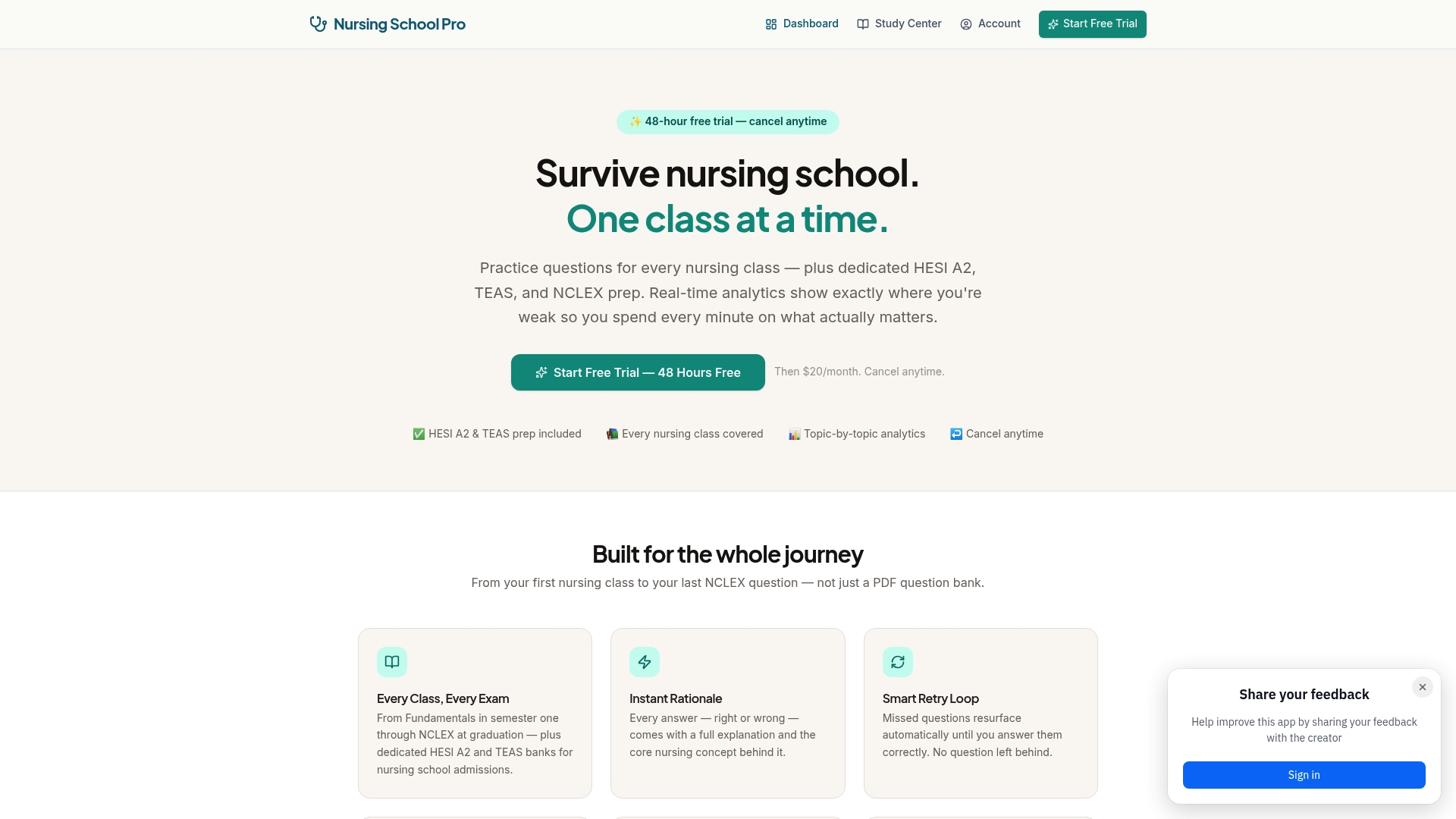
What makes it fit a reader coming from this article specifically is the missed-cue analytics. Instead of guessing which Client Needs category needs another pass, you get a direct readout after every session, and the platform's downloadable templates line up with the textbooks most nursing programs already assign, so you're not relearning terminology from scratch. The study center walks you through the full library by category, and every question comes with the instant rationale format this article has been describing throughout.
Start with the 48-hour free trial. Take one timed mixed set today, and let your first analytics report tell you exactly where to focus tomorrow.
Frequently Asked Questions
What makes a good NCLEX rationale? A strong rationale explains why the correct answer addresses the priority problem and why each incorrect option represents a specific reasoning error, not just that it's wrong. It should map to the clinical judgment steps the NGN tests: recognizing cues, prioritizing, and evaluating outcomes.
How many NCLEX practice questions should I do per day? Quality matters more than a fixed number. A focused set of 25 to 40 mixed-category questions, reviewed thoroughly with rationales, teaches more than 100 questions answered quickly without review.
Are free NCLEX question banks with rationales good enough to pass? Free resources like Nurseslabs and RegisteredNursing.org are solid for building content knowledge and volume early in your prep. Most students eventually need a CAT simulator and deeper analytics that free banks typically don't offer.
What is the difference between NCLEX practice questions and NCLEX practice tests? Individual practice questions target specific content or skills, while full practice tests simulate the adaptive, timed structure of the real exam, including the 85 to 150 item range and mixed categories.
How do I know when I'm ready to upgrade to a paid NCLEX question bank? If your missed-cue log shows repeating errors on medium or high-difficulty NGN item types, or you need realistic CAT-mode timing before your test date, that's the signal to move beyond free volume-based practice.
Sources
For anything related to test-plan changes or scoring policy, treat NCSBN's own publications as the final word over third-party guides, which sometimes lag behind official updates.