
Nursing ethics rests on four principles the American Nurses Association (ANA) groups together: autonomy, beneficence, nonmaleficence and justice. Textbooks add fidelity, veracity, accountability and confidentiality, giving a working set of seven or eight. This guide defines each one, shows how it looks at the bedside, connects it to the ANA Code of Ethics, and explains how it shows up on exams.
TL;DR
- The four core principles are autonomy, beneficence, nonmaleficence and justice. Indiana Wesleyan University credits the ANA with this framing.
- Fidelity, veracity, accountability and confidentiality are the supporting principles that OpenStax Fundamentals of Nursing lists beside the core four.
- The principles are the "why". The ANA Code of Ethics, with its ten provisions, is the "what the profession expects".
- When principles collide, work through a decision model: identify the issue, apply the Code, weigh options and consequences, then act.
- On exams, pick the answer that protects patient choice and safety first, and be ready to explain why.
Table of Contents
- What nursing ethics principles are
- The four core principles
- The supporting principles
- How the principles connect to the ANA Code of Ethics
- What to do when principles conflict
- The nurses' pledge versus the principles
- How ethics shows up on exams
- Practice ethics questions with rationales
- Our perspective on teaching ethics
- FAQ
- Sources
What nursing ethics principles are
Ethics, in the words of the American Association of Critical-Care Nurses, refers to principles that guide a person's behavior. In nursing, those principles give you a shared language for hard moments: a patient refusing treatment, a family asking you to withhold a diagnosis, a unit with too few staff and too many patients.
The framework has deep roots. The ANA formally adopted a Code for Professional Nurses in 1950, and a scoping review in PMC describes professional codes as a social contract between the public and the profession. Patients trust nurses with their bodies, their secrets and their vulnerability. The principles explain why that trust is deserved.
Four principles or seven? Both are right
Sources count differently, and that confuses students. Purdue Global reports that the ANA summarizes the code into four principles, and that author Mahlan recommends adding accountability, fidelity and veracity for seven. OpenStax lists eight: autonomy, justice, confidentiality, accountability, nonmaleficence, fidelity, beneficence and veracity.
For your coursework, learn the four first, then the extras. Your instructor's textbook decides which list your exams use.
The four core principles

Autonomy: the patient decides
Autonomy is the right of a competent adult to make decisions about their own care. In practice that means informed consent, honoring refusals, and making sure the patient has understood the information before choosing. The ANA Code's emphasis on patients' right to decide and to be informed is a recurring theme in the pages that rank for this topic.
Example: a patient with a new diabetes diagnosis declines insulin teaching today. You document the refusal, make sure they know the risks, tell the provider, and offer to revisit the teaching. You do not coerce, and you do not stop caring.
A public health version: American Nurse Journal describes the nurse's duty to respect patient autonomy while making sure families receive evidence-based information about vaccines.

Beneficence: do good
Beneficence means acting for the patient's benefit. Nevada State University gives the example of a hospice nurse prioritizing a terminal patient's comfort. Beneficence is not only dramatic rescues. Repositioning a patient, advocating for a pain reassessment and teaching a discharge plan clearly all count.
Nonmaleficence: do no harm
OpenStax defines nonmaleficence as doing no harm, intentionally or unintentionally, and expects nurses to protect those who cannot protect themselves. The Nevada State example is a nurse who holds a medication when it would do more harm than good, then notifies the prescriber.
Think of the double check on a high-alert drug, bed alarms for a fall-risk patient, or speaking up about a mislabeled specimen. Purdue Global calls beneficence and nonmaleficence two sides of the same coin.
Justice: fair treatment for everyone
Justice means treating patients fairly and impartially. Oklahoma City University explains that the principles work together so patients receive respect and fairness regardless of age, ethnicity, economic status, religion or sexual orientation. Purdue Global describes justice as the umbrella that covers the others.
At the bedside, justice shows up when you triage by need rather than by who is easiest to care for, when you arrange an interpreter, or when you split a heavy assignment fairly among colleagues.
The supporting principles
| Principle | Plain meaning | Quick example |
|---|---|---|
| Fidelity | Faithfulness and loyalty to patients and the profession | Keeping a promise to return with a pain medication check |
| Veracity | Honesty and truthful communication | Answering a patient's question about their prognosis accurately, within your scope |
| Accountability | Accepting responsibility for your own actions | Reporting a medication error instead of hiding it |
| Confidentiality | Protecting patient information | Not discussing a patient in an elevator |
The definitions come from OpenStax. Its Clinical Nursing Skills text describes fidelity as faithfulness, loyalty and commitment, including trusting relationships and confidentiality. It describes veracity as honesty and transparency, respecting the patient's right to be fully informed about their condition, options and likely outcomes.
How integrity and accountability connect
OpenStax ties the principles together: accountability means accepting responsibility for your actions, fidelity underlies accountability, and veracity underlies integrity. It adds that standards of care, policies and procedures help maintain accountability because they give a template of what should have been done to compare with what was done.
That is why charting matters ethically as well as legally. An accurate record is veracity and accountability on paper.
How the principles connect to the ANA Code of Ethics
The principles are concepts. The Code of Ethics for Nurses turns them into expectations. The ANA's 2025 Code of Ethics provisions include ten in total. Two to know first:
- Provision 1: the nurse practices with compassion and respect for the inherent dignity, worth and unique attributes of every person.
- Provision 2: the nurse's primary commitment is to the recipient of nursing care, whether an individual, family, group, community or population.
Provision 5 turns the lens on you. It states that nurses have moral duties to themselves, including an expectation of a safe workplace that fosters flourishing, along with self-respect through integrity and professional competence. Many students forget that ethics covers the nurse, not only the patient.
Provision 8 deals with health as a universal right. Oklahoma City University notes it has four parts: health as a universal right, collaboration for health and human rights, the obligation to advance health and human rights and reduce disparities, and collaboration in complex or extreme practice settings. This is where justice becomes a public health duty.
A simple way to study: for each provision, ask which principle it leans on most. Provision 2 leans on fidelity and beneficence. Provision 8 leans on justice.
What to do when principles conflict
Real dilemmas happen when two good principles point in opposite directions. A patient's autonomy says go home. Your beneficence says stay. Indiana Wesleyan University describes decision-making models with the same basic steps:
- Identify the ethical issue and who is affected.
- Apply the Nursing Code of Ethics.
- Determine your options.
- Consider the consequences of each.
- Implement the decision, then reflect on it.
OpenStax Medical-Surgical Nursing calls the four ANA principles a solid foundation for a logical, systematic approach to ethical decisions.
A worked example
An older adult with capacity wants to leave against medical advice to attend a family event. The family begs you to stop him.
- Issue: autonomy versus beneficence and nonmaleficence.
- Code: Provision 2 puts your commitment with the patient, who has the right to decide.
- Options: call the provider to talk through the risks, arrange safer discharge teaching, offer a shortened leave, or follow the facility's against-medical-advice process.
- Consequences: forcing him to stay violates autonomy. Letting him leave without teaching risks harm.
- Action: inform, document, involve the provider and the team, and keep the door open for return.
Notice the pattern: when a patient has capacity, you inform and support the choice rather than overriding it. Your own facility's policies and your supervising clinician guide the details.
The nurses' pledge versus the principles
Students often ask how the pledge differs from ethical principles. The pledge is a ceremonial promise. The principles are working tools. According to Wikipedia's article on the Nightingale Pledge, Lystra Gretter and a committee at the Farrand Training School in Detroit created it in 1893, and US nurses have recited it at pinning ceremonies for decades. Many schools have since revised the wording, for example removing the loyalty-to-physicians phrasing to reflect nursing's independent ethical standards.
The pledge says what you promise on graduation day. The principles and the Code tell you how to keep that promise on a Tuesday night shift.
How ethics shows up on exams
Ethics questions appear in fundamentals, leadership, mental health and the NCLEX. They usually give a scenario and ask for your best action. A few patterns help:
- Name the principle first. Is the stem about consent (autonomy), harm (nonmaleficence), fairness (justice), honesty (veracity) or privacy (confidentiality)?
- Assess before acting. Does the patient have capacity? Do they understand the information?
- Advocate through the chain. If something is unsafe, report it through proper channels rather than handling it alone or ignoring it.
- Watch for absolutes. Answers that coerce, deceive or breach privacy without a legal reason are rarely right.
If you are building a timeline for licensure, this NCLEX-RN study plan shows how to pace content review and practice questions across several weeks. For the exam's format, our guide to NCLEX changes covers what students should know, and our NCLEX case study examples walk through scenario-style answering. Ethics also runs through mental health content, which our two-week mental health nursing plan maps to the NCSBN model.
Study tips that stick
Make a one-page chart with each principle, its definition, a bedside example and a likely exam trap. Then write your own scenarios. If you can explain why the wrong options fail, you understand the principle rather than memorizing a list.
Practice ethics questions with rationales
Reading definitions is the first step. Applying them under time pressure is the second. Nursing School Pro gives you practice questions for nursing classes and for HESI A2, TEAS and NCLEX prep, each with an instant rationale so you see why an answer is right. Our analytics show where you keep missing questions, so you can spend time on weak areas instead of rereading what you already know.
The plan is $20 per month, and it starts with a 48-hour free trial. See the pricing page for details, or start from the Nursing School Pro homepage.
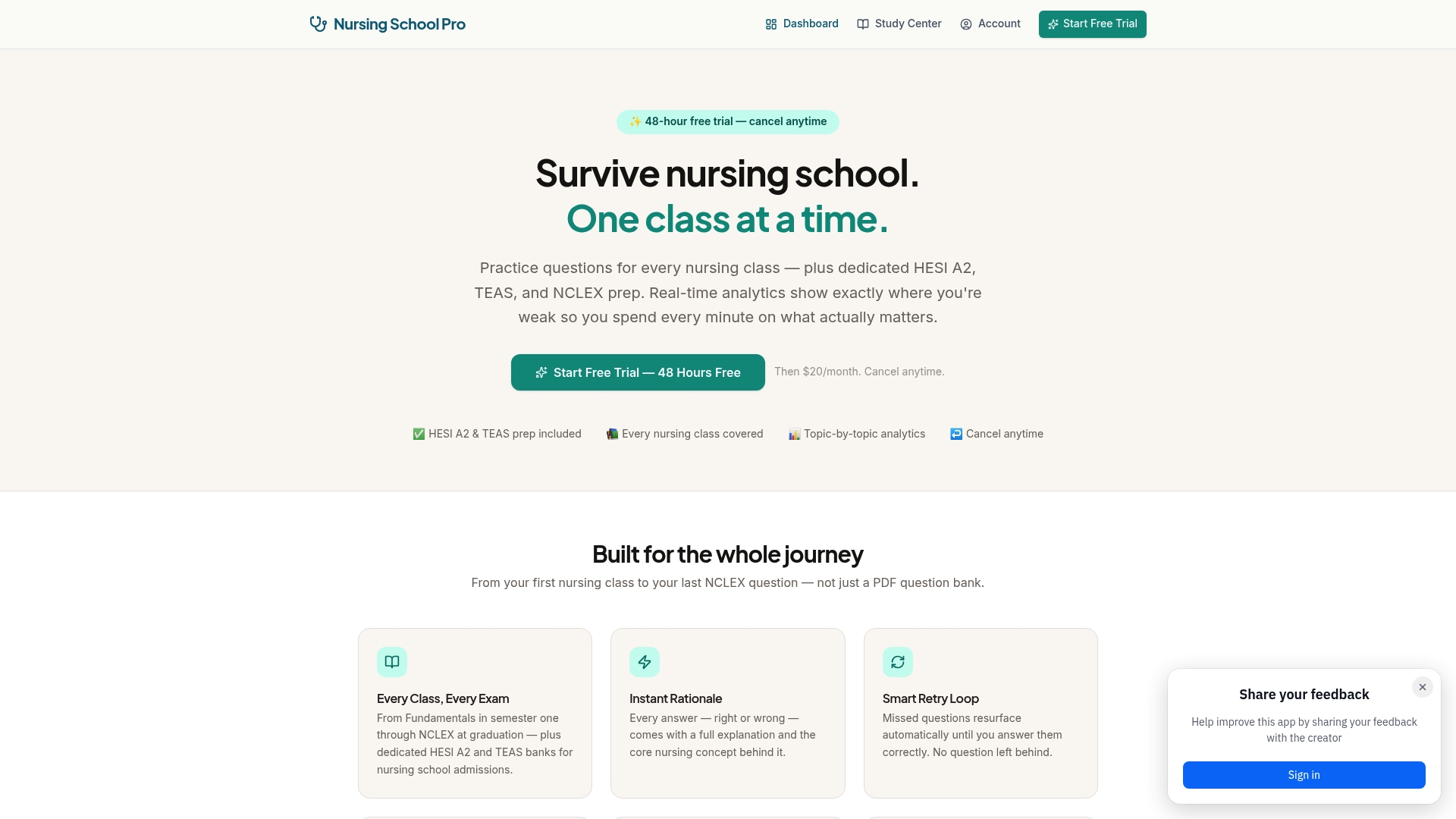
If you want to build a routine around it, our nursing study plan shows how to combine practice questions and rationales week by week. The Study Center has more free guides.
Our perspective on teaching ethics
Ethics is the part of nursing school that students tend to treat as common sense, and then it surprises them on an exam. The questions rarely ask for a definition. They ask what you would do, and the best answer depends on seeing which principle is at stake.
That is why we build practice around rationales. When you see the reason an option protects autonomy or avoids harm, the principle becomes a habit of thought rather than a vocabulary word. Our platform is designed so each answer explains itself, and our adaptive retry loops bring back the concepts you missed.
We also align our material with respected nursing textbooks and national standards, because ethics is an area where wording matters. The same principle can be described slightly differently in two books, and knowing the shared core keeps you steady.
Use the principles as a checklist at the bedside and on test day: who decides, who benefits, who might be harmed, who is treated fairly, and what is true. If you can answer those five questions, you can handle most scenarios.
Autumn
FAQ
What are the main ethical principles in nursing?
The four most cited are autonomy, beneficence, nonmaleficence and justice, which the ANA uses to summarize its Code. Many textbooks add fidelity, veracity, accountability and confidentiality. Check which list your course uses.
What is the difference between beneficence and nonmaleficence?
Beneficence means actively doing good for the patient. Nonmaleficence means avoiding harm, whether intentional or accidental. They often work together, for example when you hold a medication that would cause more harm than benefit and advocate for a safer alternative.
What does integrity mean in nursing?
Integrity means acting honestly and consistently with professional values, even when no one is watching. OpenStax links it to veracity, the honest and truthful communication that patients rely on. In practice that includes accurate charting and owning mistakes.
How many provisions are in the ANA Code of Ethics?
The ANA's 2025 Code of Ethics for Nurses has ten provisions. They begin with compassion and respect for every person's dignity and with the nurse's primary commitment to the recipient of care. Use the ANA's own site for the full text.
Sources
- Navigating Ethical Dilemmas in Nursing, Indiana Wesleyan University
- 16.2 Ethics in Nursing Practice, OpenStax Fundamentals of Nursing
- 1.1 Principles of Nursing Practice, OpenStax Clinical Nursing Skills
- Ch. 5 Summary, OpenStax Medical-Surgical Nursing
- Understanding the 7 Principles of Ethics in Nursing, Purdue Global
- Ethics Concept, AACN
- The Importance of Ethical Principles in Nursing, Nevada State University
- Social justice and nursing, Oklahoma City University
- 2025 Code of Ethics Provisions, American Nurses Association
- Use and impact of the ANA Code: a scoping review, PMC
- Nursing Ethics and Childhood Vaccination, American Nurse Journal
- Nightingale Pledge, Wikipedia