
Adaptive NCLEX practice only works if it mirrors what the real exam does: it must adjust difficulty after every answer, weave in NGN case sets, hold to strict timing, and match the NCLEX Test Plan's content distribution. Nursing School Pro builds its study center around exactly those mechanics, with instant rationales and real-time analytics tracking your ability estimate as you go. The point of practice isn't to outsmart the algorithm. It's to build stamina, get comfortable with the format, and know precisely which content areas need more work before test day.
TL;DR:
- Adaptive NCLEX practice must adjust question difficulty after each answer and include NGN case sets to accurately mirror the real exam experience.
- Practice platforms should track ability trends and provide detailed analytics rather than just percent scores, focusing on content categories and weak spots over multiple sessions.
- Repeating fixed-length quizzes without adaptive features can create a false sense of readiness, as they do not train pacing or the exam’s stop-rule logic.
- Full-length, timed simulations are essential to build stamina, simulate test-day fatigue, and adapt to maximum-length testing scenarios.
- Relying solely on volume of practice questions misses the importance of formatting, clinical judgment, and stress management skills necessary for passing the NCLEX.
Table of Contents
- How the NCLEX Computerized Adaptive Test Actually Works
- What a Realistic Adaptive Practice Simulator Should Include
- A Practical Adaptive Practice Plan for Test Week and Beyond
- What NCLEX Pass/Fail Rules Mean for How You Practice
- Why Nursing School Pro Fits the Adaptive Practice Checklist
- Where Adaptive Practice Tests Fall Short (and How to Work Around It)
- Adaptive Practice vs. Fixed-Length Practice Tests: What Actually Transfers
- What Nursing Students Get Wrong About Adaptive Practice
- Start Practicing the Way the Real Exam Actually Works
- Sources
How the NCLEX Computerized Adaptive Test Actually Works
Every NCLEX exam is built live, one question at a time. After you answer an item, the testing algorithm updates its estimate of your nursing ability, then picks the next question specifically to sharpen that estimate. Answer correctly, and the next item usually gets harder. Miss one, and it eases off. This is why two students can take "the same exam" and see almost no overlapping questions.
The exam is variable length by design. It stops only when one of three things happens, and the NCSBN's CAT guidance lays out the logic: the computer reaches a high confidence about whether your ability sits above or below the passing standard, you hit the maximum number of items, or you run out of time.
Behind the scenes, the item pool isn't random either. Every exam has to match the NCLEX-RN Test Plan's content percentages, with some flexibility across categories like Safe and Effective Care Environment, Health Promotion, and Physiological Integrity. A few structural facts matter for how you should treat every single question:
- Fifteen items on every RN exam are pretest questions being calibrated for future use, and they don't count toward your score.
- You cannot tell a pretest item from a scored one, so skipping or rushing "throwaway" questions is a real risk.
- Content distribution percentages are locked to the Test Plan, not to what feels emphasized in your coursework.
What a Realistic Adaptive Practice Simulator Should Include
Most "practice tests" online are just fixed quizzes with a randomized order. That's not adaptive test prep, and it won't prepare you for the actual test-day experience. A genuine simulator needs to hit several specific marks.
- Difficulty that responds in real time. The platform should raise or lower question difficulty based on your last answer, the same way the live NCLEX adjusts after every item.
- NGN case study sets, not just stand-alone items. Next Generation NCLEX case sets test clinical judgment across multiple linked questions, and roughly 10% of the exam can be stand-alone clinical judgment items depending on exam length.
- Accurate timing and pacing structure, including how breaks are scheduled, so your internal clock matches what you'll face in the testing center.
- Content distribution matched to the Test Plan categories, with the same ±3% tolerance NCSBN builds into the live exam.
- Pretest-style items mixed in without warning, so you build the habit of taking every question seriously.
- Analytics beyond a percent-correct score, ability-estimate trends over time, category-by-category weak spots, and rationales attached to every answer choice.
Pro Tip: Stop checking your percent correct after a practice session. Check whether your ability estimate is trending up across sessions in a single content area, that's the number that actually predicts pass/fail.
A Practical Adaptive Practice Plan for Test Week and Beyond
A calendar full of random question sets isn't a strategy. Structure beats volume, and adaptive test prep works best when it's built around a rotating weekly rhythm rather than marathon cram sessions.
Here's a sample week, six to eight weeks out from your test date:
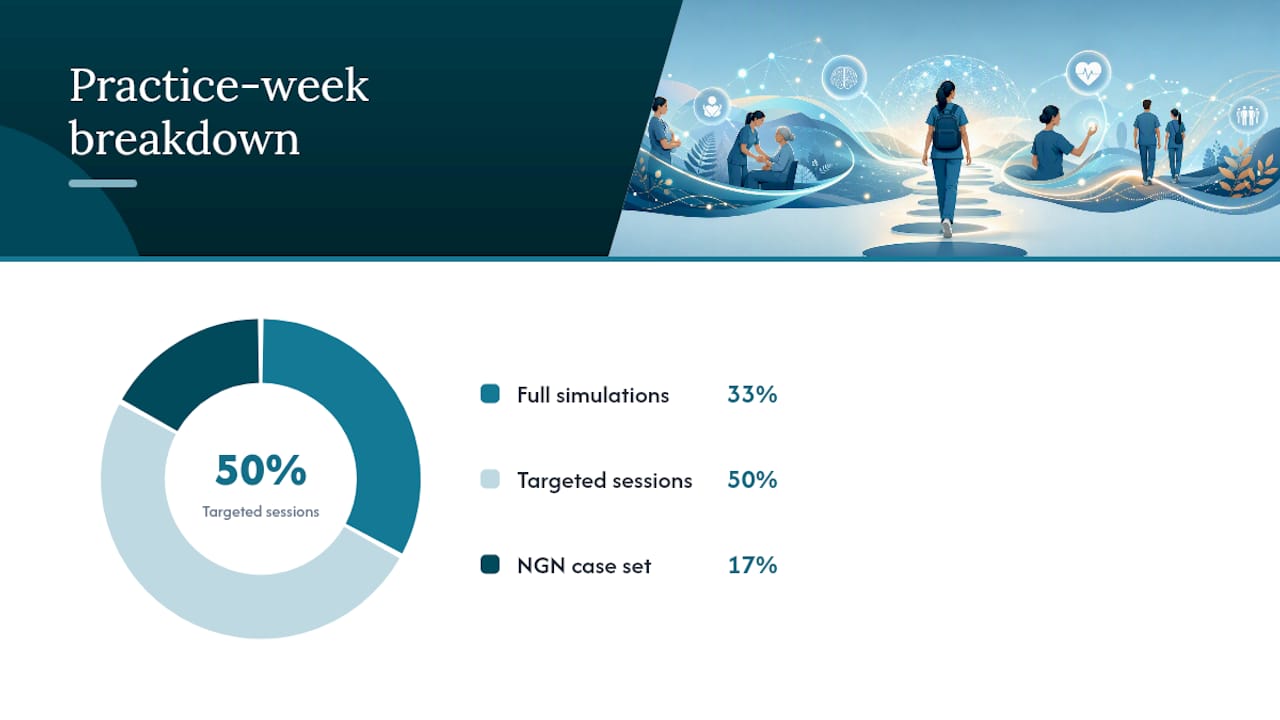
- Two full timed adaptive simulations. Sit through them start to finish, under real time constraints, no pausing for coffee or notes.
- Three targeted topic sessions built from your weakest content categories, identified from your last simulation's analytics.
- One dedicated NGN case-set session, working through multi-step clinical judgment scenarios instead of stand-alone questions.
As your test date approaches, flip that ratio. Increase full-simulation frequency to three or four a week in your final two weeks, and cut back on isolated topic drilling. This trains you for the mental fatigue of a maximum-length exam, which candidates who hover near the passing standard are more likely to experience.
When you review analytics afterward, resist the urge to fixate on your score for that one session. Instead, track whether your ability estimate in a specific category (say, pharmacological therapies) is climbing session over session. If it's flat or dropping after three attempts, that's your signal to stop testing and go back to content review.
Pro Tip: Build flashcards only from missed questions' rationales, not from the question stems themselves. The rationale explains the reasoning gap, which is what actually shows up again on test day.
Inside each session, treat pacing like part of the skill. Give yourself roughly 90 seconds per stand-alone item and budget more per case set, since NGN questions demand reading and sequencing across several linked prompts. Annotate the "why" behind every wrong answer immediately while it's fresh, not days later when you've forgotten your reasoning.
What NCLEX Pass/Fail Rules Mean for How You Practice
The exam ends in one of three ways, and each one has a direct implication for how you should prepare.
- The 95% confidence-interval rule. This is the most common outcome: the computer becomes 95% certain your ability is above or below the passing standard, and the exam stops, sometimes well short of the maximum item count.
- The maximum-length exam rule. If your ability estimate stays close to the passing standard, the test keeps going until it hits the maximum number of items allowed, forcing a final decision based on your overall performance.
- The run-out-of-time rule. If you run out of time before either of the above triggers, your final score is calculated based on the items you completed.
The NCLEX-RN Test Plan walks through all three scoring scenarios in detail, and the practical takeaway is simple: consistent performance near or above the passing standard tends to end exams faster, while borderline performance drags them toward the maximum length.
That's exactly why raw percent-correct is a poor practice metric. A candidate answering steadily at a moderate difficulty level, hitting roughly 50 to 60% correct on appropriately hard questions, can still be tracking well above the passing standard, because the algorithm has already pushed the difficulty up to match. Set your practice benchmarks around ability-estimate trends and category strength, not around chasing a high raw score on easy questions.
Why Nursing School Pro Fits the Adaptive Practice Checklist
Every feature listed above (adaptive difficulty, NGN case sets, strict timing, content-matched item pools, and analytics that track trends instead of raw scores) maps directly onto what Nursing School Pro's study center is built to do. The platform runs adaptive-style simulations alongside NCLEX practice with rationales attached to every question, so you're never guessing why an answer was wrong.
| Checklist item | How it shows up in practice |
|---|---|
| Adaptive-style difficulty | Simulated sessions adjust based on performance |
| NGN case practice | Multi-step clinical judgment case sets included |
| Instant rationales | Every question comes with an explanation, right or wrong |
| Progress analytics | Real-time tracking flags weak content areas automatically |
A rationale you read once and forget doesn't change your ability estimate. A rationale you turn into a flashcard, revisit, and retest against does.
If you want to see how the adaptive simulations and analytics work firsthand, the study center is the place to start, and a 48-hour free trial gets you in without commitment.
Where Adaptive Practice Tests Fall Short (and How to Work Around It)
No adaptive practice platform, including the best ones, can fully replicate the exact algorithm NCSBN uses for the live exam. That's a limitation worth naming honestly rather than glossing over.
First, practice item pools are smaller than the live NCLEX bank, so you'll eventually start recognizing questions if you repeat the same simulation too many times in a short window. Space out full simulations by several days rather than running three in one weekend.
Second, no third-party platform can perfectly reproduce NCSBN's exact difficulty-calibration model, since that model is proprietary and continuously recalibrated using real candidate data. Treat practice ability estimates as directional, useful for spotting trends, not as a literal predictor of your live exam outcome.
Third, over-reliance on any single practice format creates blind spots. A student who only drills stand-alone items misses the sequencing and clinical-reasoning load that NGN case study sets specifically test. Rotating between case sets, stand-alone items, and full simulations closes that gap.
Finally, anxiety can spike during practice just as it does on test day, especially during maximum-length simulations that run long. That's not a flaw in the practice tool. It's the exact stress-inoculation effect you want, since the NCSBN itself points to repeated CAT-style exposure as a way to reduce test-day anxiety through familiarity.
Adaptive Practice vs. Fixed-Length Practice Tests: What Actually Transfers
Fixed-length practice tests (the kind with a set 75 or 100 questions regardless of how you answer) still have a place, mainly for content review and quick knowledge checks. But they measure something different from what the live NCLEX measures, and conflating the two leads to false confidence.
A fixed-length test gives you a percent-correct score. That number tells you how many questions you got right out of a predetermined set, full stop. It does not adjust to your performance, doesn't simulate the stop-rule logic, and doesn't train your pacing for a test that could end at 85 items or run to the maximum allowed length.
Adaptive practice, by contrast, trains three things fixed-length tests can't touch: tolerance for escalating difficulty as you perform well, the mental stamina needed for a maximum-length session, and the habit of treating every item, pretest or scored, with equal seriousness. Students who only practice on fixed-length tests often report feeling thrown off when the real exam's difficulty ramps up mid-session or when it doesn't stop at question 75 like they expected.
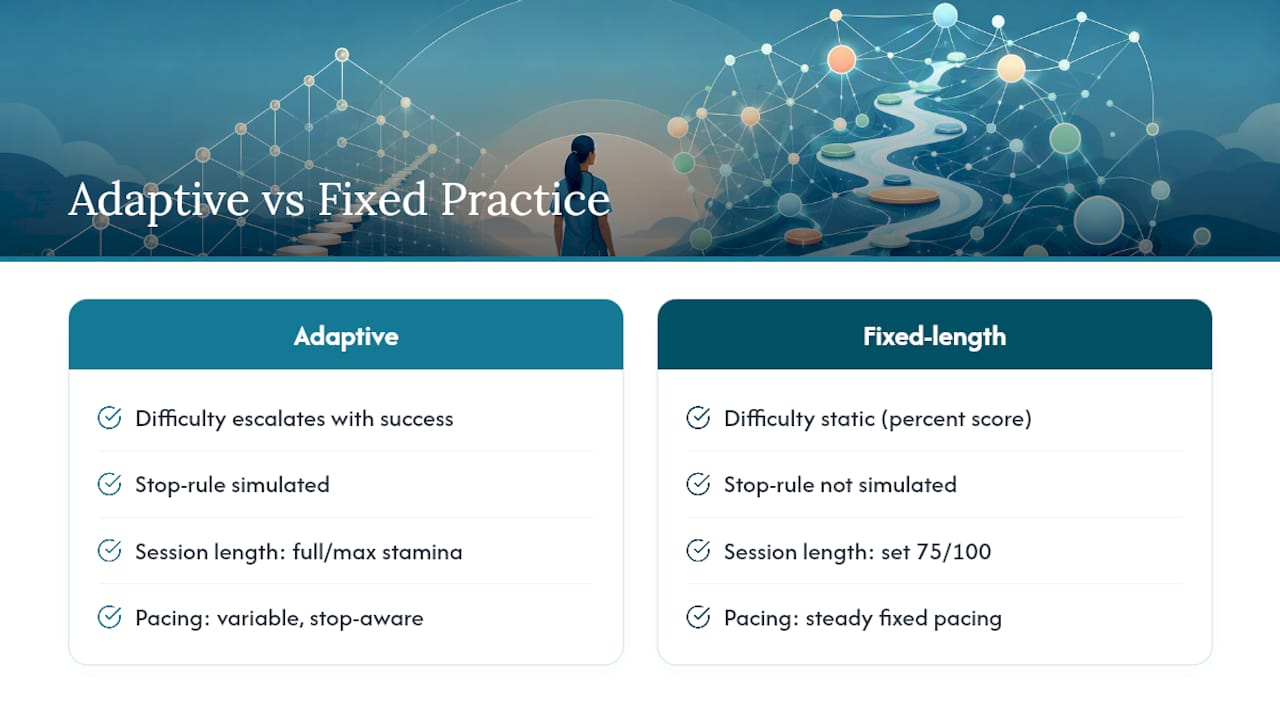
The strongest prep plans use both: fixed-length quizzes for fast content review between study blocks, and full adaptive simulations, timed and uninterrupted, to build the actual test-taking skill the NCLEX demands.
What Nursing Students Get Wrong About Adaptive Practice
Most study advice treats the NCLEX like a content problem: learn enough nursing knowledge, and the test takes care of itself. That's incomplete. The exam is also a format problem, and format is exactly what generic question banks fail to teach.
The conventional wisdom says "do as many practice questions as possible." Volume alone doesn't train you for a test that adjusts its own difficulty mid-session or for case sets that demand you hold five related pieces of information in your head while sequencing a nursing response. Quantity without adaptive structure builds content recall. It doesn't build test-day composure.
Here's what I'd prioritize differently: spend less time worrying about your raw practice scores and more time watching whether your ability estimate trends upward in your weakest categories over multiple sessions. That single shift changes how you interpret every practice attempt. It's the difference between practicing to feel good and practicing to actually close a measurable gap.
The students who walk into the testing center calm aren't the ones who memorized the most. They're the ones who've already sat through a maximum-length simulation and know exactly what that mental fatigue feels like, because they trained for it on purpose.
— Autumn
Start Practicing the Way the Real Exam Actually Works
If you've been drilling fixed quizzes and wondering why your practice scores don't seem to predict much, the fix isn't more questions. It's the right format. Nursing School Pro's study center runs adaptive-style simulations and NGN case sets side by side with instant rationales, so every missed question turns into a specific, trackable weak spot instead of a vague feeling of "I should review more."
The platform offers practice for nursing classes alongside NCLEX prep, with tools designed to support progress tracking throughout your studies. Analytics update in real time, so you can see exactly which content categories are trending up and which still need attention before you sit for the real thing.
You can test the format yourself with a 48-hour free trial, no long-term commitment required. If you're ready to see how your practice sessions map to actual NCLEX content categories, start in the study center and run your first timed simulation this week.
Sources
The technical claims in this guide come directly from NCSBN, the organization that writes and administers the NCLEX. Worth bookmarking if you want to verify anything or dig deeper into specific content categories:
- What is Computer Adaptive Testing (CAT)? – NCSBN
- The NCLEX Uses Computer Adaptive Testing (CAT) — Transcript, NCSBN
For state-specific retake timelines or exam scheduling questions, your state board of nursing's website is the authoritative source, since those procedural rules vary by jurisdiction.