
An NCLEX rationale is the evidence-based explanation behind why an answer is correct or incorrect, tying nursing action to pathophysiology and clinical judgment. The single best move you can make with it: read the rationale for every option, not just the one you picked, and map each explanation back to a concept you can name. Anchor your practice to standards from the National Council of State Boards of Nursing and a structured platform like Nursingschoolpro rather than scattered question sets.
TL;DR:
- Reviewing both correct and incorrect rationales helps reinforce exclusion rules, safety principles, and clinical reasoning more effectively than focusing only on answers you got right.
- Mapping each rationale to a clear nursing concept and recording it in a revisitable format enhances long-term retention and comprehension.
- Recognizing key clues like safety language, lab thresholds, and prioritization phrases within rationales allows targeted learning of critical NGN test categories.
- Understanding that NGN links question action with justification means practicing paired responses helps avoid answer mismatches that result in zero points.
- Using a structured study system that emphasizes frequent, rationale-focused review supports critical reasoning skills necessary for passing the NCLEX efficiently.
Table of Contents
- What Are NCLEX Rationales and Why Do They Matter?
- How Do You Read and Break Down an NCLEX Rationale?
- What Are the Main Types of NCLEX Rationale Explanations?
- How Does NGN Scoring Change How You Read Rationales?
- What Study Schedule Makes the Best Use of Rationales?
- What Do Full Rationale Breakdowns Look Like in Practice?
- How Nursing School Pro Turns Rationale Study Into a Workflow
- A Nursing Educator's Take on Studying Rationales
- Ready to Start Studying Smarter With Nursing School Pro?
- Where to Go for Official Guidance and More Practice
- Sources
What Are NCLEX Rationales and Why Do They Matter?
A rationale explains the "why" behind an answer. It links a specific nursing intervention to the pathophysiology, pharmacology, or safety principle that makes it correct, or the flaw that makes it wrong. The NCSBN frames rationales as the connective tissue between academic theory and clinical application, which is exactly the skill the Next Generation NCLEX (NGN) is built to measure.
That distinction matters because NGN doesn't just test recall. It tests clinical judgment, which means you're being scored on whether you can reason through a patient scenario the way a working nurse would, under time pressure, with incomplete information. A rationale is the closest thing you'll get to a nurse educator sitting next to you explaining their thought process in real time.
Here's the part most students skip: the rationale for the wrong answer usually teaches more than the rationale for the right one. Reading only the explanation for your chosen answer confirms what you already believe. Reading the explanation for why the other three are wrong forces you to learn the exclusion rules, the contraindications, and the dosing thresholds that actually separate a safe intervention from a dangerous one on a similar-looking future question. Studies on adaptive exam performance back this up: reviewing every option, not just the winning one, reinforces clinical judgment far more than memorizing single answers.
What rationale study actually builds:
- Pattern recognition across similar-sounding clinical scenarios
- The ability to spot a distractor that sounds plausible but violates a safety principle
- Faster recall of lab values, priority frameworks, and drug classes under time pressure
- A mental checklist for delegation and scope-of-practice questions
Pro Tip: If you can't explain in one sentence why the three wrong answers are wrong, you don't actually understand the right one yet — you just recognized it.
Comprehensive review resources built around NGN-style items, the kind commonly recommended by nursing programs, pair thousands of practice questions with full rationale explanations tied to test-taking strategy rather than isolated facts. Volume matters less than whether the explanations teach you to reason, not just remember.
How Do You Read and Break Down an NCLEX Rationale?
Most students read a rationale the way they read a text message: fast, once, and never again. That habit wastes the most useful resource in your entire study plan. Here's a method that turns every question into a repeatable learning cycle instead of a pass-or-fail moment.

1. Predict before you look at the choices. Cover the answer options and decide what you'd do based on the stem alone. This step feels slow at first, but it's what separates students who reason through NGN case studies from students who pattern-match multiple-choice answers. If your prediction matches the correct answer, good. If it doesn't, that gap is exactly where you need to focus.
2. Read the rationale for every single option, correct and incorrect. Not just the one you got wrong. Not just the one you got right. All of them. This is the step that actually moves your score, and it's the one almost everyone shortcuts when they're tired or behind schedule.
3. Map the explanation to a named concept. Don't let a rationale float as an isolated fact. Tie it to something you can label: "priority: airway before circulation," "pharmacology: therapeutic digoxin range," "delegation: RN-only assessment." A rationale you can't name is a rationale you'll forget by next week.
4. Record it in a format you'll actually revisit. A note in your phone, a line in a spreadsheet, a flashcard app. It doesn't matter which. What matters is that it exists somewhere outside the question bank, because you will not remember this specific rationale in three weeks without a written trace of it.
While you work through step two, train your eye to catch these cues inside the rationale text itself:
- Priority language — words like "first," "immediately," or "most important" signal an ABC or Maslow-based ranking question
- Lab values and reference ranges — a rationale citing a specific number (potassium, INR, glucose) is teaching you a threshold, not just a fact
- Chronology markers — "postoperative day one" or "within the first hour" often changes which intervention is safe
- Absolute qualifiers — "contraindicated," "never," "always" usually point to a safety rule the question is testing directly
- Comparative framing — "more appropriate than" tells you the wrong answer wasn't dangerous, just second-best
Tag every rationale you record with two labels: the content domain (pharmacology, maternal newborn, mental health) and the type of error you made if you missed it (misread the stem, didn't know the drug class, assumed a priority incorrectly). That second tag is what makes spaced repetition useful instead of just repetitive. Building an error log this way lets you target remediation by the actual cognitive mistake, not just the topic, which is a sharper cut than most students ever make.
What Are the Main Types of NCLEX Rationale Explanations?
Rationales tend to fall into a handful of recurring categories, and learning to recognize the category fast during review saves you real time. Once you can classify a rationale in a few seconds, you know instantly whether it's testing a safety rule, a drug interaction, or a scope-of-practice boundary.
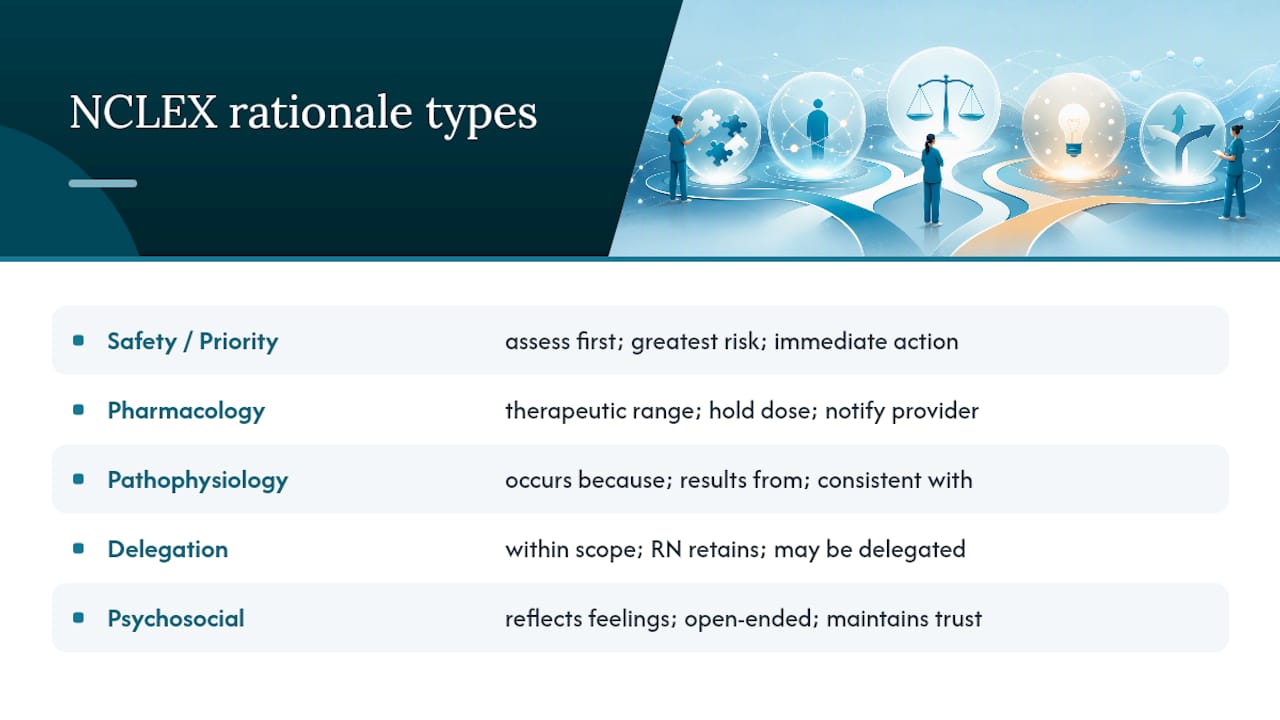
Safety and priority rationales show up constantly and usually hinge on ABC (airway, breathing, circulation) or Maslow's hierarchy. Clue phrases: "assess first," "greatest risk," "immediate action." These rationales are training you to rank interventions, not just identify a correct one.
Pharmacology and adverse-effect rationales explain why a medication is safe, contraindicated, or requires monitoring. Clue phrases: "therapeutic range," "hold the dose," "notify the provider before administering." These often cite a specific lab value or vital sign threshold, so the number in the rationale is the actual lesson.
Pathophysiology rationales connect a symptom or lab finding back to a disease process. Clue phrases: "this occurs because," "results from," "consistent with." They're teaching you the mechanism, which is what lets you recognize a variation of the same question later.
Delegation and standing-order rationales test scope of practice among RNs, LPNs, and unlicensed staff. Clue phrases: "within the scope of," "the RN should retain," "may be delegated to." These are less about clinical reasoning and more about legal and role boundaries, so treat them as a separate study category entirely.
Psychosocial rationales address communication technique, therapeutic response, and patient rights. Clue phrases: "reflects feelings," "open-ended," "maintains trust." These rationales reward the tone of an intervention as much as the action itself.
Mapping these categories onto the NCLEX client needs framework gives your study plan structure instead of randomness. If your missed-rationale log shows a cluster in pharmacology, that's your next study block. If it's scattered across delegation questions, you've found a scope-of-practice gap worth a focused review session, maybe paired with topic-specific practice like basic assessment and vital sign parameters.
How Does NGN Scoring Change How You Read Rationales?
The Next Generation NCLEX introduced a scoring rule that catches a lot of well-prepared students off guard: on linked-response items, the action and the reason behind it are graded as a single unit. Pick the right nursing action but the wrong justification, and the NCSBN's scoring model can award zero points for that pair, even though half your answer was correct.
This changes what "close enough" means during practice. A partial match isn't partial credit. It's often no credit at all.
The most common mistake looks like this: a student correctly identifies that a nurse should hold a medication, but selects the wrong clinical reason from the linked options, maybe choosing a plausible-sounding lab value instead of the actual contraindication tied to the case. On a traditional multiple-choice item, half-right thinking sometimes gets you partial credit through elimination. On a linked-response item, it doesn't. The technical grading rule treats the pair as one decision, not two.
A few habits fix this:
- Read both parts of a linked-response question as one combined claim, not two separate guesses
- When reviewing a rationale, verify the reason independently of the action, don't assume a correct action means you understood the "why"
- Practice explicitly with linked-response formats rather than only single-answer questions, since the skill of pairing action and justification doesn't transfer automatically from standard multiple choice
- Flag any linked item you get "half right" in your error log as its own category, since it reveals a reasoning gap, not a content gap
The scoring detail is technical, but the fix is simple: stop treating the reason half of a linked question as an afterthought. It's graded exactly as heavily as the action.
What Study Schedule Makes the Best Use of Rationales?
A schedule built around rationale review looks different from one built around raw question volume. The goal isn't finishing more questions. It's extracting more from each one.
1. Run a short daily session. Thirty to sixty minutes, focused on 15 to 25 questions, with immediate rationale review after every single item, not at the end of the set. Tag each miss by content domain and error type as you go. Momentum matters more than marathon sessions here; a rushed two-hour block at 11 p.m. teaches you less than four focused 30-minute sessions spread across the week.
2. Build a weekly deep-review block. Set aside two to three hours to revisit everything you tagged that week. Group missed rationales by theme (pharmacology dosing, delegation boundaries, priority sequencing) and turn the recurring ones into flashcards written in your own words, not copied verbatim from the rationale text. Converting rationales into active study artifacts like flashcards or short teach-back explanations forces synthesis, which is what actually moves information from short-term recognition to long-term recall.
3. Taper in the final two weeks before your test date. Shift from new-question volume toward timed simulated exams that mimic NGN pacing and item types. Review rationales from these practice tests the same day you take them, while the reasoning is still fresh, rather than batching review for later.
Pro Tip: Keep a running "greatest misses" deck of your five hardest rationale-based mistakes each week. Reviewing that condensed deck the night before your exam is far more useful than rereading an entire question bank.
Spaced repetition works because it forces retrieval at increasing intervals, which is exactly what a tagged error log lets you do automatically. If you missed a delegation question on Monday, you want it resurfacing Thursday, then again the following week, not sitting untouched in a notebook. A tool that tracks weak areas for you removes the manual sorting work, which is where most self-built spreadsheets eventually fall apart. If you're piecing this together manually, the Nursing School Pro study center organizes that tagging and resurfacing automatically, and a supplemental bank like RecallOS's NGN-ready practice questions gives you more current-format items to feed the same routine.
What Do Full Rationale Breakdowns Look Like in Practice?
Two walkthroughs, one pharmacology-focused and one priority-focused, show the method end to end.
Pharmacology example. A stem describes a patient on a loop diuretic with new muscle weakness and irregular heartbeat, asking which lab value the nurse should check first. Predicting before looking at answers, you'd reason: loop diuretics cause potassium loss, and hypokalemia explains both symptoms, so potassium is the logical first check.
The correct-answer rationale confirms this, tying the drug class directly to the electrolyte effect, a classic pharmacology rationale with a lab-value clue phrase. The incorrect options might include sodium, glucose, and creatinine. Each of those rationales will explain why that particular lab, while clinically relevant in other contexts, doesn't explain this specific symptom pair. That's the part worth slowing down for: the rationale isn't just saying "wrong," it's teaching you the differential.
The lesson in a distractor rationale is rarely "this lab doesn't matter." It's "this lab doesn't explain these symptoms." That distinction is what separates a nurse who checks the right thing under pressure from one who orders every test out of caution.
Study note produced: "Loop diuretics → potassium loss → muscle weakness + arrhythmia. Check potassium first. Category: pharmacology/adverse effect."
Priority example. A stem presents four patients and asks which the nurse should assess first. Predicting first, you'd apply ABC or Maslow before reading a single option, ranking airway and breathing concerns above comfort or psychosocial needs.
The correct-answer rationale will usually cite an airway or breathing compromise explicitly. The incorrect options often describe real problems, a patient in pain, a patient with an elevated but stable blood sugar, but the rationale explains why none of them represents an immediate threat to life the way the correct choice does. Missing this distinction is one of the most common errors on priority items, because every option can look urgent out of context.
Key clue phrases across both walkthroughs:
- "First check" and "priority" point to sequencing questions, not single-fact recall
- A cited lab value or vital sign number is rarely decorative; it's the actual teaching point
- A distractor rationale explaining a real but lower-urgency problem is training you to rank, not eliminate
Study note produced: "Airway/breathing threats outrank pain and stable abnormal labs. Category: safety/priority, ABC framework."
How Nursing School Pro Turns Rationale Study Into a Workflow
Everything above works better with a system behind it instead of a stack of loose notes. Nursingschoolpro was built around exactly this rationale-first workflow, mapping each study habit to a specific platform feature.
- Instant rationales appear the moment you answer, so the immediate-review step in your daily session happens automatically instead of requiring you to flip to an answer key
- Real-time analytics track which content domains and error types keep recurring, turning your weekly deep-review block into a targeted plan instead of a guessing game
- Automatic tagging organizes missed questions by topic and error type, which is the same spaced-repetition structure recommended earlier, minus the manual spreadsheet work
- Course-aligned question banks cover everything from first-semester nursing classes through NCLEX, HESI A2, and TEAS prep, so the same rationale-reading habit carries across your entire program
The platform's curriculum aligns with respected nursing textbooks and national standards, which matters when you're trying to trust that a rationale reflects current, accurate clinical reasoning rather than an outdated shortcut. You can start with a 48-hour free trial and work through a single topic set, like vital signs and neurological assessment, to see how the tagging and analytics behave before committing to anything.
A Nursing Educator's Take on Studying Rationales
The habit that changed the most for me wasn't reading more rationales. It was slowing down on the ones I got right and forcing myself to explain, out loud, why the other three were wrong. That single change surfaced gaps I didn't know existed, because getting a question right on a fact I half-remembered feels identical to getting it right on a concept I actually understood, until someone asks you to explain the difference.
Most students treat a correct answer as a finished transaction. It isn't. The rationale you skip because you already got the question right is often the one hiding your next wrong answer on test day. Read it anyway. Tag it anyway. The habit feels slow in October and pays off in March.
Try this for one week: read every rationale, correct and incorrect, and see what surfaces.
— Autumn
Ready to Start Studying Smarter With Nursing School Pro?
Reading rationales in a scattered mix of free question banks and old review books works, but it means you're doing the tagging, tracking, and spaced repetition by hand, and that manual sorting is exactly where most study plans quietly fall apart around week three. Nursingschoolpro builds the entire workflow this article describes directly into the platform: instant rationales on every question, automatic tagging by content and error type, and analytics that tell you where to focus this week instead of guessing.
Access starts with a 48-hour free trial, and after that it's $20 a month for the full study center, covering practice questions for every nursing class plus dedicated NCLEX, HESI A2, and TEAS prep. Check the full pricing and trial details and cancel anytime if it's not the right fit. Start your trial today and run your first tagged review session before your next study block.
Where to Go for Official Guidance and More Practice
- The NCSBN sets the actual NGN test plan and scoring rules, including how linked-response items are graded, making it the only source for exam mechanics you should treat as final.
- Comprehensive review resources like those outlined by Rasmussen explain what separates a strong NGN-ready question bank from an outdated one, useful if you're choosing supplemental materials.
- Nurseslabs' care-plan library breaks down rationale types by nursing diagnosis, a solid reference for the pathophysiology and delegation categories covered above.
- Registerednursing organize rationales by test-plan category, a reasonable no-cost starting point before you commit to a paid platform.
- The Nursing School Pro study center applies the tagging and analytics workflow described throughout this article directly to your coursework and NCLEX prep.
This article is general information, not a substitute for advice from a qualified doctor. Consult a qualified healthcare professional about your own circumstances before acting on anything here.
Sources
- National Council of State Boards of Nursing (NCSBN)
- NurseCram — Ultimate guide to NCLEX rationales
- Nurseslabs — Nursing care plans and rationales
- Registerednursing