
The NCLEX uses Computerized Adaptive Testing (CAT) to estimate your ability level and then compares that estimate to the NCSBN passing standard to produce a single pass/fail decision. No raw percent correct. No partial credit tally you can calculate in your head. Just your estimated ability versus a fixed competency threshold.
Three official rules determine when and how that decision gets made:
- 95% confidence interval rule: The exam stops as soon as the computer is 95% certain your ability is either above or below the passing standard. This is how most exams end.
- Maximum-length rule: If the exam reaches the item ceiling without hitting 95% certainty, your final ability estimate at that point decides the outcome.
- Run-out-of-time (R.O.O.T.) rule: If time expires, a minimum-item requirement must be met first; then your final ability estimate is applied.
All three rules, the CAT mechanics, and the scoring models are governed by NCSBN, administered through Pearson VUE, and published at Nclex.
Key Takeaways
NCLEX scoring is a pass/fail decision based entirely on your ability estimate relative to the NCSBN passing standard, with no raw percent correct involved.
| Point | Details |
|---|---|
| CAT drives every decision | Each answer re-estimates your ability in logits; the algorithm targets items near your current ceiling. |
| Three rules end the exam | The 95% confidence interval rule, maximum-length rule, and R.O.O.T. rule are the only ways an NCLEX ends. |
| Max items is not failure | Reaching the item ceiling means ability was near the standard; your final estimate decides pass or fail. |
| NGN partial credit matters | Plus/minus scoring deducts 1 for wrong selections; negative item totals truncate to zero, not carried forward. |
| Nursingschoolpro prep | Adaptive questions, instant rationales, and difficulty-level analytics mirror CAT mechanics for targeted practice. |
Table of Contents
- Quick facts about NCLEX scoring at a glance
- How computerized adaptive testing actually works
- What the passing standard is and how NCSBN sets it
- How individual NCLEX items are scored, including NGN partial credit
- The three pass/fail decision rules, explained with real scenarios
- When you get NCLEX results and what the report actually shows
- Study strategies that match how NCLEX scoring actually works
- Adaptive NCLEX prep that matches how the exam actually scores you
- Sources
Quick facts about NCLEX scoring at a glance
| Fact | NCLEX-RN | NCLEX-PN |
|---|---|---|
| Minimum scored items | 85 | 85 |
| Maximum scored items | 150 | 150 |
| Maximum exam time | 5 hours | 5 hours |
| Pretest (unscored) items | Included in total count | Included in total count |
| Score reported | Pass/Fail only | Pass/Fail only |
A meaningful portion of the exam covers clinical judgment, including Next Generation NCLEX (NGN) case sets. NCSBN's current test plan allocates a substantial share of items to clinical judgment measurement model (CJMM) content, though exact percentages shift with each test plan cycle. Check the current NCSBN test plan for the precise breakdown.
Pretest items are scattered throughout your exam and look identical to scored items. They are not counted in your ability estimate until they are statistically calibrated across many candidates and moved to operational pools. This means the item count you see on screen is always higher than the number of items actually scored.
Statistic to know: The NCLEX does not return a raw percent-correct score. Your result is determined entirely by your ability estimate relative to the passing standard, not by how many questions you got right out of the total.
How computerized adaptive testing actually works
CAT does one thing exceptionally well: it targets items at the edge of your ability so every response carries maximum information. Here is the loop, step by step.
- Initial estimate: The exam starts with a baseline ability assumption and selects an item of moderate difficulty.
- Candidate responds: Your answer, correct or incorrect, feeds into a statistical model (the Rasch measurement framework) that recalculates your ability estimate.
- Item selection: The algorithm picks the next item closest to your updated estimate, while also satisfying content-area proportions from the test plan.
- Re-estimation: This cycle repeats with every single item until a decision rule fires.
Ability is expressed in logits, a unit on a continuous scale. A positive logit means your estimated ability sits above the passing standard; a negative logit means it sits below. The passing standard itself is a fixed logit value set by NCSBN.
This is why answering a string of hard items correctly does not mean you are "winning." The algorithm responds by giving you even harder items. Conversely, missing several in a row triggers easier items, not because you are failing, but because the algorithm is still gathering information. The NCLEX-RN Test Plan confirms that item selection is designed to maximize measurement precision at your current ability estimate.

Pro Tip: Do not try to read your performance from item difficulty. A sudden run of harder questions means the algorithm thinks you are performing well, not that you are about to fail. Focus on each item independently.
What the passing standard is and how NCSBN sets it
The passing standard is the minimum ability level, expressed as a logit value, that NCSBN has determined represents safe, entry-level nursing practice. Every candidate's final ability estimate is compared to this single threshold. Pass above it, fail below it.
NCSBN's Board of Directors sets the standard based on standard-setting studies, expert panels, and candidate performance data. It is not a fixed percentage of correct answers, and it does not vary by test center, state, or exam date. According to NCSBN's pass-rate and passing-standard page, the Board reviews and reaffirms or adjusts the standard periodically, with the current standard published through 2029.
Pro Tip: To confirm the exact current passing standard value, go directly to the NCSBN passing-standard page or the NCLEX Candidate Bulletin. These are the only authoritative sources. Third-party prep sites sometimes publish outdated values.
How individual NCLEX items are scored, including NGN partial credit
Standard single-response items are scored 0 or 1. Get it right, earn the point. Get it wrong, earn nothing. NGN multi-key items are more nuanced, and understanding the three models matters for your ability estimate.
The NGN Scoring Models document from NCSBN defines them clearly:
- 0/1 scoring: Used for items with one correct answer or multi-point items where partial credit is not awarded. You either earn the full point value or zero.
- Plus/minus scoring: Each correct selection earns +1; each incorrect selection deducts 1. If your total for an item goes negative, it is truncated to zero, not carried as a penalty into the next item. A candidate who selects three correct options and two incorrect options on a five-option item scores +1 for that item.
- Rationale scoring: Applied to paired items (typically a two-part case question) where both parts must be correct to earn credit. Getting one part right does not earn partial points.
Matrix/grid items, select-N items, and drop-down cloze items most commonly use plus/minus or 0/1 partial credit. These item scores feed directly into the Rasch model, not a raw tally, so a strong performance on a high-difficulty NGN case set carries more weight than the same number of correct responses on easy standalone items.
The three pass/fail decision rules, explained with real scenarios
Scenario 1: The 95% confidence interval rule
This is how the vast majority of exams end. Some candidates hit this threshold at 85 items; others reach it at 120 or 130. The item count at stopping tells you nothing about whether you passed.
Example: A candidate answers 97 items and the exam shuts off. They assume the early stop means they passed. It might. The item count is not the signal.
Scenario 2: Maximum-length exam
Reaching the item ceiling happens when your ability estimate stays close to the passing standard throughout the exam. At that point, your final ability estimate decides the outcome.
NCSBN's Candidate Bulletin is explicit: a maximum-length exam does not automatically mean failure. Candidates who answer all items and whose final estimate sits above the passing standard pass. This misconception causes real distress, and it is simply wrong.
Example: A candidate finishes all 150 items, walks out convinced they failed, and receives a passing result two days later. Their ability estimate was above the standard at the end, even though the computer needed every item to confirm it.
Scenario 3: Run-out-of-time (R.O.O.T.)
If the clock expires before the exam ends naturally, a minimum-item threshold must have been met. If it has, the final ability estimate is applied using the same pass/fail logic. If the minimum has not been met, the result is an automatic fail, regardless of how the items answered were performing.
Example: A candidate spends too long on early case sets, runs out of time at 80 items, and has not met the minimum threshold. Automatic fail, even if their ability estimate at that point looked favorable. Pacing is not optional.
When you get NCLEX results and what the report actually shows
Test center staff cannot give you results. Every exam record is scored at the testing center by the computer and then verified after transmission to Pearson VUE. Official results are released exclusively by your nursing regulatory body (NRB), which is your state board of nursing.
- Official results timeline: Most state boards release results within a few business days to six weeks, depending on jurisdiction. NCSBN's Candidate Bulletin notes the six-week window as the outer bound for most candidates.
- Pearson VUE Quick Results: Available in most states approximately two business days after your exam for a small fee. This is an unofficial result, but it matches the official outcome in the vast majority of cases.
- What the report shows: Pass or fail. Some states also provide a diagnostic report showing performance by content area, but no raw score or percent correct appears anywhere. The Princeton Review's scoring explainer confirms this directly.
- What the report does not show: Your logit score, the number of items you answered correctly, or any comparison to other candidates.
Study strategies that match how NCLEX scoring actually works
Understanding the mechanics is only useful if it changes how you prepare. Here is what the scoring model actually demands from your study plan.
- Practice mixed-difficulty sets. CAT targets items near your ability ceiling. If you only practice easy questions, you are not training for the difficulty level the algorithm will actually serve you.
- Time-box every item. Budget roughly 1–2 minutes per item. Running out of time is an avoidable fail. Practicing timed blocks builds the pacing instinct you need before exam day. A dosage calculation mistake under pressure is a classic example of what time pressure costs you.
- Work NGN case sets regularly. Plus/minus scoring rewards precision. Selecting one extra incorrect option on a five-option item costs you a point. Practice selecting only what you can defend.
- Use performance analytics. A platform that shows your accuracy by difficulty level and content area tells you where your ability estimate is weakest, which is exactly what the algorithm will probe.
- Prioritize clinical judgment over memorization. NCSBN's own materials note that CAT re-estimates ability with every response, and the test plan weights clinical judgment heavily. Rote recall does not survive a well-calibrated adaptive exam.
Pro Tip: After every practice session, review not just the questions you got wrong but the ones you got right for the wrong reason. On an adaptive exam, a lucky correct answer still moves the algorithm, but shaky reasoning will surface eventually.
What finishing the exam actually tells you
Here is the honest truth about walking out of the testing center: you cannot reliably interpret your experience. The exam shutting off early feels like a sign. Answering 150 items feels like failure. Neither feeling is a reliable indicator.
What you can do immediately is simulate a timed CAT-style block and review NGN multi-response items, specifically the ones where you were selecting options based on instinct rather than clinical reasoning. That is the gap the algorithm will find, and closing it before a retake is the only productive response to uncertainty.
Adaptive NCLEX prep that matches how the exam actually scores you
Knowing how NCLEX scoring works is one thing. Training for it is another. Nursingschoolpro is built around the same mechanics: adaptive practice questions that adjust to your performance, instant rationales that explain the why behind every answer, and real-time analytics that show your accuracy by difficulty level and content area.
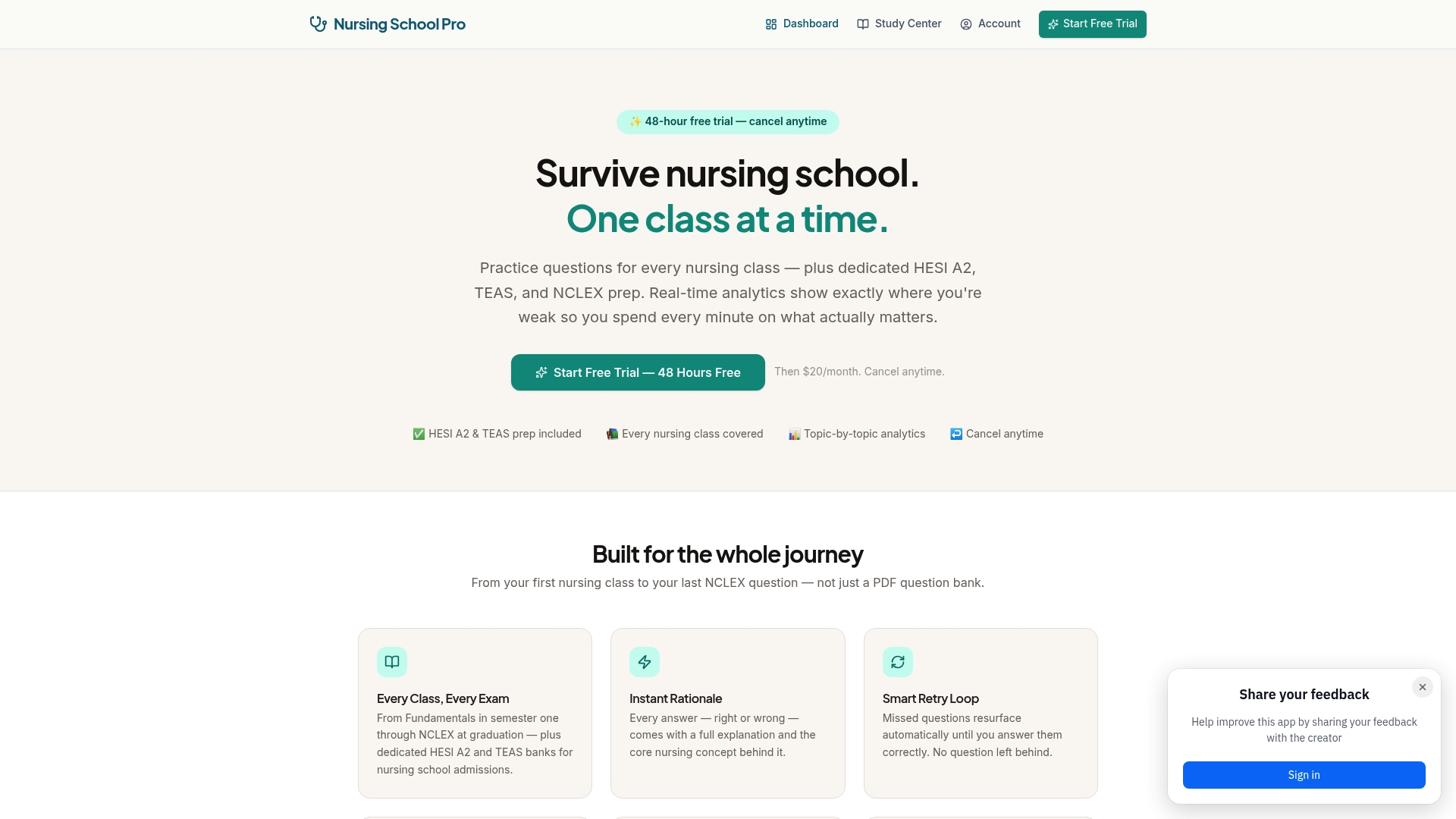
That combination directly mirrors what CAT demands. You practice at your ability ceiling, you understand the reasoning behind each item, and you can see exactly which content areas are pulling your estimate down. NGN-style multi-response items are included so you build familiarity with plus/minus scoring before it counts.
Pricing is transparent at $20/month with a 48-hour free trial, no commitment required. Start with the Nursingschoolpro study center and run a timed adaptive block today.