
An NGN case study is a short unfolding patient scenario, built around the NCSBN Clinical Judgment Measurement Model, that forces you to recognize cues, weigh priorities, and choose an action the way a working nurse would. Practicing enough of these scenarios trains the exact reasoning pattern the NCLEX now scores, not just recall of facts. Three resources anchor a solid practice routine:
- NCSBN's own NGN materials explain the six-step Clinical Judgment Measurement Model in the organization's own words, straight from the body that writes the exam.
- The University of Maryland NextGen NCLEX Library offers a faculty-reviewed case bank organized by specialty, with trend and bow-tie items built around CJM.
Students who drill unfolding cases, rather than isolated multiple-choice items, report catching missed vital-sign trends far faster after a few weeks of repetition.
Key Takeaways
Consistent practice with NGN-style unfolding cases, mapped explicitly to the six-step Clinical Judgment Measurement Model, builds exam-day clinical judgment faster than isolated content review alone.
| Point | Details |
|---|---|
| Learn the CJM steps by name | Label which of the six steps a question targets before answering it. |
| Practice across all case categories | Medical-surgical, maternity, pediatric, mental health, and community cases each stress different reasoning skills. |
| Prioritize trends over single values | Compare updated vitals and labs to the baseline instead of reading them in isolation. |
| Review rationales immediately | Correct mistakes while your reasoning is still fresh rather than days later. |
| Use analytics to target weak spots | Nursing School Pro's study center tracks recurring errors by CJM step and content area. |
Table of Contents
- What NCLEX Case Study Examples Actually Look Like
- Practice Categories You Should Prioritize
- A Worked NGN Case: Recognizing, Prioritizing, and Acting
- How to Practice NGN Cases So They Actually Stick
- How Nursing School Pro Supports Your NGN Practice
- Mistakes That Quietly Sink Case-Study Answers
- Reading Labs and Diagnostics Without Getting Lost
- Where Pharmacology Fits Into Case-Study Decisions
- Weaving Patient Safety Into Every Answer
- Repositories and Practice Tools Worth Bookmarking
- What Most Study Advice Gets Backward
- Get Structured NGN Practice With Nursing School Pro
- Frequently Asked Questions
- Sources
What NCLEX Case Study Examples Actually Look Like
Every NGN case study opens with a stem: patient history, chief complaint, and setting. From there, you get tabs of information, usually nurse's notes, vital signs, and lab or diagnostic results, that update as the scenario unfolds. Some items ask you to pick multiple correct responses from a matrix; others use a "bow-tie" format where you connect a condition to actions and parameters, or a trend item where you track values across two or three time points. Recognizing the tab layout before you start reading content saves real time.
The six CJM steps generate distinct question types:
- Recognize cues — identify which findings in the note or vitals are relevant.
- Analyze cues — group findings to explain what's happening physiologically.
- Prioritize hypotheses — rank likely problems by urgency.
- Generate solutions — match interventions to the prioritized problem.
- Take action — select the single next best step.
- Evaluate outcomes — judge whether an intervention worked based on new data.
Each full-length NGN exam includes a handful of these unfolding cases mixed among standalone items, so the practical takeaway is simple: don't just review content areas, drill the six-step pattern until it becomes automatic. A student who can label which CJM step a question is testing, before reading the answer choices, already has a head start over one who reads the options first.
Practice Categories You Should Prioritize
The NextGen NCLEX Library groups its faculty-reviewed cases into four broad categories, and that grouping maps cleanly onto how the real exam distributes clinical judgment testing: Family, Fundamentals & Mental Health, Medical-Surgical, and Community. Each category leans on a slightly different CJM skill, which is exactly why practicing across all four matters more than mastering one.
Medical-surgical scenarios tend to hinge on trend recognition and prioritization. Chest pain scenarios that evolve into suspected myocardial infarction work the same way, testing whether you catch the ST-segment change before the patient tells you something is wrong.
Family and maternity cases often test hypothesis prioritization under time pressure, such as a laboring patient whose blood pressure and reflexes suggest preeclampsia progressing toward eclampsia. The correct answer usually depends on recognizing a narrow window before the cue disappears from view.
Pediatric scenarios frequently center on dehydration or respiratory decline in a child too young to self-report, which pushes weight-based dosing and subtle behavioral cues into the recognize cues step.
Fundamentals and mental health cases commonly involve a suicide-risk assessment or a new diabetic ketoacidosis diagnosis, both of which test generate solutions since the "obvious" first action isn't always the safest one.
Community health scenarios ask you to prioritize across a caseload rather than one patient, testing triage logic more than pathophysiology.
Pro Tip: Before you start a new practice set, guess out loud which CJM step the case is probably testing based on its category. You'll be right more often than you expect, and being wrong teaches you something too.
A Worked NGN Case: Recognizing, Prioritizing, and Acting
Here's a short unfolding case that mirrors the structure you'll see on practice platforms and the real exam.
Initial stem: A 68-year-old man is admitted with a history of COPD and reports increasing shortness of breath over two days.
He is anxious and speaking in short phrases.
Update 2 (thirty minutes later): Arterial blood gas returns showing pH 7.28, PaCO2 58, HCO3 26, indicating acute respiratory acidosis.
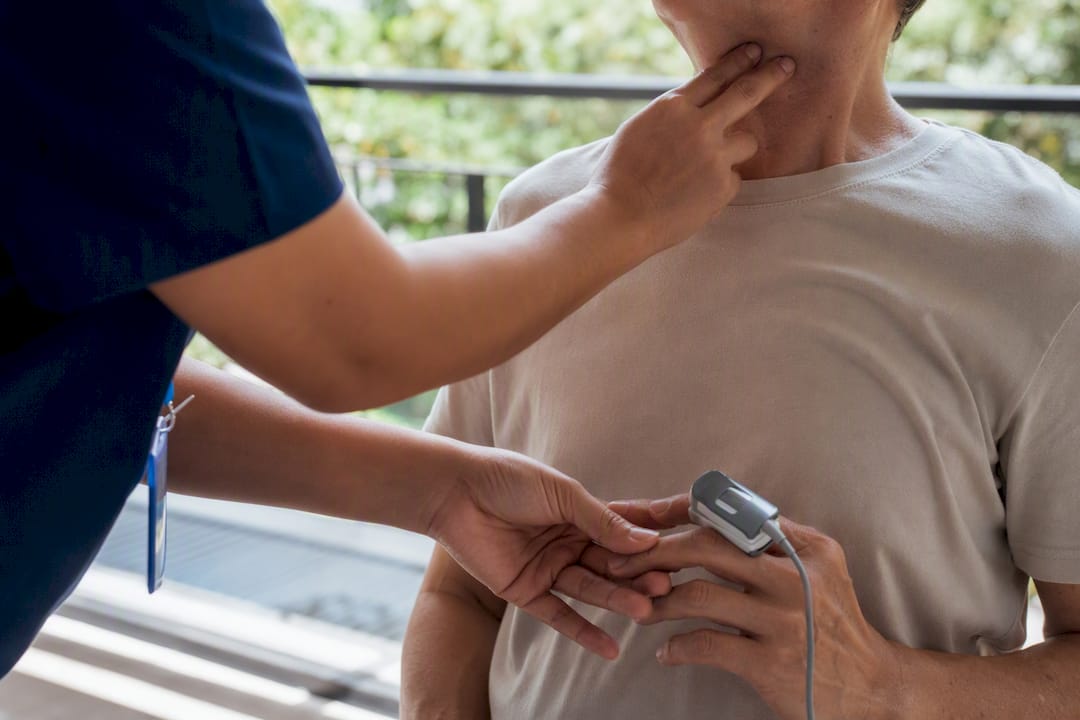
Question 1 (recognize cues): Which findings from the two-hour update require immediate follow-up? The rising respiratory rate, falling oxygen saturation despite supplemental oxygen, and accessory muscle use together signal worsening respiratory failure, not a stable COPD exacerbation. Anxiety and short-phrase speech are secondary confirmation, not the primary cue.
Question 2 (prioritize hypotheses): What is the most likely explanation for the patient's decline? Acute hypercapnic respiratory failure ranks above simple hypoxia here because the blood gas confirms rising CO2 alongside falling pH, meaning the patient isn't just short of oxygen, he's failing to ventilate adequately.
Question 3 (take action): What is the nurse's next best action? Notify the provider immediately and prepare for possible noninvasive ventilation, because waiting for further decline risks respiratory arrest in a patient whose gas exchange is already failing.
The lesson in this case isn't the diagnosis. It's the order of operations: notice the trend before the number crosses a scary threshold, connect it to a mechanism, then act on the mechanism, not just the symptom.
This progression, from a single note, to a subtler physical change, to confirmatory lab data, is exactly how sample NGN case walkthroughs demonstrate trend-based reasoning in practice.
How to Practice NGN Cases So They Actually Stick
Grinding through cases without a system wastes time. A deliberate-practice loop works better: attempt the case cold, review the rationale immediately while the reasoning is still fresh, name the specific error you made, then re-attempt a similar case a few days later. That spaced repeat is what actually moves a weak topic into a strong one.
During timed practice, track three things: time spent per question, which CJM step you keep missing, and which content areas produce repeat errors. If every miss traces back to analyze cues, more content review won't fix it, more trend-recognition practice will.
A short mental checklist helps during the exam itself:
- Scan every tab before answering, notes, vitals, labs, orders, since one buried value often changes the correct choice.
- Run the ABCs first when a scenario feels urgent; airway and breathing problems outrank almost everything else.
- Match each cue to a CJM step in your head before reading the answer options.
- Choose the action addressing the highest-priority problem, not the most familiar intervention.
Pro Tip: Tools that deliver a rationale the instant you submit an answer shorten the feedback loop dramatically. Waiting a day to review your mistakes means you've already forgotten the exact thought process that led to the wrong answer. Platforms with built-in analytics that flag weak areas turn that immediate feedback into a targeted study plan instead of a vague sense of "I should review more."
How Nursing School Pro Supports Your NGN Practice
Nursing School Pro's study center builds its practice questions around the same instant-feedback principle that makes case-study drilling effective. Instant rationales mean you find out why an answer was wrong before you move to the next question, which shortens the error-correction cycle that spaced practice depends on. Real-time analytics track which CJM steps and content areas keep tripping you up, so your next study session targets the actual gap instead of a guess.
- Instant rationales turn every missed question into a teaching moment instead of a mystery.
- Real-time analytics highlight recurring weak spots across content areas and question types.
- Curriculum alignment with leading nursing textbooks keeps practice questions relevant to what you're actually being taught.
- Transparent pricing, $20 a month after a 48-hour free trial, with no guesswork about cost before you commit.
| Feature | Study benefit |
|---|---|
| Instant rationales | Faster error correction on missed CJM steps |
| Real-time analytics | Targeted repetition on your actual weak areas |
| Textbook alignment | Practice stays relevant to current coursework |
Mistakes That Quietly Sink Case-Study Answers
The most common mistake isn't a knowledge gap, it's reading the answer choices before finishing the case data. Students who skim the vitals tab, jump to the questions, then scroll back when something doesn't add up are working backward and losing time doing it.
A second common error is treating every finding as equally urgent. Not every abnormal value belongs in your answer. A slightly elevated temperature next to a dropping oxygen saturation and rising respiratory rate is background noise; the respiratory trend is the story. Students who try to address everything at once often pick a technically-correct-but-not-prioritized answer, which NGN scoring treats as wrong or partially wrong.
Third, don't confuse a familiar intervention with the correct one. If you've seen a scenario that looks like a textbook DKA case a dozen times, it's tempting to reach for insulin as the automatic first answer. But if the stem shows severe dehydration and hypotension, fluid resuscitation often needs to happen first, insulin without volume correction can worsen electrolyte shifts.
Finally, resist the urge to overthink multiple-response items by second-guessing a clearly correct choice because "there must be a trick." NGN questions test recognition of real clinical patterns, not riddles. If the cue clearly points to a diagnosis or action, trust the pattern rather than searching for a hidden catch that usually isn't there.
Reading Labs and Diagnostics Without Getting Lost
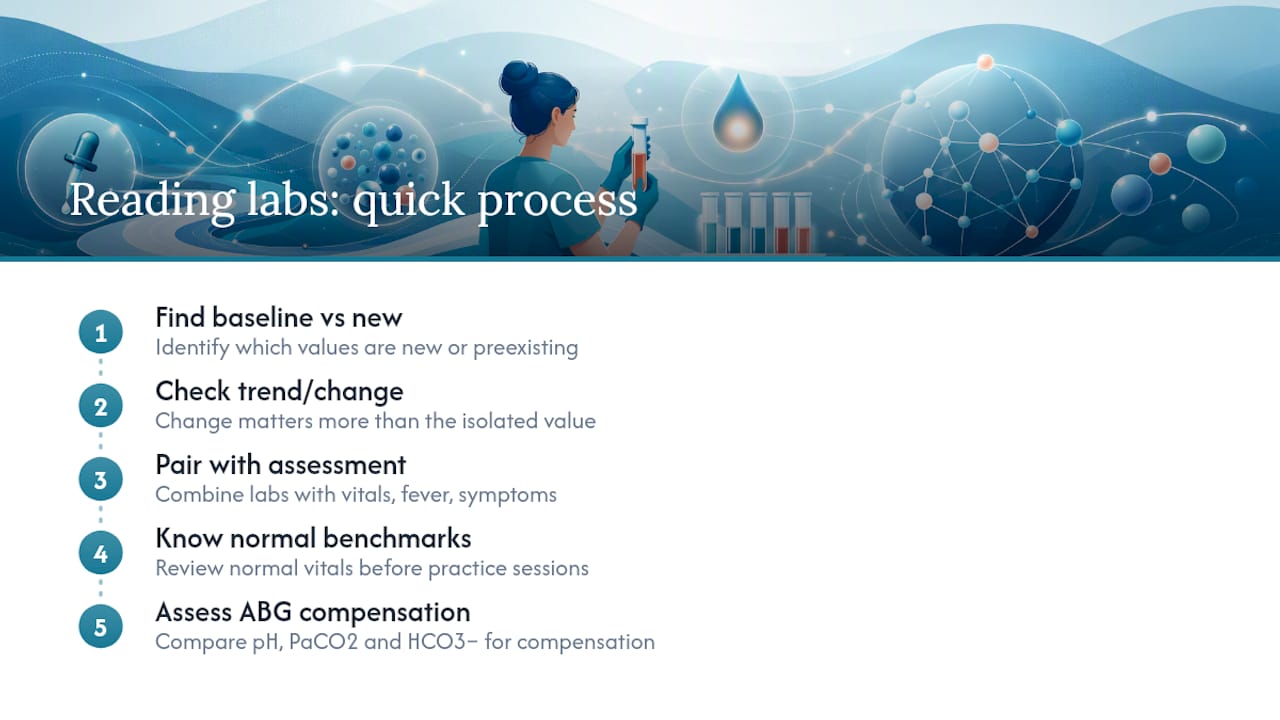
Lab values in an NGN case only matter in relation to the patient's baseline and trend, not the isolated number. A potassium of 5.2 mEq/L means something very different in a patient with new kidney injury than in one recovering from a mild dehydration episode, and NGN cases expect you to weigh that context rather than memorize a single reference range.
Start by identifying which values are new versus baseline. Case stems often include a first set of vitals or labs, then an updated set after an intervention or time passage. The change matters more than the absolute number. A blood glucose of 350 mg/dL is concerning on its own, but a glucose that dropped from 500 to 350 after insulin tells you the treatment is working, a very different clinical picture.
Pair lab data with the physical assessment findings rather than reading them in isolation. An elevated white blood cell count alongside fever and tachycardia builds a clear infection picture; the same white count with no other symptoms is easier to dismiss as a lab artifact worth rechecking. Reviewing normal vital-sign ranges and assessment benchmarks before practice sessions makes it much faster to spot which values in a case are actually abnormal.
Arterial blood gases deserve particular attention because NGN cases use them to test whether you understand compensation. A low pH with high CO2 and normal bicarbonate signals acute respiratory acidosis with no compensation yet, while the same low pH with elevated bicarbonate suggests the kidneys have started to compensate over time. That distinction often decides which intervention question comes next.
Where Pharmacology Fits Into Case-Study Decisions
Pharmacology knowledge shows up in NGN cases less as "name this drug" and more as "predict what happens next." A case might show a patient on furosemide with a potassium level trending downward, and the correct action depends on recognizing the drug's effect on electrolytes before the patient becomes symptomatic.
Dosage and timing questions test similar reasoning. If a case shows a patient receiving IV opioids with a respiratory rate that's slipped from 16 to 10, the next action isn't automatically "give the next dose", it's assessing sedation level and respiratory status first. Missing that connection is a common way students lose points on the take action step, even when they've correctly identified the cue.
Drug interactions and contraindications appear woven into the case rather than asked directly. A patient stem might mention a new prescription alongside an existing medication list, and the correct hypothesis depends on catching a conflict between the two, an anticoagulant added to a patient already on aspirin, for instance. Building genuine familiarity with high-alert medication classes (anticoagulants, insulin, opioids, IV potassium) pays off disproportionately, since these show up across medical-surgical, maternity, and pediatric cases alike. A single dosage misstep in a scenario can flip the correct action entirely, which is exactly the kind of high-stakes reasoning the NCLEX is built to catch.
Weaving Patient Safety Into Every Answer
Every NGN case has a safety layer underneath the clinical content, and the correct answer usually reflects whichever choice reduces harm most directly, not just the choice that treats the diagnosis. When two interventions both seem reasonable, the safer one, the one with fewer steps that could go wrong or fewer ways to misidentify a patient or medication, tends to be correct.
Evidence-based practice shows up in cases that reward following an established protocol over a plausible-sounding shortcut. A sepsis case, for example, often tests whether you recognize the urgency of early fluid resuscitation and antibiotic administration within a defined window, rather than waiting for a full panel of confirmatory results. The "textbook correct" answer aligns with published sepsis bundles, not with intuition alone.
Fall risk, medication reconciliation, and infection control cues often appear as background details rather than the main plot of a case, and missing them costs points on multiple-response items even when you nail the primary diagnosis. Practicing with cases that mix a clear clinical emergency with a quieter safety detail trains you to scan for both simultaneously instead of fixating on the loudest problem in the stem.
Repositories and Practice Tools Worth Bookmarking
- NextGen NCLEX Library — faculty-reviewed cases organized by specialty, with trend and bow-tie items built around CJM.
- NCSBN's NGN presentation — the source explanation of how the six CJM steps map to question formats.
- Lorea's free NGN case practice — interactive unfolding cases with immediate feedback for self-study between formal review sessions.
- Sample NGN case walkthroughs — worked examples showing how trend recognition drives prioritization.
What Most Study Advice Gets Backward
Most NCLEX prep advice still treats case studies as an extension of content review: learn the pathophysiology, then the questions will follow. That gets the order wrong. The NCSBN built the Clinical Judgment Measurement Model specifically because knowing the content isn't the same as knowing what to do with it under time pressure, and plenty of well-prepared students still miss cases because they never practiced the six-step reasoning pattern itself.
The bigger gap isn't knowledge, it's sequencing. Students default to reading answer choices before finishing the data tabs, which is backward from how the exam wants you to think. Practicing a handful of unfolding cases with real trend data, then forcing yourself to name the CJM step before looking at the options, retrains that instinct faster than another round of flashcards ever will.
If there's one thing to prioritize first, it's this: stop treating every case as a content quiz and start treating it as a sequencing drill. Get comfortable naming what step you're on, and the content review you've already done will finally show up where it counts.
Get Structured NGN Practice With Nursing School Pro
Free case walkthroughs and faculty repositories are worth your time, but they leave you piecing together your own feedback loop. Nursing School Pro's study center builds that loop in for you: every practice question comes with an instant rationale, and the analytics dashboard tracks which CJM steps and content areas keep costing you points, so your next study session targets the actual gap instead of another random content review.
The platform's question bank stays aligned with the textbooks your program already assigns, so practice time reinforces coursework rather than competing with it. You can start with a 48-hour free trial at $20 a month afterward, no long commitment required before you know whether the format fits how you study. If unfolding cases and trend-based reasoning are where you're losing points, start a free trial and let the analytics tell you exactly where to focus next.
Frequently Asked Questions
What are NCLEX case study examples, exactly? They're unfolding patient scenarios built around the NCSBN Clinical Judgment Measurement Model, where new data (vitals, labs, notes) appears in stages and questions test whether you recognize, prioritize, and act on the changing picture.
The exact count varies by candidate since the NCLEX is adaptive, but unfolding case studies make up a defined portion of the Next Generation NCLEX alongside standalone items, which is why category-based practice across medical-surgical, maternity, pediatric, and community scenarios matters more than focusing on one specialty.
Where can I find free NCLEX practice case studies? The NextGen NCLEX Library offers faculty-reviewed cases by category, and interactive tools like Lorea provide unfolding cases with instant feedback for self-study.
How is a case study question different from a standard NCLEX question? A standard item asks one question about a static scenario. A case study unfolds across multiple tabs and time points, and later questions often depend on information revealed after earlier ones, testing whether you tracked the trend rather than just the current snapshot.
Do I need to memorize the six CJM steps by name? You don't need to write them on the exam, but recognizing which step a question is testing, recognize cues versus prioritize hypotheses versus take action, helps you avoid picking a technically true answer that doesn't match what the question is actually asking.
This article is general information, not a substitute for advice from a qualified doctor. Consult a qualified healthcare professional about your own circumstances before acting on anything here.