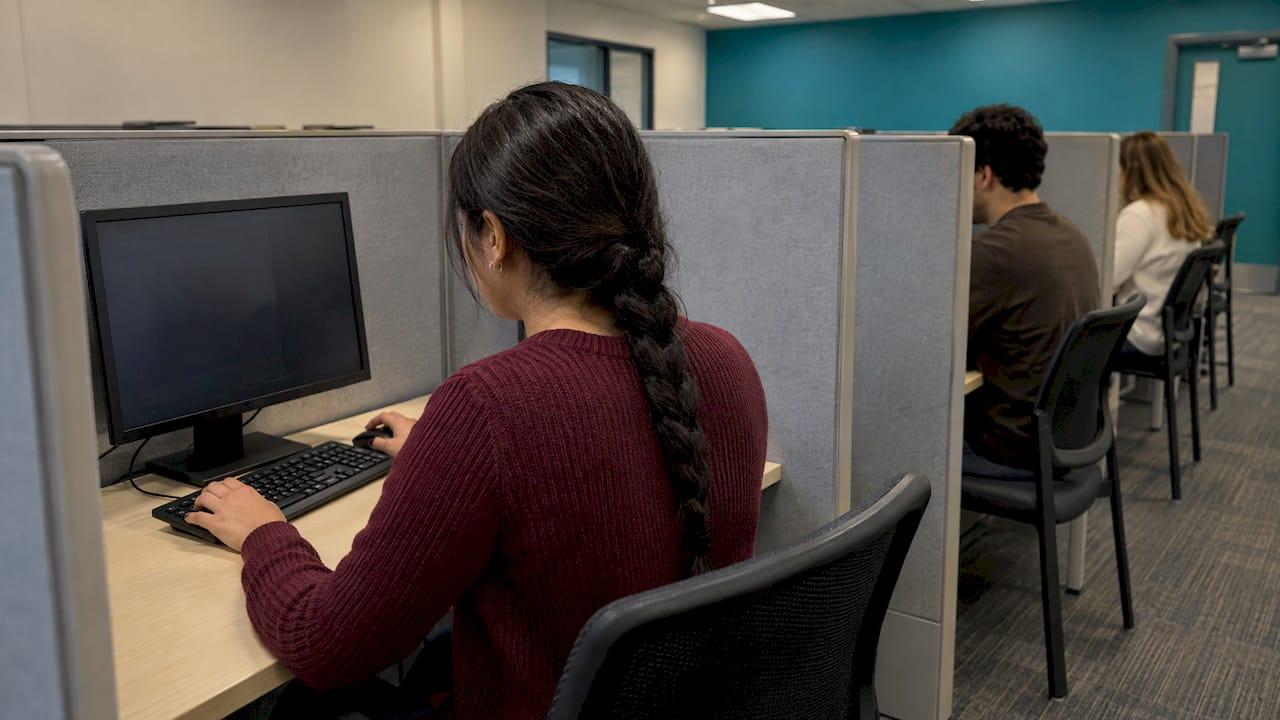
The ATI TEAS 7 gives you 209 minutes (3 hours and 29 minutes) to answer 170 questions. That time is split across four sections, and each one has its own clock. Reading gets 55 minutes, Mathematics 57, Science 60, and English and Language Usage 37. Plan to be at the test site for about four hours, because check-in and instructions are not part of the 209.
Below you will find the limit for each section, how the clock behaves, how long the whole appointment takes, what happens if you arrive late, and how to practice at the right pace.
TL;DR
- The TEAS 7 allows 209 minutes in total for 170 questions: 150 scored and 20 unscored pretest items.
- Each section is timed separately: Reading 55, Mathematics 57, Science 60, English and Language Usage 37 minutes.
- Set aside about four hours for the appointment. Some colleges suggest even more if you must park and walk to the room.
- Arrive early. Colleges set strict late cutoffs, and a missed start can mean you do not test at all.
- Practice with a timer from week one, so the pace feels normal on test day.
Table of Contents
- How long is the TEAS 7 in total?
- The time limit for each TEAS section
- Breaks and how the clock behaves
- How long the whole appointment really takes
- What if you arrive late?
- The 20 unscored questions and your clock
- How to pace yourself on test day
- Practice with the clock from the start
- Our perspective
- Try timed TEAS practice with instant rationales
- How long are TEAS scores good for, and does time matter for retakes?
- FAQ
- Sources
How long is the TEAS 7 in total?
The official ATI TEAS Version 7 content outline lists 170 questions, made up of 150 scored questions and 20 unscored pretest items. Youngstown State University's TEAS FAQ confirms that for students testing on or after June 3, 2022, the exam has 150 scored questions and 20 unscored pretest questions with 209 minutes to complete.
The 209 minutes is simply the four section limits added together:
55 + 57 + 60 + 37 = 209 minutes

That is 3 hours and 29 minutes of testing. If you spread it evenly over all 170 questions, you get a little over a minute per question on average. Some questions take ten seconds. Others, like a multi-step dosage-style math problem or a dense science passage, take two or three minutes. The sections are built so the average works out, but only if you do not sink time into one hard item.
You may also see people say the exam is "about 3.5 hours." That is the same number, rounded. If you are searching for the ATI TEAS exam length or test duration, 209 minutes of testing time is the figure to remember.
The time limit for each TEAS section
The same ATI outline gives each section's allowance. Here they are in one place:
| Section | Time allowed |
|---|---|
| Reading | 55 minutes |
| Mathematics | 57 minutes |
| Science | 60 minutes |
| English and Language Usage | 37 minutes |
| Total | 209 minutes |
The ATI content outline also notes that the Reading section has 39 scored questions within its 55 minutes.
What each limit means for your pacing
Reading (55 minutes). This section is passage-heavy, so your clock goes into reading, not clicking. Skim the question stem first so you know what to look for in the passage, then read with that purpose.
Mathematics (57 minutes). Math rewards a steady rhythm. Do the quick conversions, ratios and basic operations first and fast, so you bank time for word problems that need several steps. Our TEAS 7 math guide with formulas and a four-week plan shows how to build that rhythm.
Science (60 minutes). This is the longest section, and it covers anatomy and physiology, biology, chemistry and scientific reasoning. Anatomy and physiology carries the most weight, so protect time for it. If you want to see where to spend your study hours, read our TEAS 7 science plan for the A&P questions.
English and Language Usage (37 minutes). This is the shortest section. It feels quick, but grammar, punctuation and sentence structure items reward a calm second look, so do not rush through them just because the clock is shorter.

Breaks and how the clock behaves
The single most useful thing to know is that each section has its own timer, and a break does not stop a timer that is already running.
College of Southern Nevada explains that restroom breaks are allowed between sections so that no time is lost, while breaks taken once you are inside a section do not pause the timing. Milwaukee Area Technical College adds that students are encouraged to take a break between the Math and Science portions.
The practical lessons:
- Use the gap between sections for water, the restroom and a stretch. That time is not charged to your section clocks.
- Do not leave in the middle of a section unless you must. Every minute away is a minute off that section.
- Eat and drink beforehand so you do not need to leave mid-section. Check your testing site's rules on food, drinks and personal items before you go.
- Rules vary by location and by whether you test at a campus, a testing center or remotely, so confirm the break policy with the site where you booked.
One more point from Valencia College: the TEAS is always proctored as a package, so all testing must be completed in one sitting. You cannot take one section on Monday and another on Friday, and you cannot choose to test a single section on its own.
How long the whole appointment really takes
The 209 minutes covers only the timed questions. The real appointment includes check-in, ID verification, instructions and technical setup, plus any break between sections.
Here is what colleges that give the test tell their students:
- Valencia College advises setting aside a total of 4 hours to test.
- College of the Sequoias asks test takers to arrive one half hour early to park, find the room, sign in and get ready.
- Milwaukee Area Technical College suggests allowing four and a half hours if you need to find parking.
A sensible plan is to block out the whole morning or afternoon and nothing else. Do not schedule work, a class or a childcare pickup that leaves you watching the clock during Science.
A sample timeline
Here is an illustrative example for a morning session. Your site's schedule may differ.
| Time | What happens |
|---|---|
| 7:30 AM | Arrive, park, find the room |
| 7:45 AM | Sign in and show ID |
| 8:00 AM | Instructions and software check, then testing begins |
| About 11:30 AM | The 209 minutes of testing ends, plus any time between sections |
| Around 12:00 PM | You are free to leave |
The exact start depends on your site, and the time you spend between sections is yours to use, so treat the table as a planning aid and not a promise.
What if you arrive late?
This is a common worry, and the answer is blunt: late arrival can cost you the appointment.
- Valencia College states that if you do not begin within 15 minutes of your scheduled time, you will not be admitted and will have to reschedule.
- College of Southern Nevada allows 30 minutes from the offered start time, after which you cannot test, and exams are not refunded or rescheduled because of late arrival.
- College of the Sequoias sets fixed cutoffs: for an 8:00 AM session, no one is admitted after 7:50 AM, and the afternoon session has its own cutoff.
So the answer to "can you start a TEAS exam late?" is: sometimes by a few minutes, never by much, and at some sites not at all. Rules differ from one school to the next, so read your confirmation email and your testing site's page. Aim to be there 30 minutes early, as one college explicitly asks.
A missed or failed attempt also affects what you can do next. Our guide to the TEAS retake policy explains the waiting periods and limits, and our page on TEAS test cost covers what you pay, so you know what a rescheduled sitting could mean for your budget.
The 20 unscored questions and your clock
Of the 170 questions, 20 are pretest items that do not count toward your score. You will not be told which ones they are. They sit among the scored questions and eat the same minutes.
That has one consequence for pacing: treat every question as if it counts. If you hit a question that feels wildly unfamiliar, it may be an unscored item, but you cannot know that, so do not burn three minutes hunting for certainty. Make your best choice, flag it if the software lets you, and move on.
How to pace yourself on test day
Time pressure is usually a pacing problem, not a knowledge problem. These habits fix most of it.
- Know your checkpoints. Before test day, work out where you should be at the halfway mark of each section. For a 55-minute Reading section, that is roughly 27 minutes in. Glance at the clock at those points only, not after every question.
- Answer the easy ones first. A quick correct answer is worth the same as a slow one. Bank those points, then return to the harder items.
- Cap your time per question. If you are past about two minutes without a path to the answer, pick the most likely option and move on.
- Never leave blanks. Unanswered items earn nothing, so choose an answer before the section ends.
- If you finish early, review. Use leftover minutes to recheck flagged items, not to sit idle.
- Keep the sections separate in your head. A bad Math section does not change your Science clock. Reset between sections.
Practice with the clock from the start
Most students study untimed for weeks, then discover on test day that the clock changes everything. Reverse that. Build a habit of timing your practice early, and tighten it as you go.
A simple progression:
- Weeks 1 to 2: Untimed topic practice. Read every rationale, including those for questions you got right.
- Weeks 3 to 4: Timed mini-sets, such as 10 questions with a time cap based on the section pace.
- Weeks 5 to 6: Full-section practice under the real limits: 55, 57, 60 and 37 minutes.
- Final week: At least one full run of all four sections in one sitting, with only the break you would really get.
If you want a schedule laid out for you, we have a six-week TEAS 7 study guide mapped to measurable targets and a copyable 4, 6 and 8 week plan that uses diagnostics and analytics. For the broader habit of turning practice into retention, see our nursing study plan built on practice questions and instant rationales.
Track where your minutes go
Scores alone hide the real problem. Two students can both score 70 percent in Math, but one ran out of time on the last eight questions and the other simply did not know the content. The fix is different for each.
When you practice, note for each set:
- How many minutes you used.
- Which questions took the longest.
- Which topics you got wrong fast (a knowledge gap) and which you got wrong slowly (a pace or method gap).
That record tells you whether to study more content or to drill speed.
Our perspective
We built Nursing School Pro around one idea: students do not fail the clock, they fail to practice under it. A 209-minute exam is long, and the pressure of a running timer changes how you read, calculate and decide.
That is why our practice questions come with an instant rationale for every answer. When you finish a timed set, you see not only what was right but why, so the next time the same concept appears you spend seconds on it, not minutes. Our real-time analytics show which topics are your weak areas, and our adaptive retry loops bring those topics back until they stick.
Our content is designed to align with respected nursing textbooks and national standards, so the time you put in goes toward what the exam asks. Start timed practice early, review every rationale, and let the analytics tell you where the next hour should go. A calm, practiced pace on test day comes from repetition, not luck.
Autumn
Try timed TEAS practice with instant rationales
If you want to rehearse the real pace, Nursing School Pro gives you practice questions with an instant rationale on every answer and analytics that show your weak areas as you go. You can start with a 48-hour free trial, and after that the plan is $20 per month.
You can also browse free study material in our Study Center, and if your plans include a second exam, our HESI A2 math timed practice guide uses the same method. If you are still deciding where to apply, our overview of nursing school requirements shows what admissions committees value alongside your test score.
How long are TEAS scores good for, and does time matter for retakes?
Time also shows up after the test. Each school sets its own rules on how old a score can be and how soon you can retest, so check every program you are applying to. Do not assume one school's rule applies to another. Because attempts can be limited, you want your first sitting to be your best one, which is one more reason to rehearse the timing before you book.
FAQ
How long is the TEAS?
The ATI TEAS 7 has 209 minutes of testing time for 170 questions. With check-in and instructions, plan on about four hours at the test site. Some colleges suggest more if you need to find parking.
Is each TEAS section timed separately?
Yes. Reading is 55 minutes, Mathematics 57, Science 60 and English and Language Usage 37. Each section has its own clock, and a break taken inside a section does not pause it.
Can you start a TEAS exam late?
Only within a short window, and at some sites not at all. Valencia College admits no one after 15 minutes, College of Southern Nevada allows 30, and College of the Sequoias sets fixed cutoffs. Arrive 30 minutes early to be safe.
Can you split the TEAS across two days?
No. Colleges that administer it say it is proctored as a package and must be completed in one sitting. You cannot test one section alone or return another day for the rest.
Do the 20 unscored questions get extra time?
No. The 20 pretest questions are mixed in with the 150 scored ones and use the same 209 minutes. You cannot tell which are unscored, so give every question your normal effort and pace.
Sources
- ATI TEAS Version 7 Content Outline
- Youngstown State University: TEAS Exam Information and FAQ
- Valencia College: Test of Essential Academic Skills
- College of Southern Nevada: TEAS Exam
- College of the Sequoias: TEAS Information
- Milwaukee Area Technical College: TEAS for Allied Health