
The HESI A2 math section tests the applied arithmetic and dosage-calculation skills nursing programs expect you to use on the floor, not abstract algebra. Your single best next step right now: take a 50-question timed diagnostic under real test conditions, score it by topic, and let your wrong answers tell you exactly where to spend the next week. That one action separates students who study smart from those who review everything and improve nothing. Nursingschoolpro's HESI A2 question bank is built around this exact approach, with instant rationales and topic-level analytics that turn a diagnostic into a study plan.
Key Takeaways
The fastest path to passing the HESI A2 math section is a timed 50-question diagnostic taken first, followed by targeted practice on your weakest topics, and at least two full timed simulations before your exam date.
| Point | Details |
|---|---|
| Take a timed diagnostic first | A 50-question, 50-minute diagnostic under real conditions reveals your exact weak topics before you waste study time. |
| Prioritize fractions, dosage, and conversions | These categories carry the highest weight and appear most frequently across the 50 scored questions. |
| Aim for 80% on practice before test day | Scoring 80% or above on two consecutive timed practice tests gives you a reliable buffer for live exam conditions. |
| Review rationales after every session | Spending as much time on wrong-answer explanations as on the test itself converts errors into lasting improvements. |
| Nursingschoolpro tracks your progress by topic | The platform's analytics dashboard shows which categories still need work after every practice session, so your study plan stays current. |
Table of Contents
- What does the HESI A2 math section actually test?
- What is the format, timing, and scoring on test day?
- Why a diagnostic-first approach beats unfocused review
- What do practical study plans look like for 1, 4, and 8 weeks?
- Practice questions with worked solutions
- Common mistakes and test-day strategies
- A study workflow that actually builds the habit
- Nursingschoolpro gives you the diagnostic-driven edge
- What the best HESI math prep actually looks like
- Sources
What does the HESI A2 math section actually test?
The core topics break down into nine categories. Knowing which ones carry the most weight lets you stop treating every topic equally.

| Topic | What it looks like | Relative priority |
|---|---|---|
| Fractions, decimals, percentages | Convert 3/8 to a decimal; find 35% of 160 | High |
| Ratios and proportions (dosage) | If 450 mg/300 mL, how many mL for 450 mg? | High |
| Basic operations | Multiply or divide multi-digit numbers without a calculator | High |
| Unit and metric conversions | Convert 3.5 kg to grams; oz to mL | High |
| Basic algebra | Solve for x: 2x = 16 | Medium |
| Order of operations | Evaluate 4 + 3 × (8 ÷ 2) | Medium |
| Applied word problems | Multi-step scenarios mixing units and percentages | Medium |
| Roman numerals | Convert XXI to 21; write 29 as XXIX | Lower |
| Military time | Convert 9:30 PM to 21:30 | Lower |
A few things worth noting about each category:
- Fractions/decimals/percentages appear throughout the test, often embedded inside dosage word problems. Master these first.
- Ratios and proportions are where nursing math lives. The classic setup is a known concentration and an ordered dose; you solve for volume. A rounding error here is the kind of mistake that has real clinical consequences, which is why programs weight it heavily.
- Unit conversions trip up students who memorize the metric system but forget household equivalents (1 tsp = 5 mL, 1 oz = 30 mL).
- Roman numerals and military time take about 20 minutes to learn cold. Do them last, but do not skip them.
What is the format, timing, and scoring on test day?
The math block runs 50 scored questions in 50 minutes, which works out to roughly one minute per question. Some sources report more than 50 total items, with up to 5 unscored pilot questions embedded invisibly, so you cannot tell which questions count. The practical takeaway: treat every question as scored and pace for 50+ questions in 50 minutes.
What to expect in the testing room:
- An on-screen four-function calculator is provided. It handles addition, subtraction, multiplication, and division. It does not do fractions or percentages automatically, so you need to know the manual steps.
- No scratch paper in some testing centers; others allow a whiteboard or laminated sheet. Check with your specific testing site beforehand and practice both ways.
- Questions are multiple choice, typically four answer options.
- You cannot go back to a flagged question on most HESI administrations, so your first committed answer matters.
Scoring and pass thresholds:
HESI scores are reported on a 0–100 scale. Individual nursing programs set their own cutoffs, and those vary. A score of 75 is a common minimum at many programs, but competitive programs often want 80 or higher. Timed practice tests that mirror the live format report that students who consistently score 90% or above on full-length timed diagnostics pass the live exam at high rates.
Practical target: Score well on two consecutive full-length timed practice tests before scheduling your exam date.
Why a diagnostic-first approach beats unfocused review
Most students open a study guide on page one and read straight through. That approach ignores the single most useful piece of information available to you: your own error pattern.
A diagnostic taken early in your prep does something a study guide cannot. It shows you, in 50 questions, exactly which topics are costing you points. Fractions? Dosage proportions? Algebra? The answer is different for every student, and educator guidance consistently points to early diagnostic quizzes as the fastest way to isolate specific knowledge gaps and prioritize high-impact topics over broad, unfocused review.
The diagnostic → gap map → targeted practice cycle:
- Take a timed diagnostic of about 50 questions. Score it by topic, not just overall.
- Rank your topics from worst to best. The bottom two or three are your study priorities.
- Drill those topics with focused practice sets, then review every wrong answer's rationale before moving on.
- Retake a fresh diagnostic after one to two weeks of targeted practice. If a topic moves from "weak" to "solid," shift your focus to the next gap.
When to retake the real exam: Most programs allow a retake after a waiting period (often 60 days, though this varies by school). If you scored below 75, spend at least four weeks on targeted practice before retesting, with at least two full timed simulations in the final week.
Pro Tip: Spending as much time reviewing rationales as you spend taking the test is where the actual learning happens. A student who takes ten diagnostics without reading explanations improves far slower than one who takes five and dissects every wrong answer.
What do practical study plans look like for 1, 4, and 8 weeks?
Pick the plan that matches your timeline and your diagnostic results. All three follow the same logic: diagnose first, drill weaknesses, simulate the full test near the end.
1-week crash plan
- Day 1: Take a timed diagnostic of about 50 questions. Score by topic. Identify your two weakest areas.
- Day 2–3: Drill your weakest topic with 20–30 focused questions per session. Review every rationale.
- Day 4–5: Drill your second-weakest topic the same way. Add 10 minutes of conversion memorization daily.
- Day 6: Take a second full timed diagnostic. Compare scores by topic.
- Day 7: Light review of remaining weak spots. No new material. Rest.
4-week focused plan
- Week 1: Diagnostic + fractions/decimals/percentages deep dive (30 questions per day, rationale review).
- Week 2: Ratios/proportions and dosage calculations. Add unit conversions. One timed half-section (25 questions) mid-week.
- Week 3: Algebra, order of operations, word problems. One full timed diagnostic at week's end.
- Week 4: Targeted re-drilling of any topics still below 75%. Two full timed simulations in the final three days.
8-week mastery plan
- Weeks 1–2: Diagnostic + foundational work on fractions, decimals, and basic operations. 15–20 questions daily.
- Weeks 3–4: Ratios, proportions, and dosage. Begin memorizing conversion tables. One timed section per week.
- Weeks 5–6: Algebra, order of operations, Roman numerals, military time. One full diagnostic at the end of week 6.
- Week 7: Mixed practice sets. Use Nursingschoolpro's topic analytics to confirm which areas still need work. Two full timed simulations.
- Week 8: Final review of weak spots only. Three full timed simulations. No new material after day 5.
Daily routine that works across all three plans:
- 15–30 minutes of focused topic drills (not random questions)
- 5–10 minutes reviewing rationales for every wrong answer
- One timed drill (10–15 questions at exam pace) every other day
- Weekly full simulation starting in the second half of your plan
Nursingschoolpro's analytics dashboard shows your score by topic after every session, so you can see at a glance whether last week's weak area is improving or still needs work.
Practice questions with worked solutions
These six questions mirror the style and difficulty of the actual exam. Work each one before reading the solution.
| # | Question | Topic |
|---|---|---|
| 1 | Convert 5/8 to a decimal. | Fractions/decimals |
| 2 | A patient needs 450 mg of a drug. The vial contains 300 mg/mL. How many mL do you give? | Dosage/ratio |
| 3 | What is 35% of 160? | Percentages |
| 4 | Solve for x: 2x = 16 | Basic algebra |
| 5 | Convert 3.5 kg to grams. | Unit conversion |
| 6 | What time is 21:30 in standard time? | Military time |
Worked solutions:
-
5 ÷ 8 = 0.625. Divide the numerator by the denominator. No shortcut needed; just long division or the on-screen calculator.
-
Desired ÷ Have × Volume = x. 450 ÷ 300 × 1 mL = 1.5 mL. Set up the proportion, cross-multiply, and divide. Always label your units to catch setup errors.
-
35% × 160 = 0.35 × 160 = 56. Convert the percentage to a decimal first, then multiply. Takes under 20 seconds with the on-screen calculator.
-
2x = 16, so x = 8. Add 5 to both sides, then divide by 2. Write each step; skipping steps is where algebra errors hide.
-
1 kg = 1,000 g, so 3.5 kg = 3,500 g. Metric conversions are always a power of 10. Move the decimal right for smaller units.
-
21:30 = 9:30 PM. Subtract 12 from any hour above 12. Minutes stay the same.
Time check: Each of these should take 45–60 seconds. If any took longer than 90 seconds, that topic needs more drill time. For additional timed practice questions with rationales, reviewing worked explanations after each attempt is where the score gains actually come from.
Common mistakes and test-day strategies
Errors that cost students the most points:
- Misplaced decimals in dosage problems. Always re-check that your answer is a clinically reasonable number. 15 mL is plausible; 150 mL for a single dose is a red flag.
- Wrong fraction operation. Dividing fractions requires flipping the second fraction and multiplying. Students who add denominators instead of finding a common one lose easy points.
- Skipping conversion steps. Writing out every unit in a conversion chain catches errors before they happen. Skipping a step to save time usually costs more time in rechecking.
- Over-relying on the calculator for percentages. The on-screen calculator does not have a % button on all versions. Know how to convert a percentage to a decimal manually.
- Spending too long on one question. The one-minute-per-question guideline is real. If you hit 90 seconds and have no clear path, pick your best answer and move on.
Time-management rules:
- Scan the question for the question type in the first five seconds. Dosage? Conversion? Algebra? That tells you which formula to reach for.
- Do not second-guess a calculation you already verified. Change an answer only if you find a concrete arithmetic error, not because another option "looks better."
- Use the final three minutes to revisit any questions you flagged, if your testing platform allows it.
Pro Tip: After every calculation, ask yourself one quick question: "Is this answer reasonable for a nursing context?" A dose of 0.002 mL or 500 tablets is a signal to recheck your setup, not your arithmetic.
For broader test-day pacing strategies that apply across nursing entrance exams, the HESI and TEAS exam prep strategies resource covers time management and anxiety reduction in more depth.
A study workflow that actually builds the habit
She did not panic. She opened her topic breakdown, saw that those two categories accounted for most of her wrong answers, and built her first week around them exclusively.
Her daily routine was simple: 20 focused questions in the morning (fractions one day, dosage the next), then 10 minutes reviewing every wrong answer's rationale before closing the app. No marathon sessions. No reading chapters. Just questions, rationales, and a running note of the specific mistake type she kept repeating (she was flipping the proportion setup).

That number told her exactly what to do next: shift focus to unit conversions and algebra, which were now her weakest categories.
The habit that made the difference was the rationale review. She treated it as non-negotiable, the same way she treated brushing her teeth. Fifteen minutes every morning, no exceptions. Small, daily, and tied to a clear feedback loop. That is the replicable piece: pick one 15-minute slot, protect it, and use it only for rationale review after a focused question set.
Nursingschoolpro gives you the diagnostic-driven edge
Passing the HESI A2 math section is not about studying more hours. It is about studying the right topics with the right feedback loop.
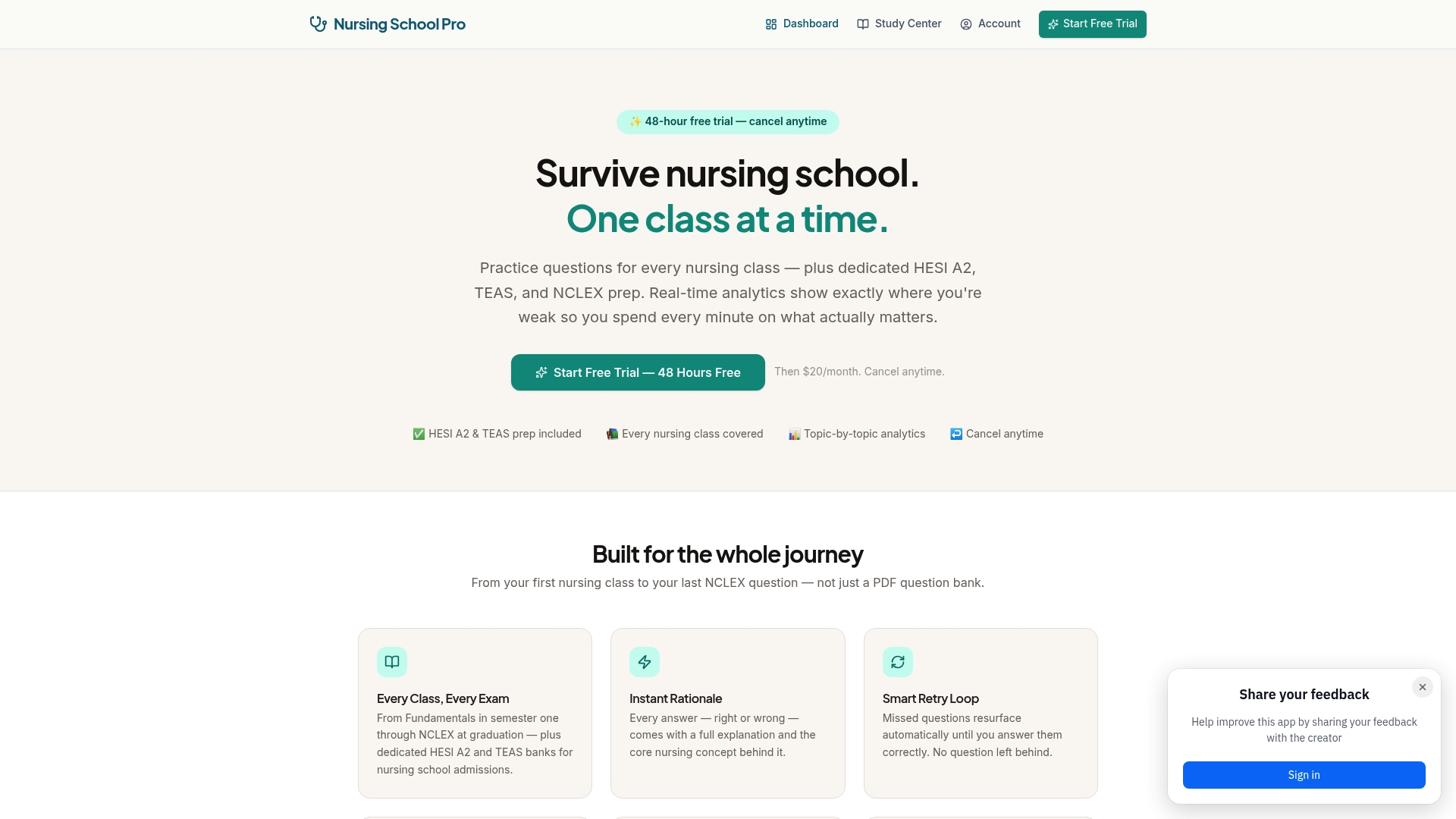
Nursingschoolpro is built for exactly this. The platform gives you timed 50-question HESI A2 diagnostics that mirror the live exam format, with instant rationales that explain not just the correct answer but the reasoning behind it. After every session, the analytics dashboard breaks your score down by topic so you can see precisely where your points are going. Dosage calculations, fractions, unit conversions, all tracked separately. No guessing about what to study next.
The question bank aligns with national nursing curriculum standards, and the dosage-calculation sets specifically address the rounding and proportion errors that trip up students most often. Whether you are on the 1-week crash plan or the 8-week mastery path, Nursingschoolpro fits into every stage: diagnostic at the start, targeted drills in the middle, full timed simulations in the final week.
Start with a 48-hour free trial and run your first timed diagnostic today. You will know your weak topics before the day is out.
What the best HESI math prep actually looks like
Most of the advice floating around on HESI math prep tells you to "study all the topics" and "practice every day." That is true but useless without structure. Here is what I think gets missed in almost every guide.
The diagnostic is not a warm-up. It is the most important thing you do in your entire prep cycle. Students who skip it and go straight to a study guide are essentially guessing at their own weaknesses, and they usually guess wrong. They over-study the topics they already understand (because those feel comfortable) and under-drill the ones that are actually costing them points.
The second thing most guides underestimate: the on-screen calculator changes the game less than you think. Students who rely on it for every step slow themselves down and make more transcription errors. The students who do best practice the mental shortcuts first, fractions to decimals, percentage conversions, proportion setups, and use the calculator only to verify. That habit alone shaves 10–15 seconds off every dosage question.
One more thing worth saying plainly: test anxiety on the math section is almost always a symptom of insufficient timed practice, not a personality trait. Students who have sat through five or six full 50-question timed simulations walk into the testing room knowing what 50 minutes feels like. The clock stops being a threat. If you are anxious about the math section, the fix is not relaxation techniques. It is more timed reps. The CAT exam format and test-day management strategies resource covers this pacing psychology well for nursing entrance exams broadly.
Sources
- 🎯 No hesi: Math HESI A2 Practice Test (Free 2026 August)
- HESI A2 Math Practice Test 2026 (50 Question Answers)
- Free HESI Math Practice Test | BoostPrep
- HESI A2 Math Study Guide - MathHelp
- Test-guide