
The TEAS costs roughly $70 to $120 per attempt in the United States, and the number you pay depends on your school and how you test. Published school pages show $70 for a campus-administered exam, $107 for an all-in on-campus total at one Texas college, and $110 to $120 for in-person or remote testing at others. Extra score reports and retakes add to that.
There is no single national price. Each nursing program decides where you test, which fees it adds, and which score reports it accepts. This guide shows what actual schools charge, what sits inside the fee, what costs extra, and how to confirm your own total before you pay.
TL;DR
- Expect $70 to $120 per attempt. Remote proctored testing is $120 at several schools; campus testing can be lower or higher once local fees are added.
- The price is set by the ATI exam fee plus anything your school or testing site adds, such as proctoring or registration fees.
- Extra score reports, transcripts and retakes cost more. Harper College lists additional score reports at $29.99.
- Test fees can be nonrefundable, so confirm your program's rules, deadline and testing method first.
- Budget for preparation too. A study plan with instant feedback costs far less than paying for a second attempt.
Table of Contents
- What the TEAS costs in real numbers
- What is inside the fee
- What costs extra
- How to confirm your exact price
- Ways to keep the total down
- Preparing so you only pay once
- Our perspective
- Try the practice before you register
- A note on HIPAA once you are in the program
- A sample budget
- FAQ
- Sources
What the TEAS costs in real numbers
The fastest way to understand TEAS pricing is to read what schools publish. The figures below come from the schools' own admissions pages. They are examples of the range, not a price list for your program.
| School | What it lists | Notes |
|---|---|---|
| Mississippi Delta Community College | $110 in person, $120 remote | Paid through ATI for both options |
| TSTC (West Texas) | $107 on-campus total; $120 virtual | On-campus total is a $7 annual RegisterBlast fee, a $25 proctoring fee and a $70-plus-tax ATI exam fee |
| Piedmont Community College | $70 campus-administered; $120 ATI remote proctoring | Transcript credit listed at $29.99 |
| Indiana University | $120 online | Fees are nonrefundable |
| Harper College | $120 per attempt | One free score report per attempt |
Two patterns stand out. First, remote proctored testing lands at $120 at nearly every school above. Second, the in-person price swings more, from $70 to $110, because each campus decides what to add on top of the exam fee.
What is inside the fee
The base fee covers one sitting of the exam. At the schools above, that sitting also comes with at least one score report sent to a school. Mississippi Delta says one transcript is complimentary, and Harper College gives one free score report per attempt.
The TSTC breakdown is a useful model of how an on-campus total gets built:
- ATI exam fee: $70 plus tax.
- Proctoring fee: $25, charged by the campus for supervising the session.
- RegisterBlast fee: $7 annually, for the scheduling system.
Add them up and you get $107. A school that charges only the exam fee will look cheaper on paper. A school that includes proctoring and registration looks pricier but may simply be more transparent. Compare totals, not line items.
What costs extra
Additional score reports
If you apply to more than one program, you may need to send your score to each. Mississippi Delta says additional school submissions require purchased transcript credits. Harper College lists additional score reports at $29.99, and Piedmont lists a transcript credit at the same $29.99. Applying to four programs could mean three extra transcripts, or about $90 on top of your exam fee at those rates.

Retakes
Every attempt is a new fee. At Harper, the cost was $120 per attempt, and remote attempts there require a 14-day interval while in-person testing does not impose a required interval. Other schools set their own waiting periods and attempt limits, so check your program before you plan a second sitting. Our guide to the TEAS retake policy walks through how to plan around those limits.
Study materials
Prep is the cost most applicants underestimate. Official practice packages, printed guides and tutoring all carry their own prices, and they vary by seller. Decide on a budget before you start buying, because you only need enough practice to hit your target score, not every product available.
How to confirm your exact price
A short routine keeps you from overpaying or paying for the wrong thing.
- Start with your program's admissions page. It states which TEAS version it accepts, the minimum scores, and how to register. Our overview of nursing school requirements shows how the test fits into the rest of an application.
- Choose a testing method. Campus testing and remote proctoring can carry different totals, as the school examples show.
- Read the refund language. Indiana University says test fees are nonrefundable, and applicants must submit their score sheet by the application deadline. Know both before you pay.
- Count your score reports. List every program you plan to apply to and see how many are covered by the free report.
- Confirm the total at checkout. Taxes and site fees can appear at the last step, as the "plus tax" at TSTC shows.
Ways to keep the total down
You cannot change the exam fee, but you can control the rest.
- Pick the lowest all-in testing option your program accepts. If your target schools allow a campus-administered exam, compare it with the remote price.
- Apply to a focused list of programs. Each extra school can mean an extra $29.99 transcript at schools that charge it.
- Register only when you are ready. Retakes are the most avoidable cost. Take a timed practice test first and schedule the real one when your scores are steady near your program's cutoff.
- Ask your school about fee help. Some testing offices and workforce programs may offer assistance. Ask the testing office directly, since policies differ by school.
- Use a structured plan. Our 4, 6 and 8 week TEAS study guide shows how to use diagnostics so every study hour goes to a weak area.
Preparing so you only pay once
The TEAS has four sections: reading, math, science and English and language usage. Weak science and math scores sink more applications than anything else, so those two deserve most of your time. We break down the 18 anatomy and physiology questions and the math formulas and practice plan for TEAS 7 separately. If you want one end-to-end schedule, use the six-week TEAS 7 study guide.
A good plan has three parts: a baseline test, targeted practice on the lowest sections, and a timed full-length run in the last week. For more on pacing and strategy across both entrance exams, these TEAS and HESI prep strategies are worth a read.
Our perspective
We built Nursing School Pro around a simple idea: the cheapest TEAS attempt is the one you only take once. The exam fee is fixed by your school, so the part you control is how ready you are on test day.
That is why every practice question on our platform comes with an instant rationale. Knowing the right answer is not enough. You need to know why it is right and why the other choices are wrong, because the real exam rewards reasoning, not memorization.
Our real-time analytics show which topics keep costing you points, so your next session goes to those topics instead of the ones you already know. The retry loops are designed to bring weak areas back until they are solid.
Our content is aligned with respected nursing textbooks and national standards, and the same platform carries you on to HESI A2, nursing class questions and NCLEX later. For one subscription you can prepare for the exam now and keep studying through graduation.
Autumn
Try the practice before you register
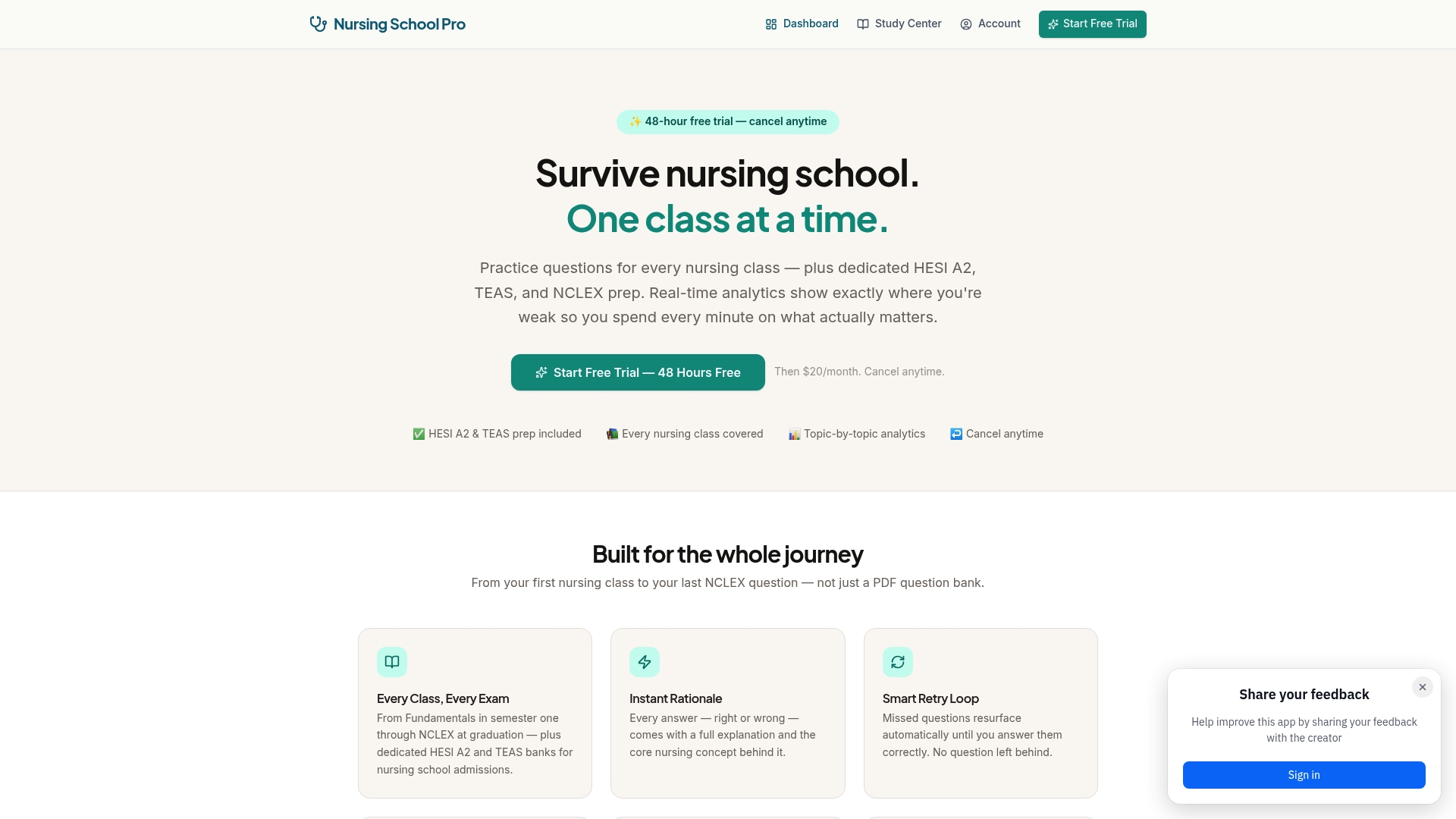
If you are still weeks away from your test date, start with practice before you spend on an attempt. Nursing School Pro offers practice questions for TEAS, HESI A2 and NCLEX with instant rationales and progress analytics. The plan is $20 per month on our pricing page, and it starts with a 48-hour free trial.
You can also explore the study center or read the practice-question study plan to see how a weekly routine works.
A note on HIPAA once you are in the program
Many TEAS readers also ask about HIPAA, because privacy training starts early in nursing school. In short, HIPAA's Privacy Rule governs individually identifiable health information. The National Student Nurses' Association describes this protected information as anything relating to a person's physical or mental health, or anything that may identify the person.
For students in clinicals, the practical rules are straightforward:
- Share patient information only for care. NCSBN guidance says information learned during patient care generally goes only to health-care-team members for patient-care purposes, with limited exceptions such as patient authorization, a legal requirement or preventing significant harm.
- Keep patient details off social media. NCSBN says nurses and student nurses must not electronically transmit patient-related information or images when it could reasonably violate confidentiality, privacy or dignity.
- Remember that no name is not the same as anonymous. Even information without a name may identify a patient when combined with contextual details.
- Follow your school's and site's consent rules. HHS has said that trainees' access to patient information must comply with patient privacy rights and applicable consent requirements.
The stakes are real. NCSBN warns that improper social-media use can lead to a report to a board of nursing and disciplinary action. If you are unsure whether something is safe to share, ask your clinical instructor before you post or send it.
A sample budget
Here is how the costs can add up for an applicant using the figures above. These are illustrations built from the published school examples, not a quote.
| Item | Low example | Higher example |
|---|---|---|
| One exam attempt | $70 (campus-administered) | $120 (remote proctored) |
| Two extra score reports at $29.99 | $59.98 | $59.98 |
| One retake | $0 if ready first time | $120 |
| Total | $129.98 | $299.98 |
The gap between the two columns is mostly one retake. That is why readiness is the best place to put money and time.
FAQ
How much does the TEAS test cost?
Published school pages show anywhere from $70 for a campus-administered exam to $120 for remote proctoring or online testing. TSTC lists a $107 on-campus total built from three separate fees. Your program's admissions page gives the figure that applies to you.
Is the TEAS fee refundable?
Often not. Indiana University states that its test fees are nonrefundable. Read your school's policy and confirm your application deadline before you register.
What happens if I need to retake the TEAS?
You pay the fee again for each attempt. Waiting periods and attempt limits depend on your school and testing method. At Harper College, remote attempts require a 14-day interval. See our retake policy guide for how to plan.
Do I pay extra to send my score to more schools?
Usually yes beyond the first. Mississippi Delta includes one complimentary transcript and requires purchased credits for more, and Harper and Piedmont list $29.99 for additional reports.
Does the exam fee cover study materials?
No. The fees above cover the exam sitting and score reporting. Practice questions and study guides are separate purchases, so choose your prep tools before you book your date.
Sources
- Mississippi Delta Community College TEAS registration instructions
- TSTC ATI TEAS admission exam, West Texas
- Piedmont Community College admissions test information
- Indiana University TEAS information
- Harper College TEAS test page
- NSNA social media recommendations
- NCSBN white paper on social media
- NCSBN social media guidelines video transcript
- HHS letter to teaching hospitals and medical schools
- TEAS and HESI exam prep strategies