
The TEAS 7 math section tests two content areas: Number & Algebra and Measurement & Data. The single best next step right now is to take a 30–40 question timed diagnostic, then build a 4-week plan around your weakest topics.
Here are the fast facts you need before anything else:
- Questions: 38 delivered, with most scored; some are unscored pretest items
- Time: About an hour total, allowing a little over a minute per question
- Content split: Number & Algebra and Measurement & Data, covering topics like fractions, decimals, basic algebra, ratios, unit conversions, geometry, statistics, and basic probability
- Best first action: Take a full diagnostic on ATI TEAS or Nursingschoolpro, then start an error log the same day
Pro Tip: Open a notes doc right now and label it "Error Log." Every time you miss a practice question, write the topic, what you did wrong, and the correct setup. This single habit separates students who plateau from those who keep improving.
Key Takeaways
Mastering TEAS 7 math requires a diagnostic baseline, targeted weekly drills, and consistent error-log review across a structured 4-week plan.
| Point | Details |
|---|---|
| Section structure | 38 questions delivered, 34 scored, 57 minutes total — plan for 90 seconds per question. |
| Top formula priority | Memorize geometry, percent, and probability formulas; ATI's official help page is the authoritative source. |
| Calculator rule | An on-screen calculator is provided for computer tests; personal calculators are never allowed. |
| 4-week plan | Week 1 diagnostic, Week 2 targeted drills, Week 3 timed sections, Week 4 full practice and review. |
| Nursingschoolpro | Offers TEAS-mapped practice, instant rationales, and real-time analytics to target weak areas efficiently. |

Table of Contents
- What does TEAS 7 math actually test?
- How the math section is structured and what your score means
- What's the calculator policy for the TEAS 7?
- Essential TEAS 7 math formulas to memorize
- Worked practice problems with step-by-step solutions
- A practical 4-week TEAS math study plan
- Where to find free TEAS 7 math practice resources
- How Nursingschoolpro helps you improve TEAS 7 math
- What most TEAS math prep gets wrong
- Try Nursingschoolpro's TEAS math practice free for 48 hours
- Sources
What does TEAS 7 math actually test?
The tested topics break cleanly into two buckets. Knowing which bucket each topic falls under helps you allocate study time, since some programs weight math performance heavily in admissions decisions.
Number & Algebra
- Fractions: Adding, subtracting, multiplying, dividing, and converting mixed numbers. Sample: "A patient receives 3/4 cup of juice three times a day. How many cups per week?"
- Decimals: Operations and rounding to a specified place. Sample: "Round 4.867 to the nearest tenth."
- Percentages: Percent of a number, percent change, and converting between fractions/decimals/percents. Sample: "A medication dose is reduced by 20%. The original dose was 250 mg. What is the new dose?"
- Ratios, proportions, and rates: Setting up and solving proportions, unit rates. Sample: "If 2 tablets contain 500 mg, how many mg are in 5 tablets?"
- Basic algebra: Solving one-variable equations and inequalities, simplifying expressions. Sample: "Solve for x: 3x + 7 = 22."
- Order of operations: PEMDAS applied to multi-step expressions. Sample: "Evaluate: 4 + 3 × (2² – 1)."
- Estimation and rounding: Approximating answers quickly to check reasonableness.
Measurement & Data
- Unit conversions: Metric (mL, L, mg, g, km) and US customary (oz, lb, in, ft, miles). Sample: "Convert 2.5 liters to milliliters."
- Geometry: Area, perimeter, volume, and the Pythagorean theorem. Sample: "Find the area of a triangle with base 8 cm and height 5 cm."
- Data interpretation: Reading tables, bar graphs, and line graphs; calculating mean, median, mode, and range. Sample: "A table shows five patient weights. What is the median?"
- Basic probability: Simple probability as a fraction. Sample: "A bag has 3 red and 7 blue marbles. What is the probability of drawing red?"
The TEAS math section emphasizes problem setup and unit tracking more than computational complexity. Most errors come from misreading the question or mismatching units, not from hard arithmetic.
How the math section is structured and what your score means
Quick structure facts:
- 38 questions delivered; 34 count toward your score
- 4 questions are unscored pretest items (you won't know which ones)
- About 57 minutes total, with an average pace per question recommended
- No penalty for wrong answers, so always guess if you're stuck
ATI reports a section-level score and a composite score. The section score reflects your performance on math specifically, while the composite blends all four TEAS sections. Many nursing programs set a minimum composite score, but some also set a floor for individual sections.
Score context: A score around 78% is widely cited as a reasonable target, but individual program cutoffs vary significantly. Always check the exact requirement for every school on your list before setting a score goal.
The practical move is to use your diagnostic percent-correct as a baseline, then track it weekly. That's a concrete, countable gap.
What's the calculator policy for the TEAS 7?
The rule is straightforward: for computer-delivered TEAS exams, ATI provides a built-in on-screen calculator. For paper-based exams, a calculator is supplied at the testing site. Personal calculators are not allowed under any circumstances.
The practical problem most students overlook is that the on-screen calculator has a specific layout, and fumbling with it under time pressure costs real points. Practice with a basic four-function on-screen calculator before test day, not a scientific calculator on your phone.
Three concrete tips:
- Use the on-screen calculator practice available on free TEAS prep sites to get comfortable with the interface
- Practice estimation first on every problem, then confirm with the calculator. If your estimate and your calculator answer differ by a lot, you likely hit a wrong key
- Drill mental math for simple operations: multiplying by 10 or 100, finding 10% of a number, and doubling/halving. These come up constantly and are faster done mentally
Pro Tip: Spend at least two practice sessions per week doing problems without any calculator. This forces you to develop number sense and catches the setup errors that a calculator can't fix for you.
Essential TEAS 7 math formulas to memorize
ATI's official help page lists the formulas and arithmetic operations students need for the TEAS exam. The list below is organized by priority.
Geometry formulas (memorize all of these):
- Area of a rectangle: A = l × w
- Area of a square: A = s²
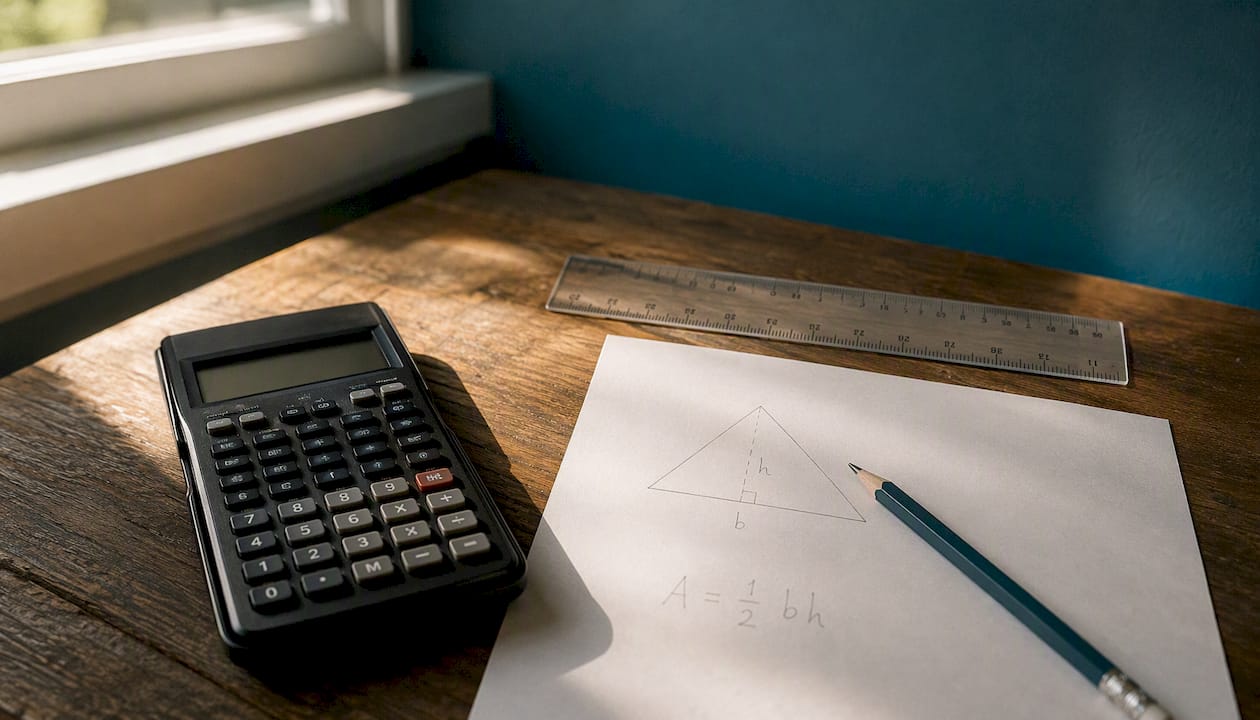
- Area of a triangle: A = ½ × b × h
- Circumference of a circle: C = 2πr
- Area of a circle: A = πr²
- Volume of a rectangular prism: V = l × w × h
- Volume of a cylinder: V = πr²h
- Pythagorean theorem: a² + b² = c²
Algebra and percent formulas:
- Slope: m = (y₂ – y₁) / (x₂ – x₁)
- Percent of a number: Part = (Percent / 100) × Whole
- Percent change: ((New – Old) / Old) × 100
- Basic probability: P(event) = favorable outcomes / total outcomes
Statistics:
- Mean: sum of all values ÷ number of values
- Median: middle value when data is ordered
- Mode: most frequently occurring value
- Range: largest value – smallest value
Common unit conversions for the TEAS:
The geometry and percent formulas are the highest priority for memorization. Statistics definitions are quick to recall once you've drilled them a few times. The calculator handles arithmetic, but it can't set up the formula for you.
Worked practice problems with step-by-step solutions
Guides that show the full setup, not just the answer, are among the most effective tools for building accuracy on TEAS-style word problems. Here are eight representative problems.
1. Fraction operations A nurse administers 2/3 of a 450 mg dose. How many mg does the patient receive? Step 1: Multiply 2/3 × 450. Step 2: 2 × 450 = 900, then 900 ÷ 3 = 300 mg. Common trap: Dividing 450 by 3 first (150), then forgetting to multiply by 2. Efficiency tip: Always write the fraction multiplication before touching the calculator.
2. Percent word problem The original dose is 80 mg. What is the new dose? Step 2: Add to original: 80 + 12 = 92 mg. Common trap: Stopping at 12 mg and not adding it back to the original.
3. One-variable algebra
Step 2: Divide by 5: x = 4. Common trap: Subtracting 3 instead of adding it when moving it to the right side.
4. Unit conversion (dimensional analysis) Convert 3.5 liters to milliliters. Step 1: Recall 1 L = 1,000 mL. Step 2: 3.5 × 1,000 = 3,500 mL. Efficiency tip: Moving the decimal three places right is faster than multiplying on the calculator.
5. Ratio and proportion If 4 tablets contain 600 mg of a drug, how many mg are in 10 tablets? Step 1: Set up the proportion: 4/600 = 10/x. Step 3: x = 1,500 mg. Common trap: Setting up the proportion inverted (600/4 = x/10 also works, but students sometimes mix the positions).
6. Geometry (area) A rectangular room is 12 ft long and 9 ft wide. What is the area? Step 1: A = l × w = 12 × 9 = 108 sq ft. Efficiency tip: If the question asks for perimeter instead, it's 2(l + w) = 2(21) = 42 ft. Read the question word carefully.
7. Data interpretation (mean) Five patients weigh 140, 155, 162, 148, and 170 lbs. What is the mean weight? Step 1: Sum = 140 + 155 + 162 + 148 + 170 = 775. Step 2: 775 ÷ 5 = 155 lbs. Common trap: Forgetting to divide by the count of values, not the range.
8. Basic probability A bag has 4 green and 6 yellow marbles. What is the probability of drawing a green marble? Step 1: Total marbles = 10. Step 2: P(green) = 4/10 = 2/5 or 0.4. Common trap: Using 4/6 (green to yellow ratio) instead of 4/10 (green to total).
The single most common reason students miss TEAS math questions is a wrong setup, not a wrong calculation. Before you touch the calculator, write out what the question is actually asking and what formula or operation applies. That 10-second pause saves more points than any arithmetic shortcut.
Pro Tip: After working through each problem above, cover the solution and try it again from scratch 24 hours later. Spaced repetition on worked examples builds the pattern recognition you need under time pressure.
A practical 4-week TEAS math study plan
Study guides recommend 20–40 focused hours on math depending on your baseline, with at least several weeks of progressive practice before test day. This plan fits that range.

4-week schedule:
| Week | Focus | Daily Activity (20–40 min) |
|---|---|---|
| Week 1 | Diagnostic + fundamentals | Take a full diagnostic; drill fractions, decimals, and percents; start error log |
| Week 2 | Targeted topic drills | Work through algebra, ratios, and unit conversions; 30 questions per session |
| Week 3 | Timed sections + weak-area review | Two timed 57-minute math sections; review error log; re-drill flagged topics |
| Week 4 | Full-length timed practice + final review | Two full timed TEAS math sections; review all formula cards; light review only in final 48 hours |
Error log template (copy this into your notes):
- Date
- Topic (e.g., "percent change")
- What I did wrong (e.g., "forgot to add back to original")
- Correct setup
- Re-tested? (Yes/No)
Pacing advice: Weeks 1–2 are about building fluency, not speed. Don't time yourself on individual problems until Week 3. Rushing too early locks in sloppy habits. By Week 3, you should be hitting roughly 90 seconds per question on timed sets. If you're consistently over that, your error log will tell you which topics are eating your time.
Platforms like Nursingschoolpro's study center include real-time analytics that show exactly which topics you're missing most, which makes the Week 2 targeting step much faster than guessing from a generic checklist.
Where to find free TEAS 7 math practice resources
Free resources are genuinely useful for diagnostics and daily drills, especially early in your prep. The key is knowing what each one is good for.
- Free TEAS math practice tests (sites like BoostPrep): Good for timed practice sets with answer explanations. Use for daily drills in Weeks 1–2 and as a warm-up before timed sections.
- Open study guides (OpenExamPrep and similar): Useful for topic-by-topic review and worked examples. Best for Weeks 1–2 when you're building fundamentals.
- University and nursing school math resources: Some programs publish clinical math practice sets. These are especially useful because they frame problems in dosage and conversion contexts, which mirrors how math competency connects to patient safety in clinical training.
When to upgrade to paid prep: Free resources cover fundamentals well. Where they fall short is adaptive feedback and analytics. If you've done two weeks of free practice and your diagnostic score hasn't moved, that's the signal to switch to a platform with real-time progress tracking.
When evaluating paid materials, check publisher reputation. The BBB profile for test publishers like Mometrix is one way to check business standing and consumer reports before purchasing. Official ATI materials and reputable nursing-education platforms are generally the safer starting point.
How Nursingschoolpro helps you improve TEAS 7 math
Nursingschoolpro is built specifically for nursing students, and its TEAS prep maps directly to the ATI objectives.
Key features for TEAS math:
- Practice question bank organized by TEAS topic (Number & Algebra and Measurement & Data)
- Instant rationales explaining why each answer is correct or incorrect
- Adaptive feedback that adjusts difficulty based on your performance
- Real-time analytics showing your percent-correct by topic so you know exactly where to drill
- Downloadable formula sheets aligned to ATI's tested objectives
- Timed-section simulations that replicate the 57-minute math section format
Workflow that works:
- Take the Nursingschoolpro TEAS diagnostic to establish your baseline by topic
- Follow the platform's targeted drill sets for your two or three weakest areas
- Re-test weekly using the built-in analytics to confirm improvement and redirect effort
The clinical framing matters too. Nursingschoolpro's questions connect math to nursing contexts like dosage calculations and unit conversions, which mirrors how university programs now teach math alongside clinical skills to reinforce both retention and relevance. For a real example of how a unit-tracking error plays out in practice, the dosage calculation mistake article on the platform shows exactly the kind of setup error the TEAS tests for.
Pro Tip: Use Nursingschoolpro's analytics after every practice session, not just at the end of the week. A five-minute review of your topic breakdown right after a session, while the questions are fresh, is more useful than a long review session days later.
What most TEAS math prep gets wrong
Most students spend too much time on question volume and not enough time on error analysis. Doing 200 practice questions with no error log is less effective than doing 80 questions and reviewing every single miss in detail.
The other underrated issue is word problem translation. The TEAS rarely asks you to solve a naked equation. It gives you a scenario, and you have to extract the math. Students who practice translating sentences into expressions before they start calculating consistently outperform those who dive straight into computation.
It's about careless setup errors, unit mismatches, and running out of time on questions that should be fast. The dosage calculation rounding mistake is a perfect example of how a small setup error compounds into a wrong answer even when the arithmetic is right.
Targeted practice beats volume. Reviewing errors beats re-reading notes. And timed practice beats untimed drilling every time once you're past the fundamentals stage.
Try Nursingschoolpro's TEAS math practice free for 48 hours
Scoring well on TEAS 7 math comes down to knowing your weak spots and drilling them with feedback. Nursingschoolpro gives you exactly that: a question bank mapped to every TEAS math topic, instant rationales on every answer, and real-time analytics that tell you where your points are leaking.
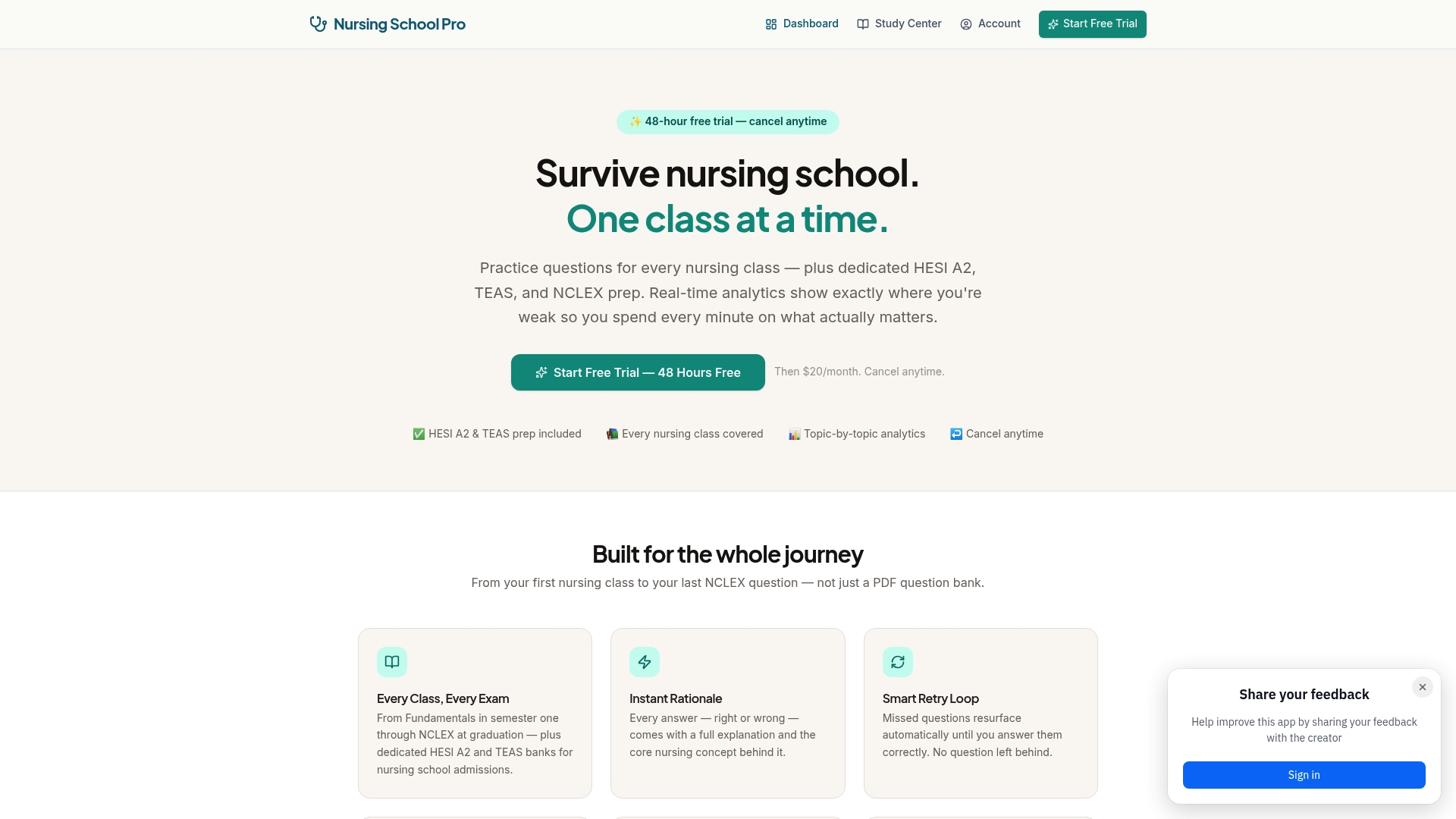
The 48-hour free trial includes full access to TEAS math practice sets, timed section simulations, and the analytics dashboard. No guessing about what to study next.
- Instant rationales on every question
- Analytics by topic so you drill what actually needs work
- Timed math simulations matching the 57-minute TEAS format
- Formula sheets aligned to ATI's tested objectives
Start your free trial at the Nursingschoolpro study center or check subscription pricing ($20/month after trial).
Sources
Bookmark these before you start studying.
- Patient-first math and nursing-faculty collaboration prioritizes patient safety and provider competency — SJU news
- Mometrix Media LLC BBB profile