
The TEAS 7 Science section delivers 50 questions in 60 minutes (44 scored) across four sub-areas: Anatomy & Physiology, Biology, Chemistry, and Scientific Reasoning. A&P carries the biggest share of points, so it deserves the biggest share of your prep time, but scientific reasoning questions are where well-prepared students still lose points to trick answers. Study A&P systems first, then drill reasoning skills with rationale-based practice, and you're studying the way score gains actually happen.
TL;DR:
- The most important content for the TEAS 7 science section is anatomy and physiology, which accounts for the largest portion of scored questions and exam weight.
- Students should focus on active, high-yield systems like cardiovascular, respiratory, nervous, digestive, endocrine, and musculoskeletal, practicing diagram redraws and flow tracing.
- Scientific reasoning questions, although fewer, are critical because they test experimental analysis skills that can significantly trip up well-prepared students.
- Practice should involve timed full-length exams, question banks with rationales, and tracking sub-area scores to identify persistent weaknesses, especially in chemistry.
- A four-week study plan prioritizes high-yield content, spaced repetition, and targeted drills, with a focus on understanding concepts rather than rote memorization alone.
Table of Contents
- What Is on the TEAS 7 Science Section?
- Which A&P Topics Show Up Most on the TEAS?
- What Biology, Chemistry, and Reasoning Topics Matter Most?
- How Do You Build a 4-Week TEAS Science Study Plan?
- What's the Best Way to Practice for TEAS Science?
- How Should You Pace Yourself on Test Day?
- Why the Usual TEAS Advice Misses What Actually Moves Scores
- Study TEAS 7 Science With Nursing School Pro
- Sources
What Is on the TEAS 7 Science Section?
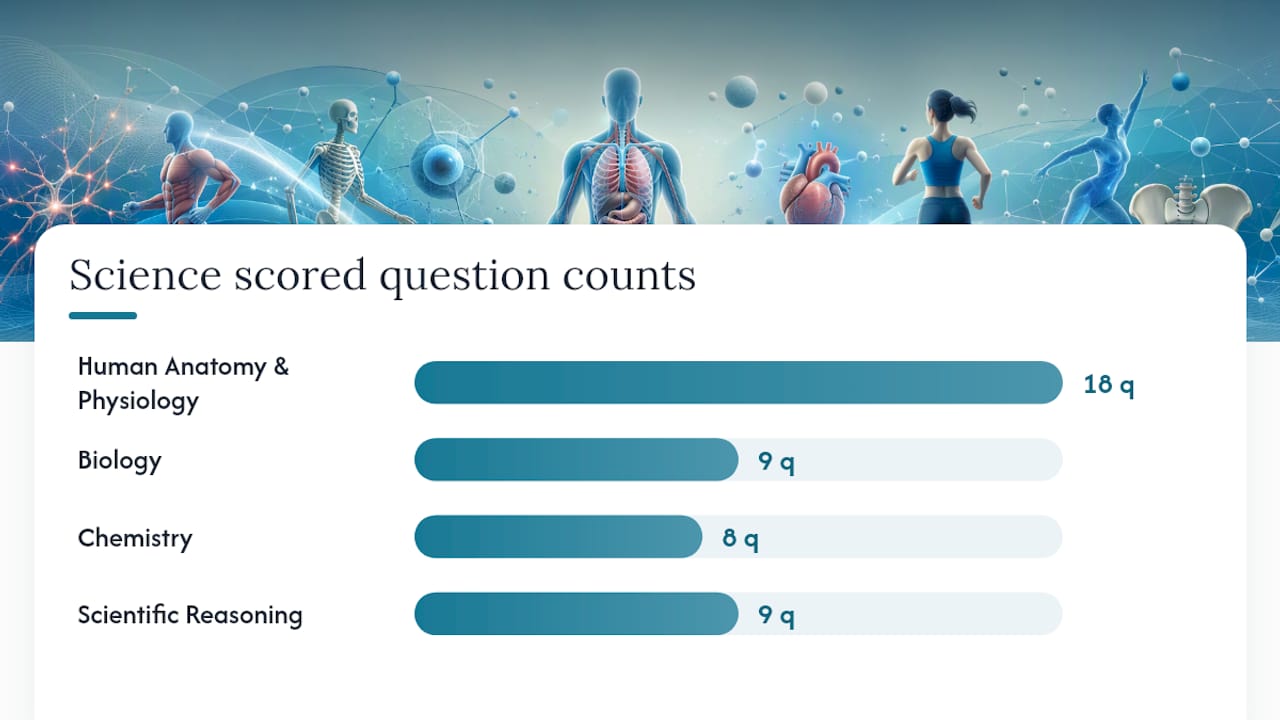
The Science section splits into four scored sub-areas, and knowing the exact weight of each one tells you where to spend your hours. ATI's own exam details list the breakdown as follows:
- Human Anatomy & Physiology: 18 scored questions
- Biology: 9 scored questions
- Chemistry: 8 scored questions
- Scientific Reasoning: 9 scored questions
That's 44 scored questions total, but you'll actually answer 50. The extra six are unscored pretest items ATI uses to evaluate future exam content, and you have no way to tell which ones they are, so every question deserves your full attention regardless of how it "feels."
Science alone makes up roughly 31% of your composite TEAS score, tying it for the most heavily weighted section on the whole exam. That single fact should change how you allocate study time. A student who spends equal hours on all four TEAS sections is under-investing in the one section with the highest return per hour studied.
Pacing matters too. Sixty minutes for 50 questions works out to about 72 seconds per question, though A&P recall items usually go faster than multi-step reasoning problems, so budget accordingly rather than pacing every question identically.
Which A&P Topics Show Up Most on the TEAS?
Not every body system gets equal airtime, though. Based on how the content distributes and how tutors report student weak spots, six systems dominate:
- Cardiovascular system — heart structure, blood flow pathways, blood pressure regulation, and the difference between systemic and pulmonary circulation.
- Respiratory system — gas exchange mechanics, lung volumes, and how breathing rate responds to blood pH.
- Nervous system — neuron structure, the central versus peripheral divide, and reflex arcs.
- Digestive system — the order organs process food in, plus the specific enzymes each organ releases.
- Musculoskeletal system — bone classifications, major muscle groups, and joint types.
- Endocrine system — key hormones, the glands that release them, and basic feedback loop logic.
Questions on these systems usually take one of three shapes: identifying a structure from a description, explaining a physiological process step by step, or applying basic pathophysiology to a symptom (why does low oxygen trigger faster breathing?).
The best way to lock these in is active, not passive. Redraw system diagrams from memory instead of just rereading labeled ones. Practice tracing a "flow" out loud, like blood moving from the right atrium to the lungs and back. Match common clinical signs to the system malfunctioning behind them, and build a few mnemonics for anything with a strict order, like digestive enzyme release.
Pro Tip: Set a timer for five minutes and hand-draw the cardiovascular system from scratch, no notes. Whatever you can't draw confidently is your next study target, not something to review "eventually."
What Biology, Chemistry, and Reasoning Topics Matter Most?
Biology and Chemistry combine for 17 scored questions, less than half of what A&P carries, so treat them as focused review rather than deep-dive subjects. Scientific Reasoning gets its own category because it tests a skill, not a body of facts, and that skill shows up buried inside questions from every other section too.
For Biology, prioritize:
- Cell structure and organelle function (mitochondria, ribosomes, nucleus)
- Mitosis versus meiosis, including why each process matters biologically
- Basic genetics: dominant and recessive traits, simple Punnett squares
- Macromolecules (carbohydrates, proteins, lipids, nucleic acids) and their roles
- Microorganism basics, especially how bacteria and viruses differ
For Chemistry, prioritize:
- Atomic structure: protons, neutrons, electrons, and how they determine element behavior
- Ionic versus covalent bonding
- The pH scale and what makes a substance acidic or basic
- Balancing simple chemical equations
- Concentration and dilution calculations, which show up more often than most students expect
Scientific Reasoning is where a lot of otherwise well-prepared students lose points, making it crucial to understand differences like CASPer vs PREview when preparing for pre-health assessments. These questions test whether you can identify the independent and dependent variables in an experiment, spot what a control group is actually controlling for, read a graph accurately without projecting assumptions onto it, and catch a flawed causal claim (correlation dressed up as causation). Practice this with short data-interpretation drills: give yourself a small graph or table, 90 seconds, and one question. Speed here comes from repetition, not memorization.
How Do You Build a 4-Week TEAS Science Study Plan?
A scattershot review of "everything" wastes hours you don't have. Tutors who work with TEAS students consistently see the biggest score jumps come from prioritizing high-yield A&P content and scientific reasoning over trying to memorize every possible fact. A four-week structure turns that principle into a daily routine:
- Week 1: Cardiovascular and respiratory A&P. These two systems interact constantly on the exam, so studying them together builds connections you'll actually be tested on.
- Week 2: Nervous, digestive, and endocrine systems. Denser material, so break sessions into 45-minute chunks by system rather than mixing all three in one sitting.
- Week 3: Biology and Chemistry fundamentals. Move fast through cell biology and atomic structure, then slow down on genetics and pH, which tend to trip students up most.
- Week 4: Mixed review, full-length timed practice tests, and targeted drilling on whatever your practice scores flag as weak.
Three study techniques make this plan actually work instead of just looking organized on paper. Chunking sessions by topic, one system per block, reduces the mental switching cost of jumping between cardiovascular structures and chemical bonding in the same hour. Spaced repetition means revisiting Week 1's cardiovascular content briefly during Week 3, not abandoning it once you've moved on. Active recall, testing yourself with flashcards that include full rationales rather than just rereading notes, builds the kind of retrieval speed the actual exam demands.
After every practice test, build a short revision checklist: identify your three weakest objectives, drill those specifically for a day or two, then retest only that material. This cycle, test, analyze, drill, retest, converts a static score into forward progress instead of just confirming what you already knew was weak.
What's the Best Way to Practice for TEAS Science?
Not all practice resources deliver the same return. The ones that move your score fastest share a specific structure:
- Topic-organized question banks with full rationales, so every wrong answer teaches you something instead of just marking you down.
- Timed, full-length practice tests that replicate real exam pressure and pacing.
- Flashcards for rapid-fire review of definitions, structures, and formulas you need cold.
- Printable cheat sheets for last-minute review the night before your test.
Running a mock exam well matters as much as the resource itself. Simulate real conditions: full 60 minutes, no phone, no pausing mid-section. Score it immediately and record your performance by sub-area, not just an overall percentage, since a 75% average can hide a 40% in Chemistry. Then go through every single rationale, including the ones you got right, since guessing correctly on a concept you don't understand is a trap waiting to resurface on test day.
Pro Tip: Track your sub-area scores across multiple practice tests in one place. A single low Chemistry score might be a fluke; three low Chemistry scores in a row is a pattern telling you exactly where to drill next.
How Should You Pace Yourself on Test Day?
Your prep only pays off if your pacing holds up under pressure. A few rules keep you from burning your 60 minutes on the wrong questions:
- Budget roughly 60 to 70 seconds for straightforward recall questions (structure identification, basic definitions).
- Give multi-step reasoning items (graph interpretation, experimental design) closer to 90 seconds, and flag them for review if you're still stuck.
- Never leave a question blank. If you're genuinely unsure, eliminate the two most obviously wrong answers first, then guess between what's left.
- Watch for distractor answers that sound almost right, over-read scenarios that add irrelevant detail, and causal claims that confuse correlation with cause.
- The morning of your test, skim your high-yield fact list one final time (major hormones, key enzymes, pH basics) rather than trying to learn anything new.
Why the Usual TEAS Advice Misses What Actually Moves Scores
Most TEAS advice treats Science like a vocabulary problem: memorize enough terms and the score follows. That's backwards. Science is 31% of your composite score specifically because it rewards applied understanding, not flashcard recall, and the students who plateau are usually the ones who can define "mitosis" but can't apply cell division logic to a graph-based question.
The conventional wisdom also underrates scientific reasoning. Students pour hours into memorizing A&P structures, which matters, but then lose easy points on reasoning questions they never practiced because reasoning "felt" less important than content. It isn't. It's tested inside almost every sub-area, quietly, and it's the fastest skill to improve with short, repeated drills.
What actually works is unglamorous: prioritize A&P because it's the largest score share, practice with rationales so every mistake teaches you something specific, and use analytics to stop guessing at what to study next. That's not a hack. It's just where the math of question weighting and score gains actually points.
— Autumn
Study TEAS 7 Science With Nursing School Pro
Nursing School Pro turns the study plan above into a daily routine instead of a wish list. Every practice question comes with an instant rationale, so you learn why an answer is right or wrong the moment you miss it, not three days later when you've forgotten the context.
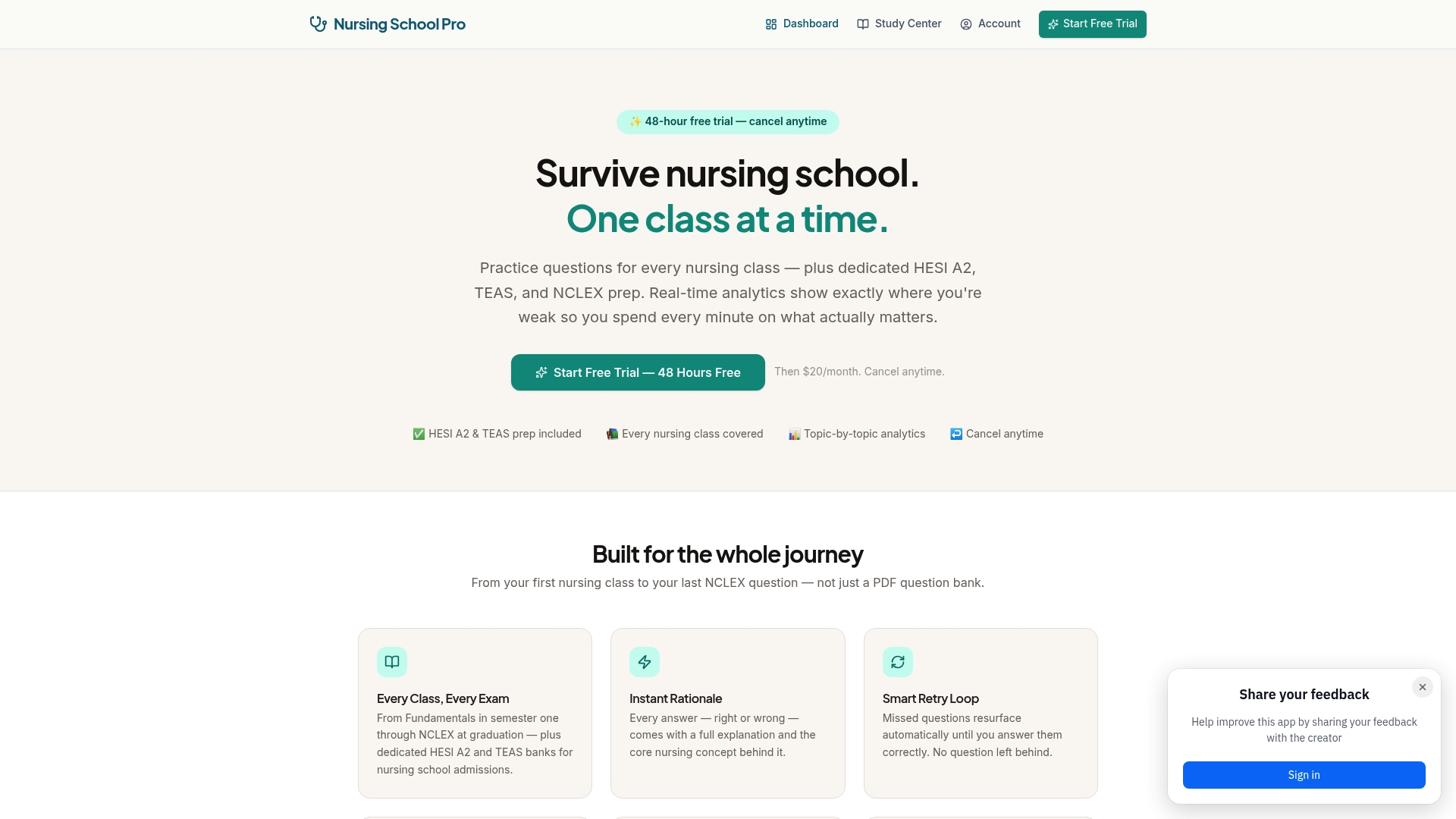
The platform's study center organizes practice by sub-area (A&P, Biology, Chemistry, Scientific Reasoning), so you can drill cardiovascular questions in Week 1 and jump straight to Chemistry fundamentals in Week 3 without hunting for relevant material. Real-time analytics track your sub-area scores across every practice session, flagging your three weakest objectives automatically instead of leaving you to guess where to focus next. Downloadable cheat sheets and a ready-made 4-week plan map directly onto the schedule outlined above.
Access starts with a 48-hour free trial, then continues at $20 a month if you want to keep going through test day. Start Week 1 with cardiovascular and respiratory A&P, let the analytics guide Weeks 2 through 4, and walk into your exam having already seen the patterns it's built to test.