
A nursing study plan is a topic-by-topic schedule paired with daily practice questions, built around what you actually get wrong. Start this week with three moves: take a diagnostic to find your weak spots, block out a daily question count you can sustain, and set a spaced-review calendar so nothing you learn on Monday evaporates by Friday. Tools like Nursing School Pro map directly onto that structure, since they pair every question with an instant rationale.
TL;DR:
- Focus on deep review of your weakest topics in the middle weeks, increasing question volume and adding timed sections as the exam nears.
- Practice 75 to 200 questions daily, adjusting for your stage, with an emphasis on timed mock exams in the final weeks to build pacing and stamina.
- Use active recall and spaced retrieval techniques, re-testing missed questions at 48 hours and one week to reinforce memory and clinical reasoning.
- Track accuracy, answer timing, and weak-topic frequency weekly to dynamically reassign study efforts and improve weak areas faster.
- Scale back study intensity if accuracy declines, sleep suffers, or anxiety spikes, prioritizing rest and micro-review over pushing through fixed schedules.
Table of Contents
- Building Your Personalized Nursing Study Plan: 6-Week and 12-Week Templates
- How Many Practice Questions Should You Do Each Day?
- Adapting Your Timeline for HESI A2, TEAS, and NCLEX
- Why Active Recall Beats Rereading Your Notes
- Turning Analytics Into a Smarter Study Schedule
- When to Scale Back Your Study Plan
- A Six-Week Test Run
- Try Nursing School Pro's Study Center for Your Exam Prep
- Sources
Building Your Personalized Nursing Study Plan: 6-Week and 12-Week Templates
Every nursing study plan starts with a map of what you're actually being tested on. Pull the content outline for your course exam, HESI A2, TEAS, or NCLEX, and sort it into weekly blocks by weight, not by whatever chapter comes next in the textbook. A structured week-by-week approach covering diagnostic testing, content review, and full practice tests works better than plowing through material in the order it was assigned.
Here's a 6-week frame you can adapt to almost any nursing exam:
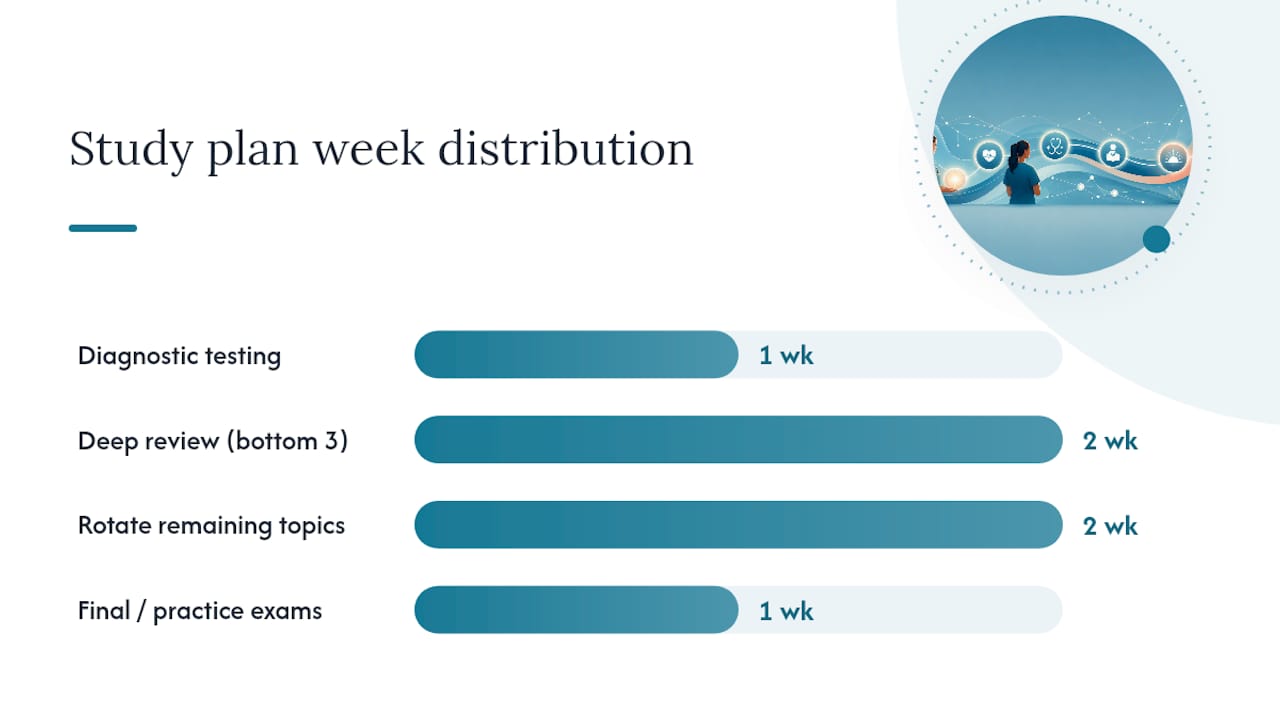
- Week 1: Diagnostic test, then rank topics from weakest to strongest.
- Weeks 2 to 3: Deep review of your bottom three content areas, 60 to 80 questions daily with full rationale review.
- Weeks 4 to 5: Rotate through remaining topics, increase question volume, add one timed section per week.
- Week 6: Two full-length timed practice exams, final review of missed-question patterns only.
Stretch that same skeleton to 12 weeks by giving each weak topic its own dedicated week instead of grouping three at once, and by adding a second diagnostic at the six-week mark to check whether your rankings have shifted. A six-week runway is a practical minimum for most students prepping for the HESI A2, and 12 weeks gives you room if you're balancing clinicals or working.
Set one SMART goal per session, not per week.
How Many Practice Questions Should You Do Each Day?
Question volume should climb as your exam date gets closer, not stay flat the whole way through. Early on, you're building foundational recall. Close to test day, you're building speed and stamina under pressure.
- Beginner stage (first third of your plan): 40 to 60 questions daily, untimed, with full rationale review after each set.
- Intermediate stage (middle third): 75 to 120 questions daily, mixing timed blocks with rationale review.
- Final month before the exam: 150 to 200 questions daily, most of them timed, with weekly full-length simulations.
Many candidates who pass the NCLEX on their first attempt report completing hundreds of practice questions and studying 3 to 5 hours a day during peak preparation, so the final-month numbers above aren't outliers. They're closer to the norm.
Structure each session the same way regardless of stage: five minutes of warm-up review on yesterday's missed questions, 30 to 40 minutes of focused content study on today's target topic, a timed question block, then rationale review on everything you got wrong. That order matters. Reviewing rationales cold, before you've engaged with the content, wastes the exercise.
For pacing on long question blocks, a 25-minute Pomodoro with a five-minute break holds attention better than a two-hour marathon session. If you're prepping for the NCLEX specifically, our NCLEX study schedule breaks this pacing down by week.
Pro Tip: Track how long each question actually takes you, not just whether you got it right. A 90-second average on pharmacology questions when the exam gives you 80 seconds per item is a pacing problem, not a knowledge problem, and it needs a different fix.
Adapting Your Timeline for HESI A2, TEAS, and NCLEX
The three exams reward different priorities, so a copy-paste plan across all of them wastes study hours. HESI A2 leans heavily on math, reading comprehension, and vocabulary alongside science content. TEAS weights science and reading more evenly with math and English. NCLEX tests clinical judgment and prioritization far more than recall.
Pick a timeline based on how much runway you have:
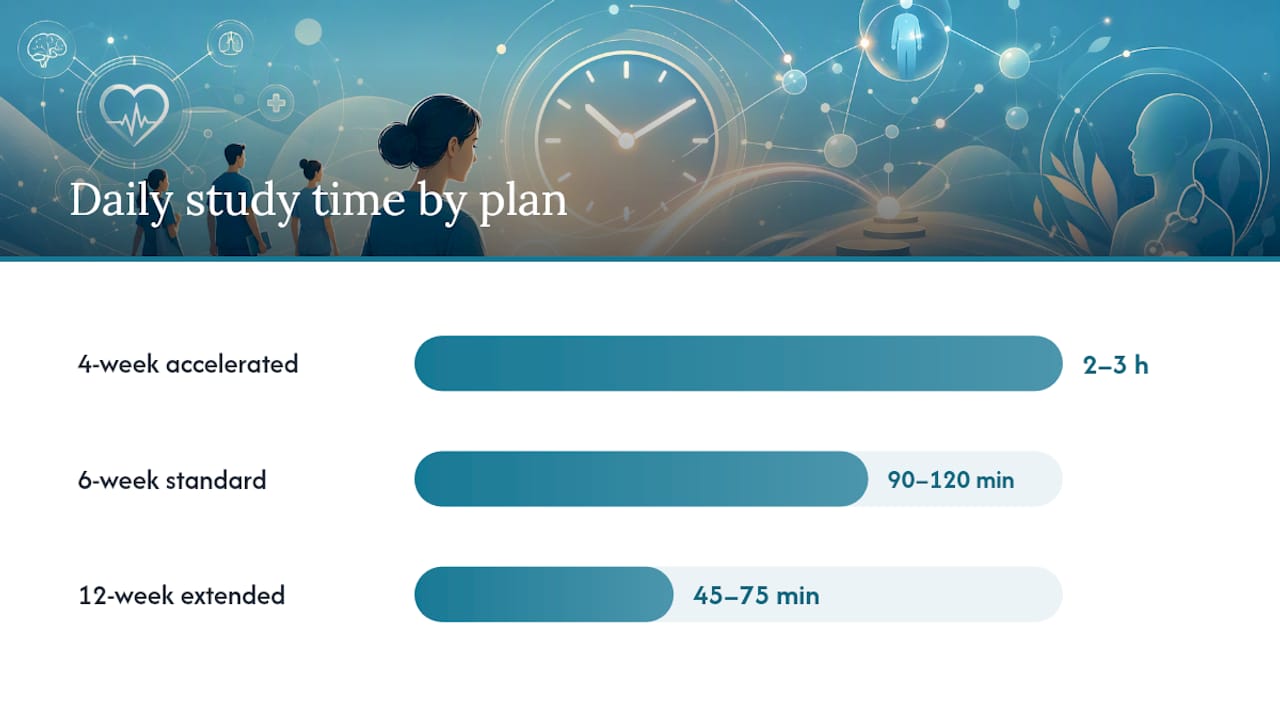
- 4-week accelerated plan: 2 to 3 hours daily, one topic block per day, no rest days, best only if you're already comfortable with most content and just need targeted review.
- 6-week standard plan: 90 minutes to 2 hours daily, weekends lighter, one full-length timed mock every week starting week 4.
- 12-week extended plan: 45 to 75 minutes daily on weekdays, deeper content review early, timed mocks starting week 8, one rest day weekly built in from the start.
Whichever timeline you choose, the final week should taper, not intensify. Cut daily question volume by roughly a third and spend that reclaimed time reviewing your error log instead of grinding new material. Timed practice under real exam conditions builds the pacing and stamina long exams like the NCLEX demand, so don't skip the mocks even when you're short on weeks. Our NCLEX test strategies guide covers pacing specifics for that exam.
Why Active Recall Beats Rereading Your Notes
Passive review, rereading notes, highlighting textbooks, watching lecture recordings on loop, feels productive but doesn't stick. Active recall and spaced retrieval outperform passive review for both retention and application, which is exactly what nursing exams test.
Spaced retrieval means testing yourself on material at increasing intervals, once today, again in two days, again in a week, rather than cramming it once and moving on. Active recall means answering a question from memory before you check the answer, rather than reading the answer first and nodding along.
Here's how to convert that research into daily practice:
- After every missed question, ask which safety-first framework applies: ABCs, the nursing process, or Maslow's hierarchy.
- Turn each rationale into a one-line takeaway you'd actually say at a patient's bedside.
- Re-test missed questions at 48 hours, then again at one week.
- Build case-based sets around a single body system to practice clinical reasoning, not just fact recall.
Applying safety-first frameworks when you're stuck on a clinical question, asking which answer protects the patient first, consistently narrows down the right choice faster than trying to recall a fact you might not remember under pressure. Our guide on NCLEX case study examples walks through this framework against real question formats.
Turning Analytics Into a Smarter Study Schedule
A study plan that never adjusts is just a schedule you're hoping works. The loop that actually improves your score looks like this: diagnostic identifies weak topics, you study those topics with daily question blocks, then you check your analytics and reassign time based on what's still weak.
Three numbers matter more than the rest:
- Accuracy by topic, tracked weekly, tells you which content areas need more time right now.
- Time-to-answer trends flag pacing problems before they show up as a low score on test day.
- Weakest-topic frequency across multiple practice sets tells you whether a topic is actually improving or just looked better on one lucky day.
Reading the instant rationale attached to every question, right or wrong, is what makes this loop fast instead of slow. A platform like Nursing School Pro surfaces that rationale immediately and logs the accuracy and timing data automatically, so you're not manually tracking spreadsheets between study sessions. Reassign your weakest two topics to focused review each week rather than trying to fix everything at once. Our breakdown on reading NCLEX rationales goes deeper on this specific habit.
When to Scale Back Your Study Plan
Declining accuracy on questions you used to get right, chronic sleep loss, or a spike in test anxiety are signs your plan needs adjusting, not signs you need to push harder. Sleep consolidates memory, and sacrificing it for extra study hours usually backfires by week two.
Quick fixes that work without abandoning the plan:
- Cut session length by a third and lower your daily question count for a few days.
- Replace broad review with a micro-review focused only on your last 20 missed questions.
- Add one full rest day if you haven't taken one in over a week.
Pro Tip: If accuracy stays flat for more than two weeks despite adjustments, that's the signal to bring in outside help, a faculty advisor, tutor, or structured review course, rather than another week of solo grinding.
A Six-Week Test Run
If I were starting from zero, week one would be a diagnostic, 40 to 60 questions daily, and blocks scheduled into my calendar like appointments I can't skip. Nothing fancy, just consistency. At week six, I'd stop and actually look at the analytics: which two topics are still dragging down accuracy, and reassign the next stretch of study time to just those.
Sleep isn't negotiable in this plan. Neither is honesty about how many hours you actually have. A realistic 90-minute daily plan you'll follow beats an ambitious three-hour plan you'll abandon by Thursday.
— Autumn
Try Nursing School Pro's Study Center for Your Exam Prep
Nursing School Pro gives you what a printed study guide can't: instant rationales on every question, so you know why an answer is right the moment you see it, plus real-time analytics that flag your weakest topics before you waste another week guessing where to focus.
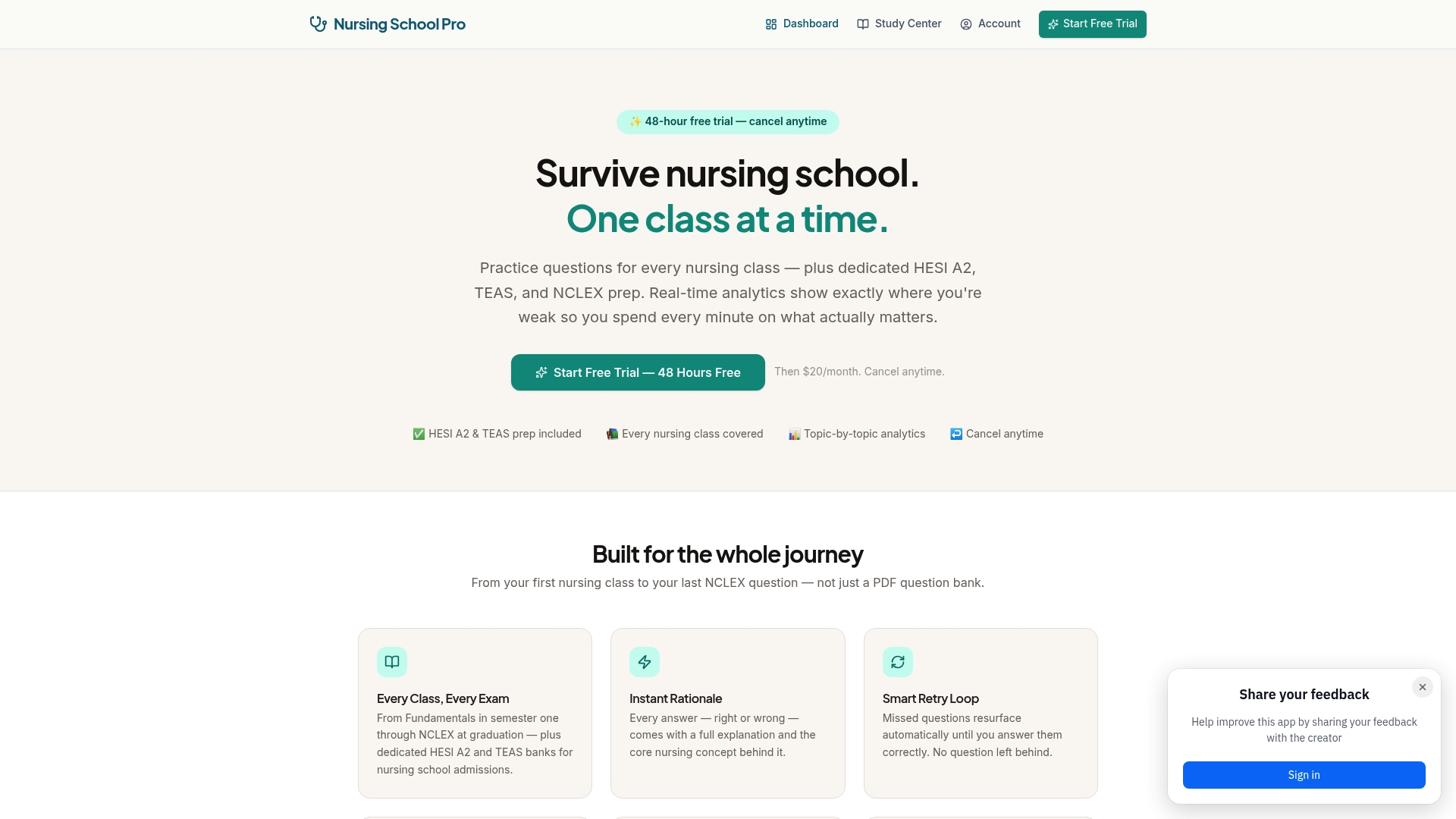
The question bank covers individual nursing classes as well as HESI A2, TEAS, and NCLEX prep, and the content aligns with the textbooks and national standards your program already uses. If you're building clinical judgment alongside exam prep, understanding how preceptorships fit into your training rounds out the practice-question work with real clinical context. Explore the study center for topic-specific resources, or head straight to pricing to see current subscription details. Start with the 48-hour free trial, run a diagnostic today, and let the analytics tell you exactly where week one of your plan should focus.
Sources
- HESI A2 studyplan (Western technical college guide)
- How to Study for Nursing Exams | University of Olivet