
Most BSN and ADN programs require Anatomy & Physiology I and II with labs, microbiology with lab, general or health-science chemistry with lab, statistics, English composition, and psychology or human growth and development. On top of that, you'll need current immunizations, a clean background check, and often a TEAS or HESI A2 score above a set minimum. Your first move isn't studying; instead, it’s important to understand how nursing admissions criteria vary by reviewing higher-education admission requirements in detail. It's pulling the exact prerequisite lists from three or four target programs and comparing them side by side, because "requirements" shifts more than most applicants expect.
TL;DR:
- Most programs require a GPA of at least 3.0, but competitive applicants often have prerequisite GPAs near 3.75 or higher.
- Entrance exam scores like the TEAS or HESI A2 typically need to be around 75% or above, with retakes limited to one or two attempts within a year.
- Prerequisite courses including anatomy, microbiology, and chemistry must usually be completed with labs before application, and transfer credit must be from regionally accredited schools.
- Clinical clearance requires immunizations, background checks, CPR certification, and drug screenings, which should be prepared for well in advance of program start dates.
- Admissions prioritize recent, high-scoring science courses and specific content mastery over overall GPA, making targeted course retakes and practice crucial for success.
Table of Contents
- Nursing School Requirements: The Core Prerequisite Courses
- Grades, GPA Cutoffs, and Repeat Policies That Actually Matter
- Entrance Exams: TEAS and HESI A2 Score Expectations
- Where to Take Prerequisites Without Wasting Time or Money
- Immunizations, Background Checks, and Other Clinical Clearance Items
- Building a Timeline That Doesn't Delay Your Start Date
- How Targeted Practice Closes the Gap Between Coursework and Test Day
- How Many Credit Hours Do You Actually Need?
- Do You Need Clinical or Volunteer Hours Before Applying?
- What Admissions Committees Look for in Recommendations and Essays
- The Physical and Technical Standards Nursing Programs Require
- What the Admissions Process Actually Rewards
- Sources
Nursing School Requirements: The Core Prerequisite Courses
Every nursing program builds around the same science backbone, but the exact packaging varies more than applicants realize. Some schools split Anatomy & Physiology into two separate courses; others run it as one dense year-long sequence. Some accept a single semester of general chemistry; others want a full year, or a course explicitly labeled "health science chemistry." Programs like the one at San José State list eight distinct prerequisites plus three corequisites, and expect the corequisites to be complete or in progress at the time you apply, not just planned for later.
The typical prerequisite lineup looks like this:
- Anatomy & Physiology I and II, each with a lab component
- Microbiology, with lab
- General or introductory chemistry, with lab (some programs accept "chemistry for health sciences" as a substitute)
- Statistics (usually a college-level intro stats course, not calculus)
- English composition (often two semesters)
- Psychology (general or developmental)
- Human growth and development (sometimes folded into psychology, sometimes standalone)
- Nutrition (required by some programs, optional at others)
- Speech or communication (required by a smaller subset of schools)
Course titles trip people up constantly. "Human Anatomy" and "Human Physiology" taught as two separate courses at one college might not satisfy a program that specifically wants "Anatomy & Physiology I & II" as a combined sequence, or vice versa. Betternurse confirms this core list holds across most programs, but lab requirements and exact sequencing rules differ enough that you can't assume equivalency without checking.
ADN programs at community colleges tend to ask for fewer prerequisites and are more flexible about course substitutions. BSN programs, especially at four-year universities, usually specify prerequisites more rigidly and add general education requirements tied to the broader degree. Accelerated BSN (ABSN) programs, built for students who already hold a bachelor's degree in another field, often compress the same science prerequisites into an intense one-year timeline. They rarely waive any of them. If anything, ABSN admissions committees scrutinize science grades even more closely because there's no room in the compressed curriculum to remediate a weak foundation.
Grades, GPA Cutoffs, and Repeat Policies That Actually Matter
A "C or better" is the baseline most programs will state outright. Getting in with C's, though, is a different story than getting in at all. Many BSN programs set a minimum cumulative and prerequisite GPA of 3.0, but that's the floor, not the bar competitive applicants clear. Fresno State's nursing admissions data shows historically admitted students averaging prerequisite GPAs closer to 3.75, well above the stated minimum.
Programs also calculate GPA in ways that catch applicants off guard:
- Overall GPA: every college course you've taken, prerequisite or not
- Prerequisite GPA: only the specific courses the program requires
- Science GPA: a narrower slice, usually A&P, microbiology, and chemistry, sometimes weighted more heavily than the rest
A strong science GPA can carry an application even when your overall GPA is unremarkable, because admissions committees increasingly treat spots as limited and lean on science grades as the sharpest predictor of who survives the curriculum.
Repeat policies vary in ways that can quietly sink an application. Some schools average every attempt at a course into your GPA. Others count only the first attempt, treating a retake as a red flag rather than a fix. San José State's admissions page notes this kind of first-attempt scrutiny directly, and it's worth confirming this policy before you decide to retake anything.
Pro Tip: If you're going to prioritize grade recovery anywhere, prioritize A&P and microbiology. These are the courses admissions committees weight most heavily, and a B or C in either one is more visible than a mediocre grade in an elective.
Entrance Exams: TEAS and HESI A2 Score Expectations
Nearly every ADN and BSN program requires either the TEAS or the HESI A2 as part of admission, and both test the same core areas: reading comprehension, math, science, and English language usage. Programs use these scores to standardize comparisons across applicants who took prerequisites at wildly different schools with wildly different grading standards.
Minimum scores are set by each individual program, and they're not uniform. Some CSU nursing programs require a TEAS score around 75%, while others set the bar lower or higher depending on how competitive their applicant pool is that cycle. Retake policies matter just as much as the score itself, since most schools limit you to one or two attempts within a rolling period, often six months to a year.
Timing the exam well means waiting until you've completed most of your science prerequisites, since the science section draws heavily on A&P and microbiology content, but leaving enough runway before your application deadline to retake it if the first score falls short. Dedicated question banks and practice exams tend to move scores meaningfully, mostly because they force you to practice pacing under timed conditions, not just review content you already half-know.
Where to Take Prerequisites Without Wasting Time or Money
Regional accreditation is the single detail that determines whether a prerequisite course will transfer cleanly. A biology class from an unaccredited or nationally accredited (but not regionally accredited) institution can look identical on a transcript and still get rejected outright by an admissions office.
- Check articulation agreements first. Many state college systems have formal agreements that guarantee specific community college courses transfer as direct equivalents to university prerequisites, which removes the guesswork entirely.
- Request a formal equivalency evaluation from your target program's admissions office before you register for a course, not after you've finished it.
- Confirm online course and lab policies separately. Programs often accept online lecture content but require in-person labs, and this restriction is not always obvious from a course catalog.
- Save every syllabus. Admissions offices sometimes need syllabi to verify course content matches their requirements, especially for transfer credits from out-of-state schools.
- Keep transcripts organized for NursingCAS. If your target programs use the centralized application system, having every transcript ready before you start the application saves weeks.
Betternurse.org confirms that community colleges and online providers are widely accepted for prerequisite coursework, but the equivalency check is not optional. Waiting until application season to sort this out is how students end up scrambling for a last-minute retake.
Immunizations, Background Checks, and Other Clinical Clearance Items
Clinical sites won't let you near a patient without documentation, and hospitals set these rules, not your nursing program. Start gathering records the moment you're accepted, since some immunizations take months to complete if you're starting from zero.
- Immunizations: Hepatitis B series, MMR, Varicella, Tdap, and an annual flu shot
- TB screening: usually required annually, sometimes twice a year depending on the clinical site
- CPR certification: BLS for Healthcare Providers specifically, not a general community CPR card
- Criminal background check: run through the program or a designated vendor, often required before clinical placement is finalized
- Drug screening: typically completed close to your clinical start date, not at initial acceptance
Nurse confirms this clearance list is close to universal across programs. Keep every record in one digital folder from day one. Clinical coordinators request this documentation repeatedly throughout the program, and re-tracking down a titer result from 18 months ago is a hassle you can avoid entirely.
Building a Timeline That Doesn't Delay Your Start Date
Most programs require prerequisites to be fully complete by matriculation, and competitive programs often want them done by the application deadline itself, not just "in progress." A few schools will accept one or two courses still in progress at the time you apply, but this varies enough that assuming leniency is risky.
- Map your target programs' exact lists side by side before registering for a single class.
- Sequence non-lab general education courses first (English, psychology, statistics) to build early momentum while you plan the heavier science load.
- Space out A&P I, A&P II, and microbiology across separate terms rather than stacking them together, since overloading these courses tends to hurt grades in exactly the classes that matter most.
- Schedule your entrance exam after most science prerequisites are done but early enough to retake it if your first score misses the cutoff.
Full-time students typically finish prerequisites in three to four semesters. Part-time or working students often need 12 to 24 months. Neither timeline is wrong. What matters is building yours around your target programs' actual deadlines, not a generic estimate.
How Targeted Practice Closes the Gap Between Coursework and Test Day
Getting through A&P, microbiology, and chemistry with strong grades is one challenge. Translating that knowledge into a passing TEAS or HESI A2 score is a different skill entirely, and it's where a lot of otherwise strong students stumble. Deliberate practice with immediate feedback on why an answer is right or wrong tends to close that gap faster than rereading textbook chapters.
Nursing School Pro's study center builds around that exact principle, with tools that matter directly to prerequisite and exam prep:
- Course-specific question banks covering A&P, microbiology, and other prerequisite subjects
- Dedicated TEAS and HESI A2 practice sets with instant rationale on every answer
- Real-time analytics that flag which content areas need more attention before test day
If you're weeks out from a science final or your entrance exam, working through targeted practice questions in the subject you're weakest in usually moves the needle faster than passive review.
How Many Credit Hours Do You Actually Need?
Total credit hour requirements depend heavily on which degree path you're pursuing, and this number surprises a lot of applicants who assume "prerequisites" means a short list of eight or nine classes. ADN programs typically require somewhere in the range of 20 to 30 prerequisite credit hours before you can even apply, on top of the technical coursework once you're admitted. BSN programs run higher, often 40 to 60 credit hours of general education and science prerequisites, since a bachelor's degree carries broader liberal arts requirements alongside the science backbone.
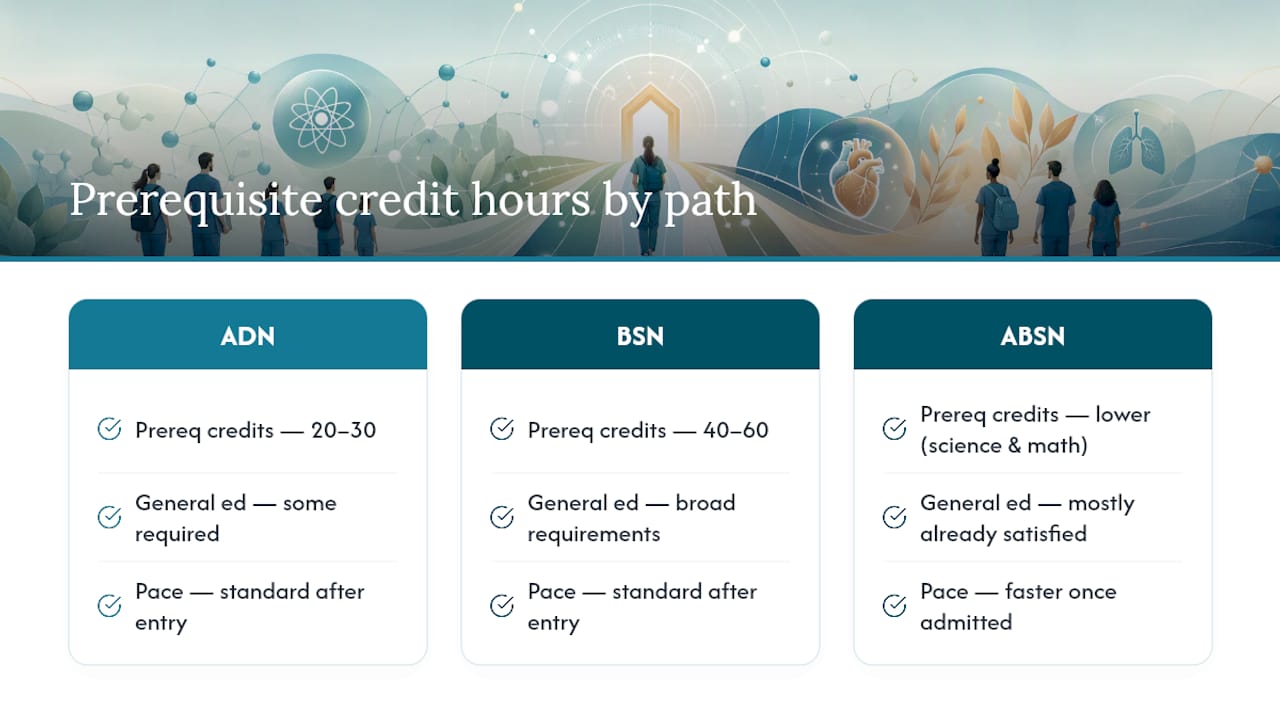
ABSN programs are the exception. Because applicants already hold a bachelor's degree, most of the general education requirement is already satisfied. What's left is almost entirely the science and math prerequisites, which keeps the credit hour count lower even though the pace of the program itself is faster once you're in.
Full BSN degree completion typically requires 120 to 130 total credit hours, prerequisites included. That total matters for financial aid purposes and for understanding how much of your degree is "prerequisite work" versus nursing-specific coursework you'll tackle after admission. Always check your target program's official credit hour breakdown rather than assuming a standard number, since state university systems and private institutions structure their general education requirements differently.
Do You Need Clinical or Volunteer Hours Before Applying?
Most ADN and traditional BSN programs don't require documented clinical or volunteer hours as a hard prerequisite, but that doesn't mean they're irrelevant. Competitive applicant pools mean admissions committees often use healthcare exposure as a tiebreaker, especially at programs that receive far more qualified applications than they have seats.
Shadowing a nurse, volunteering at a hospital or clinic, or working as a certified nursing assistant (CNA) all demonstrate the kind of firsthand exposure that strengthens an application, even when it's not formally required. Some accelerated and direct-entry BSN programs do require a minimum number of healthcare-related volunteer or work hours, so this is a detail worth confirming per program rather than assuming applies universally.
Once you're admitted, clinical hours become mandatory and are built directly into the curriculum. These aren't optional or extra. They're structured rotations through medical-surgical units, pediatrics, obstetrics, and other specialties, supervised by faculty and hospital staff, and they run parallel to your coursework rather than after it. The volunteer or shadowing hours you accumulate before admission are about proving readiness. The clinical hours after admission are about building competence.
What Admissions Committees Look for in Recommendations and Essays
Not every program requires letters of recommendation, but a meaningful number do, particularly BSN programs at four-year universities and competitive ABSN programs. When required, most ask for two to three letters, and the strongest ones come from people who can speak to your work ethic in an academic or clinical setting: a science professor who watched you work through difficult material, or a supervisor from healthcare-adjacent work or volunteering.
Generic letters from family friends or unrelated employers tend to carry little weight. If a program gives you the choice of who to ask, prioritize someone who taught you A&P or microbiology over someone who simply likes you.
Personal statements or admission essays follow a similar logic. Admissions committees read hundreds of these, and the ones that stand out avoid vague statements like "I've always wanted to help people" in favor of something specific: a moment that clarified your interest in nursing, a challenge you worked through in a prerequisite course, or a concrete reason you're drawn to a particular specialty or patient population. Specificity reads as sincerity. Vagueness reads as a template.
Check each program's exact essay prompt and word count well before your deadline. Some ask a single broad question; others ask two or three narrower ones, and reusing one generic essay across every application usually shows.
The Physical and Technical Standards Nursing Programs Require
Nursing programs generally publish a list of "technical standards" or "functional abilities" that go beyond grades and test scores, because clinical work makes physical and sensory demands that classroom learning doesn't. These standards typically cover the ability to lift and reposition patients, stand for extended shifts, perform CPR, distinguish colors accurately (important for reading lab results and skin changes), and hear normal speaking volume well enough to use a stethoscope effectively.
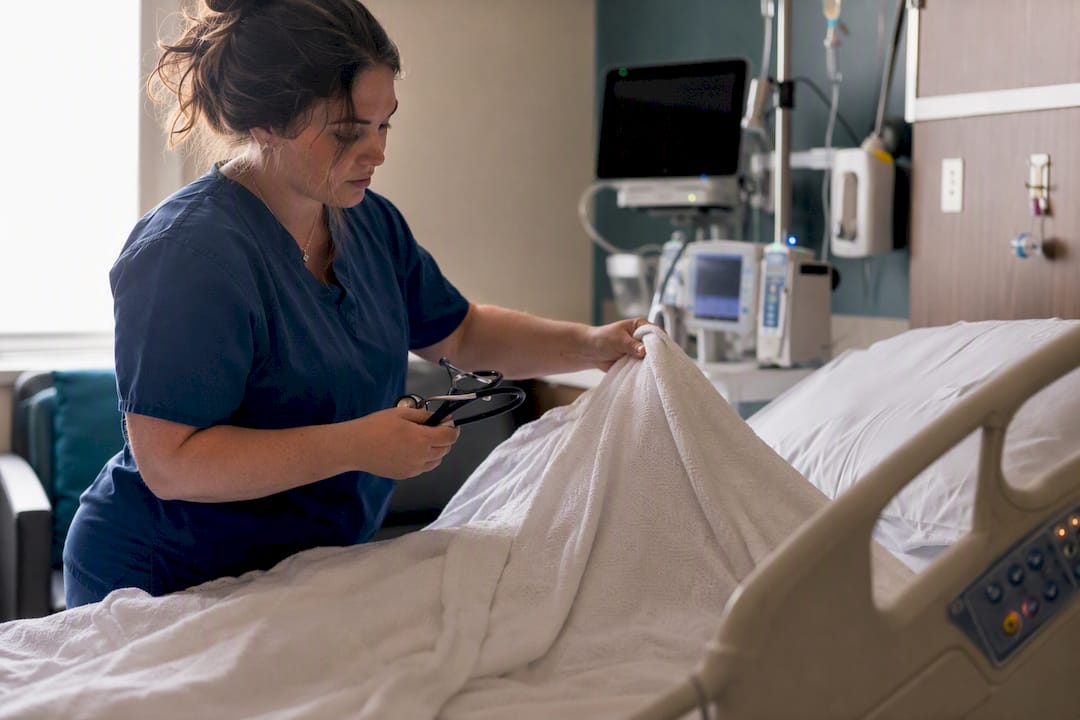
Programs frame these as functional requirements rather than rigid physical criteria, and most will work with students who need reasonable accommodations to meet them, consistent with disability accommodation laws. What they won't do is waive the underlying clinical demand. A student who can't safely lift or reposition a patient, even with an assistive device, may need to explore accommodation options directly with the program's disability services office before enrolling, not after clinicals begin.
Read your target program's technical standards document early. It's usually a page or two buried in the admissions section of a nursing school's website, easy to skip past, and it occasionally rules out students who assumed grades and test scores were the only bar to clear.
What the Admissions Process Actually Rewards
The conventional advice treats nursing school admission like a checklist: hit the GPA, pass the exam, submit the application. That's not wrong, but it misses what actually separates admitted applicants from waitlisted ones. Admissions committees are ranking exercises, not pass/fail gates, and the ranking leans hardest on science grades and recency, not overall GPA.
A 3.8 overall GPA padded with easy electives loses to a 3.4 GPA built on strong A&P, microbiology, and chemistry grades earned within the last few years. That's the part most applicants underweight. They chase a GPA number instead of protecting the handful of courses that committees actually scrutinize.
If you're building a plan, sequence backward from your weakest science subject. Give yourself room to retake it once if needed, understand your target programs' first-attempt policies before you register for anything twice, and treat your entrance exam score as a lever you control, not a fixed outcome. Nursing school admission rewards specificity: knowing your target programs' exact numbers and building toward them deliberately beats a generic plan built around what "most schools" supposedly want.
— Autumn
Sources
- BSN Admission Requirements - Nursing
- Fresno State nursing admissions - prerequisite GPA and TEAS requirement
- Betternurse
- Nurse