
The fastest, most reliable way to pass TEAS 7 is a timed baseline diagnostic followed by a structured 4 to 6 week plan built on high-volume mixed practice, full-length timed simulations, and a running error log. Book your test date six weeks out today, then sit for a full timed diagnostic this week under real test conditions. A tool like Nursing School Pro can map every stage of that plan to a specific study feature, so you're never guessing what to do next.
TL;DR:
- Taking a full-length timed diagnostic within 48 hours is essential to identify your two weakest sections before focusing your study efforts.
- Prioritize anatomy and physiology in science, as nearly 40% of the scored questions test this area, demanding targeted review and practice.
- Study time should be allocated based on section question speed: roughly 72 seconds per science question, 73 seconds for reading, 90 seconds for math, and 60 seconds for English.
- Complete three full simulations—baseline, mid-plan, and final—to accurately gauge readiness, while flagging questions that take longer than 90 seconds.
- Using structured tools like Nursing School Pro that provide analytics, targeted practice, and timed exams can streamline preparation and improve performance.
Table of Contents
- Your TEAS 7 Study Plan Checklist
- What's Actually on the TEAS 7 Exam?
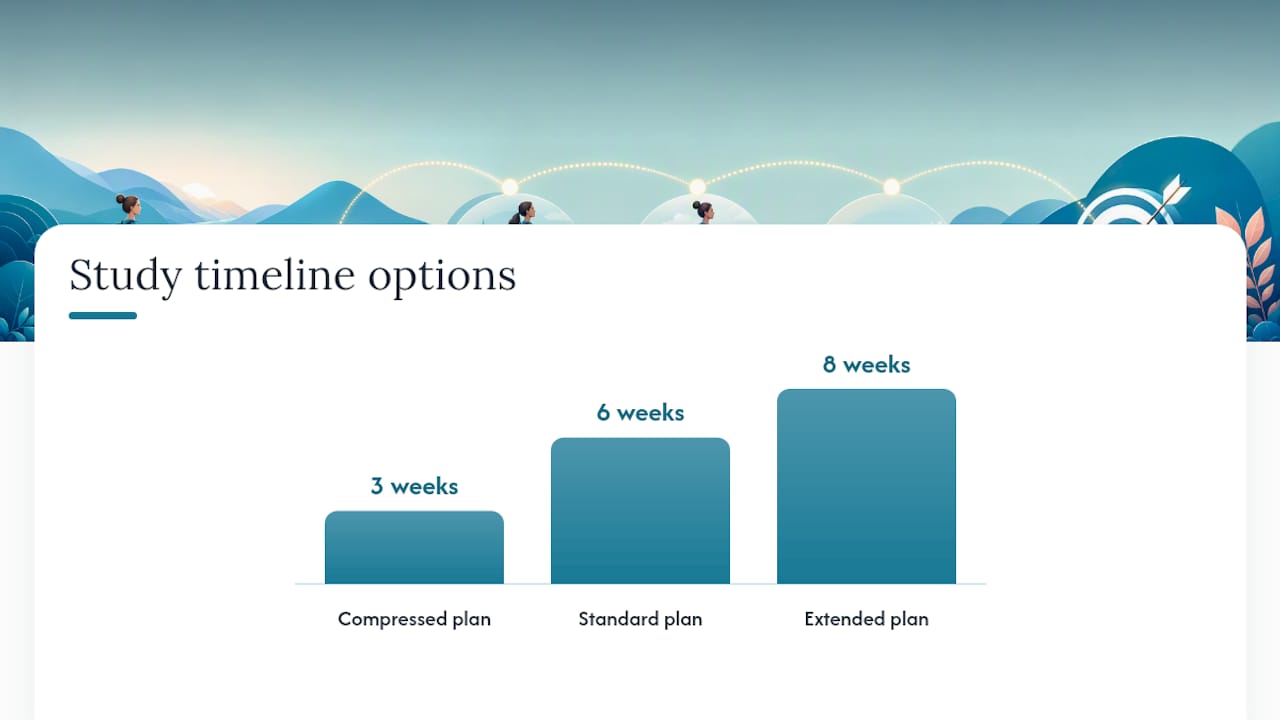
- The 6-Week TEAS 7 Study Plan (Plus Faster and Slower Options)
- How to Study for Each TEAS 7 Section
- How Many Practice Tests and Flashcards Do You Actually Need?
- Pacing Rules and Test-Day Logistics
- When Are You Actually Ready for Test Day?
- How Nursing School Pro Maps to This Exact Plan
- What I Wish More Students Understood About TEAS Prep
- Start Your 6-Week TEAS 7 Plan Today
- Sources
Your TEAS 7 Study Plan Checklist
Before you dig into strategy, here's the skeleton you can act on today, even before finishing this article.
- Book your test date now, ideally six weeks from today, and block 1 to 3 hours daily on your calendar.
- Take a full-length timed diagnostic within 48 hours to expose your two weakest sections before you waste time studying blind.
- Build a weakness map from that diagnostic: rank all four sections from worst to best.
- Run a daily 25/10 rhythm: 25 minutes of focused study on one topic, then 10 minutes of closed-book retrieval where you write everything you remember with no notes. This active recall approach outperforms passive rereading in nearly every controlled comparison.
- Set weekly targets, not vague intentions. Something like "200 practice questions and one A&P review session" per week is trackable; "study more science" is not.
- Schedule three simulations: one baseline (already done), one mid-plan around week 3 or 4, and a final one in week 6.
- Taper hard in the last week. Stop learning brand-new material and shift entirely to error-log repair and light review.
If six weeks feels too long, compress the content sweep and lean harder on question volume. If you have eight weeks because your anatomy and chemistry coursework is a year or two old, use the extra time for a slower first pass through science content before ramping up simulations.
What's Actually on the TEAS 7 Exam?
The ATI TEAS 7 delivers a total number of questions within a little over 200 minutes, but only a portion count toward your score. Some questions are unscored pretest items ATI uses to evaluate future exam questions, and you won't know which they are, so treat every question as if it matters.
Here's how those questions and minutes break down across the four sections, based on official TEAS test information:
| Section | Delivered Questions | Time Allotted |
|---|---|---|
| Reading | 50 | 60 minutes |
| Mathematics | 50 | 60 minutes |
| Science | 50 | 60 minutes |
| English & Language Usage | 37 | 37 minutes |
Each section runs on its own independent timer. Once you submit Math, you cannot go back to it after starting Science, and the clock for each section starts fresh when you begin it. There's one built-in break, ten minutes long, that falls immediately after the Math section, which matters more for your pacing strategy than most students realize.
Notice that Science packs 50 questions into 60 minutes, the tightest ratio on the exam, while English gives you almost exactly a minute per question with no cushion at all. That single fact should shape how you allocate study time over the next six weeks. Testing fees in the U.S. typically run $70 to $115 depending on your school and whether you test in person or through remote proctoring, so factor that into your budget before you schedule a retake you might not need.
Most nursing programs use TEAS composite and section scores as an admissions filter, which is exactly why a scattershot study approach costs you more than the exam fee. It costs you a semester.
The 6-Week TEAS 7 Study Plan (Plus Faster and Slower Options)
A structured plan beats an unstructured one, full stop. Research on TEAS preparation consistently points to a seven-step sequence: learn the exam structure, run a baseline diagnostic, identify weaknesses, review those weak areas directly, grind practice questions, retest, and finish with full-length timed simulations. Here's how that sequence fills six weeks.
-
Day 1: Baseline diagnostic. Sit for a full-length, timed practice exam under real conditions, no phone, no notes, no pausing. This single data point tells you more than a week of unfocused studying. Score each section separately and rank them worst to best.
-
Weeks 1 to 2: Content sweep on your two weakest sections. If Science and Math are your soft spots, that's where 60% of your study time goes for these two weeks. Work in 25-minute focused blocks followed by 10 minutes of closed-book retrieval, writing down everything you remember before checking your notes. If you can't write it, you haven't learned it yet, no matter how many times you've reread the chapter.
-
Weeks 3 to 4: Ramp up volume and mix sections. Stop studying Science in isolation and Math in isolation. Start alternating within single sessions, because the real exam forces you to switch cognitive gears every 37 to 60 minutes, and your brain needs practice making that switch cleanly. Increase your daily question count and start timing individual question sets, not just full sections.
-
Weeks 5 to 6: Full simulations, pacing drills, and taper. Run your mid-plan simulation at the start of week 5, then a final simulation at the start of week 6. Between simulations, drill pacing specifically: give yourself the exact per-question time budget you'll face on test day and practice cutting yourself off. In the final three to four days, stop introducing new material entirely. Review your error log, redo your weakest question categories, and get sleep.
Pro Tip: Keep a single running error log from day one, not a separate notebook per section. When you review it in week 6, you want to see patterns across all four sections at once, like discovering that half your missed questions involve unit conversions, whether they showed up in Math or Science.
If you only have three weeks, compress weeks 1 through 4 into a single ten-day content sweep focused exclusively on your two weakest sections, skip straight to mixed practice, and run two simulations instead of three. You'll cover less ground, but concentrated effort on your actual weak points beats a diluted review of everything.
If you have eight weeks, most likely because your anatomy, physiology, or chemistry coursework is more than a year old, stretch the content sweep to three full weeks instead of two. A 6-week plan at 10 to 12 hours per week tends to be the sweet spot for students who recently finished related coursework, but there's no penalty for giving your brain more runway when the foundational material feels rusty.
Whatever timeline you choose, the daily hour count matters more than the calendar length. Research on TEAS preparation points to 4 to 8 weeks at 1 to 3 hours per day as the effective range. Cramming six weeks of material into four frantic days the week before your test does not work the same way, no matter how many hours you try to stack into those days.
How to Study for Each TEAS 7 Section
Generic advice like "review more" doesn't help you when you're staring at a countdown timer. Here's what actually moves the needle in each section.
Reading
Read the question stem before the passage, every single time. This tells you exactly what to hunt for instead of absorbing the whole passage and hoping the answer surfaces. Practice with mixed passage types, not just narrative text, since TEAS Reading includes informational passages, paired passages, and graphic or chart-based items that test different skills entirely. Master the four core question types: main idea, inference, detail recall, and vocabulary in context. Graphic literacy items, reading a table or chart under time pressure, trip up more students than the actual prose passages do, so don't skip practicing those.
Math
Practice fraction-to-decimal and percentage conversions by hand until they're automatic, because the on-screen calculator provided during the test is a basic four-function tool with no memory functions and no shortcuts. If your practice sessions rely on a scientific calculator, you're training for a tool you won't have on test day. Memorize your core formula set: dosage calculations, basic algebra manipulation, ratio and proportion setups, and metric conversions. A single missed unit conversion can cascade into three wrong answers if you don't catch it early, which is exactly the kind of mistake a detailed error log tends to catch before it becomes a pattern.
Science
This is where targeted effort pays off fastest. Roughly 18 of the 50 scored Science questions test anatomy and physiology specifically, which means A&P is the single highest-yield content area on the entire exam. Focus your flashcard time here before spreading effort across chemistry, biology, and scientific reasoning. Practice one high-yield fact per body system rather than trying to memorize entire textbook chapters, and drill chart and graphic interpretation daily, since Science moves at roughly 72 seconds per question, the fastest pace of any section on the exam.
Nearly 40% of the scored Science section is anatomy and physiology content alone, based on the current TEAS 7 blueprint. That single fact should reorder your entire study priority list if it hasn't already.
English & Language Usage
This section rewards rule mastery over content knowledge, which makes it perfect for flashcard drilling. Build cloze-style cards for subject-verb agreement, pronoun agreement, and punctuation rules, then run them daily in short five-minute bursts rather than one long weekly session. Vocabulary questions frequently test word roots and affixes, so learning common prefixes like "hyper" or "brady" pays off across both English and Science sections simultaneously. Nurse are built around exactly this kind of high-frequency, spaced repetition approach.

However you structure individual sessions, mix sections within a single study block once you're past the initial content sweep. TEAS forces you to pivot from grammar rules to chemical reactions to reading inference in the span of an hour, and switching stamina is a skill you build through practice, not something that shows up automatically on test day.
How Many Practice Tests and Flashcards Do You Actually Need?
More isn't always better here, but structure matters enormously. Here's a practical framework for how much practice is enough.
- Simulations: one baseline diagnostic on day one, one mid-plan simulation around week 3 or 4, and two to four final simulations in weeks 5 and 6 depending on how much time remains before test day.
- Error log entries: log every missed question with a one-line repair note, something like "forgot to convert mL to L before dividing," not just the correct answer. The note is what prevents you from repeating the same mistake three weeks later.
- Flashcard sessions: daily, five to ten minutes each, split across English grammar rules, unit conversions, and A&P facts. Short and frequent beats long and occasional every time.
- Question volume: aim for a steady climb from roughly 20 to 30 questions per day in weeks 1 and 2 up to 75 to 100 per day by weeks 5 and 6, mixed across sections.
When you're evaluating any prep platform, whether that's a free flashcard site or a paid question bank, look for four specific things: instant answer rationales that explain why an answer is correct, not just what the answer is; analytics that flag your weak categories automatically instead of making you track them by hand; a question bank large enough that you're not seeing repeats by week 4; and content that maps to actual TEAS 7 blueprint categories rather than generic test-prep material. This partner guide on study strategies covers additional angles on mixing active learning techniques if you want a second perspective on building your practice routine.
Pacing Rules and Test-Day Logistics
Here's your per-question time budget, rounded for easy mental math during practice: Science at roughly 72 seconds per question, Reading around 73 seconds, Math closer to 90 seconds given its calculation load, and English at about 60 seconds. Practice against these numbers specifically, not just against the section clock, so you build an internal sense of when you're falling behind.
- Cap any single question at 90 seconds. If you're still stuck, flag it and move on. You can always return if time allows, but a stalled question early in a section can cost you three or four questions you'd have answered easily later.
- Use the flag feature aggressively, not just for genuinely hard questions but for anything that makes you hesitate for more than a few seconds.
- Plan your 10-minute break after the Math section around hydration and a restroom trip, not around reviewing notes. This is not study time. Studying during your one break tends to spike anxiety rather than reduce it.
- Arrive 30 minutes early with valid photo ID, since check-in procedures at some testing centers include locker storage and biometric verification that eat into your buffer time if you show up right at your appointment slot.
- Stop learning new content 48 hours before test day. Shift entirely to error-log review and light, confidence-building repetition of material you already know well.
Pro Tip: If your practice simulations consistently run you 5 to 10 minutes over on Science, that's not a sign you need more content review. It's a sign you need more timed drilling specifically on pacing, which is a different problem with a different fix.
When Are You Actually Ready for Test Day?
The clearest readiness signal isn't a gut feeling, it's consistency. If your last two or three full-length simulations land within a few points of each other and above your program's minimum score requirement, you're genuinely ready. A single great simulation surrounded by weaker ones usually means you got lucky on question selection, not that you've mastered the material.
If you fall short, most testing centers apply a cooldown period of around 30 days before a retake, so use that window deliberately. Run a fresh diagnostic rather than assuming your weak areas are the same ones from six weeks ago; scores often shift in ways that surprise students. Retake fees add up fast, generally in that same $70 to $115 range per attempt, which makes thorough first-attempt preparation far cheaper than repeated retakes. If your fresh diagnostic shows the same two sections struggling, rebuild those from the ground up rather than lightly reviewing material that clearly didn't stick the first time.
How Nursing School Pro Maps to This Exact Plan
Every stage of the plan above corresponds to a specific tool, not a vague suggestion to "study harder." The Nursing School Pro study center opens with a timed baseline diagnostic that mirrors real TEAS 7 section timing, so your day-one numbers reflect actual test conditions instead of an untimed guess.
From there, real-time analytics flag your two weakest sections automatically, replacing the manual weakness map most students try to build in a spreadsheet. The question bank is organized by TEAS 7 blueprint category, which means when you need targeted anatomy and physiology drilling for that high-yield Science content, you're not sifting through unrelated material to find it. Sample content like this nursing assessment breakdown shows the level of specificity built into the A&P-focused practice sets.
Every question comes with an instant rationale explaining why the correct answer is correct and why the others aren't, which is exactly the kind of feedback that turns a missed question into a fixed knowledge gap instead of a repeated mistake in week 5. When you reach the simulation stage, full-length timed practice exams replicate the section-by-section structure and mandatory break, so your final week of prep happens under conditions that match test day as closely as possible.
What I Wish More Students Understood About TEAS Prep
The biggest mistake I see isn't lack of effort. It's mistaking rereading for studying. Highlighting a textbook chapter for the third time feels productive, but it builds recognition, not recall, and TEAS tests recall under time pressure. Students who switch to closed-book retrieval, even reluctantly at first, tend to see faster score movement than students who log more total study hours doing passive review.
Expect gradual improvement, not a dramatic jump. Most students see their biggest gains in weeks 2 through 4, once the content sweep gives way to mixed practice. Week 1 often feels discouraging because you're confronting weak areas directly for the first time.
One behavioral tip for test day itself: if you hit a question that rattles you, don't let it bleed into the next three questions. Flag it, take one breath, and move on. The exam rewards composure as much as content knowledge.
— Autumn
Start Your 6-Week TEAS 7 Plan Today
You've got the framework. What you need now is a system that turns it into daily action instead of another study guide you bookmark and forget. Nursing School Pro gives you the diagnostic, the analytics, and the timed simulations described throughout this guide in one connected platform, so you're not stitching together three different apps to run a proper study plan.
A 48-hour free trial gives you enough time to run your baseline diagnostic and see exactly where your weakness map lands before committing to anything. After that, full access runs $20 a month, no long-term contract required. Here's how to start today: first, create your account and run the timed diagnostic. Second, check your analytics dashboard to confirm your two weakest sections. Third, open the study center and begin your first focused content block on whichever section scored lowest. Six weeks from now, you'll be sitting for TEAS 7 with a real plan behind you instead of a stack of half-finished study guides.
Sources
- TEAS test information — University of Evansville
- How to Study for the TEAS: A 6-Week Nursing Plan (2026) | Notesmakr
- Mics
- Nurse