
The fastest reliable path to a better TEAS score runs through four steps: take a diagnostic test, pick a study timeline that matches your baseline, drill weak sections with targeted practice, and finish with full-length timed simulations. ATI, the exam's own developer, recommends allowing at least six weeks for prep, and analytics tools can help you find your weak spots faster than guessing ever will. Start with a diagnostic test today.
TL;DR:
- A diagnostic test helps determine whether you need six, four, or eight weeks of study based on your specific strengths and weaknesses across all sections.
- Focus your study plan on targeted practice for each section, emphasizing active reading, formula recall, diagram labeling, and grammar rules, rather than basic content review alone.
- Full-length timed practice tests, aligned with the actual exam format and question types, significantly improve scoring better than passive studying.
- Using analytics and instant rationales on missed questions accelerates learning by pinpointing actual weak areas and turning mistakes into lessons.
- Prioritize active retrieval and practice over passive review, especially in science, where intensive diagram and terminology work can produce notable score gains.
Table of Contents
- How to Use a Diagnostic Test and Pick the Right Study Timeline
- What to Study and How to Practice for Each TEAS Section
- How to Practice with Tests: Diagnostics, Simulations, and the Five Question Formats
- How to Choose Study Materials Without Wasting Money or Time
- Copyable Weekly Plans for 4, 6, and 8 Weeks
- Test-Day Checklist and How to Read Your Score
- How to Put This Plan Into Practice With Nursing School Pro
- What Actually Matters if You're Short on Time
- How Nursing School Pro Helps You Hit Every Study Milestone
- Where to Go for Official Guidance and Extra Practice
- Sources
How to Use a Diagnostic Test and Pick the Right Study Timeline
A diagnostic test is not a formality. It's the single piece of data that tells you whether you need four weeks or eight, and which of the four TEAS sections deserves the biggest slice of your calendar. Skip it, and you're guessing your way into a study plan built on assumptions instead of evidence.
Take a full-length diagnostic before you buy a single study guide or watch one review video. Your raw scores across Reading, Math, Science, and English & Language Usage become the blueprint for everything that follows. A student who scores Proficient in Math, but Basic in Science needs a completely different week-by-week plan than someone with the opposite profile, even if their composite scores land in the same range.
ATI's own guidance is blunt on timing: allow at least six weeks to prepare, and treat cramming as a losing strategy. That six-week window isn't arbitrary. It gives you roughly two weeks per major content area plus a dedicated stretch for full-length practice tests and review, which multiple prep guides identify as the phase where scores actually move.
Here's how to translate a diagnostic score into a real schedule:
- Score in the Basic range on two or more sections? Extend to eight weeks. You need more repetitions on foundational content before timed practice will do you any good.
- Proficient across the board with one weak section? Six weeks works well. Spend extra time on the weak section during weeks one through four, then shift to full-length tests.
- Already Advanced or Exemplary on most sections? Four weeks is enough. Your job is maintenance and speed, not content relearning.
- Can't retake the diagnostic for a few days? Use your most recent practice quiz scores as a rough proxy, but plan to re-diagnose within the first week of your official schedule.
Once you've picked a timeline, convert each section score into a weekly time budget. A Basic score in Science might mean 90 minutes of dedicated review four days a week, while a Proficient score in English might only need two 30-minute sessions. Numbers do.
What to Study and How to Practice for Each TEAS Section
Every TEAS 7 section rewards a different kind of practice. Treating all four sections the same way, cramming vocabulary the same way you drill algebra, wastes hours you don't have. Here's what actually moves the needle in each one.
Reading: train your eyes to hunt for structure
Reading is less about comprehension and more about speed under pressure. You have roughly 55 minutes to work through a set of passages, and the biggest score killer isn't vocabulary. It's re-reading the same paragraph three times because you didn't have a strategy going in.
Active reading means scanning for the passage's main claim before you touch the questions, then hunting for supporting evidence only when a question asks for it. Chart and graph interpretation questions show up more often than most students expect, and they're some of the easiest points on the entire exam once you know to check axis labels and units before answering.
Common traps to watch for:
- Answer choices that are technically true but don't actually answer the question asked
- Passages that bury the main idea in the second or third paragraph instead of the first
- Questions asking you to infer something the passage never states outright
Pro Tip: Practice reading the last paragraph of a passage first. Authors often summarize their main point there, and it can save you a full read-through on time-pressured questions.
Math: fix your formula gaps before you touch a calculator
Math on the TEAS leans heavily on fractions, ratios, proportions, and basic algebra, the kind of material that feels rusty if you haven't touched it since high school. Dosage calculation style questions, converting measurements, and interpreting word problems make up a large share of the section.
Build a formula checklist and drill it daily until the conversions are automatic: metric to household measurements, percentage calculations, and basic algebraic manipulation. A four-function calculator is provided during the test, so your job isn't mental math speed. It's recognizing which operation a word problem is actually asking for, which is where most students lose points.
Practice tasks that work:
- Ten mixed word problems daily, timed at roughly 90 seconds each
- One dosage-conversion drill set per session during weeks focused on Math
- A weekly formula quiz with no notes, to test recall under pressure
A 4-week math plan built around a formula checklist can work well if Math is your only weak section and you're on a compressed timeline.
Science: the most content-dense section, and the one with the biggest upside
Science covers anatomy and physiology, basic chemistry, and scientific reasoning, and it tends to be the most content-dense and score-variable section on the whole exam. That variability cuts both ways: students who score lowest on their diagnostic often see the largest gains here, because there's simply more low-hanging fruit to pick up.
Diagram labeling is disproportionately effective for anatomy and physiology. Print a blank diagram of the cardiovascular or respiratory system and label it from memory, then check your work. Repeat that three or four times across a week and the structures stick in a way flashcards alone rarely achieve. Spaced repetition, reviewing the same terms at increasing intervals rather than cramming them once, works especially well for chemistry vocabulary and body system terminology.
- Anatomy and physiology: daily diagram labeling plus a 20-question quiz
- Basic chemistry: focus on pH, states of matter, and basic reactions rather than advanced stoichiometry
- Scientific reasoning: practice identifying independent and dependent variables in sample experiments
English and Language Usage: precision beats memorization
This section tests grammar rules, sentence structure, punctuation, and vocabulary in context, not abstract grammar theory. The vocabulary-in-context questions reward students who can infer meaning from surrounding sentences rather than those who memorized a word list.
Daily grammar drills covering subject verb agreement, comma usage, and sentence structure pay off fast because the rules repeat across dozens of questions. For students who want an extra layer of editing practice, running your own practice paragraphs through a tool like Eagle Eye can help you spot the kind of sentence-level errors the TEAS tests, misplaced modifiers, subject verb mismatches, and awkward punctuation, before you ever see them on a real question.
If you're not, add a second short session per week rather than extending your overall timeline.
How to Practice with Tests: Diagnostics, Simulations, and the Five Question Formats
Not all practice tests serve the same purpose, and using the wrong type at the wrong stage wastes real study time. A diagnostic test, taken once at the start, tells you where you stand. Formative quizzes, short and section-specific, tell you whether a particular study block worked. Full-length timed simulations, reserved for the back half of your schedule, tell you whether you're actually ready for test day.
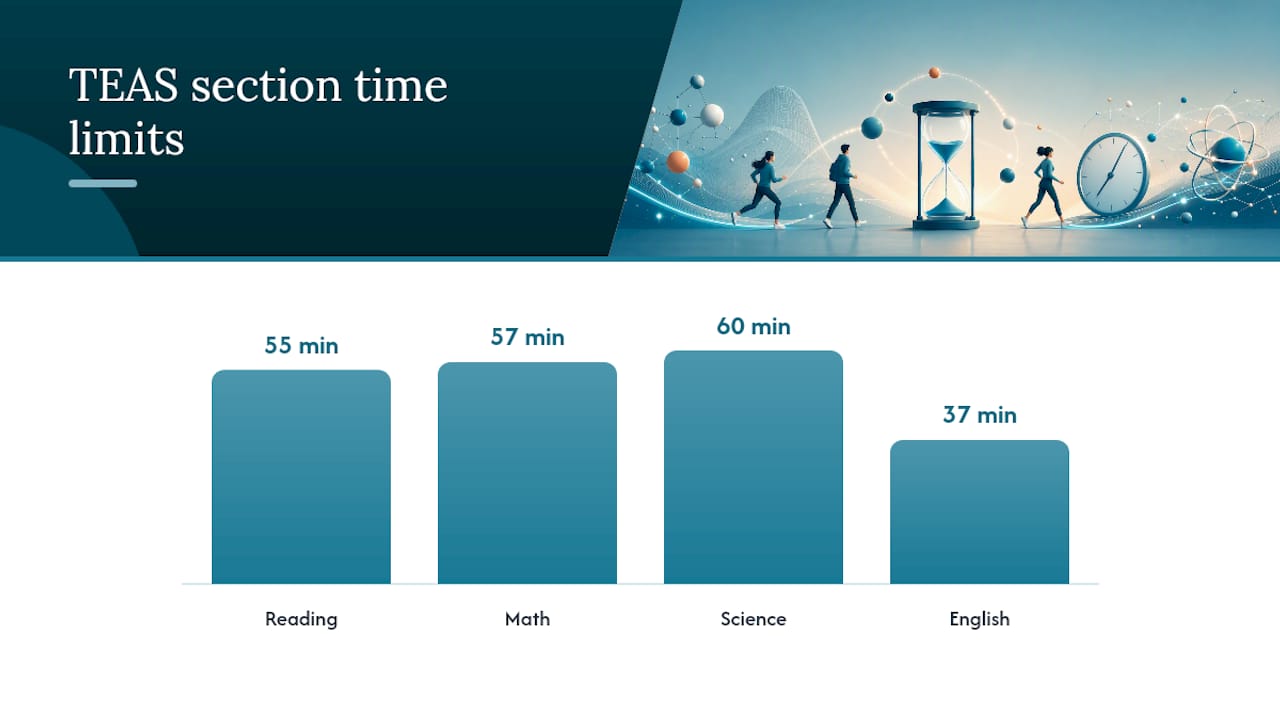
Full-length, timed practice tests that mimic the real exam's format produce measurably better outcomes than passive review like re-reading notes or watching videos without testing yourself. The TEAS itself runs 170 questions across 209 minutes, split into section-specific time limits: Reading gets 55 minutes, Math 57, Science 60, and English 37. Your practice tests should mirror those limits exactly, not a rounded-off version of them.
The exam uses five distinct question formats, and each deserves its own drill:
- Multiple choice: the majority format; practice eliminating two wrong answers first to narrow your odds
- Multiple select: pick all that apply; practice treating each option as its own true/false question
- Hot spot: click the correct area of an image; drill these specifically since they're easy to misjudge under time pressure
- Fill in the blank: usually math or grammar; double check units and decimal placement
- Ordered response: arrange items in sequence; practice these slowly first, then add a timer
One insight worth building into every session: starting with a short 15 to 20 minute mixed-section timed set before you dive into focused review builds test rhythm and surfaces weak spots you didn't know you had, faster than jumping straight into content review.
After every practice test, build an error log: question type, why you got it wrong, and the correct reasoning written in your own words. Pairing that error log with a weekly spaced retest of logged mistakes converts errors into durable learning far faster than simply re-reading your notes. Schedule your first full-length simulation at roughly the halfway point of your plan, then again in the final week.
How to Choose Study Materials Without Wasting Money or Time
Not every TEAS resource online is built on the current exam blueprint, and some free practice sets circulate content from retired versions of the test. Before you commit hours to any resource, run it through a short checklist:
- Does it explicitly align with TEAS 7, the current version of the exam?
- Does it include at least one full-length practice test, not just isolated question sets?
- Does every question come with a rationale explaining the correct answer?
- Does it cover all five question formats, not just standard multiple choice?
- Has it been updated recently enough to reflect current content weighting?
Free resources can genuinely carry a big share of the load. Curated video playlists on YouTube, digital flashcard decks on Quizlet, content refreshers on Khan Academy, and library-sourced study books can form a workable core. Many students reach Advanced or Exemplary score ranges using curated free resources combined with targeted practice tests, particularly for content review and vocabulary building.
Paid resources earn their cost when they add two things free tools rarely offer well: instant rationales tied to every question, and analytics that show exactly which subtopics are dragging your composite score down. Official ATI materials, including the TEAS Study Manual, official practice tests A and B, and the SmartPrep tutorials, are built directly from the exam blueprint and worth the investment if your budget allows.
The most efficient setup for most students: free resources for initial content review and vocabulary drilling, paired with a paid platform's practice questions and analytics for the diagnostic, weak-area targeting, and full-length simulation work.
Copyable Weekly Plans for 4, 6, and 8 Weeks
Your diagnostic score decides which of these three timelines fits. Each one follows the same daily formula: a short warm-up set, a focused content block, timed practice, and a review pass on missed questions.
- 4-week accelerated plan (for students scoring Proficient or higher across most sections): Week 1 hits your single weakest section hard. Weeks 2 and 3 rotate through all four sections with daily mixed practice sets. Week 4 is two full-length timed simulations plus error-log review.
- 6-week standard plan, aligned with ATI's six-week recommendation: Weeks 1 and 2 cover Reading and English content review. Weeks 3 and 4 cover Math and Science. Weeks 5 and 6 shift entirely to full-length practice tests, error logs, and spaced retesting of past mistakes.
- 8-week comprehensive plan (for students with two or more Basic-range scores): Weeks 1 through 5 rotate through all four sections at a slower pace, with extra repetition on the weakest areas. Weeks 6 and 7 add full-length simulations every few days. Week 8 is light review and rest.
Every daily session, regardless of which plan you're on, should follow the same shape: a 15 to 20 minute mixed warm-up, a 30 to 45 minute focused content block on that day's target section, a short timed drill, and 10 minutes reviewing what you missed. A full 6-week TEAS 7 plan mapped to weekly targets can give you a template to copy directly instead of building one from scratch.
Test-Day Checklist and How to Read Your Score
The night before matters more than most students think. Lay out your ID and confirmation email, confirm your testing center location and arrival time, and stop studying new content entirely. A light review of your error log is fine. Cramming new material the night before adds anxiety without adding real gains.
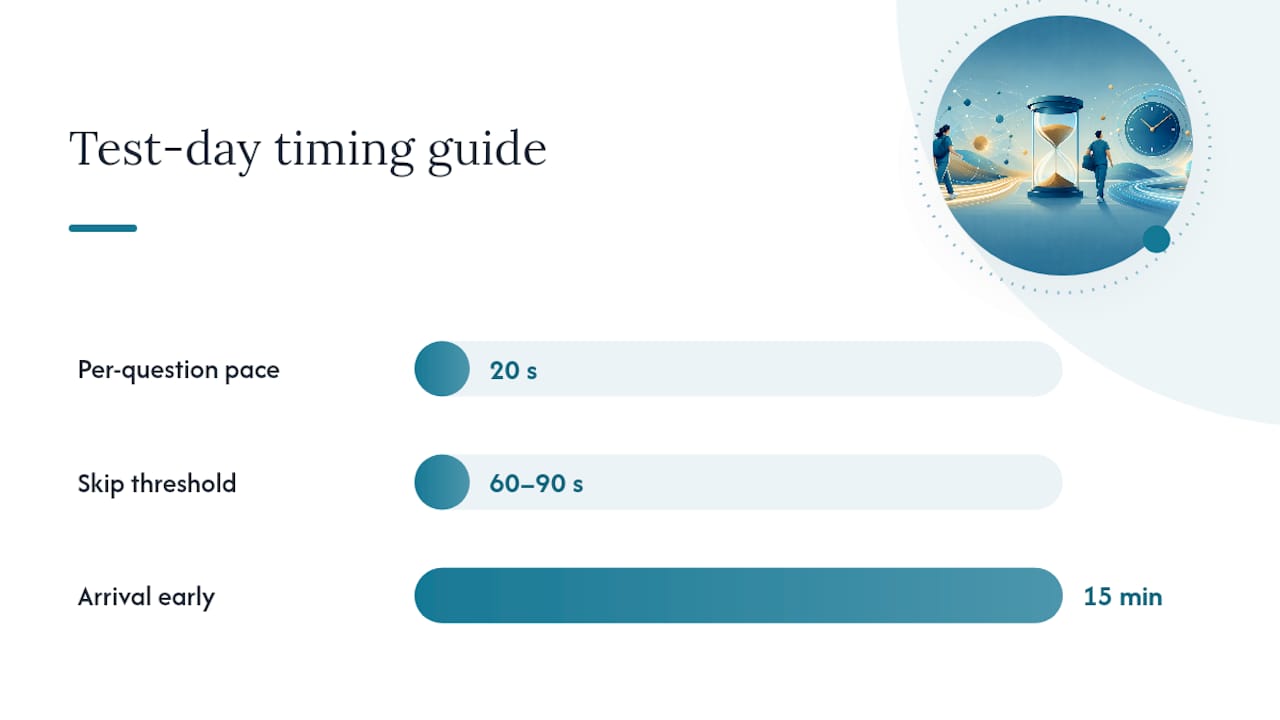
During the test, use a skip-and-return strategy on anything that stalls you for more than 60 to 90 seconds. Mark it, move on, and come back if time allows. There's no penalty for guessing on the TEAS, so never leave a question blank. Eliminate obviously wrong answers first, then guess among what's left.
- Arrive at least 15 minutes early to handle check-in without rushing
- Bring a valid photo ID that matches your registration exactly
- Budget roughly 20 seconds per question as a rough pace check, adjusting per section time limit
- Skip and flag anything that stalls you rather than burning time on one question
Pro Tip: If you finish a section with time remaining, don't submit early. Go back through flagged questions first. Small careless errors caught on a second pass are some of the easiest points you'll recover all test.
Score interpretation matters as much as the score itself. Nursing and allied health programs set their own composite score cutoffs, and they vary by school. Retaking a full-length practice test two to three weeks before your exam is the clearest way to confirm you're actually ready, and aim to beat your target program's minimum by a comfortable cushion rather than scraping in exactly at the cutoff. If your score falls short, check your target program's retake policy before you register again, since waiting periods and attempt limits differ by institution.
How to Put This Plan Into Practice With Nursing School Pro
Reading a study plan is easy. Running it consistently for four to eight weeks is the actual challenge, and it's where having the right tool cuts hours off your prep instead of adding to it.
Here's a practical three-step workflow using Nursing School Pro's study center:
- Run a diagnostic first. Start with a full diagnostic set and read the analytics dashboard closely. It breaks your performance down by subtopic, not just by section, so you can see that your Math score is really being dragged down by ratio problems specifically, not algebra broadly.
- Convert weak-topic data into daily sessions. Rather than reviewing everything evenly, use analytics to concentrate fewer, higher-quality questions on your actual weak subtopics instead of grinding through hundreds of low-value repeat questions.
- Use instant rationales on every miss. Every wrong answer comes with an explanation of the correct reasoning right there, which turns each mistake into a short lesson instead of a mystery you carry into the next practice set.
That loop, diagnose, target, correct, repeats every few days across whichever timeline you picked, and it's the same rhythm this entire guide has been building toward.
What Actually Matters if You're Short on Time
If you only take one thing from this guide: stop reviewing content you already know and start testing yourself on content you don't. That single shift, from passive re-reading to active retrieval, accounts for most of the score improvement I see students describe when they compare their diagnostic to their final practice test.
Two things that don't get said enough in TEAS prep advice. First, Science rewards effort more than any other section precisely because it's the most content-dense, students who put in focused diagram and terminology work here often see the biggest jumps on their next practice test, bigger than the same hours spent polishing an already-strong Reading score. Second, an error log beats a highlighter every time. Rereading a passage you got wrong feels productive. Writing down why you got it wrong and retesting yourself on it a week later is what actually sticks.
Use the weekly templates above as a starting structure, not a rigid script, and let your diagnostic and follow-up practice scores tell you when to adjust.
— Autumn
How Nursing School Pro Helps You Hit Every Study Milestone
Most TEAS resources give you a pile of questions and leave you to figure out what to do with a wrong answer. Some platforms provide every practice question with an instant rationale, so a missed question turns into a fixed knowledge gap in the same sitting instead of a mystery you carry into your next study session. Paired with real-time analytics that flag your weakest subtopics, this approach helps you spend study time on what's actually costing you points, not just grinding through questions at random.
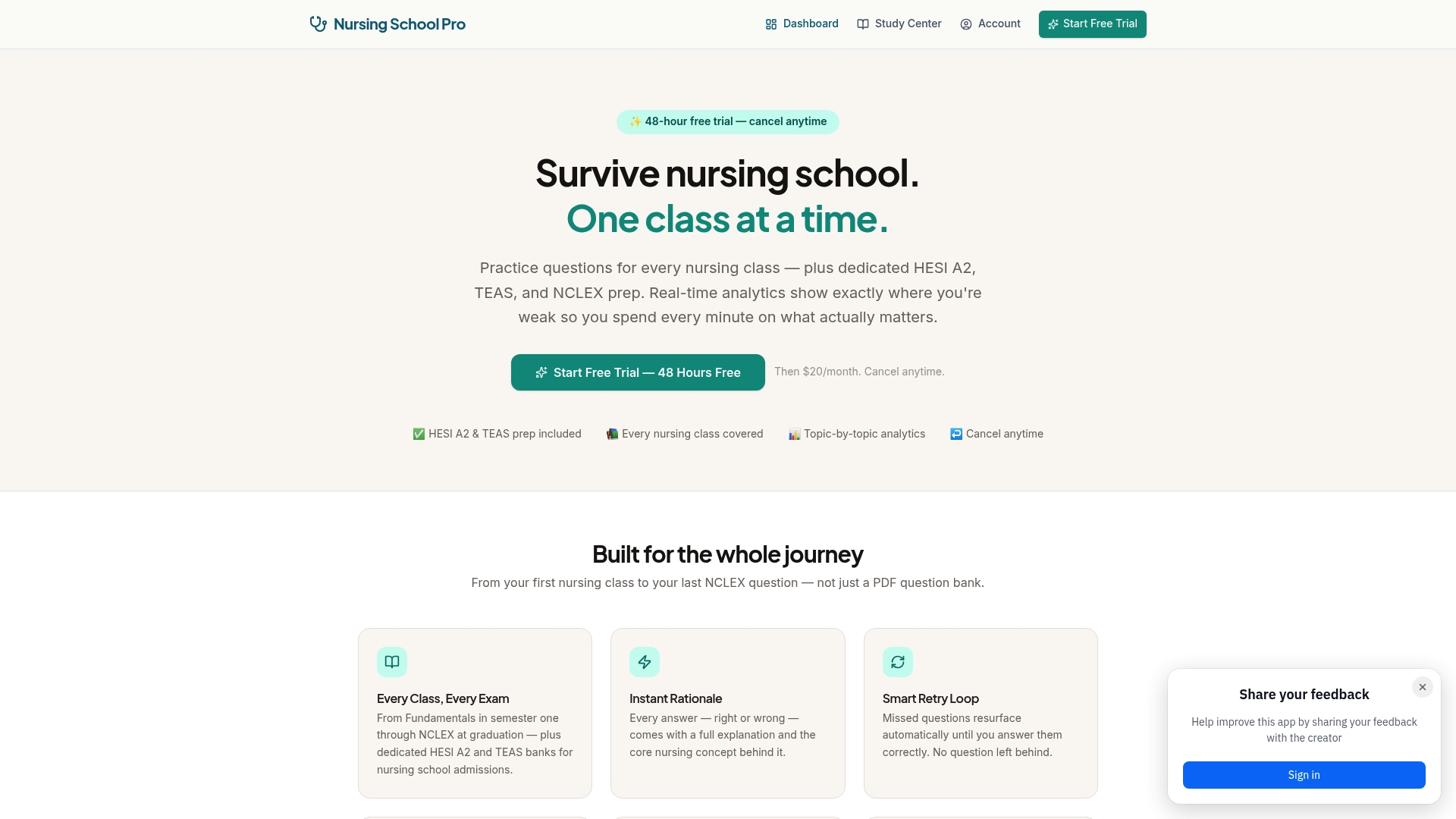
You can plug this directly into any of the schedules above. Run your diagnostic in week one, let the analytics dashboard show you exactly where to focus during your content-review weeks, and use the rationale-backed practice sets for your daily drills and full-length simulations alike. A 48-hour free trial gives you enough time to test the diagnostic and see your first analytics report before committing, and the platform runs $20 per month after that, with no long-term commitment required. If you're already deep into a study plan, start with a diagnostic on the study center today and let your own weak-topic data decide what you study tomorrow.
Where to Go for Official Guidance and Extra Practice
For the exam's actual blueprint and content weighting, go straight to ATI's TEAS Study Manual guidance, the test developer's own materials, and use it to confirm your study plan covers the right proportions across all four sections. ATI's official practice tests A and B are worth the investment specifically because they mirror the real exam's difficulty and format more closely than most third-party question banks.
For a broader look at study strategy and a sample week-by-week structure, Nurse.org's TEAS study guide lays out a practical framework worth comparing against your own diagnostic results. Use it early in your planning phase to sanity check your timeline choice, then lean on full-length timed simulations and your error log for the stretch run.
Save the official ATI materials for the weeks closest to your test date, since their practice tests most closely simulate real exam difficulty. Use broader guides and free content resources earlier in your plan, while you're still building foundational knowledge across Reading, Math, Science, and English and Language Usage.
Sources
- Tips for using the ATI TEAS Study Guide | ATI
- Nurse
- 7 tips to help you pass the TEAS | Herzing University