
Evidence-based practice in nursing is a lifelong, problem-solving approach to clinical care that integrates the best available research evidence, a clinician's own expertise, and the patient's values and preferences. The American Nurses Association's framework built around those three components runs on a simple loop:
- Ask a focused clinical question
- Acquire the relevant evidence
- Appraise its quality and relevance
- Apply it at the bedside
- Assess the outcome
Nurses who use this loop consistently make decisions that hold up under scrutiny instead of decisions based on habit or hallway consensus. The payoff shows up where it counts: fewer complications, better-managed chronic conditions, and care standards that keep pace with what current research actually supports.
Key Takeaways
Evidence-based practice in nursing works only when best research, clinical judgment, and patient preference are applied together through a repeatable ask-to-assess cycle.
| Point | Details |
|---|---|
| Three components, not one | Best evidence, clinical expertise, and patient values must all be present, or it isn't EBP. |
| Start with PICO(T) | A structured question with Population, Intervention, Comparison, and Outcome makes searches faster and more precise. |
| Rank evidence before trusting it | Systematic reviews and RCTs outrank expert opinion; match study design to the question type. |
| Pick a model and name it | Iowa fits unit pilots, Johns Hopkins PET fits documented system change, ARCC fits long-term culture building. |
| Measure before you pilot | Choose the outcome metric before starting a PDSA-style pilot to keep results credible with leadership. |
| Practice the reasoning, not just the facts | Nursing School Pro's rationale-driven questions build the same appraisal skills EBP requires, tracked through real-time analytics. |
Table of Contents
- What Evidence-Based Practice in Nursing Actually Means
- Turning a Clinical Question into a PICO(T) Search
- How to Judge Whether a Study Is Worth Trusting
- Choosing an Implementation Model That Fits Your Project
- Five Clinical Scenarios Where EBP Changes Outcomes
- Overcoming the Real Barriers to EBP at the Bedside
- Where to Find Reliable Evidence Fast
- Making Evidence Part of the Shift, Not a Special Project
- Build EBP Reasoning Before You're Tested on It
- Sources
What Evidence-Based Practice in Nursing Actually Means
Strip away the jargon and evidence-based practice nursing comes down to three things working together, not one thing standing alone. Best evidence means peer-reviewed research, not a textbook from a decade ago or a habit a preceptor picked up in 2003. Clinical expertise means the pattern recognition a nurse builds over years of hands-on assessment. Patient values means the care plan actually fits the person living with it. Skip any one of the three and you don't have EBP. You have research application, or intuition, or customer service, but not the full model.
A quick example of each in isolation: a nurse who follows a new turning-schedule study to the letter without checking whether the patient's mattress surface even matches the study conditions is applying evidence without expertise. A nurse who relies purely on "what's always worked" while ignoring a Cochrane review showing a technique is outdated is leaning on expertise without evidence. A nurse who pushes an evidence-backed intervention on a patient who explicitly declines it is skipping the values piece entirely.
People also mix up EBP with nursing research and quality improvement, and the distinction matters for one very practical reason: institutional review board approval. Nursing research generates new generalizable knowledge and almost always needs IRB oversight. Quality improvement tests whether an existing standard is being met locally, usually exempt from IRB review. EBP applies evidence already established elsewhere to a specific patient or unit, which is why a well-designed unit-level EBP project typically does not require IRB approval either. The QSEN competencies treat EBP as one of six core skills every nursing graduate needs, alongside patient-centered care and quality improvement, and Magnet-recognized hospitals require documented EBP integration as part of their designation. That is not a bureaucratic footnote. It's a hiring signal: units that can show a live EBP culture get better survey scores and, often, better retention.
Pro Tip: If you're not sure whether your unit project needs IRB review, ask your nursing professional development (NPD) practitioner before you start collecting data, not after.
Turning a Clinical Question into a PICO(T) Search
The 7-step EBP process outlined by Melnyk and Fineout-Overholt adds "cultivate a spirit of inquiry" as step zero and separates dissemination as its own final step, but functionally it maps onto the same 5-step loop most units teach. Pick whichever version your institution uses. What matters is what you do with step one: the question.
PICO(T) breaks a vague clinical worry into a searchable question. The letters stand for Population, Intervention, Comparison, Outcome, and Timeframe (the T is optional and often dropped for background questions).
Therapeutic example: In adult post-surgical patients (P), does early ambulation (I) compared to delayed ambulation (C) reduce incidence of deep vein thrombosis (O) within 72 hours of surgery (T)?
Diagnostic example: In febrile infants under 3 months (P), does procalcitonin testing (I) compared to standard CBC and blood culture (C) more accurately identify serious bacterial infection (O)?
Once you have a PICO(T) question, the search itself follows a repeatable pattern:
- Pull the P, I, and O terms out of your question and list synonyms for each.
- Search a clinical database using those terms combined with AND/OR operators, starting broad.
- Filter by publication date (last 5 to 7 years unless it's a landmark study) and study design.
- Skim abstracts first, not full text, to cut candidates down to the 3 to 5 worth reading closely.
- Save the search and set an alert if the question is likely to recur on your unit.
The PubMed EBP tutorial shows exactly how to translate PICO terms into MeSH headings, which cuts search time dramatically compared to typing plain-language phrases into a search bar.
Pro Tip: Search your Comparison and Outcome terms first, then add Population last. Population terms are usually the broadest, and adding them too early buries good studies under thousands of irrelevant results.
How to Judge Whether a Study Is Worth Trusting
Not all evidence carries equal weight, and knowing the hierarchy saves you from building a practice change on a shaky foundation. The evidence pyramid used across U.S. nursing programs ranks systematic reviews and meta-analyses at the top, followed by individual randomized controlled trials, then cohort studies, case-control studies, qualitative studies, and expert opinion or case reports at the base.
That ranking exists for a reason: systematic reviews aggregate multiple studies and dilute the risk that any single flawed trial skews your decision, while a single expert's opinion carries only that person's experience and bias. Systematic reviews answer "does this work across many settings?" Cohort studies answer "what happens to a group over time without intervention?" Qualitative studies answer "why do patients experience this the way they do?" Match the study type to your question instead of grabbing whatever ranks highest regardless of fit.
Five questions get you through a fast bedside appraisal:
- Was the study design appropriate for the question being asked?
- How was bias controlled (randomization, blinding, control groups)?
- Is the sample size large enough to trust the result?
- Do the findings match what similar studies have found?
- Does the population studied resemble your own patients?
CASP checklists and AMSTAR tools structure these questions into a repeatable scoring system, and most nursing school and hospital libraries provide free access to both. Watch for three red flags that should make you pause before applying a finding: a sample under 50 participants, an outcome measured by a surrogate marker instead of a real clinical endpoint, and inconsistent measurement tools across the studies you're comparing.
Choosing an Implementation Model That Fits Your Project
A PICO(T) question and solid evidence only get you halfway. Turning that evidence into a lasting practice change needs a framework, and the four most widely taught in U.S. nursing programs each fit a different scale of project.
- Iowa Model works best for unit-level change with a defined trigger, like a spike in catheter-associated infections. It walks a team from problem identification through piloting and system-wide rollout.
- Johns Hopkins Evidence-Based Practice (PET) Model structures around Practice question, Evidence, and Translation, and suits projects where a specific clinical problem needs a documented path from question to implemented change.
- ARCC Model (Advancing Research and Clinical practice through close Collaboration) centers on EBP mentors embedded in the unit and fits organizations trying to build a sustained EBP culture rather than complete a single project.
- Star Model of Knowledge Transformation maps how evidence moves through five stages from discovery to evaluation, and works well for education-focused initiatives explaining the full evidence lifecycle to students or new hires.
For a quick pilot on a single unit, Iowa gives you the clearest structure. For a system-wide policy change touching multiple departments, Johns Hopkins PET forces the documentation rigor that administrators expect. For building a long-term culture of inquiry rather than solving one problem, ARCC's mentorship structure does more heavy lifting than a one-time framework can. Whichever model you pick, name it explicitly in your proposal. A single sentence like "This project follows the Iowa Model's trigger-to-implementation structure" tells reviewers you understand the difference between doing EBP and just talking about it.
Five Clinical Scenarios Where EBP Changes Outcomes
Reading about EBP in the abstract only gets you so far. These five scenarios show what the ask-acquire-appraise-apply-assess loop looks like in real units, using common practice areas where evidence has directly reshaped protocols.
- Pressure injury prevention. PICO: In immobile ICU patients, does a structured turning schedule combined with skin assessment reduce pressure injury incidence compared to standard care? Best evidence typically comes from RCTs and cohort studies. Track hospital-acquired pressure injury rate per 1,000 patient days.
- Hand hygiene compliance. PICO: In hospitalized patients, does alcohol-based hand rub compared to soap-and-water washing reduce healthcare-associated infection rates? Systematic reviews carry the most weight here. Track infection rate alongside direct observation compliance percentage.
- Pediatric blood pressure technique. PICO: In pediatric patients, does cuff size selected by mid-arm circumference compared to visual estimation improve blood pressure reading accuracy? Diagnostic accuracy studies answer this best. Track the rate of repeat readings needed due to implausible values.
- COPD oxygen management. PICO: In COPD patients with acute exacerbation, does titrated oxygen to a target saturation compared to high-flow oxygen reduce the incidence of hypercapnic respiratory failure? RCTs are the gold standard. Track arterial CO2 levels and rate of non-invasive ventilation initiation.
- Alarm fatigue mitigation. PICO: On telemetry units, does customized alarm parameter setting compared to default manufacturer settings reduce non-actionable alarms without missing critical events? Quality improvement data and cohort studies apply here. Track alarms per patient day and missed critical event rate.
A short case makes the pattern concrete. A step-down unit noticed nurses silencing telemetry alarms faster than they were assessing them, a classic alarm fatigue pattern. The team asked a PICO(T) question, pulled two cohort studies on customized alarm thresholds, appraised them against their own patient population, piloted new parameters on one wing for four weeks, and tracked non-actionable alarms before and after. The pilot cut alarm volume by a substantial fraction on that wing, and leadership approved unit-wide rollout based on that single measured outcome.
Overcoming the Real Barriers to EBP at the Bedside
Nurses rarely reject EBP on principle. They reject it because a 12-hour shift leaves no room for database searching, and because most units have never made appraisal feel fast or normal. Naming the actual barrier is the first step toward a tactic that works instead of a mandate that gets ignored.
- No time to search: pre-build saved searches and database alerts during onboarding so the heavy lifting happens once, not every shift.
- No confidence appraising studies: adopt a one-page appraisal template based on CASP questions so nurses aren't starting from a blank page each time.
- No visible champion: designate an EBP champion per unit, ideally an NPD practitioner, who fields questions in real time rather than routing everything through committee.
- No leadership buy-in: run a small PDSA-style pilot with pre-specified, nurse-sensitive outcome metrics like infection rates or patient satisfaction scores before asking for system-wide resources.
Framing matters when you take results to a manager. Lead with the metric that lines up with what they're already accountable for: safety events, cost per patient day, or patient satisfaction scores. A pilot that "felt like it worked" gets shelved. A pilot that shows a measured drop in one specific, pre-agreed metric gets funded.
Pro Tip: Pick your outcome metric before you start the pilot, not after you see the results. Retrofitting a "success" measure after the fact is how good projects lose credibility with skeptical leadership.
Where to Find Reliable Evidence Fast
Skip generic search engines when a real clinical question is on the table. PubMed and CINAHL cover the broadest range of nursing and biomedical literature, while the Cochrane Library specializes in pre-appraised systematic reviews that save you the appraisal step entirely. For care standards rather than individual studies, guideline repositories from specialty organizations often have the answer faster than a database search would.
For appraisal, CASP checklists and the JBI critical appraisal tools cover most study designs nurses encounter, and AGREE II works specifically for evaluating clinical practice guidelines. Most nursing school and hospital library systems provide free institutional access to all of these, often bundled with a librarian who will run a search with you if you ask. Set up saved searches and email alerts on your two or three most common clinical questions. That five-minute setup pays for itself the first time a similar question comes up on shift.

Making Evidence Part of the Shift, Not a Special Project
The nurses who stay sharpest with EBP don't treat it as a research assignment they complete once and file away. They treat it as a habit woven into ordinary shift routines: a two-minute PICO question raised during huddle, a quick "why do we still do it this way?" during a slow stretch on nights. That's where an NPD practitioner earns their keep, not by running formal in-services but by answering a hallway question with an actual citation instead of a shrug. Mentorship, more than any checklist, is what keeps evidence-based practice nursing from becoming a phrase people say in job interviews and forget by Tuesday.
— Autumn
Build EBP Reasoning Before You're Tested on It
Every scenario above, the PICO(T) questions, the appraisal heuristics, the model selection, comes down to one underlying skill: reasoning through why an answer is correct, not just memorizing that it is. That's the exact muscle Nursing School Pro trains. Practice questions across every nursing class come with instant rationales that walk through the evidence behind each answer, so you're building the same appraisal instincts covered in this article every time you drill a question set.
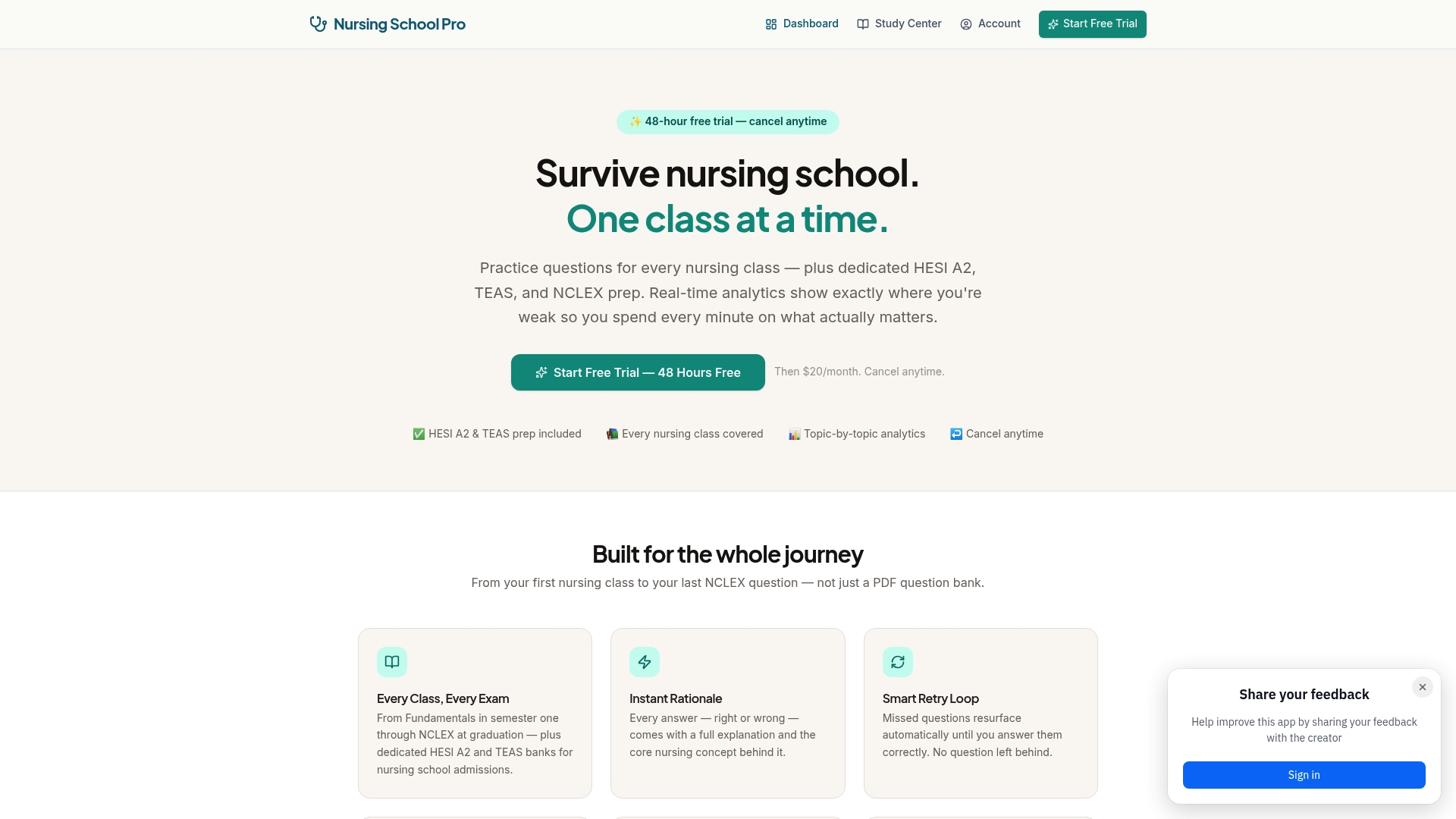
Real-time analytics flag the specific content areas where your reasoning is weakest, whether that's levels of evidence, pharmacology, or diagnostic accuracy questions, so your study time goes toward actual gaps instead of topics you've already mastered. The Nursing School Study Center organizes practice by class and by exam (HESI A2, TEAS, NCLEX), all aligned with the textbooks and national standards referenced throughout this guide. Start with the 48-hour free trial and see which of your own knowledge gaps show up first.
Sources
- Evidence-based practice and research — Texas State University Pressbooks
- Quality and evidence-based practice - Nursing Management and Professional Concepts — NCBI Bookshelf
- Using PubMed in Evidence-Based Practice — NLM / PubMed tutorial
This article is general information, not a substitute for advice from a qualified doctor. Consult a qualified healthcare professional about your own circumstances before acting on anything here.