
The fastest path to psychiatric nursing exam readiness is timed practice questions with immediate rationale review instead of more highlighting or rereading notes. This guide maps the high-yield psychiatric topics to the NCSBN Clinical Judgment Measurement Model, gives you a two-week schedule you can start tonight, and points to the exam-focused resources, including Nursing School Pro's question bank, that turn content review into test-day performance.
TL;DR:
- Prioritize understanding presentation clues, nursing actions, and medication monitoring for mood, psychotic, anxiety, substance use, and personality disorders.
- Practice applying clinical judgment through cue recognition, analysis, solution generation, action, and outcome evaluation rather than memorization alone.
- Use targeted resources at each stage of study, from flashcards early on to full practice tests and analytics in the final days before the exam.
- Focus heavily on communication and de-escalation techniques, including active listening, limits, choices, and calm approaches, with role-play practice and recording.
- Follow a structured two-week schedule with timed question blocks, focused review, and rest, adjusting for shorter timeframes while maintaining practice quality.
Table of Contents
- What Topics Should You Prioritize in a Mental Health Nursing Study Guide?
- How Do You Apply Clinical Judgment to NCLEX-Style Questions?
- Which Practice Resources Should You Use at Each Study Stage?
- What Communication and De-Escalation Skills Should You Rehearse?
- What Does a Two-Week Study Schedule Look Like Before the Exam?
- What Legal and Ethical Rules Govern Mental Health Nursing?
- How Do You Handle a Psychiatric Crisis or Emergency?
- What Does Community Mental Health Nursing Involve?
- Autumn's Take on Studying Smarter, Not Longer
- Try Nursing School Pro's Study Center Before Your Next Exam
- Where to Go Deeper on Mental Health Nursing Content
- Sources
What Topics Should You Prioritize in a Mental Health Nursing Study Guide?
Psychiatric nursing exams reward pattern recognition over rote memorization. You need to know how each disorder presents, what to do first, and which medication class shows up in the distractor answers.
Here is where to spend your hours:
- Mood disorders (major depressive disorder, bipolar I/II): watch for anhedonia, psychomotor changes, and mania's pressured speech. Priority action is always a suicide risk check before anything else.
- Psychotic disorders (schizophrenia, schizoaffective): know positive versus negative symptoms cold. Safety flag is command hallucinations or paranoia driving aggression.
- Anxiety and trauma-related disorders (GAD, panic disorder, PTSD): grounding techniques and recognizing hyperarousal are tested more than diagnostic criteria.
- Substance use disorders: memorize withdrawal timelines. Alcohol withdrawal seizures peak within the first few days; delirium tremens is a medical emergency, not just a psychiatric one.
- Personality disorders (borderline, antisocial): the nursing priority is consistent limit setting, not diagnosing.
- Eating disorders: cardiac monitoring and refeeding syndrome are the safety flags exam writers love.
- Dissociative disorders: less common on exams but tested through grounding interventions.
- Neurocognitive disorders (delirium versus dementia): this distinction is one of the most frequently missed items. Delirium is acute and reversible; dementia is gradual and progressive.
For each category, drill three things: presentation clues, the immediate nursing priority, and the medication class with its key monitoring parameter (lithium levels, clozapine and agranulocytosis, MAOIs and dietary restrictions).
You also need the assessment skeleton memorized without thinking: mental status exam components (appearance, mood, affect, thought process, cognition), suicide and self-harm screening questions, and a basic psychosocial history framework. These show up embedded inside nearly every case-based item, even when the question never mentions them directly.
How Do You Apply Clinical Judgment to NCLEX-Style Questions?
Modern licensure exams do not just test what you know. They test how you think under pressure, which is exactly what the NCSBN Clinical Judgment Measurement Model was built to measure. Mental health nursing programs are increasingly aligning coursework to this framework, so you should practice with it, not around it.
The five steps work like this when you read a psychiatric case item:
- Recognize cues. Pull the abnormal findings out of the stem: flat affect, disorganized speech, a stated suicide plan.
- Analyze cues. Connect them to a probable diagnosis or risk level. A stated plan plus access to means signals high acuity.
- Generate solutions. List plausible nursing actions before you look at the answer choices.
- Take action. Choose the response that addresses the most urgent safety need first.
- Evaluate outcomes. Ask whether your chosen action would actually resolve or reduce the risk described.
Build your practice around this structure rather than isolated recall. Rotate timed, mixed-topic question blocks with NGN unfolding case studies, then review every rationale immediately, right or wrong. Spacing this out over days beats one long cram session, and tracking your analytics tells you exactly which step in the five-step model you keep missing.
Pro Tip: If you keep picking the "textbook correct" answer instead of the "safest right now" answer, you are skipping step four. Reread the stem and ask what happens in the next five minutes if you do nothing.
When in doubt, prioritize acute and safety actions first, rule out answers that delay intervention, and default to de-escalation before restraint or medication when the stem allows it.
Which Practice Resources Should You Use at Each Study Stage?
Not every resource earns your time at every stage. Match the tool to where you are in the nursing mental health resources you're pulling from.
- Early learning: flashcards and pocket guides for building recall of drug classes, defense mechanisms, and diagnostic criteria.
- Mid-cycle: timed question banks and NGN case practice, where you apply the clinical judgment steps under time pressure.
- Late-stage: full-length practice tests and targeted blocks that hammer only your weakest tag areas.
When picking a question bank, check for four things: answer rationales written for every option (not just the correct one), NGN-aligned item types, topic tagging by disorder or skill, and analytics that show trend lines over time, not just a raw score.
Nursing School Pro's question bank organizes practice questions by class and exam, attaches instant rationales to every answer choice, and tracks your weak areas through real-time analytics, so you're not guessing which chapter to revisit. To trial any question bank effectively, set a strict timer per block, log every miss in a running list, and review the rationale the moment you finish, not the next day when the reasoning has gone cold.
What Communication and De-Escalation Skills Should You Rehearse?
Therapeutic communication techniques are tested constantly and rehearsed rarely, which is exactly why they trip students up on exam day. Active listening, validation, open-ended prompts, and nonjudgmental language form the backbone of nearly every psychosocial item.
Do not skip silence. Therapeutic silence gives patients room to process and respond, and experienced nurses use it deliberately instead of filling every pause with reassurance.
De-escalation follows a consistent sequence, which is detailed in mental health support for first responders:
- Approach calmly, keep a safe distance, and speak in a low, steady tone.
- Set clear, matter-of-fact limits: "I need you to lower your voice so we can keep talking."
- Offer choices where possible to restore a sense of control.
- Withdraw attention from manipulative or escalating behavior while reinforcing calm behavior, an approach backed by clinical literature on managing manipulative behavior in psychiatric settings.
Structured communication frameworks also build confidence for talking-therapy style questions, which show up more often now that mental health content is folding into general nursing exams.
Practice with short, scripted role-plays that isolate one technique per session, validation only, then silence only, rather than a free-form scenario that tries to cover everything at once.
Pro Tip: Record yourself running a five-minute de-escalation script and listen back. You will hear filler words and reassurance clichés you never notice while speaking them live.
What Does a Two-Week Study Schedule Look Like Before the Exam?
A tight, structured schedule beats an open-ended one every time, mostly because it forces you to stop reviewing and start testing.
- Days 1 to 3: Topic blocks (mood, psychotic, anxiety disorders) paired with 25-question timed sets per topic.
- Days 4 to 6: Substance use, personality, and eating disorders, plus your first NGN case-study set.
- Days 7 to 8: Full mixed-topic practice test, then a full day reviewing every rationale, right and wrong.
- Days 9 to 11: Targeted blocks hitting only your lowest-scoring tags from the analytics.
- Days 12 to 13: Second full-length practice test plus final NGN case drills.
- Day 14: Light review only: flashcards, mnemonics, and rest.
Quick recall tools worth memorizing now: mental status exam order (appearance, behavior, mood, affect, speech, thought, cognition, insight), suicide risk red flags (prior attempt, specific plan, access to means, hopelessness), and a med-monitoring checklist (lithium levels, clozapine and white blood cell counts, MAOIs and tyramine).
If you have fewer than fourteen days, compress the topic blocks and keep both full-length tests. With more time, add a third practice test and extend the targeted review phase.
What Legal and Ethical Rules Govern Mental Health Nursing?
Psychiatric nursing carries legal weight that general medical nursing does not, mostly because it can involve restricting a patient's freedom. You need to know the difference between voluntary and involuntary admission, and the specific criteria your state uses for an involuntary hold, typically danger to self, danger to others, or grave disability.
Informed consent gets more complicated in psychiatry. A patient can refuse treatment unless a court or your facility's policy has established they lack decision-making capacity, and capacity is task-specific. Someone can lack capacity to consent to a complex medication regimen while still retaining the right to refuse a specific injection.
Confidentiality rules under HIPAA apply with extra sensitivity in psychiatric settings. Exam items often test the exceptions: you can break confidentiality when a patient discloses intent to harm a specific identifiable person (the Tarasoff duty), when reporting is mandated for abuse, or when there's an imminent suicide risk requiring intervention.
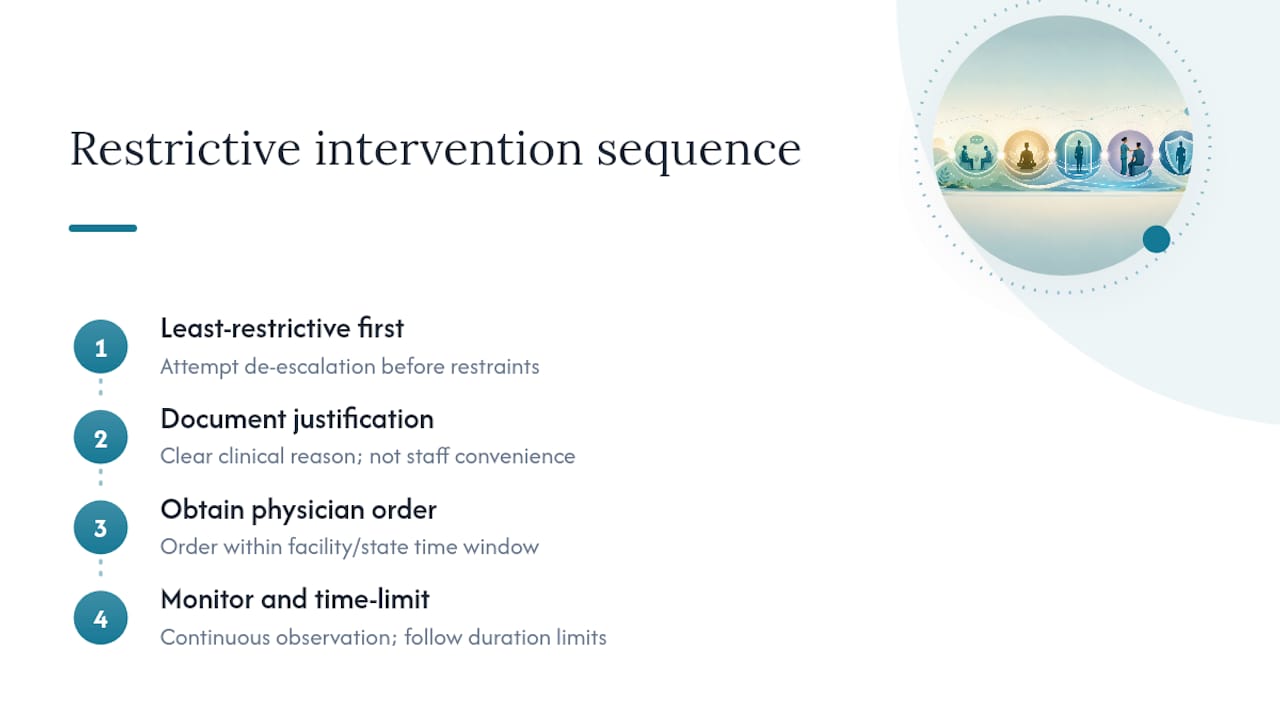
Restraint and seclusion carry their own documentation and time-limit requirements, and exam writers love testing the sequence: least restrictive intervention first, physician order within a set window, and continuous monitoring throughout. Know your patient's right to refuse medication except in true emergencies, and understand that every restrictive intervention needs a clear, documented clinical justification, not just staff convenience.
How Do You Handle a Psychiatric Crisis or Emergency?
Crisis situations test your ability to sequence actions correctly under pressure, which is precisely what clinical judgment items are built to measure.
Start every crisis assessment with environmental safety: clear the area of potential weapons, position yourself near an exit, and call for additional staff before a situation escalates rather than after. For suicidal patients, that means removing access to means (sharps, cords, medications) immediately, not after you finish your assessment.
Crisis intervention follows a rough arc: stabilize the immediate danger, assess risk level, and then move toward a longer-term safety plan. A no-suicide contract alone is not adequate risk management; exam items increasingly flag this as an outdated, insufficient intervention on its own. The correct sequence pairs environmental safety with a collaborative safety plan and, where indicated, a higher level of care.
For aggressive or violent behavior, verbal de-escalation always precedes physical intervention unless there is immediate danger to the patient or staff. When medication becomes necessary, it should be the least restrictive option that addresses the acute symptom, and you should know which as-needed medications (like short-acting benzodiazepines or antipsychotics) are typically ordered for acute agitation.
Documentation during a crisis matters as much as the intervention itself: time-stamped behavioral observations, exact statements about intent or means, and every step taken in sequence protect both the patient and your license.
What Does Community Mental Health Nursing Involve?
Not every psychiatric nurse works inside a locked unit. Community mental health roles focus on keeping patients stable and out of the hospital, and exams increasingly test this setting because care models are shifting that direction.
Case management is the core function here: coordinating medication adherence, housing stability, outpatient therapy appointments, and follow-up after a hospital discharge. A community mental health nurse often functions as the single point of continuity for a patient bouncing between a psychiatrist, a social worker, and a primary care provider.
Assertive community treatment (ACT) teams represent a model worth knowing by name. They deliver intensive, team-based care to patients with severe and persistent mental illness who struggle with traditional outpatient follow-up.
Relapse prevention is the other pillar. That means teaching patients to recognize their own early warning signs (sleep changes, social withdrawal, medication noncompliance) before a full crisis develops, and building a plan for what to do when those signs appear. Community nurses also handle medication administration logistics, like long-acting injectable antipsychotics, that keep patients stable between appointments without requiring daily pill adherence.
Autumn's Take on Studying Smarter, Not Longer
Pacing beats cramming every time I've reviewed how students actually improve. Short, timed blocks with real breaks between them build stamina for a four-hour exam better than marathon sessions ever do. Track your analytics honestly, your weak-area report is more useful than your gut feeling about what you "should" know by now. And don't skip case studies for pure recall drills; judgment gets built through practice, not memorization.
— Autumn
Try Nursing School Pro's Study Center Before Your Next Exam
This service gives you what a textbook and a pile of flashcards cannot: instant rationales on every practice question, so you know why an answer is right and why the others are wrong, plus real-time analytics that flag your weak areas before your next exam does.
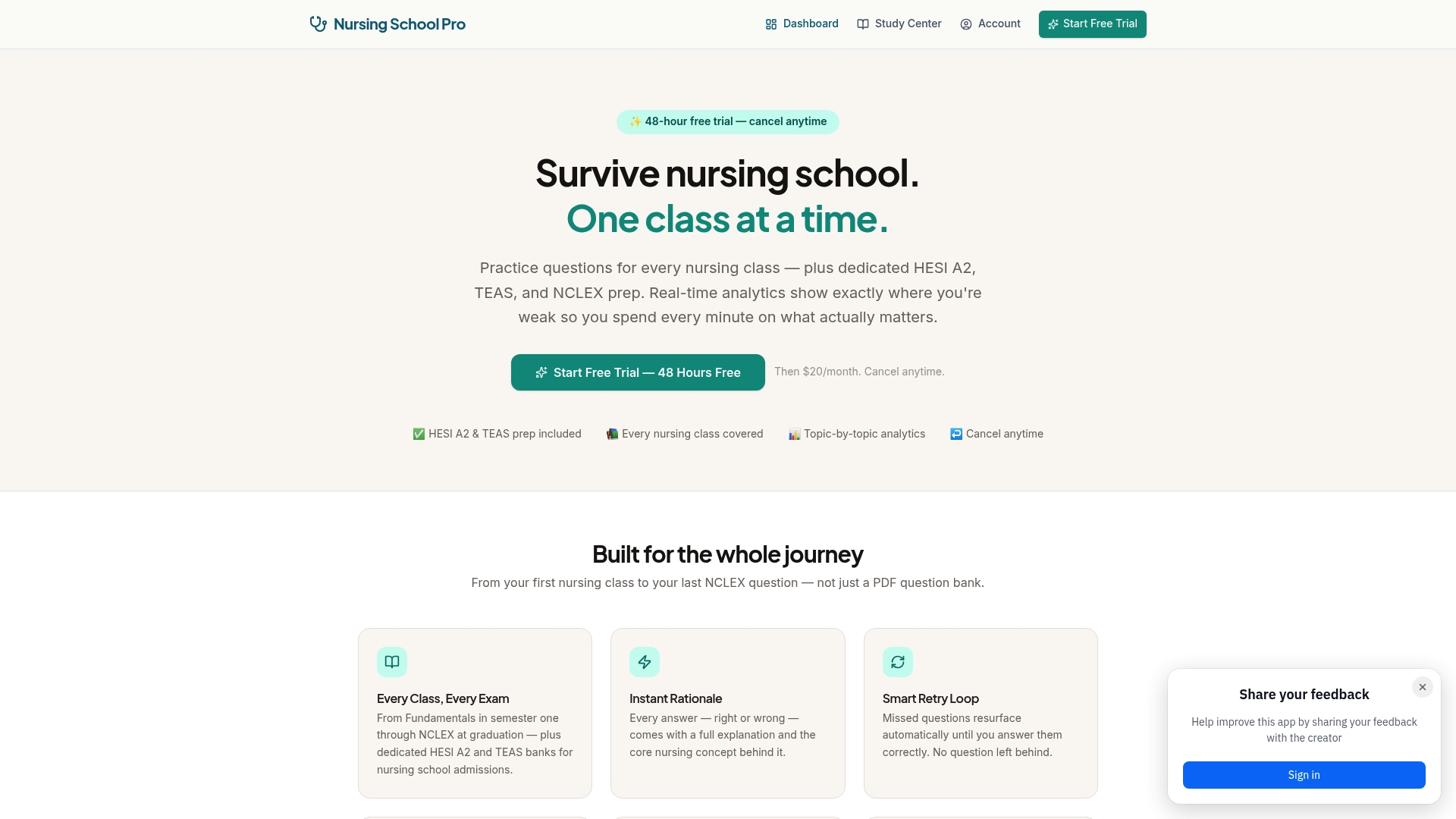
The study center organizes questions by class and by exam, HESI A2, TEAS, and NCLEX, and aligns content with the textbooks your program already assigns. You get a 48-hour free trial to test the question bank and see your own analytics before committing to anything. Check the pricing page for plan details, or start the trial directly and run your first timed block tonight.
Where to Go Deeper on Mental Health Nursing Content
- For assessment theory, NCSBN clinical judgment crosswalks, and NGN-style case studies, the Nursing: Mental Health & Community Concepts textbook is the strongest free reference.
- For communication technique drills, see the Nursing Times guide and the APNA resource library.
- For crisis support as a nurse, the Washington State Board of Nursing's mental health resources list hotlines including 988 and the Crisis Text Line.
Sources
- Clinical judgment in nursing: applying the NCSBN model beyond the exam
- Therapeutic communication essentials for nursing practice (PubMed entry)
- Nursing: Mental Health & Community Concepts (2nd edition) - NCBI Bookshelf
- Mental Health Resources for Nurses | Washington State Board of Nursing