
Evidence-based practice (EBP) in nursing means blending the best available research evidence, your own clinical expertise, and the patient's preferences into a single care decision, rather than relying on habit or "how we've always done it." You see it in action every shift. Common examples include:
- Hand hygiene and infection-control protocols
- Pressure ulcer prevention through scheduled repositioning
- Fall-prevention bundles for high-risk patients
- Multimodal postoperative pain management
- Early mobility after surgery
- Central line and catheter care bundles
- Teach-back for patient education
The American Nurses Association treats these as core practice standards, and the Cochrane Library is where most of the underlying research gets synthesized before it ever reaches a bedside policy.
Key Takeaways
Evidence-based nursing combines research evidence, clinical judgment, and patient preference through the 5 A's process, and bundled interventions only deliver their full benefit when applied completely.
| Point | Details |
|---|---|
| Three pillars, one decision | Research evidence, clinical expertise, and patient preference must all factor into an EBP choice. |
| Follow the 5 A's | Ask, Acquire, Appraise, Apply, and Assess give you a repeatable process for any clinical question. |
| Bundles are all-or-none | Skipping one step in a CLABSI or fall-prevention bundle can erase the expected benefit. |
| Match the model to the project | Use the Iowa Model for unit-level fixes and PARIHS for complex, system-wide change. |
| Mentorship speeds success | Structured training and an early mentor relationship prevent most projects from stalling. |
Table of Contents
- Why Evidence-Based Nursing Care Matters
- The Three Pillars Behind Every EBP Decision
- What Are the 5 A's of Evidence-Based Practice?
- Which EBP Model Fits Your Project?
- Practical Examples of Evidence-Based Nursing Practice
- Turning an Idea Into a Mini EBP Project
- Common Barriers to EBP and How to Get Past Them
- Reading Levels of Evidence at the Bedside
- Why Practical EBP Training Matters More Than Theory
- Where to Keep Learning About Evidence-Based Nursing
- Frequently Asked Questions
- Sources
Why Evidence-Based Nursing Care Matters
EBP works because it replaces guesswork with a documented pattern of what actually helps patients heal faster and stay safer. When a unit adopts evidence-based nursing care instead of tradition-based habits, the shift shows up in outcomes, not just paperwork.
- Patients recover with fewer complications when interventions match current research.
- Hospital-acquired infections and falls drop when nurses follow bundled, tested protocols instead of ad hoc routines.
- Care becomes more consistent across shifts and staff, so a patient gets the same standard whether it's day three or night eleven.
- Patients get a say in their own treatment, which improves adherence and satisfaction.
Two signals worth knowing: the Magnet Recognition Program rewards hospitals that embed EBP into culture, and the QSEN competencies build it directly into nursing school curricula.
The Three Pillars Behind Every EBP Decision
Every solid EBP decision rests on three pillars working together, not any one of them alone.
- Best available research evidence. Systematic reviews and randomized controlled trials carry more weight than a single small study or a textbook chapter written a decade ago.
- Clinical expertise. Your assessment skills and pattern recognition from actual patient care catch what a study protocol never anticipated.
- Patient and population preferences. A frail 88-year-old with three comorbidities may need a modified version of what worked for the healthy 45-year-olds in the original trial.
At the bedside, a fast appraisal cue helps: ask whether the evidence came from a systematic review or RCT, and if it did, weight it more heavily than a single cohort study or an expert's opinion.
What Are the 5 A's of Evidence-Based Practice?
The 5 A's give you a repeatable sequence: Ask a focused clinical question, Acquire the evidence, Appraise its quality, Apply it to your patient, and Assess the outcome.
- Ask. Frame a PICO question: Population (post-op adult patients), Intervention (early ambulation within 24 hours), Comparison (standard delayed mobility), Outcome (reduced length of stay).
- Acquire. Search the Cochrane Library first, then check professional guidelines, then PubMed or CINAHL if you need more depth.
- Appraise. Skim the abstract for sample size, study design, and whether the population resembles your unit's patients.
- Apply. Adapt the intervention to your specific patient and setting.
- Assess. Track a measurable outcome afterward, like time to first ambulation or readmission rate.
A rapid bedside decision, like whether to reposition a patient now versus in an hour, might take you fifteen minutes of reasoning through steps one through four. A unit-level project, like changing your fall-prevention protocol, typically runs four to twelve weeks from question to result.
Pro Tip: Keep a running list of clinical questions that puzzle you during shifts. Half of finding good evidence is noticing you have a real question worth answering.
Which EBP Model Fits Your Project?
Three models dominate nursing practice, and picking the right one saves you weeks of wasted effort.
- The Iowa Model works best for unit-level quality improvement projects, like changing a wound care protocol on a single med-surg floor.
- The Johns Hopkins Evidence-Based Practice Model suits clinical practice changes that need detailed implementation steps and a clear PET (Practice question, Evidence, Translation) structure.
- PARIHS (Promoting Action on Research Implementation in Health Services) fits complex, system-level change where multiple departments and stakeholders need alignment.
Match the model to your scope. A single-unit fix rarely needs the full PARIHS framework, and a hospital-wide policy change will outgrow the simpler Iowa approach fast.
Practical Examples of Evidence-Based Nursing Practice
These are the evidence-based nursing projects you'll actually run into on the floor, each paired with its supporting evidence level.
Hand hygiene and infection control. Alcohol-based hand rub before and after every patient contact, backed by decades of systematic review data, cuts transmission of resistant organisms. Expected outcome: fewer hospital-acquired infections unit-wide.
Pressure ulcer prevention. Scheduled repositioning every two hours plus a validated risk-assessment tool (like the Braden Scale) prevents skin breakdown in immobile patients. Evidence level: multiple RCTs and clinical guidelines.
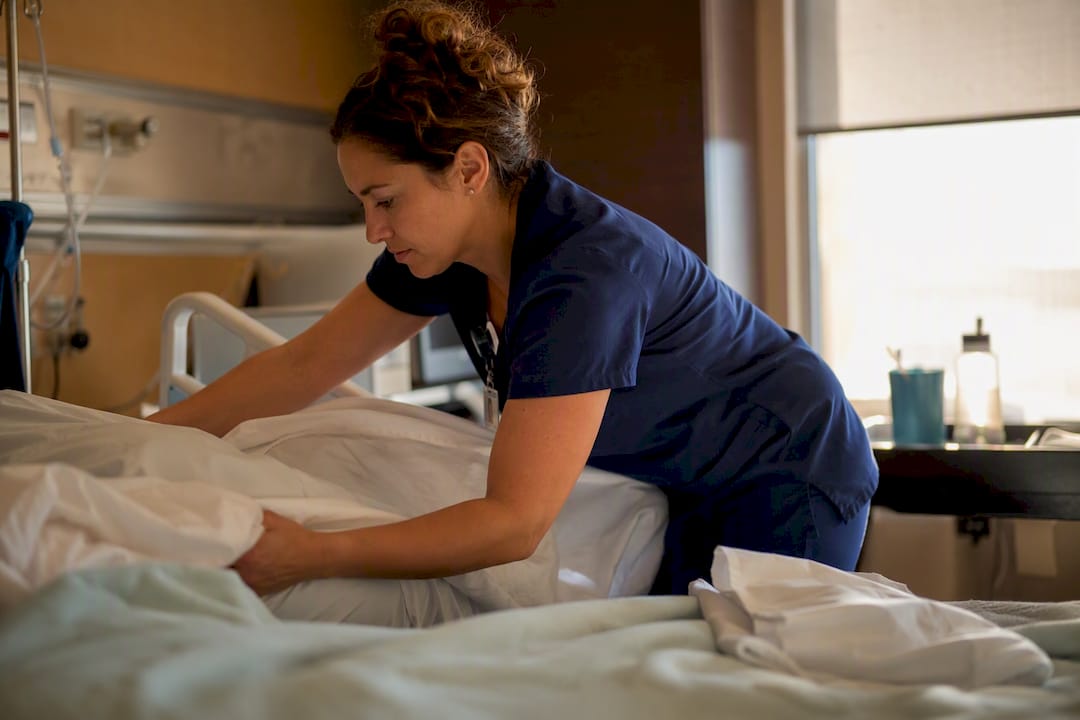
Fall-prevention bundles. Bed alarms, non-slip footwear, hourly rounding, and clear signage combined as a bundle reduce falls more than any single measure alone. Evidence level: systematic reviews of bundled interventions.
Multimodal postoperative pain management. Combining scheduled acetaminophen, NSAIDs where appropriate, and lower opioid doses controls pain with fewer side effects than opioids alone. Evidence level: RCTs across surgical populations.
Early mobility after surgery. Getting patients out of bed within 24 hours of most surgeries shortens hospital stays and reduces pneumonia risk. Evidence level: RCTs and clinical practice guidelines.
Catheter and central line bundles. A standardized bundle, insertion checklist, daily necessity review, sterile technique, applied as an all-or-none set rather than picking and choosing steps.
Teach-back for patient education. Asking patients to repeat instructions in their own words catches misunderstanding before discharge, backed by health literacy research.
Bedside shift report. Handing off at the patient's bedside instead of at the nurses' station improves accuracy and lets patients correct errors in real time.
EBP bundles have been linked to dramatic infection reductions when applied consistently: CLABSI bundles have been associated with a significant decrease in central line infection rates in hospitals that adopted them fully.
Pick one or two nurse-sensitive indicators (infection rate, fall count, pain score) and measure them before and after any change you adapt locally.
Pro Tip: Bundles only work as a complete set. Skip the daily line-necessity review and you've weakened the whole CLABSI bundle, even if every other step was done perfectly.
Turning an Idea Into a Mini EBP Project
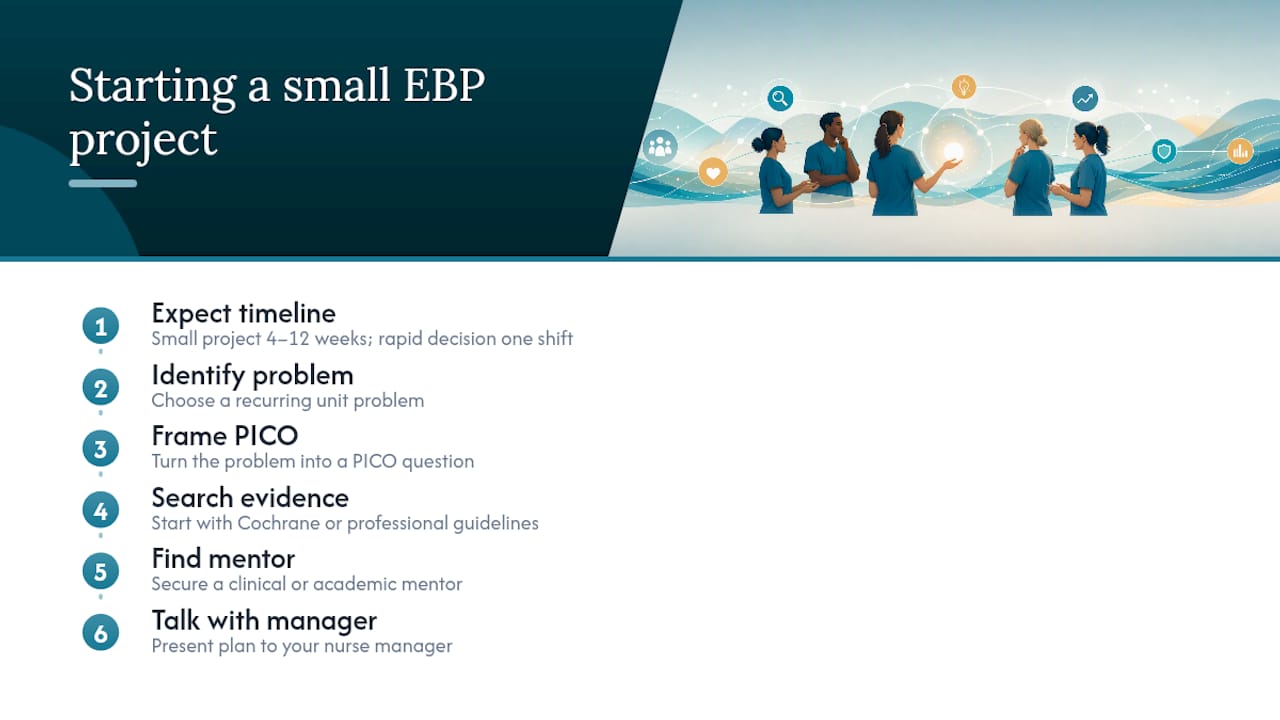
You don't need a doctorate to run a small, credible project. A basic template gets you from idea to results in about six to eight weeks.
- Write an aim statement. One sentence: what you want to change, by how much, by when.
- Frame your PICO question. This keeps your search focused instead of drowning in unrelated literature.
- Pick your measures. One primary outcome (fall rate) and one balancing measure (staff time spent on rounding) so you catch unintended tradeoffs.
- Sketch a run chart. Plot your measure weekly, even roughly, so trends become visible fast.
- Set milestones. Week 1 to 2: literature search and appraisal. Week 3 to 4: pilot on a small scale. Week 5 to 6: full rollout. Week 7 to 8: measure and present results.
- Find a mentor early. A charge nurse, clinical educator, or unit champion who's run a project before will save you from common mistakes.
Bring your nurse manager a one-page summary, not a full proposal, when you first pitch the idea. Nursing School Pro's study center has resources for building the appraisal and clinical reasoning skills a mini-project demands.
Pro Tip: Ask your mentor what killed the last three project ideas on your unit. That answer tells you more than any journal article about your actual barriers.
Common Barriers to EBP and How to Get Past Them
Time pressure kills more good ideas than bad evidence does. A twelve-hour shift leaves little room for literature searches, so lean on pre-appraised summaries and existing guidelines instead of starting from scratch.
Lack of mentorship stalls projects before they start. Recruit a unit champion, a colleague who's already done this, to walk you through the first cycle.
Limited access to databases is real for many bedside nurses. Free resources through the ANA and your hospital library card usually cover more ground than you'd expect.
Workplace resistance to change is common, and structured training programs measurably increase nurses' research-practice ability and follow-through, which is why institutional buy-in matters as much as individual motivation.
Reading Levels of Evidence at the Bedside
Evidence sits on a hierarchy: systematic reviews and meta-analyses at the top, then randomized controlled trials, then cohort studies, then case series, then expert opinion at the bottom.
- For major protocol changes, lean on systematic reviews and clinical practice guidelines. That's the strongest available evidence.
- For urgent bedside decisions where you don't have time to appraise a full study, combine the best evidence you can quickly find with your clinical judgment and the patient's stated preference.
- If a finding conflicts with what your unit currently does, or the population studied looks nothing like your patient (younger, healthier, different comorbidity profile), escalate it to a formal appraisal rather than changing practice on the spot.
Why Practical EBP Training Matters More Than Theory
Nursing students often learn EBP as an abstract research exercise, disconnected from an actual shift. The nurses who stick with it are the ones who start with one small, measurable question and a mentor willing to review their thinking. Try the mini-project template with a real question from your unit, and find someone who's done this before to walk beside you.
Where to Keep Learning About Evidence-Based Nursing
- Cochrane Library: reliable, pre-appraised systematic reviews on nearly every clinical question.
- ANA resources: practice standards and EBP definitions from nursing's national professional body.
- PubMed and CINAHL: searchable databases for primary research when you need more depth than a summary.
- QSEN: competency framework that builds EBP skills into nursing education.
- Magnet Recognition Program: hospital designation tied to embedded EBP culture.
- Professional society guidelines: specialty-specific recommendations, often stronger evidence than a single study.
- Nursing School Pro's practice question platform sharpens the clinical reasoning skills that make appraising evidence faster and more accurate.
Frequently Asked Questions
What are some simple evidence-based practice examples in nursing? Hand hygiene protocols, fall-prevention bundles, scheduled repositioning for pressure ulcer prevention, and teach-back education are among the most common examples nursing students encounter early in clinical rotations.
What's the difference between EBP and a nursing best practice? A nursing best practice is often just what a unit has always done. EBP specifically requires that the practice be backed by current research evidence, tested against clinical expertise, and matched to patient preference.
How long does a typical EBP project take? A small unit-level project usually runs four to twelve weeks from question to results, while a rapid bedside decision can happen in a single shift using existing evidence and clinical judgment.
Do I need advanced statistics knowledge to practice EBP as a bedside nurse? No. Most bedside EBP work involves reading abstracts, checking study design and sample size, and applying established guidelines, not running your own statistical analysis.
Where should I start if I want to try a small EBP project as a student? Pick one recurring problem you've noticed on your unit, frame it as a PICO question, search the Cochrane Library or a professional guideline first, and find a mentor before you approach your nurse manager.
This article is general information, not a substitute for advice from a qualified doctor. Consult a qualified healthcare professional about your own circumstances before acting on anything here.