
Therapeutic communication is purposeful, patient-centered conversation that builds trust, helps patients express what they feel and need, and supports their care. In practice it comes down to a small set of skills: listening fully, asking open questions, clarifying, reflecting, using silence, and avoiding replies that shut the patient down. This guide covers each technique with example phrases, the nontherapeutic habits to drop, and how to respond when a patient uses a defense mechanism.
TL;DR
- Therapeutic communication is goal-directed, patient-centered talk that builds trust and gets you accurate information. It is a skill you practice, not a personality trait.
- Core techniques: active listening, open-ended questions, clarifying, reflecting, focusing, silence, and giving information.
- Nontherapeutic responses include false reassurance, unsolicited advice, changing the subject, judgmental comments, and arguing. Exam questions often hide them in the "most reassuring" answer.
- Defense mechanisms are normal stress responses. Acknowledge the feeling, stay calm, and avoid confronting or labeling the patient.
- On NCLEX-style questions, the best answer usually keeps the patient talking about feelings before you act or advise.
Table of Contents
- What therapeutic communication means in nursing
- The phases of the nurse-patient relationship
- Therapeutic communication techniques with examples
- Nontherapeutic communication to avoid
- How to tell therapeutic from nontherapeutic on an exam
- Defense mechanisms in nursing
- Putting it into practice
- Perspective
- Practice communication questions with rationales
- A quick study routine for communication content
- FAQ
- Sources
What therapeutic communication means in nursing
Therapeutic communication uses verbal and nonverbal messages to help a person cope with distress, understand their situation, and take part in their own care. It differs from social conversation. Social talk is mutual and casual. Therapeutic talk has a purpose, stays focused on the patient, and the nurse's own needs stay out of it.
The foundation is ethical. The ANA's Code of Ethics for Nurses, Provision 1.1 states that nursing practice rests on respect for the dignity, worth, unique attributes, and human rights of every person. It also commits nurses to sustaining an environment where the nurse-patient relationship can flourish. Every technique below is a practical way of showing that respect in a conversation.
Why it matters at the bedside:
- Accurate assessment. Patients tell you more when they feel heard. A pain history, a fear about discharge, or a medication they stopped taking often surfaces only after trust is built.
- Safer care. Clarifying and teach-back catch misunderstandings before they become errors.
- Better cooperation. Patients who feel respected are more likely to take part in decisions about their care.
- Lower distress. Feeling understood can ease anxiety, even when the news is hard.
The phases of the nurse-patient relationship
Most fundamentals and mental health courses describe the relationship in phases. Your textbook may name them slightly differently, but the pattern is consistent.
- Orientation. You introduce yourself, explain your role and the purpose of the interaction, set boundaries, and begin building trust.
- Working phase. You explore concerns, support coping, and help the patient work toward goals.
- Termination. You summarize progress, review what was achieved, and prepare the patient for the end of your involvement, such as shift change or discharge.
Knowing which phase you are in helps you answer exam questions. If a scenario shows a nurse meeting a patient for the first time, the right response is usually an introduction and an explanation of purpose, not deep exploration of painful feelings.
Therapeutic communication techniques with examples
The open-access Fundamentals of Nursing textbook from OpenStax presents therapeutic techniques in a table of definitions and examples, including clarifying, which it describes as checking communication that patients often give in confusing or ambiguous terms. The table below is our own working summary of the techniques students are expected to know, with phrases you can adapt.
| Technique | What it does | Example phrase |
|---|---|---|
| Active listening | Gives full attention through eye contact, posture, nodding, and not interrupting | (Sit down, face the patient, put the chart aside) "Tell me what has been going on." |
| Open-ended questions | Invites the patient to describe in their own words | "How have you been feeling since the surgery?" |
| Clarifying | Checks that you understood correctly | "When you say you feel weak, do you mean tired or dizzy?" |
| Reflecting | Returns the patient's feeling to them | "You sound worried about going home." |
| Restating | Repeats the main idea in similar words | "You haven't been sleeping because of the pain." |
| Focusing | Narrows a wandering conversation to the key concern | "You mentioned your son a few times. Let's talk about that." |
| Silence | Gives the patient time to think or gather feelings | Wait quietly for several seconds after a hard question |
| Exploring | Goes deeper into a topic the patient raised | "Can you tell me more about the pain at night?" |
| Offering self | Makes your presence available without conditions | "I'll sit with you for a few minutes." |
| Giving information | Supplies facts patients need to decide and feel safe | "The test takes about 20 minutes, and you will lie still on a table." |
| Summarizing | Pulls the conversation together and confirms next steps | "So the main concerns are pain control and getting home safely. Is that right?" |
| Validating | Acknowledges that the feeling makes sense | "Anyone in your position might feel scared." |
Active listening
Active listening is the technique everything else depends on. Face the patient, sit if you can, keep your body open, and let them finish. Nonverbal messages carry as much as words. Crossed arms, a glance at the clock, or typing while a patient speaks all tell the patient their concerns are not a priority.
Open-ended questions
A closed question ("Are you in pain?") gets yes or no. An open one ("What does the pain feel like?") gets a description. Use closed questions when you need a quick fact, such as allergies or last oral intake, and open questions when you want the patient's experience.

Reflection and restating
Reflection names the emotion. Restating repeats the content. Together they show the patient you heard both the facts and the feeling. Avoid parroting every sentence, which feels mechanical. Pick the main point and say it in your own words.
Silence
Silence feels uncomfortable to new students, so they rush to fill it. Resist that. A patient who has just received a diagnosis often needs a few moments before speaking. Stay present, keep a calm face, and let them begin.
Giving information
Patients feel safer and make better decisions when they know what to expect. Give information in plain language, in small pieces, then check understanding by asking the patient to explain it back in their own words.
Nontherapeutic communication to avoid
OpenStax lists the common nontherapeutic behaviors: attacking or interrogating the patient, changing the subject, giving automatic unhelpful responses, false reassurance, advice, passive, aggressive, judgmental, or defensive responses, and arguing. Here is what they sound like and what to say instead.
| Nontherapeutic response | Why it blocks communication | Therapeutic alternative |
|---|---|---|
| "Don't worry, everything will be fine." (false reassurance) | Dismisses the fear and promises something you cannot know | "It sounds like you're very worried. What concerns you most?" |
| "You should just ask for a second opinion." (advice) | Takes the decision from the patient | "What options have you been thinking about?" |
| "Let's not talk about that. How about lunch?" (changing the subject) | Signals that the topic is off limits | "It seems this is hard to talk about. I'm here when you're ready." |
| "Why did you stop taking your medication?" ("why" questions) | Can sound accusing and trigger defensiveness | "What made it hard to keep taking the medication?" |
| "That's a silly thing to be afraid of." (judging) | Shames the patient | "Tell me what scares you about the procedure." |
| "I'm sure the doctor knows best." (automatic response) | Ends the conversation | "What questions do you have for the doctor?" |
The "why" question deserves special attention. Many textbooks flag it because it can sound like criticism. You can often get the same information by asking "what" or "how" instead.
How to tell therapeutic from nontherapeutic on an exam
Communication questions on NCLEX-style exams follow predictable patterns. Use this quick sequence.
- Find the patient's feeling. The correct answer usually acknowledges or explores it.
- Reject answers that close the conversation. Reassurance, advice, and topic changes shut it down.
- Reject "why" questions and judgments.
- Prefer open-ended answers over yes or no questions when the goal is exploration.
- Check safety first. If a patient states a plan to harm themselves or others, assessment and safety come before further open exploration. Say it directly and ask about the plan.
Here is a worked example. A patient newly diagnosed with cancer says, "I don't think I can go through chemotherapy." Possible nurse replies:
- A. "You'll be fine, lots of people go through it." (false reassurance)
- B. "You need to be strong for your family." (judgmental, advice)
- C. "Tell me more about what worries you about chemotherapy." (exploring, open-ended)
- D. "Would you like to talk to the doctor about it?" (closed, shifts responsibility)
The answer is C. It invites the patient to continue, stays on the patient's concern, and passes no judgment.
If you want more practice with this pattern, our two-week mental health nursing plan maps communication topics to the NCSBN test model.
Defense mechanisms in nursing
Defense mechanisms are unconscious psychological strategies people use to manage anxiety, stress, or painful feelings. Everyone uses them. Using one does not mean a patient has a mental illness, and your task is not to diagnose or strip the defense away. Your task is to recognize it, understand the stress behind it, and respond in a way that keeps the relationship intact.
| Defense mechanism | What it looks like | Helpful nursing response |
|---|---|---|
| Denial | A patient with a new diabetes diagnosis says, "The lab must be wrong." | Stay calm, avoid forcing acceptance, and provide information at the pace the patient can take in. |
| Regression | An adult in pain becomes clingy or childlike | Meet basic needs, stay consistent, and encourage independence as the stress eases. |
| Projection | "The nurses here don't like me," when the patient is the one feeling hostile | Respond without defensiveness and name the feeling you can see: "You seem frustrated." |
| Displacement | A patient angry about a diagnosis snaps at the nurse | Do not take it personally. Acknowledge the anger and set limits if behavior becomes unsafe. |
| Rationalization | "I skipped my insulin because I was too busy." | Avoid arguing. Explore barriers and problem-solve together. |
| Intellectualization | Discussing a terminal diagnosis in purely clinical terms | Gently invite feelings: "This is a lot to take in. How are you feeling about it?" |
| Repression | The patient cannot recall a traumatic event | Do not push for memories. Offer support and refer to the right clinician. |
| Reaction formation | A patient who dreads surgery is overly cheerful about it | Accept the behavior, and look for the fear underneath. |
| Sublimation | Channeling anger into exercise or a constructive hobby | Support the healthy outlet. |
| Splitting | Praising one staff member and criticizing another | Keep the team consistent and share the same approach and limits. |
Three principles cover most situations:
- Confrontation rarely helps. Telling a patient "you're in denial" tends to increase defensiveness. Accept where they are and keep the door open.
- Look for the need behind the behavior. Anger often covers fear. Cheerfulness can hide grief.
- Be consistent. Predictable responses from the whole team help patients feel safe, especially with splitting.
For exams, remember that mental health questions often ask you to match a behavior to its defense mechanism, then pick the response that supports the patient without confronting. Our nursing mnemonics guide is a good place to find memory aids for lists like these.
Putting it into practice
Textbook phrases only work when you use them naturally. A few habits make the difference.
Start every encounter with a purpose
Introduce yourself, state your role, and say what you are there to do. "I'm your nurse for today. I'm going to check your vital signs and ask about your pain." That small step lowers anxiety and shows respect.
Match your words to the patient
Avoid jargon. Say "high blood pressure" instead of "hypertension" unless the patient uses the clinical term. Consider health literacy, language, hearing, and culture. Use a qualified interpreter when a patient and nurse do not share a language, rather than relying on family members.
Watch the nonverbal channel
Check your own tone, facial expression, and posture. Also watch the patient: clenched hands, avoided eye contact, or a sudden change of subject can signal discomfort worth gently exploring. Remember that nonverbal norms such as eye contact vary across cultures.
Protect the boundary
Therapeutic does not mean friendship. Keep the conversation on the patient, avoid sharing your own personal problems, and maintain professional limits. If a patient asks personal questions, answer briefly and turn back to them.
Use structured tools for team communication
Therapeutic communication is about patients, but clear communication with colleagues is part of the same professional skill. Structured formats such as SBAR (situation, background, assessment, recommendation) are widely used for handoffs and escalating concerns. Our nursing report sheet templates help you organize the information before you give report.
Delivering difficult news
Hard conversations call for planning. Find a private space, sit down, check what the patient already understands, share information in small pieces, and then pause. That pause matters. A useful explanation of how a short silence works in a high-stakes conversation is in this guide on breaking bad news. Nursing students can borrow the idea for any conversation where a patient needs time to absorb something heavy. After the pause, respond to the emotion first, and return to the facts when the patient is ready.

Document what you hear
Chart the patient's own words in quotation marks when they matter, such as statements about mood, pain, or safety. Objective, specific charting supports continuity of care.
Perspective
Students tend to treat communication as the "soft" part of nursing and spend their study time on pharmacology and lab values. We see it differently. Communication questions are among the most predictable on nursing exams, because the same few principles repeat: acknowledge the feeling, keep the patient talking, avoid reassurance and advice, and put safety first.
The difficulty is that you can memorize every technique and still pick the wrong answer when two choices sound kind. What separates them is the rationale. That is why we built our platform around instant rationales for every answer. When you see why a response is therapeutic and why a close cousin is not, the pattern sticks.
We also think progress analytics matter here. Most students are not weak at communication across the board. They miss one pattern, such as confusing reflection with reassurance, or choosing a "why" question. Seeing those weak areas in real time lets you spend your hours on the exact pattern that costs you points, instead of rereading chapters you already know.
Practice questions aligned with respected nursing textbooks and national standards give you a reliable way to build the habit before you are standing in front of a frightened patient.
Autumn
Practice communication questions with rationales
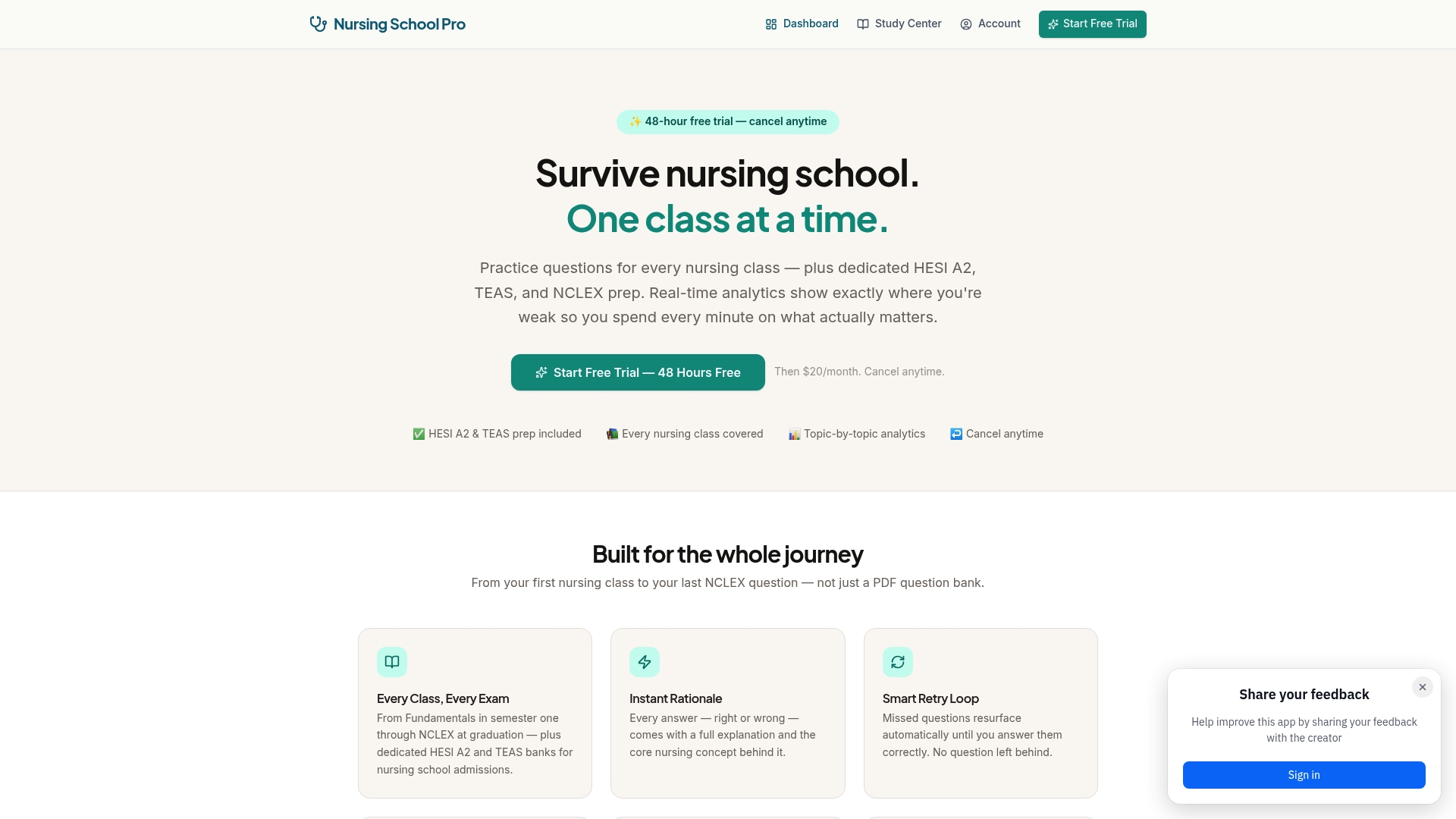
Reading about techniques is the first step. Recognizing them under exam pressure is the second. Nursing School Pro gives you practice questions for every nursing class, plus HESI A2, TEAS, and NCLEX preparation. Each answer comes with an instant rationale, and real-time analytics show which topics need more work. You can try it with a 48-hour free trial. After that, the plan is $20 per month. See the pricing page for details.
If you would rather start with free reading, the Nursing School Study Center collects study resources, and our guide to evidence-based practice examples shows how research findings turn into everyday nursing habits.
A quick study routine for communication content
You can learn this material in short, repeated sessions.
- Day 1: Learn the technique table until you can give a definition and an example for each without looking.
- Day 2: Learn the nontherapeutic list and write one therapeutic replacement for each.
- Day 3: Do 15 to 20 scenario questions. For every miss, write down which pattern you fell for.
- Day 4: Review defense mechanisms and match each to a patient example.
- Day 5: Mix communication questions with other topics so you practice switching.
- Weekly: Role-play one hard conversation aloud with a classmate. Saying the words is very different from recognizing them on paper.
FAQ
What are the 5 main therapeutic communication techniques?
There is no single official list of five, and textbooks vary. The ones students rely on most are active listening, open-ended questions, clarifying, reflecting, and silence. Focusing, restating, summarizing, and giving information round out the usual set. Learn the full table above so you can recognize any of them on an exam.
What is the difference between therapeutic and nontherapeutic communication?
Therapeutic communication keeps the focus on the patient, invites them to share, and builds trust. Nontherapeutic communication blocks that exchange. Common examples are false reassurance, giving advice, changing the subject, judging, and arguing. Ask yourself whether the response keeps the patient talking or closes the conversation.
Why are "why" questions considered nontherapeutic?
A "why" question can sound like blame, which makes patients defensive and less open. Rephrase with "what" or "how": instead of "Why didn't you take your pills?", try "What made it hard to take your pills?" You get the same information with less pressure.
How should a nurse respond to a patient in denial?
Do not argue or force acceptance. Stay calm, acknowledge the feeling, and give information at a pace the patient can handle. Keep checking in, because denial often eases as the patient feels safe. If denial interferes with treatment or safety, involve the care team and, when appropriate, the mental health or social work team.
Is silence really a therapeutic technique?
Yes. Silence gives patients time to collect their thoughts and feelings, and it shows you are not rushing them. Stay present, keep your expression calm, and let the patient start. If the silence goes on a long time, you can gently offer an opening, such as "Take your time. I'm here."
Sources
- 2025 Code of Ethics for Nurses, Provision 1.1 (ANA)
- 2.4 Therapeutic Communication, Fundamentals of Nursing (OpenStax)
- Breaking bad news and the 3-second pause (BoardMaster Blog)