
The HESI A2 Critical Thinking section is a 30-question exam of reasoning in healthcare scenarios. It is not a content test like math or anatomy. It asks whether you can read a situation, weigh the facts and choose a sound next step. Some nursing programs require it and some ignore it, so check your school's list first. Then prepare by practicing scenario questions and studying the rationale behind every answer, including the ones you got right.
This guide explains what the section measures, how schools use the score, what the questions look like, and a method for working through them under time pressure.
TL;DR
- The Critical Thinking exam has about 30 questions on reasoning with facts, patient data, different points of view, and ethical, moral and legal problems.
- Not every program counts it. Some require 75% or higher, and others leave it out of admission entirely.
- Practice with scenario questions, not memorized answer dumps, because the exam tests how you reason and not what you recall.
- Read every rationale, and keep a log of the reasoning errors you repeat.
- Budget time per question: one program's checklist recommends 45 minutes for the 30 items.
Table of Contents
- What the HESI A2 Critical Thinking section measures
- Does your program require it?
- The skills behind the questions
- A worked example, with the rationale
- A five-step method for scenario questions
- Pacing the 30 questions
- How to use answer rationales to improve
- Building the supporting skills
- A simple three-week routine
- Our perspective
- Try the practice on Nursing School Pro
- FAQ
- Sources
What the HESI A2 Critical Thinking section measures
The HESI A2 is the Health Education Systems, Inc. Admission Assessment, a standardized test required for entry into many nursing programs that looks at readiness for nursing school across subjects such as math, biology, grammar, reading comprehension and critical thinking.
The exam is a set of separate tests. According to the University of Texas Rio Grande Valley's FAQ, the HESI A2 consists of nine different exams: seven on academic subject areas and two on personal assessment. The same document notes that many schools of nursing add the Critical Thinking exam as an additional requirement. That is why you will see it listed as optional at one school and mandatory at the next.
Germanna Community College's preparation guide describes the section as 30 questions that examine critical thinking in healthcare scenarios. They cover using facts to solve healthcare issues, ethical, moral and legal problems, different points of view, and patient data.
The point is not to know more medicine than a first-semester student. The point is to show that you can think the way a nurse has to think: gather what you know, separate the relevant from the irrelevant, and decide.
Does your program require it?
The single most useful thing you can do before studying is look up your own school's admission checklist. Policies differ, and the differences are large. Here is how four U.S. programs handle it, from their own published pages:
| Program | How Critical Thinking is treated |
|---|---|
| UTRGV | Applicants must reach 75% or higher on required individual components, including Critical Thinking |
| BMCC (RN) | Checklist recommends a score of 75%-79% on the 30-item exam, with a recommended time of 45 minutes |
| Alvin College (ADN) | The department does not count the test toward admission; required exams are Math, Reading Comprehension, Vocabulary & General Knowledge, Grammar, and Anatomy & Physiology |
| Germanna Community College | Lists the section as part of its HESI A2 entrance exam preparation guide, with 30 questions |
A few practical takeaways follow from the table.
Read the exact wording. "Recommended" and "required" are different. A recommended range tells you where competitive applicants land. A required minimum is a gate.
Check whether scores are per section or cumulative. Some schools set a minimum for individual exams and a separate one for the cumulative score. A strong Critical Thinking result may not rescue a weak reading comprehension score if a school sets a minimum on that exam.
Do not skip it just because one school ignores it. If you are applying to more than one program, a single sitting can serve all of them. If even one of your target schools includes it, plan to prepare. For help deciding how to divide your time across exams, see our guide to which HESI A2 sections to prioritize, and for how schools read results, what counts as a good HESI score.
The skills behind the questions
Texas State Technical College's library guide describes the section as roughly 30 questions meant to assess logical thinking and effective reasoning in specific real-world situations. It lists these skills:
- Analyzing information
- Making inferences and deductions
- Drawing conclusions
- Interpreting graphs and charts
- Understanding statistics
- Analyzing written passages
The full description is on the TSTC study guide. Put together with the Germanna description, you can sort the questions into five working types.
Prioritization and "what comes first"
You get several clients or findings and must decide who needs attention first or which action comes first. These questions reward a framework, not a hunch. Think about airway, breathing and circulation, then acute versus chronic, then stable versus unstable.
Reading patient data
A short chart, a set of vital signs or lab values appears, and you must say what it means or what is missing. This is where graph and chart skills show up. Read the labels and units before you read the numbers.
Ethical, moral and legal situations
You meet a dilemma involving consent, privacy or a client's wishes. The best answer usually protects the client's rights and safety while staying inside your role.
Different points of view
A client, family member and clinician each say something. You identify which statement reflects a concern, which is a fact, and what the nurse should address.
Inference from a passage
You read a short passage and draw a conclusion that the text supports, not one you bring from outside. This overlaps with reading comprehension, so practice there helps here too.
A worked example, with the rationale
The question below is an original practice item we wrote to show the format. It is not taken from any exam.
A nurse in a pediatric clinic is reviewing four clients waiting to be seen. Which client should the nurse assess first?
A. A 6-year-old with a scraped knee, crying but consolable B. A 3-year-old with a temperature of 100.8°F who is drinking fluids C. A 2-year-old with noisy, labored breathing and drooling who is sitting very still D. A 10-year-old with a stable sprained wrist awaiting an X-ray
Answer: C.
Rationale: Labored breathing with drooling and unusual stillness suggests a possible airway problem. Airway is the first priority because it threatens life within minutes. The child with a mild fever who is drinking is stable. The scraped knee and sprained wrist are real concerns but not immediately life-threatening.
Notice what the rationale does. It does not just name the winner. It states a rule (airway first), applies it to the clues, and explains why each other option ranks lower. That structure is what you want from any practice resource, and it is what you should rebuild in your own head when you review.
A five-step method for scenario questions
Under time pressure, a repeatable routine beats improvisation. Try this one.
- Read the last sentence first. Know whether you are being asked for the first action, the best response, or a conclusion the data supports.
- Read the scenario and mark the clues. Note ages, vital signs, symptoms, words like "sudden" and "new," and anything the client or family says.
- Name the rule that applies. Airway, breathing, circulation. Safety. Client rights. Stable versus unstable. Say it to yourself in a few words.
- Eliminate two options. Remove answers that are unsafe, outside a nurse's role, or based on a fact the passage does not give.
- Choose between the final two by asking which one addresses the most urgent problem in the question as asked.
One common trap is picking an answer that is true but not responsive. A statement can be a good nursing action and still not be the first one, or still not answer the question that was asked. Another trap is bringing in outside assumptions. If the scenario does not say the client has a history of something, do not reason as though they do.
Pacing the 30 questions
BMCC's checklist recommends 45 minutes for the 30 items. Your testing site or program may set its own limits, so confirm on your school's page. As a planning figure, 45 minutes works out to 90 seconds per question.
In practice, you will not spend equal time on each. Straightforward inference questions may take 40 seconds. A long scenario with a chart may take two minutes. So:
- Set a first-pass target of about a minute on each question.
- Flag the ones that need more thought and return to them.
- Leave time at the end to review flagged items, not to change answers you were sure about.
When you practice, time yourself in sets of 10 questions with a 15-minute limit, then build up to all 30.
How to use answer rationales to improve
Practice questions only help if you learn from them. A rationale tells you the reason, and the reason is what transfers to a question you have never seen.
Review right answers too. If you guessed or got it right for the wrong reason, you will miss the next version of that question. Mark those as "unsure" and treat them as errors.
Write an error log. After each set, record each miss in one line with three parts: the topic (prioritization, data, ethics), the mistake (misread the question, ignored a clue, picked a true but irrelevant answer) and the rule you should have used. After two weeks, patterns appear. Many students find they miss one type, such as "first action" questions, far more than the others.
Redo missed questions after a few days. Waiting lets you check whether you learned the reasoning or only remembered the letter.
Be wary of answer-dump documents. Several of the top search results for this topic are PDF collections of questions "with answers." A list of answers without clear reasoning teaches you to recognize questions, not to think through new ones. Since this section tests reasoning on new scenarios, choose materials that explain why.

Building the supporting skills
Critical thinking is not isolated from the rest of your preparation.
Germanna's guide lists Kozier & Erb's Fundamentals of Nursing, 10th edition, Chapter 10, and the AHRQ Sample Medical Record as helpful resources. It also links free HESI A2 practice exams, some with worked problems and answer explanations. Reading a sample medical record helps because it shows you how real patient data is laid out, which is exactly what the data questions ask you to interpret.
A few other habits support this section:
- Read short clinical passages daily. Five minutes with a short health article builds the habit of finding what the text actually says.
- Practice with charts. Look at any graph and state its main trend in one sentence.
- Learn the basic priority frameworks. Airway, breathing, circulation, safety, and Maslow's hierarchy of needs come up constantly in nursing reasoning.
To fit this into a full plan alongside math, science and reading, use our HESI A2 study guide and the nursing study plan built on practice questions and instant rationales. If math is the section that worries you more, see HESI A2 math with timed practice.
A simple three-week routine
This is a suggested pattern, not a requirement. Adjust it to your test date.
Week 1: Learn the formats. Do 10 questions a day, untimed. After each, write why every wrong option is wrong. Start your error log.

Week 2: Add the clock. Do 15 questions in 20 minutes, then review. Pick the two error types that show up most and drill them with 10 extra questions each.
Week 3: Simulate. Take one full 30-question set in 45 minutes. Review every flagged item. Redo earlier misses. Rest the day before.
If you study alongside other exams, put Critical Thinking in shorter, more frequent sessions. Reasoning habits build with repetition more than with long single sessions.
Our perspective
We built Nursing School Pro on a simple belief: a correct answer teaches you very little until you know why it is correct. That matters more for Critical Thinking than for almost any other section, because the exam keeps changing the scenario while the reasoning stays the same.
That is why every practice question on our platform comes with an instant rationale. We want you to see the rule behind the answer while the question is still fresh in your mind. Our adaptive retry loops bring weak areas back so you meet them again, and our real-time analytics show which kinds of questions are costing you points, so you can aim your next session at them instead of rereading what you already know.
We also align our material with respected nursing textbooks and national standards, because the habits you form for admission testing should be the same habits that carry you through your first class and on toward graduation. Our goal is a student who reasons well, not one who memorizes well.
Autumn
Try the practice on Nursing School Pro
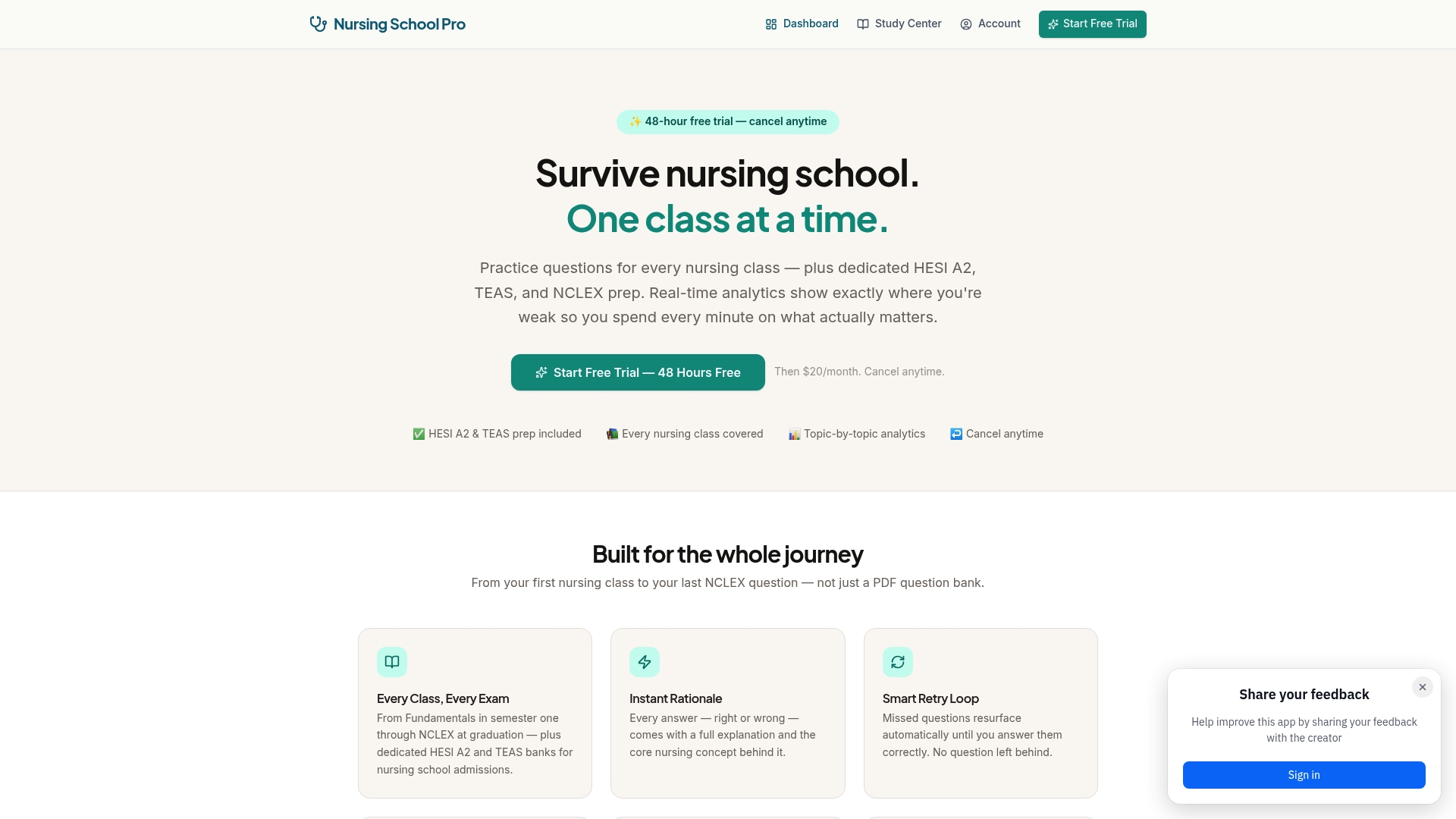
If you want scenario practice with an explanation behind every answer, Nursing School Pro gives you practice questions for nursing classes and for the HESI A2, TEAS and NCLEX, with instant rationales and analytics that highlight your weak areas. You can start with a 48-hour free trial on our site, and the plan is $20 per month afterward, as shown on the pricing page.
As you progress, our study center keeps your tools together, and our guide to NCLEX practice with rationales shows how the same habit carries forward to licensing prep.
FAQ
How many questions are on the HESI A2 Critical Thinking section?
Published school guides describe about 30 questions. Germanna Community College and BMCC both list a 30-item exam. Confirm the format and time limit with your own program or testing site before your test date.
What score do I need on HESI Critical Thinking?
It depends on the school. UTRGV asks for 75% or higher on its required components, and BMCC recommends 75%-79%. Some programs, such as Alvin College's ADN, do not count the test toward admission. Check your program's admission page for the current requirement.
Is the Critical Thinking section the same as the rest of the HESI A2?
It is one of the separate exams that make up the HESI A2, and many schools add it on top of the academic exams. It tests reasoning in healthcare scenarios and not a subject such as math or biology. For the academic subjects, start with our guides to HESI A2 biology and math.
What do Critical Thinking practice questions look like?
They are short scenarios, often with patient data, followed by a question such as who to assess first, what a set of facts means, or what conclusion a passage supports. The worked example earlier in this guide shows the format. The most useful practice sets explain why each wrong option is wrong.
Can I prepare with free resources?
Yes, to a point. Germanna's guide links free HESI A2 practice exams, some with worked problems and explanations. Whatever you use, pick materials with reasoning explained and review every miss in an error log.
Sources
- HESI A2 Nursing Entrance Exam Preparation Guide, Germanna Community College
- HESI Admission Assessment Exam FAQ, UTRGV
- Study Guide: HESI A2, Texas State Technical College Library Guides
- RN Checklist Fall 2023, BMCC
- Nursing (ADN) HESI A2 Exam, Alvin College