
Confirm which sections your program requires, take a timed baseline test, then drill your weakest section first. That single workflow outperforms every "study everything equally" approach. For question practice with instant answer rationales and real-time progress tracking, Nursingschoolpro is the recommended hub. Here's how to put it all together:
- Step 1: Contact your target program and confirm exactly which HESI A2 subtests they require and their minimum score cutoffs.
- Step 2: Take a full-length timed baseline test before you open a single textbook. Your score gaps tell you where to spend your hours.
- Step 3: Start a 6-week focused plan (or a compressed version if your test date is closer), beginning with your lowest-scoring section and finishing with full-length timed simulations.
Key Takeaways
Confirming your program's required sections and minimum cutoffs before you study a single page is the single most important step — everything else follows from that.
| Point | Details |
|---|---|
| Confirm sections and cutoffs first | Contact your program to verify which subtests are required and whether they gate by section or composite. |
| Baseline test before studying | Take a full timed baseline before opening any content; your score gaps define your study priorities. |
| Weakest section gets first attention | Drill your lowest-scoring section first; don't spend extra time on sections already above your target. |
| Full-length sims in final weeks | Run at least two full-length timed simulations and review every missed item with rationale analysis. |
| Nursingschoolpro as your practice hub | Use Nursingschoolpro's instant rationales and analytics to identify error patterns and track real improvement across sessions. |
Table of Contents
- What does the HESI A2 actually look like?
- What should you study for each HESI A2 section?
- How do you build a study plan that actually works?
- Which resources give you the best return?
- How should you practice with questions to actually improve?
- How do you raise your HESI A2 math score quickly?
- How does HESI scoring work, and what score do you need?
- What should you do on test day?
- Why rationale-based practice changes how fast you improve
- Start your HESI A2 prep with a 48-hour free trial
- Sources
What does the HESI A2 actually look like?
The HESI A2 is a modular, computer-based exam. Schools choose which subtests each applicant must complete, so two students at different programs may sit for entirely different combinations. That's the first thing to confirm before you study a single page.
The core academic sections most programs require are Math, Reading Comprehension, Vocabulary and General Knowledge, and Grammar. Science subtests, including Anatomy and Physiology, Biology, Chemistry, and Physics, are common but not universal. A small number of programs also require a Critical Thinking section.
Typical section structure at a glance:
The exam sections have approximate numbers of questions and typical time limits commonly in these ranges: Math, Reading Comprehension, Vocabulary & General Knowledge, and Grammar commonly have around fifty scored questions each with time allowances close to fifty minutes. Science sections like Anatomy & Physiology, Biology, Chemistry, and Physics typically have fewer questions and shorter time allotments.
One important detail: the exam mixes in unscored pilot items alongside the scored questions, and you won't know which is which. Treat every question as if it counts.
Scoring basics:
- No single national passing score exists. Programs set their own cutoffs.
- Most programs require a minimum passing score per section or composite, often set at what would be described as a moderately high threshold. Competitive programs often expect even higher performance.
- Some programs gate on section minimums rather than a composite score, meaning a low score in one section can disqualify you even if your overall average looks fine.
What should you study for each HESI A2 section?
Not every section rewards the same study strategy. Vocabulary and Math scores tend to rise fastest with focused daily practice. Anatomy and Physiology and Biology take longer because they require building conceptual frameworks, not just memorizing facts.
Math
The HESI A2 math section focuses on applied arithmetic, not abstract algebra. High-yield topics:
- Fractions, decimals, and percentages (conversions between all three)
- Ratios and proportions, including dosage-style word problems
- Unit conversions (metric to standard and back)
- Basic algebra: solving for one variable
- Roman numerals (still appear on some versions)
- Rounding and estimation
- Reading and interpreting simple data tables
The on-screen basic calculator is available for most math items, but it won't save you if you don't understand the setup. Practice the problem structure, not just the arithmetic.
Reading comprehension
- Identifying the main idea of a passage
- Drawing inferences from context
- Understanding the author's purpose and tone
- Vocabulary in context (word meaning from surrounding text)
- Distinguishing fact from opinion
- Following the logic of an argument
Bring only what the passage says. Outside knowledge hurts you here.
Vocabulary and general knowledge
Vocabulary is a finite pool. Consistent daily flashcard work produces steady gains faster than any other study method per minute invested. Focus on:
- Medical and healthcare terminology (prefixes, suffixes, roots)
- Common academic vocabulary (analogies, context clues)
- Word relationships and connotations
Quizlet decks built around HESI-specific vocabulary lists are a practical starting point. Aim for 20–30 new terms per day with spaced repetition.
Grammar
- Subject-verb agreement
- Pronoun-antecedent agreement
- Correct verb tense and tense consistency
- Comma rules and punctuation
- Sentence structure: fragments and run-ons
- Commonly confused words (affect/effect, their/there/they're)
Anatomy and physiology
A&P is recall-based and rewards system-level thinking. High-yield clusters include cardiac blood flow (trace blood through all four chambers), endocrine gland-to-hormone mapping, directional and positional terms, and organ system cause-and-effect. Also prioritize:
- Skeletal and muscular system basics
- Nervous system divisions (CNS vs. PNS, sympathetic vs. parasympathetic)
- Respiratory mechanics
- Digestive enzyme functions
- Urinary system filtration steps
For quick clinical reference while studying A&P, the basic nursing assessment guide at Nursingschoolpro covers vital signs and assessment terms that overlap with A&P content.
Biology
- Cell structure and organelle functions
- Mitosis vs. meiosis
- DNA replication and protein synthesis basics
- Genetics: dominant/recessive, Punnett squares
- Photosynthesis and cellular respiration (inputs and outputs)
- Ecosystems and basic ecology
Chemistry
- Atomic structure: protons, neutrons, electrons
- Periodic table trends (electronegativity, atomic radius)
- Chemical bonding: ionic vs. covalent
- Balancing simple equations
- Acids, bases, and pH scale
- Molarity and concentration basics
Physics
- Newton's laws of motion
- Work, power, and energy
- Waves: frequency, wavelength, amplitude
- Electricity: current, voltage, resistance (Ohm's law)
- Optics: reflection and refraction basics
- Fluid dynamics fundamentals
Critical thinking (if required)
- Evaluating the strength of an argument
- Identifying assumptions and logical fallacies
- Distinguishing relevant from irrelevant information
Pro Tip: After your baseline test, rank your sections from lowest to highest score. Study the bottom two sections first and hardest. Don't spend extra time on sections already above your target cutoff — that's time stolen from where you actually need it.
How do you build a study plan that actually works?
The most effective HESI A2 study schedule follows a four-phase cycle: baseline test, triage, focused drilling, and full-length simulation. Starting with a baseline before scheduling your study weeks is the single highest-leverage move most students skip.

Retest every two weeks to measure real improvement, not just effort. If a section score isn't moving, change the resource or the method, not just the hours.
Sample 6-week HESI A2 study plan
| Week | Focus | Daily Practice Tasks |
|---|---|---|
| 1 | Baseline + triage | Full baseline test; score each section; rank weakest to strongest; build resource list |
| 2 | Weakest section (deep drill) | 20–30 timed questions; immediate rationale review; error log entries |
| 3 | Second-weakest section | Same drill structure; add 15-min vocabulary flashcards daily |
| 4 | Third-priority section + vocabulary | Mixed-section mini-sets; continue vocab; first full-length timed sim |
| 5 | Mixed practice + science sections | Interleaved question sets across all required sections; second full-length sim |
| 6 | Full-length simulations + review | Two to three full-length timed exams; review every missed item; light reading on strong sections |
Compressed and extended alternatives
4-week plan (moderate baseline): Combine weeks 1–2 into a single intensive triage week. Run two focused drill weeks, then finish with a simulation week. Daily commitment: 90–120 minutes.
2-week crash plan: This works only if you have a recent science background and a strong baseline. Diagnostic triage on day one, then interleave two subjects at a time in 45-minute blocks. No time for slow reading — go straight to question banks and rationale review. Daily commitment: 2–3 hours minimum.
8–12-week relaxed plan: Ideal if you're balancing work or classes. One section per week, 45–60 minutes daily. Use the extra time for spaced repetition on vocabulary and math. Run full-length sims in weeks 9 and 11.
Pro Tip: Run at least two full-length timed simulations before exam day, and review every missed item immediately after. Don't just note the right answer — understand why each wrong choice was wrong. That's where the learning actually happens.
Which resources give you the best return?
The right combination of resources matters more than the total number of hours you log. Here's how each type fits into a productive HESI A2 prep workflow.
Official review book: The HESI Admission Assessment Exam Review published by Elsevier is the closest thing to an official study guide. Use it for content review at the start of each new section, not as a primary practice tool. Read the relevant chapter, then immediately move to questions.
Question banks with rationales: This is where most of your active study time should go. Reviewing rationales — understanding why the correct answer is right and why each distractor is wrong — accelerates learning faster than re-reading content. Platforms that pair question banks with instant, detailed rationales and progress analytics produce faster score gains than static practice sets.
Nursingschoolpro's study center is built around exactly this model: HESI A2 practice questions with instant rationales and real-time analytics that surface your weak topics across sessions. Use it as your daily practice hub.
Flashcards: Quizlet decks work well for vocabulary and A&P terminology. The key is spaced repetition — review cards you got wrong more frequently than cards you got right. Fifteen minutes of focused flashcard work daily beats a two-hour cramming session once a week.
Full-length simulations: Reserve these for weeks 4–6 (or the final two weeks of any plan). Simulations under timed, realistic conditions reveal pacing problems and stamina issues that mini-sets never expose.
Free textbook backup: For conceptual science review when you need more depth than a review book provides, OpenStax offers free, peer-reviewed textbooks covering biology, anatomy, chemistry, and physics. Use them for concept clarification, not exam-style practice.
Session structure that works: Start each study session with a 10-minute topic review (book or notes), run a timed 20–30 question set, review every rationale immediately after, then log your errors by question type and root cause. That four-step loop is more productive than any single resource alone.
How should you practice with questions to actually improve?
Doing questions is not the same as learning from questions. The difference is what you do after you submit an answer.
Weekly practice cadence (6-week plan):
- Days 1–5: Two timed mini-sets of 20–30 questions per day, each followed by immediate rationale review
- Day 6: One full section-length timed set (50 questions for core sections, 25 for science)
- Day 7: Error log review and light flashcard work only — no new questions
Building and using an error log:
Create a simple three-column log: question topic, root cause of the error (content gap, misread the question, careless arithmetic, test anxiety), and the corrective action you took. Review the log weekly. If the same root cause keeps appearing, the problem isn't the content — it's the habit.
Interleaving and difficulty progression:
Start each section with easier questions to build confidence, then move to harder mixed-topic sets. By week 5, your practice sets should pull from multiple sections simultaneously. This interleaving approach builds retrieval strength that blocked practice (one topic at a time, all week) doesn't.
Drop a topic from active study when you've scored above your target cutoff on it for two consecutive sessions. Shift that time to a section still below target.
Pro Tip: When you review a rationale, cover the answer and re-read the question first. Ask yourself what you'd choose now. If you'd still choose wrong, the rationale didn't land — read it again more slowly and write the key concept in your own words. That extra step is what converts a missed question into a retained fact. For more on HESI and TEAS study strategies, the shared principles around rationale review and timed practice apply across both exams.
How do you raise your HESI A2 math score quickly?
Math is one of the fastest sections to improve because the topic list is short and the question formats repeat. The core topics are fractions, ratios and proportions, percentages, unit conversions, and applied word problems framed in nursing contexts.
High-yield math topic checklist:
- Converting between fractions, decimals, and percentages without a calculator
- Setting up and solving proportion equations (a/b = c/d)
- Metric conversions: mg to g, mL to L, kg to lb
- Dosage-rate problems: mg/kg, drops per minute
- Solving one-variable algebra equations
- Interpreting word problems: identifying what's being asked before calculating
Two sample problems:
Problem 1: A patient weighs 68 kg. The ordered dose is 5 mg/kg. How many milligrams should be administered? Solution: 68 × 5 = 340 mg. Set up the multiplication first, then calculate. Don't rush past the unit.
Problem 2: Convert 0.75 to a percentage. If the question asks for a fraction, 0.75 = 3/4. Know all three forms.
Daily math drill: Ten minutes of mental math (no calculator) every morning before any other study. Focus on fraction-to-decimal-to-percent conversions and proportion setups. Speed and accuracy both improve with daily repetition.
Pro Tip: The most common math errors on the HESI A2 aren't calculation mistakes — they're setup mistakes. Students calculate the right answer to the wrong question. Before you touch the calculator, write down what the question is actually asking and what unit your answer needs to be in. That 10-second habit eliminates a significant share of careless errors. For a deeper look at dosage calculation pitfalls, the rounding errors that trip up nursing students on math sections are worth reviewing before test day.
How does HESI scoring work, and what score do you need?
Your HESI A2 score is reported as a percentage for each section, converted from your raw score on the scored items. Pilot (unscored) items don't affect your score, but you can't identify them during the exam, so every question gets your full attention.
There is no single national passing score. Programs set their own cutoffs, and those cutoffs vary significantly:
- 75–80%: Common minimum threshold at many programs. Scoring below this in any required section typically disqualifies the application.
- 85%+: Expected at competitive programs. Some top programs use HESI scores as a ranking factor, not just a pass/fail gate.
- Section gating: Some programs require a minimum score in each individual section rather than (or in addition to) a composite. A 90% composite with a 68% in Biology can still fail you at a gating program.
Setting your target score:
Research your specific program's requirements before you start studying. If the program gates by section, your target for every required section is the cutoff plus a 5–10 point buffer. If the program uses a composite, identify which sections you can realistically score highest in and weight your study time accordingly.
Retaking the HESI A2:
Most programs allow retakes, but many impose a waiting period (commonly 60 days) and limit the number of attempts. Check your program's retake policy before your first attempt. If you need to retake, use your section score report to identify exactly where points were lost, then rebuild your study plan around those gaps.
Pro Tip: *If your program gates by section, treat each section as its own independent exam. A strong composite score won't save you if one section falls below the cutoff.
What should you do on test day?
Logistics and pacing matter as much as content knowledge on exam day. A strong study plan can be undone by poor sleep, a late arrival, or a panicked first 10 minutes.
Pre-test checklist:
- Confirm your testing center location and arrival time at least two days before
- Bring a valid government-issued photo ID (check the exact ID requirements for your testing site)
- Get 7–8 hours of sleep the night before — cramming the night before a modular exam does more harm than good
- Eat a real meal before the exam; avoid heavy or unfamiliar foods
- Arrive 15–20 minutes early to handle check-in without rushing
- Know which sections you're taking and in what order (if your program specifies)
In-test pacing:
For 50-question sections with 50–60 minutes, you have roughly one minute per question. For 25-question science sections with 25 minutes, the pace is the same. If a question is taking more than 90 seconds, flag it and move on. Return to flagged items after completing the rest of the section.
On reading comprehension, read the question first, then the passage. You're looking for a specific answer, not a general understanding. Bringing in outside knowledge is the most common reading error — if the passage doesn't say it, don't choose it.
Common mistakes to avoid:
- Overreading: second-guessing a clear answer because you're looking for a trick
- Unit mismatches on math: calculating the right number in the wrong unit
- Rushing the first few questions to "bank time" — this increases careless errors early
Managing test anxiety:
Before each section starts, take three slow breaths and remind yourself that you've practiced under timed conditions. Anxiety peaks in the first five questions; it typically drops once you're in a rhythm. If you feel stuck, skip and return. A blank answer earns zero; a reasoned guess has a chance.
After the exam, write down any topics that surprised you while they're fresh. If you need to retake, that list is your starting point.
Why rationale-based practice changes how fast you improve
Most students study the HESI A2 the same way: read a chapter, do some questions, check the answer key, move on. The problem is that checking an answer key tells you what you got wrong. It doesn't tell you why you got it wrong or what to do differently next time.

The research on this is consistent. Reviewing rationales — understanding why the correct answer is right and why each distractor is wrong — is the highest-yield study method available for multiple-choice exam prep. It's not about reading more content. It's about interrogating every wrong answer until you understand the reasoning gap it exposed.
What I've seen students underestimate is how much the analytics layer matters alongside rationale review. That's the difference between studying Biology and fixing the actual problem.
Nursingschoolpro's practice question platform is built around both of these principles: instant rationales on every question and real-time analytics that track error patterns across sessions. Students who use it as their primary practice hub — not as a supplement to passive reading, but as the center of their daily study loop — tend to close score gaps faster than those who rely on static review books alone.
The conventional wisdom says "study more." The better advice is "study what's broken, and understand why it broke."
Start your HESI A2 prep with a 48-hour free trial
Nursingschoolpro gives nursing school applicants a focused, analytics-driven alternative to generic test prep. Instead of working through a static review book and hoping the content sticks, you get a practice environment that shows you exactly where your score is leaking and why.
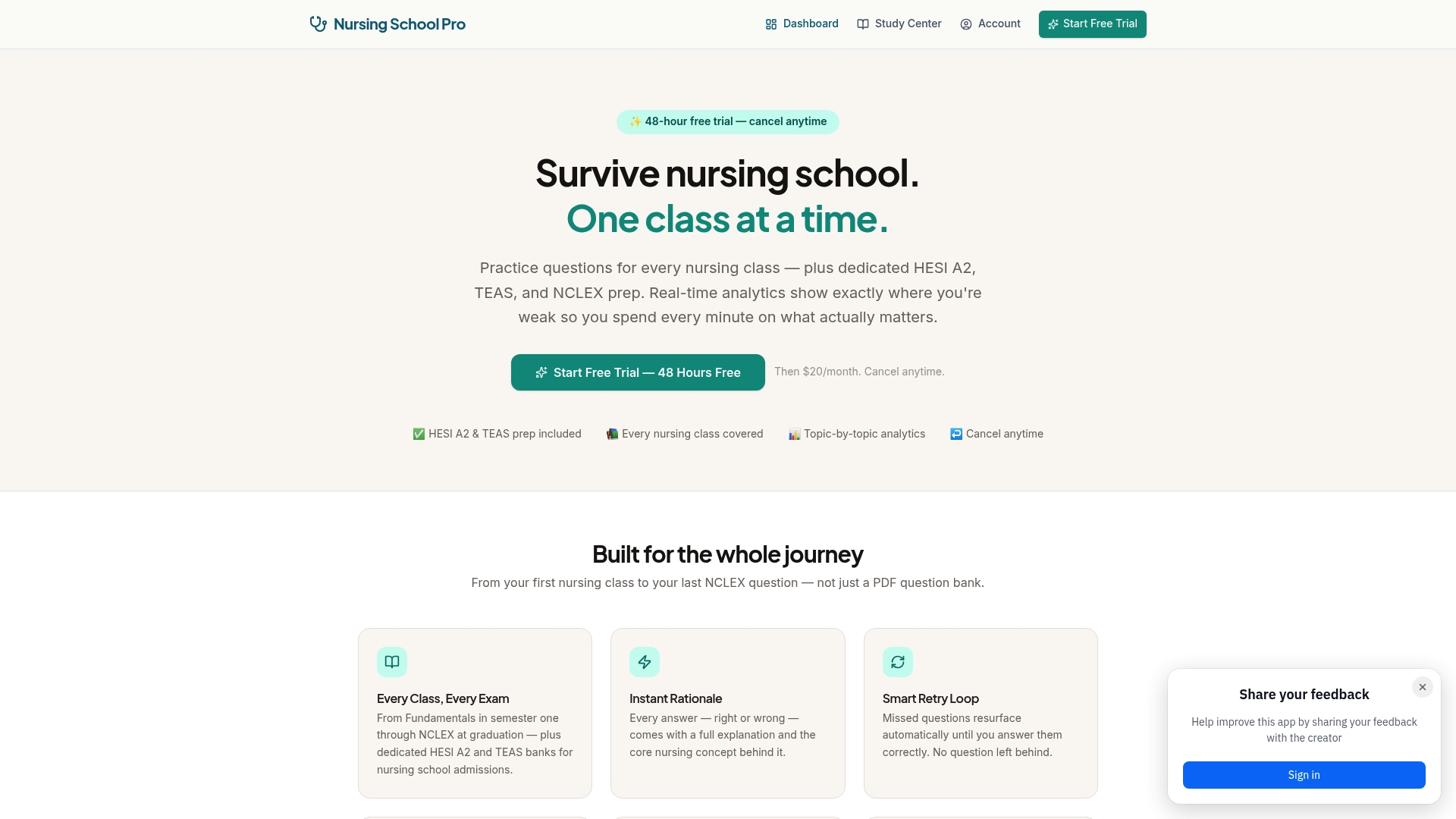
The 48-hour free trial includes full access to HESI A2 practice question banks with instant rationales, full-length timed simulations, real-time progress analytics, and downloadable study templates aligned with national curriculum standards. At $20/month after the trial, it's built for short-term exam prep without a long-term commitment.
To get the most from your trial window: take a baseline timed set in your weakest section on day one, review every rationale immediately, check your analytics dashboard to confirm which question types drove your errors, and build your first week's study plan around that data. That's a better first 48 hours than most students get from two weeks of unfocused reading.
Start your free trial and go into your HESI A2 with a score gap you've already started closing.
Sources
- HESI A2 Study Guide 2026: Vocabulary List, A&P Review, Practice Tests
- HESI: HESI Admission Assessment Prep Guide: Making a Study Plan
- FREE HESI A2 Study Guide 2026 + Quizzes & Readiness Score