
The HESI A2 biology section has 30 questions, and you get about 25 minutes to answer them. It rewards students who know a short list of topics well: cells, biological molecules, metabolism, photosynthesis, genetics and DNA. This guide covers what each topic looks like, how to review it, and how to tell when you are ready.
TL;DR
- The biology section has 30 items, 25 scored and 5 unscored pilot questions, with a recommended time of 25 minutes.
- Content centers on cells, biological molecules, metabolism, cellular respiration, photosynthesis, genetics and DNA.
- Start with a diagnostic test, then spend your time on the topics you miss, not the ones you already know.
- Plan for at least six weeks if you are also studying the other sections, or use a compressed two-week plan if your test date is close.
- Practice questions with a written rationale for every answer teach you the reasoning, not just the right letter.
Table of Contents
- What the HESI A2 biology section looks like
- The biology topics to know
- How biology on the HESI A2 compares with the TEAS
- Build a biology study plan that fits your test date
- Which practice questions help most
- Perspective
- Try biology practice with instant rationales
- Test-day habits for the biology section
- FAQ
- Sources
What the HESI A2 biology section looks like
The HESI A2 is a computer-delivered, modular exam. Each nursing program chooses which sections you must take, and most programs require six of the eight. Biology is one of the science sections programs ask for most often. Check your target school's admission page before you spend weeks on it, because some programs skip biology and require anatomy and physiology instead.
Here is what to expect on test day:
| Feature | Biology section |
|---|---|
| Total items | 30 |
| Scored items | 25 |
| Unscored pilot items | 5 |
| Recommended time | 25 minutes |
| Main question type | Multiple choice |
Source for the item counts and timing: Georgia Southern University's HESI A2 admission document. You will not know which five questions are pilot items, so treat every question as if it counts.
The exam is primarily multiple choice. That makes the format simple, but the content still demands real understanding. A multiple-choice question about osmosis can include three answer choices that sound plausible, and only a student who understands the process can eliminate them.
If you are deciding which sections deserve the most of your time, our guide on which HESI A2 sections to prioritize walks through the trade-offs.
The biology topics to know
Academic prep centers describe the same core list. FSU's Academic Center for Excellence names cells, biological molecules, metabolism, cellular respiration, photosynthesis, genetics and DNA. Its two-week plan splits biology into chemical and cellular foundations, cellular processes, and molecular biology and genetics. That is a useful way to organize your own notes, and the sections below follow it.
Chemical and cellular foundations
Start with the building blocks. You should be able to explain:
- The four classes of biological molecules: carbohydrates, lipids, proteins and nucleic acids. Know the monomer of each (simple sugars, fatty acids and glycerol, amino acids, nucleotides) and one job each performs.
- Water and pH: why water is a good solvent, what an acid and a base are, and why the body works to keep pH in a narrow range.
- Cell structure: the function of the nucleus, mitochondria, ribosomes, endoplasmic reticulum, Golgi apparatus, lysosomes and the cell membrane.
- Prokaryotes versus eukaryotes: which cells have a nucleus and membrane-bound organelles and which do not.
Questions here often give you a job and ask for the organelle, or name an organelle and ask what would happen if it stopped working. Learn each organelle by its job, not just its name.
Cellular processes
This is where most students lose points, because the topics connect to each other.
Transport across the membrane. A student on a pre-nursing forum advises reviewing the transport methods of active transport, passive transport, diffusion and osmosis as much as possible. The distinctions below are what the test checks:
| Process | Energy needed? | Direction | Quick cue |
|---|---|---|---|
| Simple diffusion | No | High to low concentration | Molecules spread out |
| Facilitated diffusion | No | High to low concentration | A channel or carrier helps |
| Osmosis | No | Water moves toward higher solute concentration | Only water moves across |
| Active transport | Yes (ATP) | Low to high concentration | Moves "uphill" |
Active transport matters in the body at scale: OpenStax College Physics reports that at least 25% of the body's energy is spent on active transport of substances at the cellular level. When a question mentions ATP, a pump or movement against a gradient, think active transport.
Cellular respiration and photosynthesis. Learn them as mirror images. Photosynthesis uses light, water and carbon dioxide to make glucose and oxygen. Cellular respiration uses glucose and oxygen to make ATP, carbon dioxide and water. Know where each happens (chloroplasts and mitochondria) and the three stages of respiration: glycolysis, the Krebs cycle and the electron transport chain. Be ready for the difference between aerobic and anaerobic pathways, including that fermentation yields far less ATP.
Enzymes and metabolism. Enzymes lower activation energy and are specific to their substrates. Expect questions on what happens to enzyme activity when temperature or pH changes drastically, and on the difference between anabolic reactions (building) and catabolic reactions (breaking down).
The cell cycle. Know the phases of mitosis (prophase, metaphase, anaphase, telophase), what meiosis does differently, and why meiosis produces genetic variety.
Molecular biology and genetics
This group is the most calculation-friendly part of biology, so it is a good place to gain easy points.
- DNA structure: a double helix of nucleotides, with adenine pairing with thymine and guanine pairing with cytosine. RNA uses uracil in place of thymine.
- The central flow of information: DNA is transcribed to mRNA in the nucleus, then translated into a protein at the ribosome.
- Mendelian genetics: dominant and recessive alleles, genotype versus phenotype, homozygous versus heterozygous.
- Punnett squares: practice until you can do them in under a minute.
A typical question gives you parents with set genotypes and asks about the offspring. For example, if one parent is BB and the other is bb, every child is Bb, so all of them inherit the dominant trait. Write the square out even when you think you know the answer. It takes seconds and prevents careless errors.
How biology on the HESI A2 compares with the TEAS
If your list includes schools that accept the TEAS instead, the biology content is organized differently. According to Nurse.org's comparison:
- The TEAS Science section has 50 questions covering anatomy and physiology, biology, chemistry and scientific reasoning in 60 minutes.
- The HESI separates Biology and A&P into their own 25-question, 25-minute sections, with Chemistry optional.
- The TEAS uses five question formats and averages about 1.4 minutes per question, while the HESI is mostly multiple choice at about 1.0 minute per question.
- The TEAS is published by ATI and the HESI by Elsevier.
The practical takeaway: HESI biology gives you a dedicated block of time for biology alone, so the questions can go deeper into cell processes and genetics. If you are preparing for both, our TEAS 7 science plan shows how to cover the overlap once.
Build a biology study plan that fits your test date
The best study guide is the one that turns into a calendar. Two academic sources agree on the basics: test yourself first, study early, and put extra time into weak areas.
FSU's Academic Center for Excellence recommends taking a diagnostic practice test first to see which sections and content to review, starting early so you avoid cramming, building a plan around your normal schedule, and spending more time on areas that need improvement.

If you have six weeks or more
Western Technical College recommends starting at least six weeks before the test, studying a few hours each week, and allowing at least one week for each of the four academic sections. Here is how biology can fit inside that:
- Week 1: Take a diagnostic biology test. Sort every miss into one of the three groups above: foundations, cellular processes, or molecular biology and genetics.
- Weeks 2 to 3: Study your weakest group first. Write one-page summaries from memory, then check them against your textbook.
- Week 4: Move to the second weakest group and add timed sets of 25 questions in 25 minutes.
- Week 5: Mix all topics together, because the real test does.
- Week 6: Take a full timed practice section, review every miss, and do a light pass on weak notes. Do not learn new material the night before.
If you only have two weeks
FSU's two-week plan begins with diagnostics in biology, math, A&P and reading comprehension, then gives more time to your weaker sections. For biology alone, a short version looks like this: days 1 to 2 for the diagnostic and notes on transport and organelles, days 3 to 6 for metabolism and cell division, days 7 to 9 for DNA and genetics, and the remaining days for mixed timed sets.
For a wider look at how biology fits with the other sections, read our complete HESI A2 study guide. If you want a structure that pairs practice questions with rationales week by week, see our nursing study plan.

Which practice questions help most
Not all practice is equal. Use three kinds, in this order:
- Untimed topic sets. Ten to fifteen questions on one topic, such as membrane transport. Your goal is understanding, so read every answer choice and decide why the wrong ones are wrong.
- Timed mixed sets. Twenty-five questions in 25 minutes, with topics shuffled. This builds the pacing you need on test day.
- A full simulated section. Do this once or twice near the end, in a quiet place, without notes.
The rationale is the most important part. A right or wrong mark tells you what happened. A rationale tells you why, and the why transfers to the next question. After each set, write down the concept behind every miss, not just the answer. Over a week, patterns show up: maybe you confuse osmosis with diffusion, or mix up transcription and translation. Those patterns tell you what to study next.
When you review, sort misses into three buckets:
- Did not know it: go back to your notes and relearn the concept.
- Knew it but misread: slow down and underline the key word, such as "not" or "except."
- Guessed right: count it as a miss, because you cannot rely on luck.
Perspective
We built Nursing School Pro around one idea: students improve fastest when every practice question explains itself. In biology, that matters even more, because a missed question about osmosis or protein synthesis usually points to a gap in a concept, not a gap in memory.
That is why our platform gives an instant rationale for each answer and tracks your results in real time, so you can see which topics keep costing you points. Our content is designed to align with respected nursing textbooks and national standards, so what you review supports you not only on the HESI A2 but in your first nursing classes too.
Our advice for biology: take a diagnostic early, let the analytics show your weak areas, and retry those topics until the reasoning feels natural. Short, focused sessions beat long, unfocused ones.
Autumn
Try biology practice with instant rationales
Nursing School Pro offers practice questions for nursing classes and for HESI A2, TEAS and NCLEX prep, with an instant rationale for every answer and analytics that highlight weak areas. You can start with a 48-hour free trial on the Nursing School Pro site, and the plan is $20 per month, as listed on the pricing page.
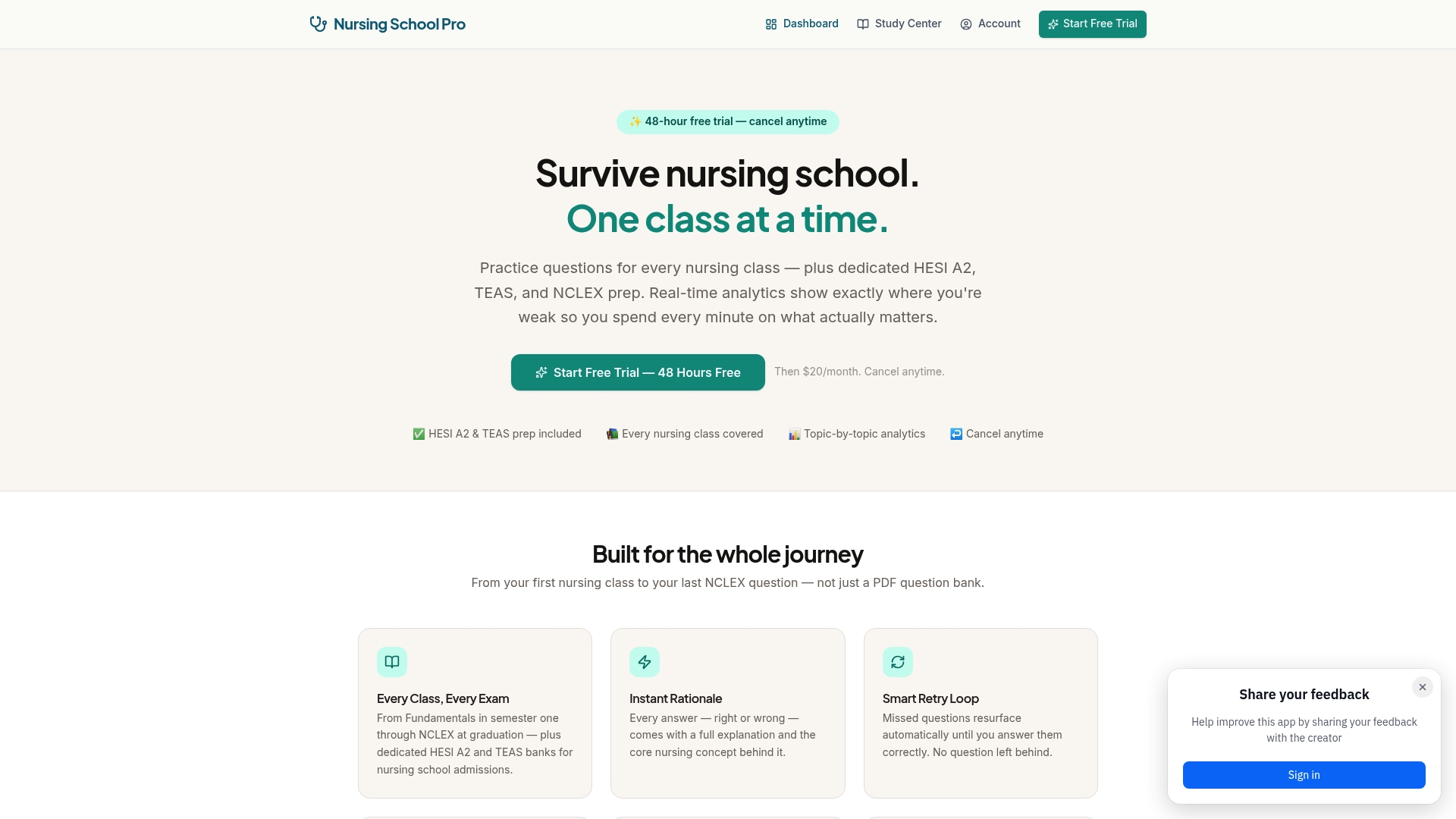
If you are still choosing between programs and exams, the Study Center is a good place to see what is available.
Test-day habits for the biology section
- Pace yourself. With 30 items in a recommended 25 minutes, you have roughly 50 seconds per question. Do not stall on one hard item.
- Answer every question. You cannot tell which five are unscored, so leave nothing blank.
- Eliminate first. Cross out choices that contradict a rule you know, such as an answer that says osmosis needs ATP.
- Watch for qualifiers. Words like "primarily," "except" and "not" change the correct answer.
- Use scratch space for genetics. Draw the Punnett square instead of doing it in your head.
After the test, you will want to know whether your score is competitive. Our article on what counts as a good HESI score explains how to think about it. If math is next on your list, the HESI A2 math guide covers timed practice.
FAQ
How many questions are on the HESI A2 biology section?
The section has 30 items: 25 are scored and 5 are unscored pilot questions. The recommended time is 25 minutes, according to Georgia Southern University's HESI A2 document. You will not know which items are pilot questions, so answer all of them carefully.
What topics should a HESI A2 biology study guide include?
It should cover cells, biological molecules, metabolism, cellular respiration, photosynthesis, genetics and DNA, the list named by FSU's Academic Center for Excellence. Organize your notes into three groups: chemical and cellular foundations, cellular processes, and molecular biology and genetics. Add practice questions with rationales to each group.
How long should I study for HESI A2 biology?
Western Technical College suggests starting at least six weeks before your test and studying a few hours a week across the academic sections. If your test is sooner, a two-week plan can work if you start with a diagnostic and focus on weak topics.
Do all nursing programs require HESI A2 biology?
No. Each program chooses its required sections, and most require six of the eight. Biology is one of the most commonly required science sections, but check your school's admission requirements to be sure.
Sources
- HESI A2 Prep, FSU Academic Center for Excellence
- HESI A2 Two-Week Study Plan, FSU
- HESI Admission, Georgia Southern University
- Making a Study Plan, Western Technical College
- TEAS vs HESI A2, Nurse.org
- Molecular Transport Phenomena, OpenStax College Physics 2e
- Hesi A2 Biology, r/prenursing