
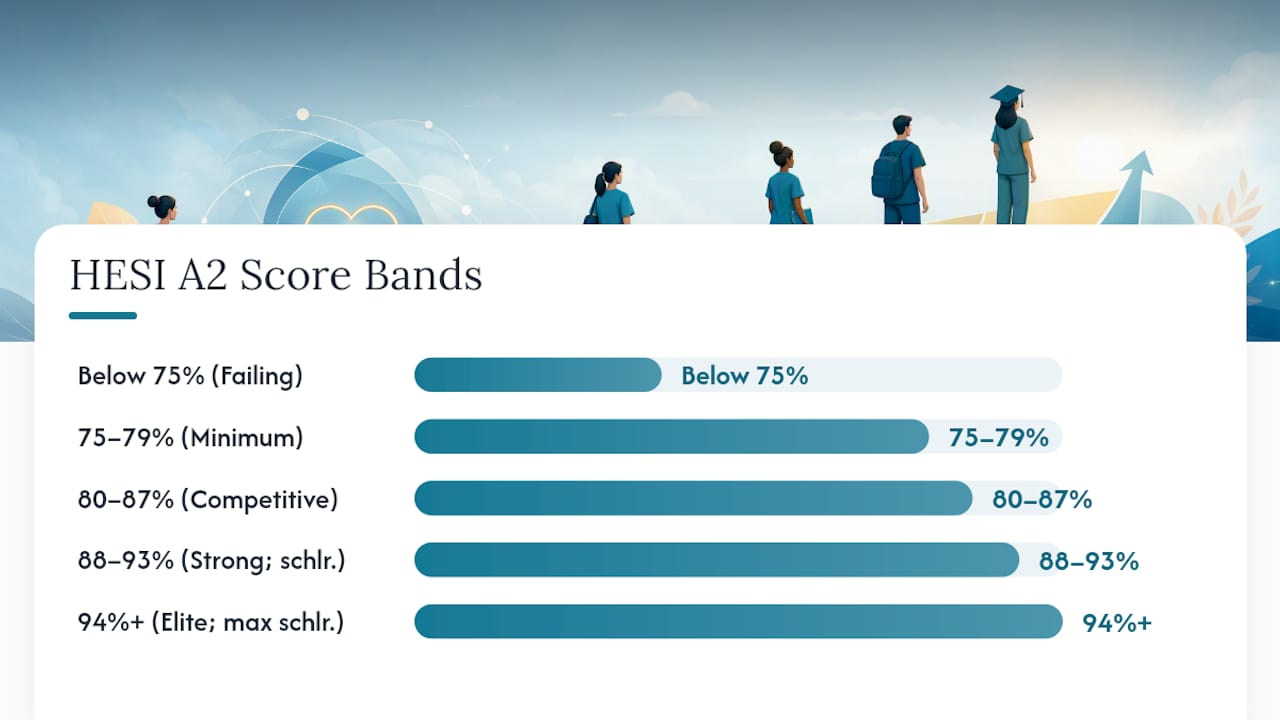
A good HESI A2 score for most U.S. Here is the full picture, broken into bands you can act on:
- Below 75%: Failing or below minimum at most programs. A retake is necessary before applying.
- 75–79%: Meets the floor for some ADN programs but leaves little margin. Waitlist risk is real.
- 80–87%: Competitive for many BSN and ADN programs. This is the range most applicants should target as a baseline.
- 88–93%: Strong. Opens scholarship consideration at some schools and improves ranking in competitive cohorts.
- 94% and above: Elite. Puts you near the top of most applicant pools.
One distinction matters more than any single number: the HESI A2 uses a percent-correct score (0–100%) for admissions, while the HESI Exit Exam uses Elsevier's HESI Predictability Model (HPM), a scaled score ranging from 0 to 1,500 that forecasts NCLEX first-attempt pass probability. A score on the Exit Exam corresponds to an acceptable mastery level with a high predicted NCLEX pass rate. These two scoring systems are not interchangeable. Comparing your A2 percent to an Exit HPM number is like comparing miles to kilometers.
Key Takeaways
| Point | Details |
|---|---|
| Score bands that matter | Below 75% disqualifies; 80–87% is competitive; 88–93% is strong; 94%+ is elite. |
| No universal passing score | Every program sets its own cutoffs, section minimums, and recency windows. |
| A2 percent vs. Exit HPM | HESI A2 uses percent (0–100%); HESI Exit uses scaled HPM (0–1,500). Never compare them directly. |
| Immediate next step | Verify your score report, check each school's policy, then decide retake or apply. |
| Nursingschoolpro | Offers targeted HESI A2 practice with instant rationales and analytics for a 48-hour free trial. |
Table of Contents
- What each HESI A2 score band actually means for your application
- How the HESI A2 is actually scored
- How admissions committees actually use your HESI scores
- Quick reads on common specific scores
- What to do immediately after you get your score
- A focused study plan to raise your HESI A2 score
- Realistic targets and where HESI fits in holistic admissions
- Nursingschoolpro gives you targeted HESI practice with instant feedback
- Sources
What each HESI A2 score band actually means for your application
Aggregated admissions data across U.S.
| Score Band | Label | Common Program Reaction |
|---|---|---|
| Below 75% | Failing/Disqualifying | Application rejected or held; retake required |
| 75–79% | Minimum/Borderline | Eligible at some ADN programs; waitlist risk high |
| 80–87% | Competitive | Accepted at most ADN and many BSN programs |
| 88–93% | Strong | Preferred range; scholarship eligibility at some schools |
| 94%+ | Elite | Top of most applicant pools; maximum scholarship consideration |
The practical stakes differ by degree level. If your school list includes both, the BSN cutoff governs your target.
Scholarship eligibility is a secondary but real consideration.
Pro Tip: A practical strategy is to identify the highest published cutoff on your school list and add a buffer to account for test-day variability, ensuring competitiveness even if one section underperforms.
How the HESI A2 is actually scored
The composite score is the average of all required sections your program specifies. According to the HESI A2 Scoring Guide, common required sections include Reading Comprehension, Grammar, Vocabulary, and Math, though programs vary in which sections they count.
Two terms trip up a lot of students: percent and percentile. Your percent score is simply the share of questions you got right on that form. A percentile rank compares you to a reference group. Some programs publish cutoffs in percentile terms rather than percent, so read your target school's admissions language carefully before assuming the two are the same.
What to look for on your score report: Section scores (each as a percent), composite score (average of required sections), test date (for recency verification), and any program-specified section minimums. If a section score is missing, that section may not have been required or may need to be retaken separately.
The percent score is the standardized output, not the raw count.
How admissions committees actually use your HESI scores
There is no universal passing score for the HESI A2. Every program sets its own rules, and those rules have more moving parts than most applicants realize.
Common admissions policies include:
- Per-section minimums: Many programs require a minimum score on each section regardless of the composite; a strong composite with a weak section might still lead to disqualification.
- Composite cutoffs: The averaged score across required sections must meet or exceed the published threshold.
- Score weighting: Some programs weight Reading or Math more heavily in their ranking formula.
- Recency windows: Score validity commonly ranges from one to three years depending on the institution. An expired score is treated as no score.
- Attempt limits: Many schools limit the number of retake attempts allowed per admission cycle. Some average all attempts; others take the highest.
Programs also differ in how they apply scores. Some use the HESI as a pass/fail gate: meet the cutoff and your application proceeds, miss it and it stops. Others use the composite to rank applicants against each other, where every point above the minimum improves your position. Knowing which model your target school uses changes how aggressively you should aim above the cutoff.
Pro Tip: Before your first attempt, pull the admissions page for every school on your list and record: composite minimum, per-section minimums, recency window, and attempt limit. Build a single spreadsheet. Your test-day target is the highest composite minimum on that list, plus your 5-point buffer.
For a concrete example of how one institution structures these policies, Laurel Ridge Community College publishes explicit HESI A2 benchmark scores by program, showing per-subtest and composite requirements side by side.
Quick reads on common specific scores
Knowing your number is one thing. Knowing what to do with it is another.
- 70%: Below the minimum at most programs. Do not apply on this score. Build a focused retake plan targeting at least 80% before your next application cycle.
- 84%: Competitive for most ADN programs and many BSN programs. Solid enough to apply, but check per-section scores. One low section can override a good composite.
- 92%: Strong. You are in scholarship territory at some schools and near the top of most applicant pools. Apply with confidence; consider whether a retake is worth the risk of a lower score.
- 980 on the HESI Exit (HPM): This is a scaled score, not a percent. On Elsevier's 0–1,500 HPM scale, 980 sits well above the 850 threshold associated with a 96%+ predicted NCLEX pass rate, indicating strong readiness.
Program-specific rules override every general benchmark.
What to do immediately after you get your score
Getting your score is not the end of the process. It is the start of a decision.
- Verify your score report. Log into your Evolve account and confirm section scores, composite, and test date. Screenshot and save it.
- Check each school's published policy. Pull the admissions page for every program on your list. Confirm composite minimum, per-section minimums, recency window, and attempt limit.
- Compare your score to your target band. Use the highest cutoff on your list plus 5 points as your benchmark. Did you clear it?
- Decide: retake or apply. If you cleared your target, apply. If you missed by 1–4 points, weigh the attempt limit against the gain. If you missed by 5 or more points, a retake with focused study is the better path.
- Time your retake. Moving from the 75–79% band to 80–87% typically requires four to six weeks of focused study. Moving from 80–87% to 88–93% takes longer. Admissions analyses suggest roughly 80 hours of focused study to move between those upper two bands on average.
Pro Tip: Treat your first sitting as if it is your only sitting. Some programs average all attempts rather than taking the highest. Walking in underprepared and hoping to "see what it's like" can permanently lower your composite if the school averages scores. Know the policy before you sit.
A focused study plan to raise your HESI A2 score
Four to eight weeks is a realistic window for meaningful score improvement, depending on your starting point and how many hours per week you can commit.
Weeks 1–2: Diagnostic and targeting
- Take a full-length practice test under timed conditions.
- Record your section scores. Identify your two lowest sections.
- Pull your target school's required sections and confirm which ones count toward your composite.
Weeks 3–5: Focused section work
- Spend the majority of study time on your weakest sections, especially Math and Dosage Calculation. Targeted math practice yields disproportionate composite gains because math tends to move composites more efficiently than other sections for many test-takers.
- Use Khan Academy for foundational arithmetic and algebra if your math base needs rebuilding.
- Work through dosage calculation drills specifically. Rounding errors and unit conversion mistakes are the most common math killers on the A2.
Weeks 6–7: Mixed practice and weak-section reinforcement
- Shift to mixed-section practice sets to simulate real test conditions.
- Review any section still below your target band.
Week 8: Full practice tests
- Take two to three full-length timed practice tests.
- Review every wrong answer with a rationale, not just the correct answer.
High-value resources to use throughout:
- Elsevier's Evolve HESI product pages for official section descriptions and test structure
- Khan Academy for math fundamentals
- Nursingschoolpro's study center for targeted HESI A2 practice questions with instant rationales and analytics that flag your weakest areas
Pro Tip: After each practice session, sort your wrong answers by section. If one section keeps appearing, that is your composite bottleneck. Fix it before moving to full mixed practice.
Realistic targets and where HESI fits in holistic admissions
The students who get tripped up most often are the ones chasing a round number without knowing what their specific schools actually require.
A practical rule: identify the highest cutoff on your school list, add 5 points, and make that your floor, not your ceiling. If you clear it with room to spare, you are done. If you are within 3 points, consider whether the attempt limit and averaging policy make a retake worth it.
HESI scores do carry weight in holistic review, but they rarely override everything else. Where HESI can genuinely compensate is at the margin: a borderline GPA paired with a strong HESI composite signals academic readiness in a way that admissions committees notice. Nursingschoolpro's analytics-driven practice is built specifically for that scenario, helping students identify and close the gaps that move scores between bands.
Nursingschoolpro gives you targeted HESI practice with instant feedback
Scoring in the competitive band takes more than reading a textbook. Nursingschoolpro delivers HESI A2 practice questions built around the sections that move composites most, with instant rationales that explain why each answer is right, not just which one it is. Real-time analytics show exactly which sections are pulling your composite down, so you study what matters instead of reviewing what you already know. The platform covers every required A2 section, including Math and Dosage Calculation, the two areas where focused practice pays off fastest.
A 48-hour free trial gives you full access before you commit. After that, a subscription runs $20 per month. Start your trial at Nursingschoolpro and see your weak sections before your next test date.

Sources
Official and institutional sources are the only reliable place to confirm what your specific programs require. General benchmarks give you a starting point; your school's admissions page gives you the actual rules.
- HESI Nursing School Exam Facts & Tips | WCU
- HESI A2 Test - Tallahassee Community College
- HESI Exam Scores Explained (2026 August Guide)