
The HESI A2 is a modular exam built from eight possible academic sections: Math, Reading Comprehension, Vocabulary & General Knowledge, Grammar, Anatomy & Physiology, Biology, Chemistry, and Physics. Most nursing programs require only four to six of them, typically Math, Reading, Vocabulary, Grammar, and Anatomy & Physiology. Every school picks its own combination, so confirm your specific program's required sections before you start studying.
TL;DR:
- Most programs prioritize Anatomy and Physiology and Math, so focus on recall-based content and multi-step dosage calculations to maximize scores.
- Be aware that scoring cutoffs and score validity periods vary significantly between schools, so confirm specific requirements before testing.
- Treat every question as scored, since unmarked pilot questions look identical and cannot be identified during the exam.
- Allocate study time based on your baseline test results, with the largest focus on Anatomy and Physiology, then Math, followed by reading and grammar.
- Prioritize sections required by all your target programs, as a low score in any critical section can jeopardize your overall application success.
Table of Contents
- HESI A2 Sections at a Glance: Every Module You Might Face
- What Each Section Actually Tests
- How Many Questions, How Much Time, and What Pilot Items Mean
- How Programs Set Cutoffs, Score Validity, and Retake Rules
- Building a Study Plan That Matches How the Sections Are Weighted
- Deciding Which Sections to Prioritize First
- Study Smarter With Practice Built Around the HESI A2 Sections
- Where to Verify Your Program's Exact HESI A2 Requirements
- Sources
- FAQ
HESI A2 Sections at a Glance: Every Module You Might Face
Nursing schools draw from a menu of eight academic HESI A2 sections and three optional non-academic components. No single applicant takes all eleven. Your program's admissions or testing office decides which land on your version of the exam, which is why two students applying to different schools can walk away with completely different testing experiences.
The academic modules are:
- Math — arithmetic, fractions, ratios, conversions, and basic dosage calculation
- Reading Comprehension — passage-based questions on main idea, inference, and detail
- Vocabulary & General Knowledge — medical terminology and everyday word usage
- Grammar — sentence structure, punctuation, and error identification
- Anatomy & Physiology — body systems and how they function together
- Biology — cell structure, genetics, and basic biological processes
- Chemistry — atomic structure, chemical reactions, and lab-adjacent concepts
- Physics — basic mechanics and applied physical science
Some schools also add non-academic modules: Learning Style, Personality Profile, and Critical Thinking. These don't carry a pass/fail score in the same way. According to testing-center guidance, programs commonly build their required list from that pool of eight academic sections, and the four most frequently required are Math, Reading, Vocabulary, and Grammar, often paired with Anatomy & Physiology.
What Each Section Actually Tests
Knowing the section names only gets you halfway there. The real prep work starts once you know what's actually being asked inside each one.
Math leans heavily on practical calculation: ratios, proportions, fractions, decimals, percentages, military time, and basic dosage and metric conversions. Most testing centers do not allow an outside calculator, though some provide an on-screen one built into the exam software, so check your program's policy directly rather than assuming. Questions tend to be short and numeric rather than word-problem heavy, but dosage-style items trip up a lot of first-time test takers because they combine two or three conversion steps in a single question.
Reading Comprehension gives you short passages, then tests main idea, inference, supporting detail, and author's purpose. It rewards careful rereading more than speed.
Vocabulary & General Knowledge draws from medical root words (think "cardio," "brady," "hyper") and everyday vocabulary used in clinical settings. Context clues carry a lot of weight here.
Grammar covers sentence correction, subject-verb agreement, and punctuation. It's less about memorizing rules and more about recognizing what sounds wrong in a sentence.
Anatomy & Physiology is the deepest section by content volume. It clusters heavily around cardiac, respiratory, and electrolyte physiology, along with major organ systems. This is the section where recall matters more than reasoning, which is exactly why it trips people up. You either know the physiology or you don't; there's no clever test-taking trick that substitutes for content knowledge.
Biology, Chemistry, and Physics show up less often and mostly on programs with a stronger science-prerequisite emphasis. If your school doesn't list them as required, skip studying them entirely and redirect that time toward A&P and Math.
How Many Questions, How Much Time, and What Pilot Items Mean
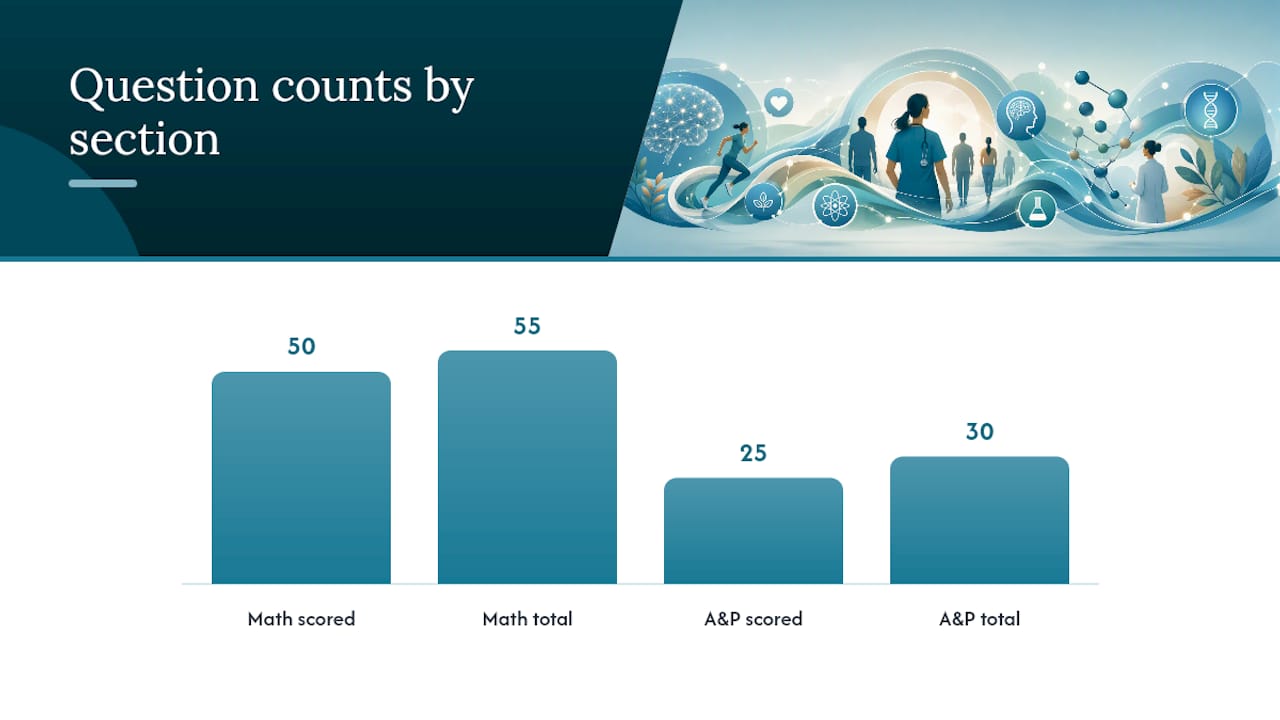
Section length and question counts vary by program, but published study guides give a workable baseline. Math typically runs around fifty scored questions out of approximately fifty-five administered; Anatomy & Physiology runs closer to twenty-five scored out of about thirty administered. The gap between "scored" and "administered" is pilot questions, unscored items Elsevier mixes in to test future exam content.
| Section | Approx. scored items | Approx. total administered |
|---|---|---|
| Math | 50 | 55 |
| Anatomy & Physiology | 25 | 30 |
Pilot items look and feel exactly like scored ones. There's no flag, no different formatting, nothing that tells you which questions count. The only safe strategy is to treat every single item as if it's scored, because you have no way to identify the ones that aren't.
Total exam time depends entirely on how many sections your program assigns. Tarrant County College allows up to 5 hours for its full version of the exam, and most programs fall somewhere in the 3 to 5 hour range depending on how many modules are required.
How Programs Set Cutoffs, Score Validity, and Retake Rules
Your program, not Elsevier, decides what counts as passing. That means the same HESI A2 score can be a strong result at one school and a rejection at another.
Cutoff scores vary widely by institution, but published examples give you a sense of range. Estrella Mountain Community College lists example thresholds like a 75% minimum on Math and an 80% English composite, alongside a retake policy allowing up to three attempts within 12 months, with a minimum 60-day wait between attempts. Score validity windows commonly run 12 to 24 months, though this differs by school.
Before you schedule a test date, confirm these details directly with your target program:
- Which specific sections are required for your application
- The minimum passing score for each required section
- How long your scores remain valid once you test
- Retake limits and the required waiting period between attempts
IRSC's assessment center page is a good example of how much these administration details vary school to school. Two nursing programs in the same state can run completely different rules on retakes and score windows, so don't assume your friend's experience at another school applies to you.
Building a Study Plan That Matches How the Sections Are Weighted
Start with a timed, mixed-subject practice test before you touch individual subject drills. That baseline tells you where you're actually weak instead of where you assume you're weak, and it prevents the common mistake of over-studying a section you're already strong in.
A workable weekly study allocation once you have that baseline:
- Anatomy & Physiology gets the largest share of your time. It's recall-heavy rather than reasoning-heavy, so focused factual review produces fast score gains, especially around cardiac, respiratory, and electrolyte content.
- Math gets the second-largest share, particularly dosage-conversion practice, since these multi-step problems are where most points get lost.
- Reading, Vocabulary, and Grammar get lighter, consistent review rather than heavy blocks, since they respond well to steady practice over cramming.
This is exactly the workflow Nursingschoolpro's HESI A2 study guide is built around: practice sets mapped to each section, instant rationales that explain why an answer is right or wrong, and progress analytics that flag your weak areas automatically instead of leaving you to guess.
Pro Tip: On test day, budget your time per question before you start, not while you're mid-section. If Math gives you roughly a minute per item, glance at the clock every ten questions so a slow start doesn't force you to rush the last stretch.
Deciding Which Sections to Prioritize First
If you're applying to multiple programs, prioritize the sections every school on your list requires: Math, Reading, Vocabulary, and Grammar. Add Anatomy & Physiology and the sciences only once your core scores are solid, since a strong core beats a mixed bag of average scores across eight sections.
Admissions committees weigh cutoffs section by section, and one score below the line can sink an otherwise strong application. Always verify your target program's exact requirements before you lock in a study plan.
— Autumn
Study Smarter With Practice Built Around the HESI A2 Sections
You can find dosage-conversion drills and A&P recall practice mapped to the exact sections your program requires, not a generic question bank you have to sort through yourself.
Practice questions with instant rationales explaining why answers are right or wrong help avoid memorizing outcomes alone. Performance tracking by section can reveal which areas need more study. The Nursing School Study Center covers all HESI A2 modules discussed here, and a 48-hour free trial is available. For details on required sections and pricing, see the pricing and trial details and begin with your weakest section.
Where to Verify Your Program's Exact HESI A2 Requirements
Section lists and cutoffs change by school, so confirm details directly before you register:
- HESI A2 Exam Information — Tarrant County College
- HESI A2 Admissions Assessment — IRSC
- HESI A2 Testing Services — Estrella Mountain Community College
- HESI Admission Assessment Exam Review — Elsevier
Your program's admissions or testing office always has the final word on required sections and passing scores.
Sources
- HESI A2 Exam Information
- HESI A2 Admissions Assessment Exam
- HESI A2 — Estrella Mountain Community College
FAQ
How Many Sections Does the HESI A2 Exam Have?
The full exam offers eight academic sections plus optional non-academic modules, but most nursing programs only require four to six of them, commonly Math, Reading, Vocabulary, Grammar, and Anatomy & Physiology.
Which HESI A2 Section Is Considered the Hardest?
Anatomy & Physiology is widely reported as the section where scores drop the most, largely because it's recall-heavy and covers a wide range of body systems rather than a narrow skill you can reason your way through.
Is the HESI A2 the Same at Every School?
No. Schools choose their own required sections, passing cutoffs, score validity windows, and retake rules, so the same test can carry different requirements depending on where you apply.