
A HESI conversion score is a scaled number, not a simple percentage. Elsevier's proprietary algorithm takes your raw performance, weights each question by difficulty, and maps the result to a standardized scale, producing the number your program actually evaluates. That number is what determines whether you clear admissions, graduate, or sit for the NCLEX.
Here is what matters immediately:
- Per-section floor: Most programs require a minimum passing score on each section. Falling below that on even one section can disqualify you regardless of your composite.
- Competitive admission target: Programs typically expect scores above the minimum passing level across required sections for a realistic shot at competitive cohorts.
- Exit/NCLEX clearance: Certain scaled score thresholds are commonly cited as benchmarks for HESI Exit clearance and higher NCLEX pass probability.
- Sections score independently. A strong Anatomy score does not rescue a weak Reading Comprehension score. Watch every section, not just your composite.
A score of 850 on the Exit signals moderate NCLEX readiness. A score of 900 or above correlates with high pass probability. Anything below 75 on any section is a red flag that needs immediate attention before your program's retake window closes.
Table of Contents
- What the HESI conversion score actually measures
- How to read the HESI score scale and what each range means
- How HESI A2 scoring differs from the HESI Exit Exam
- What common HESI scores actually mean in practice
- What to do next based on where your score lands
- A 4–6 week study plan to raise your HESI conversion score
- Key Takeaways
- Scores are data, not verdicts
- Nursingschoolpro gives you the tools to move your score
- Useful sources
What the HESI conversion score actually measures
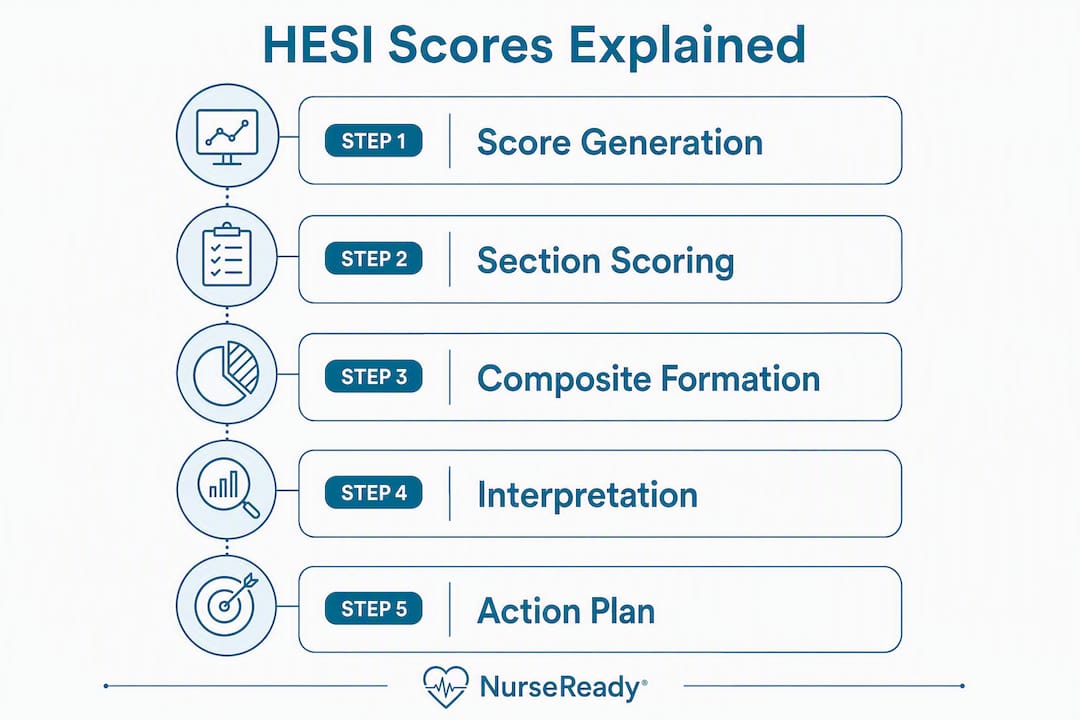
Your HESI report does not show how many questions you answered correctly. It shows where your performance lands on a scaled distribution after the algorithm has done its work.
Elsevier's scoring model weights each item by its difficulty characteristics, applies partial credit logic for multiple-select questions, and then normalizes results across different test forms. Two students who both answer 80 out of 100 questions correctly can end up with different scaled scores if they faced items of different difficulty levels. The student who answered harder questions correctly gets a higher scaled output. That is the core mechanic.
Each section is scored independently. Your Vocabulary score does not bleed into your Math score. The algorithm runs separately for every content area, which is why programs set per-section minimums rather than relying entirely on a composite.
Pro Tip: When you get your score report, look at each section score before you look at the composite. A composite of 82 can hide a 71 in Critical Thinking, which may put you below your program's floor even if everything else looks fine.
How to read the HESI score scale and what each range means
HESI scores appear in two common formats depending on which exam you took and how your school reports them.

For the HESI A2, section scores are typically reported on a 0–100 scaled range, formatted to look like a percentage but functioning as a scaled score. For the HESI Exit Exam, scores are often displayed on a broader distribution, sometimes extending toward 1,500, with program cutoffs expressed as absolute numbers like 850 or 900 rather than percentages.
| Score Range | Interpretation | Typical Program Signal |
|---|---|---|
| Below 75 | High risk | Below most program floors; remediation required |
| 75–84 | Borderline | Meets minimum; not competitive for selective programs |
| 80–84 | Acceptable | Meets most admission targets; moderate NCLEX readiness |
| 85+ | Strong | Competitive for admission; solid NCLEX readiness |
| 850–900 (Exit) | Acceptable clearance | Meets many Exit thresholds; moderate NCLEX probability |
| 900+ (Exit) | Recommended clearance | High NCLEX pass probability; preferred by most programs |
Programs set their own cutoffs, and those vary. Many programs publish floors of 75 per section, but admitted cohorts at competitive schools often average 85 or higher. The published minimum and the realistic target are two different numbers. Know both for your specific program.
A score of 900 on the Exit is the benchmark most frequently cited for high NCLEX pass probability. That figure comes from the HESI Predictability Model (HPM), Elsevier's research-backed framework that correlates Exit performance with first-attempt NCLEX outcomes. Programs that set one threshold as their floor do so as a safety net; those using a higher threshold aim for a stronger statistical buffer.
How HESI A2 scoring differs from the HESI Exit Exam
The HESI A2 and the HESI Exit Exam use similar conversion logic but serve entirely different purposes, and confusing the two leads to real misreads of what your score means.
| Feature | HESI A2 | HESI Exit Exam |
|---|---|---|
| Purpose | Admissions screening | Graduation gate and NCLEX predictor |
| Who takes it | Applicants to nursing programs | Students nearing program completion |
| Score format | Section scores (0–100 scaled) | Scaled score, broader distribution |
| Common cutoffs | passing minimum per section; higher scores competitive | 850 acceptable; 900 recommended |
| Primary use | Admission decision | NCLEX readiness determination |
| Predictability model | Not applicable | HESI Predictability Model (HPM) |
The A2 is a gatekeeping tool. Programs use it to compare applicants, so your score is evaluated relative to other candidates in that cycle, not just against a fixed threshold. A 78 might admit you at one school and not at another.
The Exit is a predictive tool. Item Response Theory and adaptive testing logic drive the scoring, and the output is explicitly designed to estimate your NCLEX pass probability. Programs use it to decide whether you are ready to graduate and sit for licensure.
Before your exam, confirm these specifics with your program:
- Published per-section minimums and composite requirements
- Retake policy (how many attempts, waiting period between attempts)
- Score validity window (how long a score remains usable for admission or graduation)
- Whether your program uses a composite average or requires every section to clear the floor independently
What common HESI scores actually mean in practice
Raw numbers only make sense when you can map them to real outcomes. Here are six scenarios that cover the range students most often ask about.

Score of 70 (A2 section): Below the standard floor of 75. Most programs will not count this section as passing. You need to retake that section or the full exam depending on your program's policy. A 70 is not a near-miss; it is a disqualifier at most schools.
Score of 78 (A2 composite): Meets the minimum at many programs but sits in borderline territory. At selective programs averaging admitted cohorts of 85+, 78 composite puts you at a competitive disadvantage even if you technically cleared the floor.
Score of 85 (A2 section): Solid. This is the range where you stop worrying about floors and start thinking about how your score compares to other applicants. Most guidance recommends 85+ for competitive programs.
Score of 840 (Exit): Below the 850 threshold many programs use for clearance. One more attempt with focused remediation on weak sections is the typical path forward here.
Score of 900 (Exit): This is the target. Research linking the HESI Exit to NCLEX outcomes consistently points to 900 as the threshold where pass probability becomes high. Programs that set 900 as their floor are not being arbitrary.
Score of 980 (Exit): Yes, 980 is a strong score. It places you well above the 900 benchmark and suggests a high probability of first-attempt NCLEX success. Do not let a 980 make you complacent about weak clinical areas, but you are in a good position.
One practical note: HESI score reports are typically available within 24–48 hours through your program's testing portal or the Evolve platform. Check with your program coordinator if you do not see results after 48 hours, since institutional delivery timelines vary.
What to do next based on where your score lands
Your next move depends on which zone your score falls in. Here is a tiered action plan.
If you scored below 75 on any section:
- Pull your score report and identify every section below 75 before you do anything else.
- Check your program's retake policy immediately. Most programs allow one to three retakes with a mandatory waiting period of 30–60 days.
- Do not review broadly. Target the specific content areas that failed. Dosage calculations and A&P tend to carry the most weight in math and science sections.
- Use a conversion cheat sheet for math and practice dosage problems daily. These items are difficulty-weighted, so accuracy here moves your scaled score faster than reviewing vocabulary.
- Schedule a meeting with your faculty advisor or remediation coordinator before you register for a retake.
If you scored 75–84 (borderline):
- Identify your two lowest sections and focus there first.
- Run targeted practice sets of 20–30 questions per weak topic, three to four times per week.
- Aim for a 30-day intensive before retesting. A 60-day window is better if you have two or more sections to improve.
- Track accuracy by topic, not just overall score. You want to see 80%+ accuracy on practice questions before you retest.
If you scored 85 or above (on target or above):
- Confirm your score meets your specific program's published requirements, including any per-section floors.
- For the Exit, verify whether your program requires 850, 900, or another threshold for graduation clearance.
- If you are above target, shift focus to NCLEX prep. Your HESI score suggests readiness; now build the clinical reasoning depth the NCLEX tests.
A 4–6 week study plan to raise your HESI conversion score
Broad review rarely moves scaled scores. Targeted practice with instant rationales and analytics-driven prioritization does. Here is a plan that works with that principle.
Weeks 1–2: Diagnose and prioritize
Run a full diagnostic practice set across all HESI content areas. The goal is not to score well; it is to surface your weakest topics. Track accuracy by subject, not by total questions answered. Any topic below 70% accuracy goes on your priority list. Dosage calculations and unit conversions belong there by default if math is a weak section, since those items carry outsized difficulty weight.
Pro Tip: Use Nursingschoolpro's real-time analytics to sort your practice results by topic accuracy rather than overall score. This shows you exactly where the algorithm is likely penalizing you, not just where you feel uncertain.
Weeks 3–4: Targeted drilling
Work through 25–30 practice questions per priority topic per session. Read every rationale, including the ones you got right. Understanding why a correct answer is correct is what builds the pattern recognition the HESI rewards. Aim for 80% accuracy on each priority topic before moving on.
Weeks 5–6: Simulate and calibrate
Run timed, full-length practice sections under test conditions. Track time per question (target: 60–90 seconds average). Review error categories: are you missing questions due to content gaps, misreading stems, or calculation errors? Each error type has a different fix. Content gaps need more drilling. Stem misreads need slower, more deliberate reading practice. Calculation errors often come down to one or two conversion formulas you have not fully memorized.
Retest when you are hitting 80–85% accuracy consistently on practice sets for your weakest sections. That accuracy level tends to correlate with scaled scores in the competitive range.
Key Takeaways
A HESI conversion score is a scaled, difficulty-weighted number, not a raw percentage, and the 850/900 Exit benchmarks are the most reliable indicators of NCLEX readiness.
| Point | Details |
|---|---|
| Scaled score, not raw percent | Two students with identical correct counts can receive different scores based on item difficulty weighting. |
| Per-section floors matter | A strong composite cannot offset a section score below 75; check every section individually. |
| 850 vs. 900 on the Exit | 850 meets many program floors; 900 correlates with high NCLEX pass probability per the HESI Predictability Model. |
| A2 vs. Exit purpose | The A2 screens applicants; the Exit predicts NCLEX readiness. Cutoffs and stakes differ significantly. |
| Nursingschoolpro study plan | Targeted practice with instant rationales and analytics is the most efficient path to raising a borderline conversion score. |
Scores are data, not verdicts
Here is something most score-interpretation guides skip: the conversion score is a snapshot of one test day, not a fixed measure of your ability. The HESI Predictability Model is genuinely useful because it gives programs a data-driven way to protect graduation outcomes, but a score of 840 does not mean you will fail the NCLEX. It means you have a gap to close, and you have time to close it.
What I find students underestimate is the leverage in understanding the algorithm itself. Once you know that difficulty-weighted items drive your scaled score more than raw volume, your study strategy changes. You stop trying to cover everything and start drilling the hard stuff. That shift alone can move a borderline score into the competitive range in four to six weeks of focused work.
The 900 benchmark is worth aiming above, not just at. A score of 910 gives you a buffer; a score of exactly 900 gives you none. Programs that set 900 as a floor are not being harsh; they are using the HESI Predictability Model the way it was designed to be used.
Nursingschoolpro gives you the tools to move your score
Knowing what your conversion score means is step one. Closing the gap is where most students stall, usually because they review broadly instead of drilling what the algorithm actually penalizes.
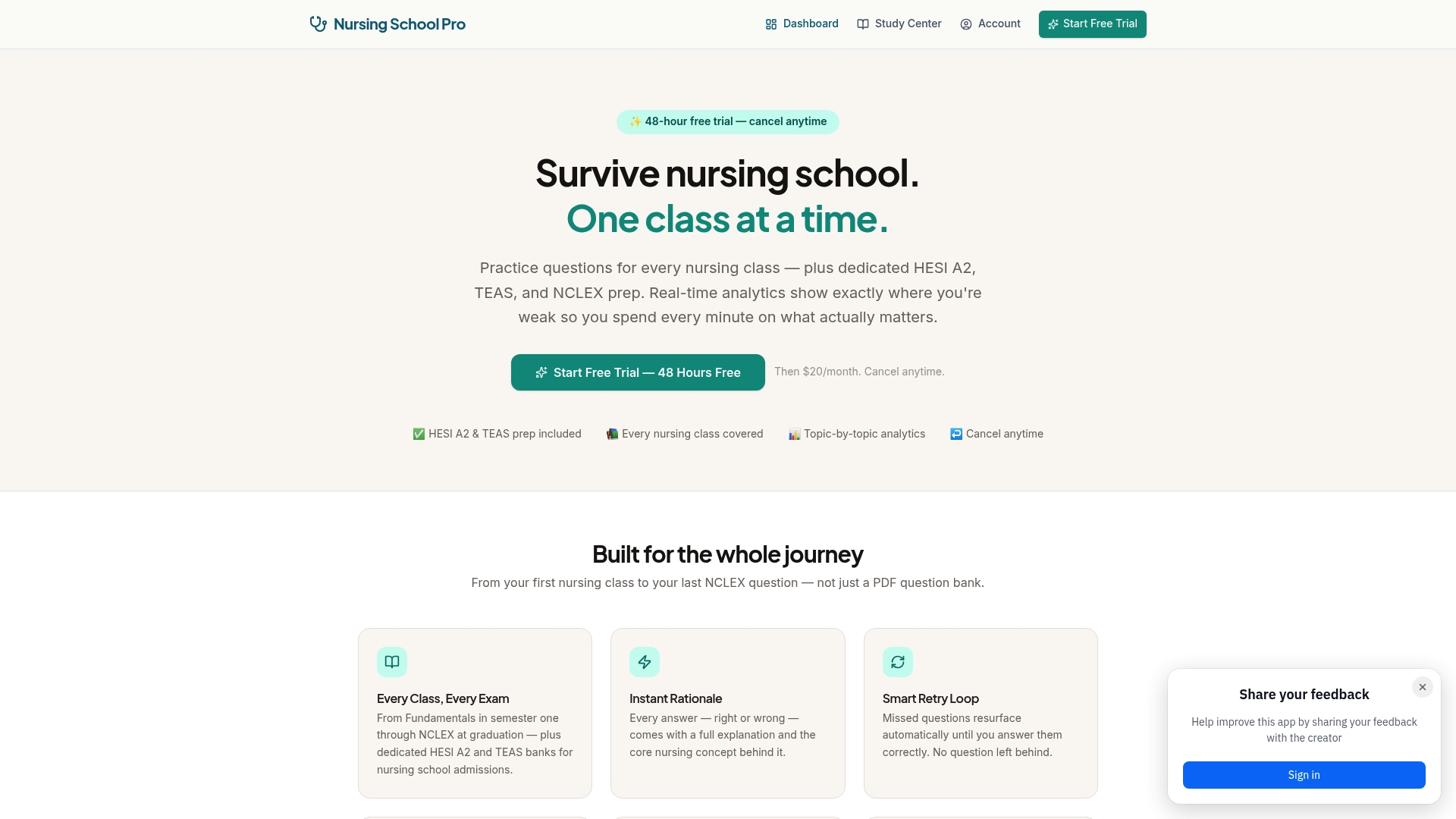
Nursingschoolpro is built for exactly this situation. The platform's question bank covers every HESI A2 and Exit content area, and the real-time analytics break your results down by topic so you can see where your scaled score is taking the hit. Every question comes with an instant rationale, so you understand the reasoning behind each answer, not just the answer itself. That is the difference between memorizing and building the pattern recognition the HESI rewards.
The 48-hour free trial costs nothing and gives you immediate access to practice sets, analytics, and rationales. If you are sitting with a borderline score and a retake window closing in 30 days, that is where to start.
Useful sources
These are the sources used throughout this article. Each one adds something specific.
- Understanding the HESI Score: Predicting NCLEX Success — Elsevier's own documentation on the HESI Predictability Model and how Exit scores correlate with NCLEX outcomes. The authoritative primary source for the 850/900 benchmarks and the HPM framework.
- HESI Passing Scores & Score Conversion — Covers program-level practices, published floors, and the practical gap between minimum cutoffs and competitive admitted averages. Used in the score scale and BLUF sections.
- Conversion Score HESI Guide & Scoring — Plain-language explanation of the weighting algorithm, partial credit logic, and why raw percent does not equal scaled score. Used in the definition and interpretation sections.
- How Is the HESI Exit Scored? — Explains Item Response Theory, adaptive testing, and NCLEX predictability metrics for the Exit Exam. Used in the A2 vs. Exit and score-scale sections.
- What is a good HESI A2 score? — Synthesizes guidance-site recommendations and common admissions committee practices. Used in the FAQ-style interpretation examples.
- HESI A2 Math Formulas & Conversions Cheat Sheet — Covers dosage calculation weighting and why conversion practice yields faster scaled-score gains in the math section. Used in the study plan and next-steps sections.
- HESI Nursing Tests: How to Study & Pass HESI Exams — Recommends targeted analytics-driven study over broad review. Used to support the study-plan methodology.
- Nursingschoolpro Study Center — Platform hub for scoring methodology, practice resources, and remediation workflows for HESI A2, Exit, and NCLEX prep.
- Dosage Calculation Rounding: A Common Mistake — Practical reference for students working on math section remediation, particularly rounding errors in dosage calculations.