
This guide ranks the nursing mnemonics that pay off most on NCLEX-style questions and in clinical rotations, with quick examples for each and a practice routine you can start today. You'll find categorized lists for pharmacology, assessment, maternal/newborn, and cardiac/neuro content, plus references drawn from NCSBN, the NCBI, and clinical sources like Mayo Clinic and Cleveland Clinic. The goal isn't memorization for its own sake. It's turning a string of letters into a habit you fall back on when a patient's oxygen saturation drops and you have ten seconds to think straight.
TL;DR:
- Mnemonics like ABCDE and SAMPLE are crucial for rapid assessment and decision-making during patient deterioration or emergency situations.
- Building personalized mnemonics through chunking, visualization, and testing enhances memory retention and clinical application validity.
- Applying mnemonics in practice, especially through simulated scenarios, improves transfer from memorization to real-time clinical reasoning.
- Digital tools such as flashcard apps and question banks support spaced repetition and context-based learning to reinforce mnemonic recall.
- Consistent use of mnemonics during shifts and study sessions aligns with evidence-based teaching strategies for better retention and exam success.
Table of Contents
- Top 12 Nursing Mnemonics Every Student Should Memorize
- Mnemonics Organized by Clinical Subject
- How to Build and Practice Mnemonics That Actually Stick
- Where the Evidence Backs Up These Study Methods
- Apps and Digital Tools for Practicing Mnemonics
- A Working Nurse's Take on Mnemonics in Real Shifts
- Practice These Mnemonics Where They Actually Count
- Sources
Top 12 Nursing Mnemonics Every Student Should Memorize
These twelve show up across med-surg, critical care, and NCLEX practice exams more than any others. Learn them in this order, because each one builds toward faster clinical decision making, not just faster test taking.
- ABCDE (Airway, Breathing, Circulation, Disability, Exposure). This is your triage backbone for any deteriorating patient. On an NCLEX scenario involving a post-op patient with stridor, ABCDE tells you to check the airway before you chart vitals. Common pitfall: students jump to "Circulation" and start counting a pulse before confirming the airway is actually open.
- SAMPLE (Symptoms, Allergies, Medications, Past medical history, Last meal, Events). Use this for rapid history-taking in the emergency department or during a focused admission assessment. A patient arriving confused after a fall needs a SAMPLE history before you can safely medicate them. Skipping "Last meal" is the most common miss, and it matters enormously if surgery is on the table.
- OPQRST (Onset, Provocation, Quality, Radiation, Severity, Timing). Pair this with SAMPLE whenever a patient reports pain or chest discomfort. Together, these two mnemonics for history-taking form the structure most NGN case studies expect you to reconstruct from a patient narrative.
- ADPIE (Assessment, Diagnosis, Planning, Implementation, Evaluation). This is the nursing process itself, and NCLEX loves testing whether you know which stage a question is describing. If a scenario asks what comes after identifying a nursing diagnosis, the answer is planning, not intervention.
- SBAR (Situation, Background, Assessment, Recommendation). This is how you hand off a patient to a physician or the next shift without losing critical detail. A weak SBAR handoff, one missing the actual recommendation, is a leading cause of communication errors on real units.
- APGAR (Appearance, Pulse, Grimace, Activity, Respiration). Scored at one and five minutes after birth, APGAR gives you a fast numeric snapshot of a newborn's transition to extrauterine life. A score under 7 at five minutes prompts continued monitoring, not panic.
- FAST (Face, Arm, Speech, Time). Stroke still recommends this as the fastest public and clinical screen for stroke. On the floor, FAST is what you run through in the sixty seconds before calling a rapid response, and time is the variable that decides whether thrombolytics are even an option.
- SLUDGE (Salivation, Lacrimation, Urination, Defecation, GI upset, Emesis). This describes cholinergic toxicity, the kind you'll see with organophosphate poisoning or an overdose of certain medications. The pitfall here is confusing SLUDGE with anticholinergic symptoms, which look almost opposite.
- PRICE (Protection, Rest, Ice, Compression, Elevation). A musculoskeletal injury mnemonic that's more common in orthopedics and sports medicine content, but it still surfaces on NCLEX questions about acute injury management.
- Hs and Ts (Hypovolemia, Hypoxia, Hydrogen ion/acidosis, Hyper/hypokalemia, Hypothermia, Tension pneumothorax, Tamponade, Toxins, Thrombosis). This is the reversible-cause checklist for cardiac arrest. During a code, running through the Hs and Ts is often what catches a treatable cause that basic ACLS algorithms alone would miss.
- VEAL CHOP (Variable decelerations/Cord compression, Early decelerations/Head compression, Accelerations/Okay, Late decelerations/Placental insufficiency). This pairs fetal heart rate patterns with their likely cause, and it's a near-guaranteed topic on maternal/newborn NCLEX content.
- ACHES (Abdominal pain, Chest pain, Headache, Eye problems, Severe leg pain). A pharmacology mnemonic for oral contraceptive warning signs. It's a compact way to remember when a patient on estrogen-containing birth control needs to call their provider immediately rather than wait it out.
Mnemonics Organized by Clinical Subject
Studying by rotation cuts down on the mental switching cost of jumping between unrelated content, and it mirrors how Nurseslabs organizes its own mnemonic library by specialty rather than alphabetically.
Pharmacology. Beyond ACHES, remember "hot as a hare, dry as a bone, red as a beet, blind as a bat, mad as a hatter" for anticholinergic toxicity, and DUMBBELSS for cholinergic crisis (a longer cousin of SLUDGE). These matter because pharm questions on the NCLEX rarely ask you to name a drug class. They ask you to recognize a toxidrome from a symptom cluster.
Assessment and vitals. SAMPLE and OPQRST cover history. For neuro checks, the Glasgow Coma Scale itself functions as a scoring mnemonic across eye, verbal, and motor response, detailed further in Nursing School Pro's assessment guide. AVPU (Alert, Verbal, Pain, Unresponsive) is the faster field version when a full GCS isn't practical.
Maternal/newborn. APGAR and VEAL CHOP anchor this category. Add "the 5 Ts of newborn distress" (Tachypnea, Temperature instability, Tone changes, Tremors, Trouble feeding) for postpartum unit rotations.
Cardiac/neurology. FAST and the Hs and Ts lead here. For limb-threatening emergencies, the 5 P's (Pain, Pallor, Paresthesia, Pulselessness, Paralysis) flag compartment syndrome before permanent damage sets in, a mnemonic worth memorizing cold since delayed recognition is a common cause of missed diagnoses.
How to Build and Practice Mnemonics That Actually Stick
Memorizing someone else's mnemonic gets you partway there. Building your own, especially for content that keeps tripping you up, cements it further because you're doing the cognitive work instead of borrowing it.
- Chunk the content. Take a lab value cluster, say the electrolytes tied to cardiac arrhythmias, and group them into three to five items max. Working memory handles small chunks far better than long lists.
- Create an image. For hyperkalemia's tall, peaked T-waves, some students picture a "tall Tina" on the monitor. The sillier or more visual the image, the stickier it gets.
- Turn it into a phrase or word. Convert the chunk into a first-letter acronym or a short sentence, the same way SLUDGE compresses five cholinergic symptoms into one word.
- Test it under pressure. Recite your mnemonic without notes, then apply it to a scenario question within the same study session. If you can't use it under a timer, it isn't learned yet.
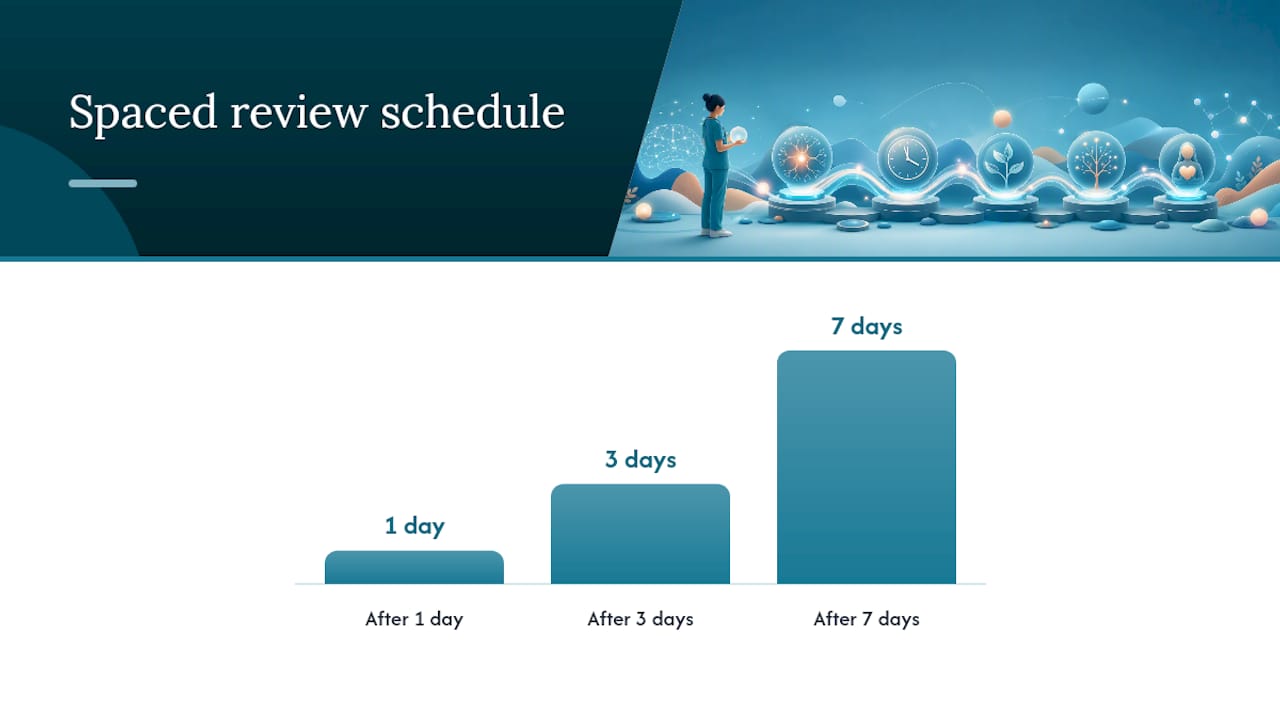
Space your review across days, not hours. Revisit each mnemonic at roughly one day, three days, and seven days out, then fold it into NGN-style case practice so recall and clinical judgment train together.
Pro Tip: Never let a mnemonic answer a question by itself. Use it to generate your first hypothesis, then verify against the actual patient data in the scenario before you commit to an answer choice.
Where the Evidence Backs Up These Study Methods
Structured memory techniques paired with active recall improve retention in clinical learners more than passive review, according to educational research reviewed on NCBI. That's the science behind why chunking and spaced repetition outperform simply rereading a textbook chapter.
The NCLEX itself has shifted toward Next Generation NGN items that reward applied reasoning, not recall alone, per NCSBN's own exam documentation. A mnemonic that never leaves flashcard form won't transfer to a six-step clinical judgment question.
A few limits worth naming directly:
- Mnemonics are heuristics, shortcuts, not substitutes for a full patient assessment.
- Condition-specific signs, like the ones Mayo Clinic documents for hypokalemia, still need to be verified against the actual patient in front of you.
- A mnemonic memorized wrong is worse than no mnemonic at all, since it produces false confidence.
Nursing School Pro's study center attaches instant rationales to practice questions, which is exactly the verification step a mnemonic alone can't provide.
Apps and Digital Tools for Practicing Mnemonics
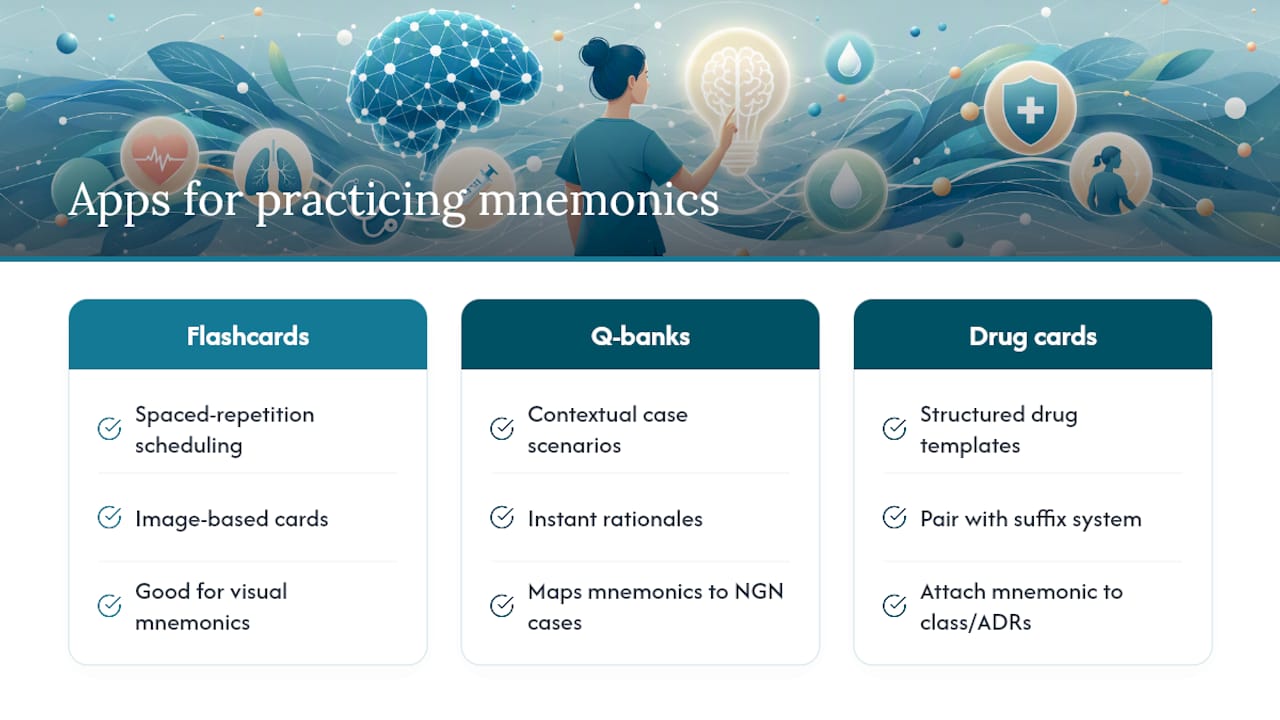
Flashcard apps like Anki and Quizlet remain the default for spaced repetition because they let you schedule review intervals automatically instead of guessing when to revisit a card. Both support image-based cards, which matters since visual mnemonics (like the "tall Tina" T-wave image) encode better than text alone.
Question-bank platforms add something flashcards can't: context. A mnemonic like Hs and Ts means little in isolation, but running it against a simulated code scenario with instant rationales shows you exactly where your recall breaks down under pressure. That's the gap Nursing School Pro's practice questions are built to close, mapping mnemonic-based recall directly onto NGN-style case items.
For pharmacology specifically, drug card templates give you a structured place to attach a mnemonic to a drug class, its suffix pattern, and its major adverse effects in one view. Pairing a memory aid with a suffix-based study system cuts down on the confusion that happens when two mnemonics compete for the same acronym letters, which happens more often than students expect once you're juggling a dozen of them at once.
A Working Nurse's Take on Mnemonics in Real Shifts
On a busy shift, mnemonics layer: SAMPLE gets the history, ADPIE shapes the plan, SBAR carries it to the next nurse. That chain matters more than any single acronym. Build one daily habit: five minutes reviewing a mnemonic, then one NGN-style question applying it. When you rotate specialties, swap in that unit's high-yield mnemonics rather than clinging to generalist ones.
— Autumn
Practice These Mnemonics Where They Actually Count
Knowing SLUDGE or VEAL CHOP cold doesn't help if you've never applied it under exam conditions. Nursing School Pro's study center maps mnemonics like the ones above directly onto practice questions for HESI A2, TEAS, and NCLEX, with instant rationales that explain not just the right answer but why your mnemonic-based hunch was right or wrong.
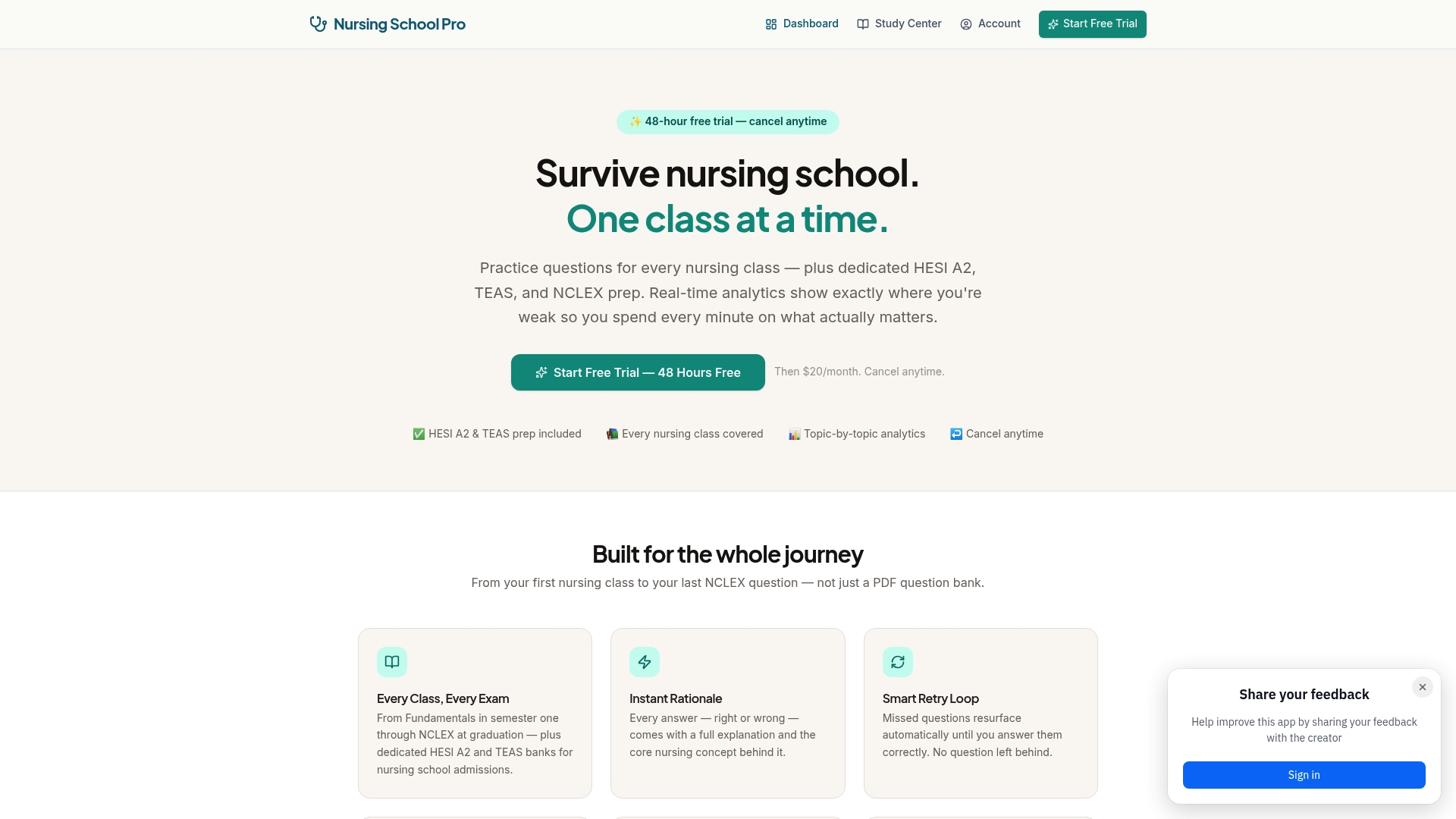
Real-time analytics flag which categories, pharmacology, maternal/newborn, cardiac, keep tripping you up, so your next study session targets the actual gap instead of reviewing content you've already mastered. A 48-hour free trial gives you enough time to run a handful of mnemonics through real NGN-style scenarios and see how they hold up. From there, pricing stays simple: one subscription, full access. Start the trial today and test your top mnemonics against practice questions before your next exam.
Sources
- PMC education review (mnemonics / memory techniques)
- NCLEX (NCSBN)
- Mayo Clinic — low potassium (hypokalemia)
- Cleveland Clinic — compartment syndrome