
Drug suffixes, formally called drug stems, let you identify a medication's pharmacologic class directly from its generic name. That single skill can unlock dozens of exam questions before you've even read the answer choices. Here are the highest-yield stems to know first:
- -pril (ACE inhibitors): lisinopril, enalapril, captopril
- -sartan (ARBs): losartan, valsartan, irbesartan
- -olol (beta-blockers): metoprolol, atenolol, propranolol
- -ipine (calcium channel blockers): amlodipine, nifedipine, felodipine
- -statin (HMG-CoA reductase inhibitors): atorvastatin, simvastatin, rosuvastatin
- -prazole (proton pump inhibitors): omeprazole, pantoprazole, lansoprazole
- -cillin (penicillin antibiotics): amoxicillin, ampicillin, nafcillin
- -floxacin (fluoroquinolone antibiotics): ciprofloxacin, levofloxacin, moxifloxacin
- -azole (antifungals): fluconazole, ketoconazole, itraconazole
- -tidine (H2 blockers): famotidine, ranitidine, cimetidine
- -mycin / -micin (macrolide/aminoglycoside antibiotics): azithromycin, clarithromycin, gentamicin
- -mab (monoclonal antibodies): rituximab, trastuzumab, adalimumab
Pro Tip: Stems are strong clues, not guarantees. Always verify the mechanism and clinical cautions for each individual drug before applying a stem-based assumption in clinical care.
Key Takeaways
Learning 40–60 high-yield drug stems gives nursing students a reliable shortcut to identifying drug classes, mechanisms, and clinical cautions directly from a generic name on any exam.
| Point | Details |
|---|---|
| Stems signal drug class | A generic name's suffix (e.g., -pril, -olol, -statin) identifies the pharmacologic family and its key clinical properties. |
| Prioritize ~40–60 stems | The full stem list runs to roughly 800 entries; focus on cardiovascular and antimicrobial stems first for maximum exam yield. |
| Exceptions are real | Lookalike stems (-pine in CCBs vs. antipsychotics; -mycin across macrolides and aminoglycosides) require verification of mechanism and indication. |
| Use active recall to memorize | Spaced repetition, interleaved practice, and stem-identification drills build faster pattern recognition than re-reading. |
| Nursingschoolpro for targeted practice | Practice questions with instant rationales and analytics help you identify and close gaps in stem-based pharmacology knowledge. |
Table of Contents
- What are pharmacology drug suffixes and how do you read them?
- Comprehensive drug suffixes reference table for exam prep
- Exceptions, lookalike stems, and clinical cautions you need to know
- How to memorize drug suffixes efficiently for NCLEX and HESI
- Your printable drug suffix cheat-sheet
- Why stems matter more than students realize
- Nursingschoolpro makes mastering drug stems faster
- Sources
What are pharmacology drug suffixes and how do you read them?
A drug stem is a standardized fragment, usually at the end of a generic drug name, that signals the drug's pharmacologic class or mechanism of action. The United States Adopted Names (USAN) Council assigns these stems deliberately so that healthcare providers and students can recognize drug families at a glance. When you see lisinopril on an exam, the -pril ending tells you it belongs to the ACE inhibitor class before you read a single word of the question stem.
Generic names carry these signals reliably. Brand names do not. Zestril and Prinivil are both lisinopril, but neither ending tells you anything about the drug class. That's why common drug stems are taught as a class-based learning strategy: instead of memorizing 300 individual drugs, you learn 40–60 stems and immediately recognize the family each drug belongs to.
Two quick examples show how this works in practice:
- lisinopril → suffix -pril → ACE inhibitor → treats hypertension and heart failure, watch for cough and hyperkalemia
- amlodipine → suffix -dipine (variant of -ipine) → dihydropyridine calcium channel blocker → treats hypertension and angina
Stems sit at the end of the generic name most often, but some appear as infixes (in the middle) or prefixes. For exam purposes, the terminal stem is the most reliable signal. Brand name endings like "-XR," "-SR," or "-Plus" are formulation or marketing labels, not pharmacologic signals.
Comprehensive drug suffixes reference table for exam prep
The table below covers the highest-yield pharmacology drug suffixes organized by body system. It draws from NCBI Bookshelf's medication class reference and AccessPharmacy's pharmacologic suffixes resource. Print it, tape it to your desk, or save it as a phone screenshot.
A few important notes on using this table:
- Generic names only appear here. Brand names vary by manufacturer and carry no pharmacologic signal.
- Stems marked with ⚠️ carry a major safety flag worth memorizing for NCLEX alternate-format questions.
- The table covers the most exam-relevant stems. Memorizing Pharm notes that the full cumulative stem list runs to roughly 800 entries; you do not need to memorize all of them. Focus on the 40–60 stems that appear most in clinical practice and licensure exams.
Exceptions, lookalike stems, and clinical cautions you need to know
Stems are clues, not diagnoses. Treating them as guarantees is one of the most common exam traps, and it can cause real harm in clinical settings.
The -pine problem is a classic example. Amlodipine ends in -pine (technically -dipine), a calcium channel blocker. Olanzapine also ends in -pine, but it's an atypical antipsychotic. The full name context and the drug's indication are what separate them. When a stem looks familiar but the indication doesn't match what you expect, stop and verify the mechanism.
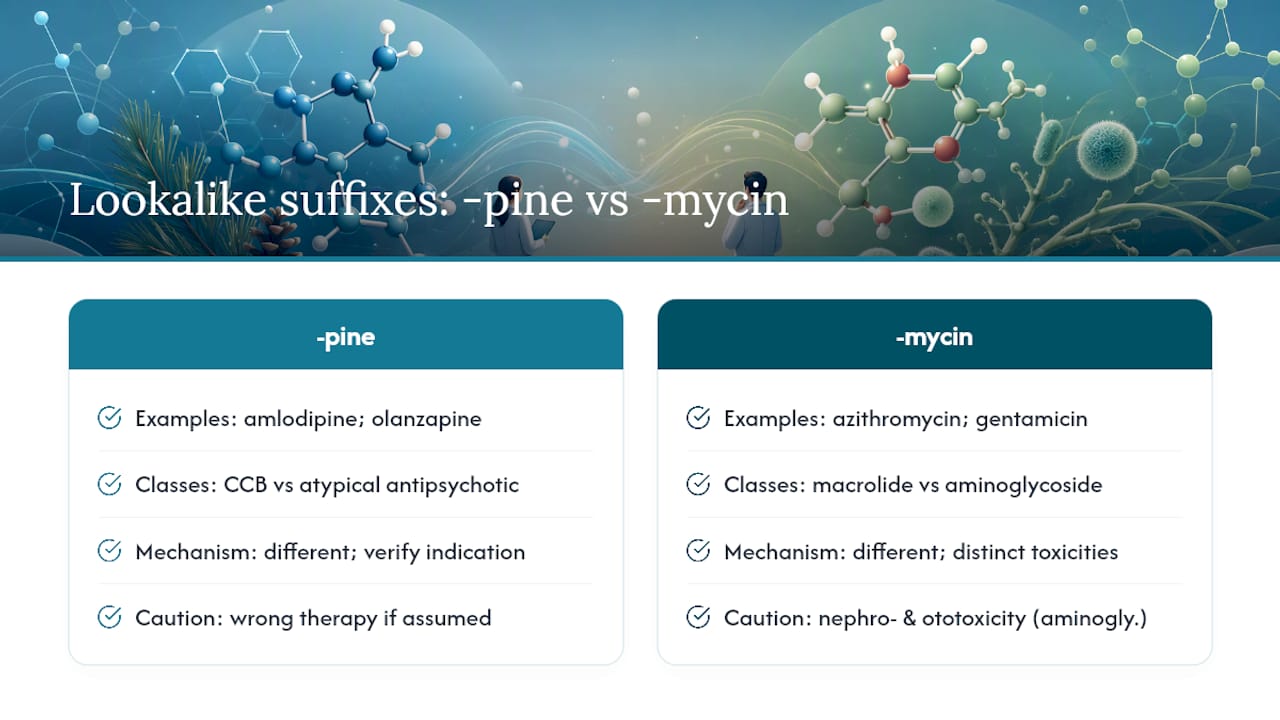
Similarly, -mycin covers both macrolides (azithromycin, clarithromycin) and aminoglycosides (gentamicin, tobramycin). These are entirely different classes with different mechanisms and toxicity profiles. Aminoglycosides carry nephrotoxicity and ototoxicity risks that macrolides don't. Grouping them only by the suffix would be a serious clinical error.
Allergy cross-reactivity is another area where stem knowledge matters beyond naming. The -cillin family carries the highest allergy potential of any antibiotic class. Patients with a penicillin allergy have a small but real risk of cross-reactivity with cephalosporins (cef-/ceph-). The AccessPharmacy pharmacologic suffixes reference ties specific safety flags to these stems, and NCLEX questions frequently test whether students know to ask about penicillin allergy before giving a cephalosporin.
Fluoroquinolones (-floxacin) carry an FDA black box warning for tendon rupture and peripheral neuropathy. The risk is highest in patients over 60, those on corticosteroids, and patients with kidney, heart, or lung transplants. This is a high-yield safety fact for both NCLEX and clinical practice.
The PPI vs. H2 blocker distinction is worth noting here too. Both classes treat acid-related conditions, but PPIs (-prazole) work by irreversibly blocking the proton pump, making them substantially more potent than H2 blockers (-tidine). Long-term PPI use carries its own risks: hypomagnesemia, increased C. difficile susceptibility, and potential bone density effects. Knowing the stem tells you the class; knowing the class tells you which risks to monitor.

Pro Tip: When a stem looks familiar but the drug's indication or mechanism doesn't match your expectation, use Tall Man lettering (e.g., amLODIPine vs. OLANZapine) and check the drug's therapeutic category in a reliable reference like Lexicomp or Micromedex before acting.
How to memorize drug suffixes efficiently for NCLEX and HESI
The full stem list is enormous, but FlashGenius's pharmacology pattern-recognition guide makes a useful point: you don't need to memorize every stem, you need to build a core lexicon of high-yield stems and recognize patterns quickly. Here's a four-week plan built around that idea.
4-Week Study Plan
- Week 1: Cardiovascular stems. Master -pril, -sartan, -olol, -ipine/-dipine, and -statin. These five stems cover a huge portion of NCLEX pharmacology questions. Use the reference table above to make five flashcards, one per stem, with the class, one mechanism note, and one clinical caution.
- Week 2: Antimicrobials. Add -cillin, cef-/ceph-, -floxacin, -azole, -mycin/-micin, and -cycline. Group them by gram-positive vs. gram-negative coverage to add a second layer of meaning to each stem.
- Week 3: GI, Neuro, and Endocrine. Cover -prazole, -tidine, -pam/-lam, -pine (antipsychotics), -gliptin, -gliflozin, and -glitazone. These appear heavily in med-surg and pharmacology exams.
- Week 4: Oncology, Respiratory, and Review. Add -mab, -nib, -lukast, and -terol. Spend the second half of the week on interleaved practice: mix stems from all four systems in a single quiz session.
Active learning tactics that actually work:
- Spaced repetition: Use Anki or physical flashcards with a spaced repetition schedule. Review new stems daily for the first week, then every 3 days, then weekly.
- Interleaved practice: Don't drill one stem class for an hour. Mix cardiovascular and antimicrobial stems in the same session. Research on learning consistently shows interleaving beats blocked practice for long-term retention.
- Active recall over re-reading: Cover the "drug class" column and try to name it from the stem alone. Then flip it: cover the stem and name it from the class. Both directions matter for NCLEX.
- Build mnemonics by system: For cardiovascular stems, try "Pretty Sad Old Iguanas Swim" for -Pril, -Sartan, -Olol, -Ipine, -Statin. For antimicrobials, "Cephalosporins Fight Awful Mycobacterial Cycles" covers cef-, -Floxacin, -Azole, -Mycin, -Cycline.
Pro Tip: Write out 10 generic drug names from a practice question set and identify the stem in each one. This active identification drill builds faster pattern recognition than any passive review method.
For NCLEX specifically, alternate-format questions often give you a generic drug name and ask you to identify the class, expected side effects, or contraindications. A student who knows stems cold can narrow those questions to one or two choices before reading the full scenario.
Your printable drug suffix cheat-sheet
The Nursingschoolpro Study Center hosts downloadable study materials including a one-page drug suffix reference sheet. The layout mirrors the table above: stem in column one, drug class in column two, one representative generic example in column three, and a short clinical warning in column four. It fits on a single sheet of letter-size paper at standard margins.
Printing tips:
- Set your printer to landscape orientation for the best column width.
- Use "fit to page" scaling if your printer clips the right margin.
- Print two copies: one for your desk and one to fold into a pocket card for clinical rotations.
For digital use, save the PDF to your phone's Files app or Google Drive so you can pull it up during a study break. A phone-sized version works well for quick stem drills between classes. Physical cards still outperform screens for active recall, though, so the desk copy earns its ink.
Why stems matter more than students realize
Most nursing students approach pharmacology the same way: they open the drug list, start at the top, and try to memorize each drug individually. By week three of a pharmacology module, the list feels impossible. That's not a memory problem. It's a strategy problem.
Stems reframe the entire task. Instead of 300 isolated facts, you have 40–60 patterns, each of which unlocks a whole family of drugs at once. When you know that -pril means ACE inhibitor, you also know the mechanism (blocks angiotensin-converting enzyme), the major side effects (cough, hyperkalemia, angioedema), the contraindications (pregnancy, bilateral renal artery stenosis), and the monitoring parameters (potassium, creatinine). One stem, one family, one coherent set of clinical facts.
The students who struggle most on NCLEX pharmacology questions tend to be the ones who memorized drug names without connecting them to class. They recognize lisinopril but freeze when the question uses enalapril. Students who learned the -pril stem handle both without hesitation.
There's a caveat worth repeating, though: stems are a starting point, not a finish line. The exceptions in this article are real, and clinical practice will surface more of them. The habit to build now is verification: when a stem gives you a class, confirm the mechanism and indication before you act on it. That habit protects patients and earns points on exams.
The WSU Common Drug Stems classroom handout frames this well for instructors and students alike: the goal is class-based learning, not name-based memorization. Stems are the bridge between a drug's name and its pharmacology. Build that bridge early, and the rest of pharmacology gets a lot less overwhelming.
Nursingschoolpro makes mastering drug stems faster
Knowing the stems is step one. Applying them under exam pressure is where most students need more practice. Nursingschoolpro gives you pharmacology practice questions mapped to every drug class, with instant rationales that explain why the correct answer connects to the drug's stem, mechanism, and clinical cautions, not just what the answer is.
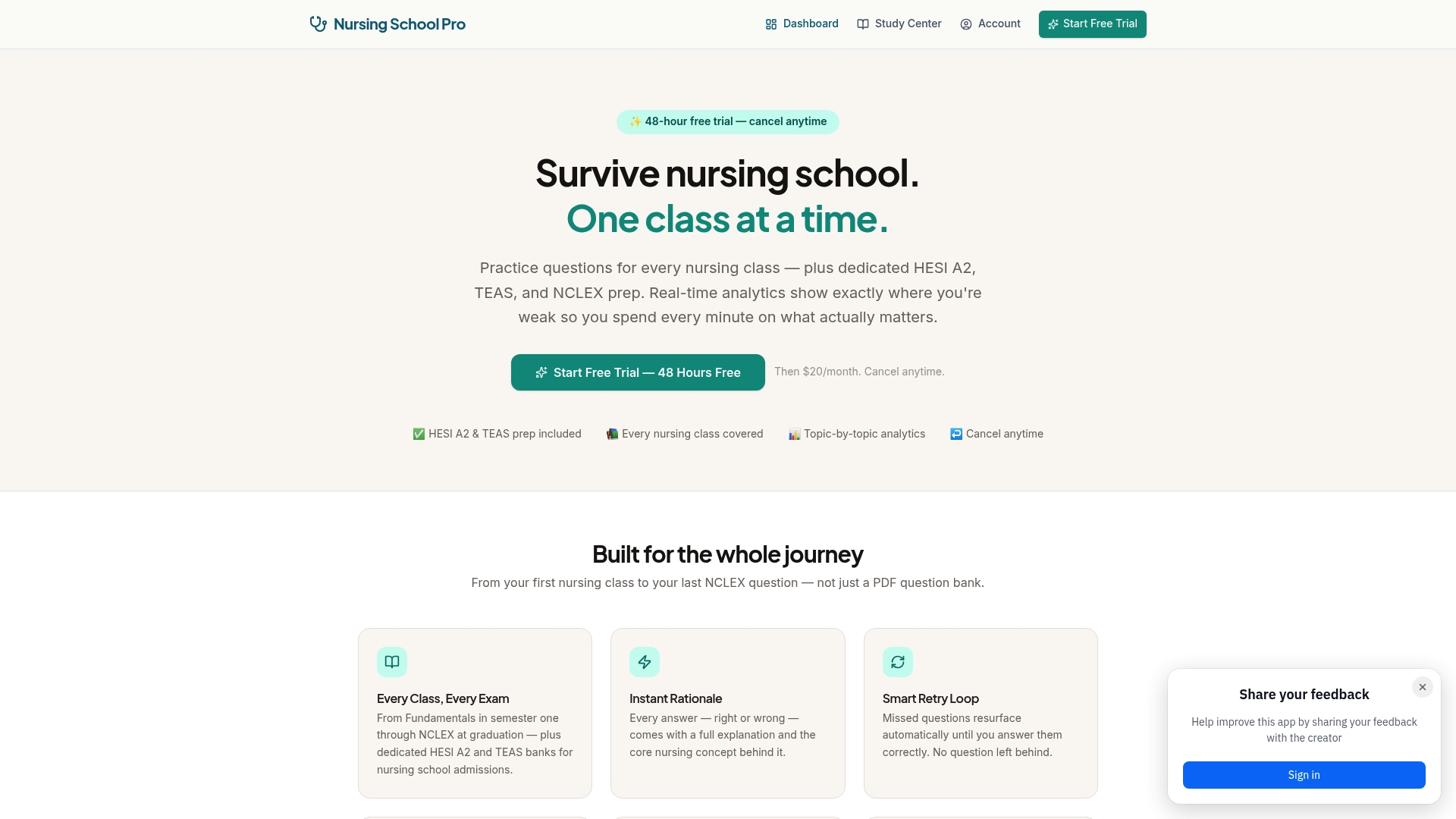
Real-time analytics track which drug classes you're missing most, so you can run a targeted stem-focused practice set instead of grinding through questions at random. If -prazole questions keep tripping you up, the platform flags it and surfaces more of them until the pattern sticks.
Start with a 48-hour free trial and run your first pharmacology practice set today. Three steps: sign up, select a pharmacology topic set, and check your analytics after 20 questions to see exactly which stems need more work.
Sources
These sources were used to build the reference table and study strategies above. Each one is worth bookmarking for deeper study and drug mechanism verification.
- Table 1.8, Common Classes of Medications, Examples, Suffixes, and Roots. - Nursing Pharmacology - NCBI Bookshelf
- Pharmacologic Suffixes
- Common Drug Stems
- Mastering PTCB Pharmacology: Drug Prefixes, Suffixes & Medication Families Simplified | FlashGenius
- Drug Prefixes and Suffixes | Memorizing Pharm
Use these alongside a current drug reference (Lexicomp, Micromedex, or your program's approved formulary) whenever you need to verify a mechanism or confirm a clinical caution before applying stem-based reasoning in practice.
This article is general information, not a substitute for advice from a qualified doctor. Consult a qualified healthcare professional about your own circumstances before acting on anything here.
Recommended
- The Dosage Calculation Mistake That Almost Failed Me | Nursing School Pro
- Pricing — Nursing School Pro | $20/month, 48-Hour Free Trial
- Blood Draw Order of Draw: Tube Colors, Lab Tests & Nursing Tips (2026) | Nursing School Pro
- Nursing School Pro — Practice Questions for HESI A2, TEAS & NCLEX | 48-Hour Free Trial