
The single most effective way to prepare for the NCLEX is a timed, daily practice-question routine built around active rationale review and spaced repetition mapped to your weakest topics. Not flashcards. Not re-reading textbooks. Questions, rationales, and a log of what you got wrong.
Start here:
- Review the official NCSBN test plan to know exactly which content domains the exam weights most heavily.
- Set a practice-question cadence: at minimum 75 questions daily, plus one full-length or half-length mock exam per week.
- Track every wrong answer in an error log with the topic, why you missed it, and the correct rationale. Accuracy percentage and average time per question are the two metrics that matter most.
Pro Tip: The ANA advises prioritizing clinical judgment over rote memorization. When you review a rationale, ask yourself why the correct answer is safe and why each wrong answer could harm a patient. That mental habit transfers directly to test day.
Key Takeaways
The most reliable path to passing the NCLEX is a daily timed practice-question routine paired with active rationale review, a maintained error log, and spaced repetition mapped to your weakest topics.
| Point | Details |
|---|---|
| Daily question cadence | Run at least 75 timed questions per day and review every rationale immediately after. |
| Map weaknesses from baseline | Take a diagnostic test in Week 1 and build your weekly schedule around the topics below 60% accuracy. |
| Spaced repetition on errors | Review flagged topics at Day 3, Day 7, and Day 14 intervals to move weak content into long-term memory. |
| Confirm test-day logistics | Check NCSBN's candidate rules page within the final week to verify ID requirements and break policy. |
| Nursingschoolpro | Provides instant rationales, NGN item formats, and a real-time analytics dashboard to support the 8-week plan at $20/month after a 48-hour free trial. |
Table of Contents
- What the NCLEX actually tests and how the exam works
- How to build a personalized 8-week NCLEX study plan
- High-impact study techniques that raise your pass probability
- How to read stems, eliminate distractors, and choose the right answer
- How to use practice questions and mock exams to close your gaps
- Managing test anxiety and your test-day checklist
- How Nursingschoolpro fits this study plan and speeds improvement
- What to do in the final 72 hours before your exam
- A note from Autumn on what actually moves the needle
- Nursingschoolpro gives you the question cadence this plan needs
- Sources
What the NCLEX actually tests and how the exam works
The NCLEX measures whether a new graduate can practice nursing safely at the entry level. NCSBN, the organization that develops and administers the exam, frames the entire test around clinical judgment, not textbook recall.
The exam is organized into four Client Needs Categories:
- Safe and Effective Care Environment (Management of Care; Safety and Infection Control): the largest weighted domain, covering delegation, prioritization, and error prevention.
- Physiological Integrity (Basic Care and Comfort; Pharmacological and Parenteral Therapies; Reduction of Risk Potential; Physiological Adaptation): the bulk of the exam's content, including medications, lab values, and disease management.
- Psychosocial Integrity: therapeutic communication, mental health, coping, and crisis intervention.
- Health Promotion and Maintenance: developmental stages, prevention, and patient education across the lifespan.
The NCLEX runs on computer adaptive testing (CAT). The algorithm adjusts question difficulty based on each answer you give. Answer correctly and the next item gets harder; miss one and it pulls back. The exam ends when the algorithm is statistically confident you are above or below the passing standard, which is why some students finish in 85 questions and others see 150. Length alone tells you nothing about whether you passed.
Item types now include traditional multiple choice, select-all-that-apply (SATA), case studies, matrix grids, drag-and-drop, and hot-spot items. The Next Generation NCLEX (NGN) formats introduced partial-credit scoring on some items, which changes how you should approach them.
How to build a personalized 8-week NCLEX study plan
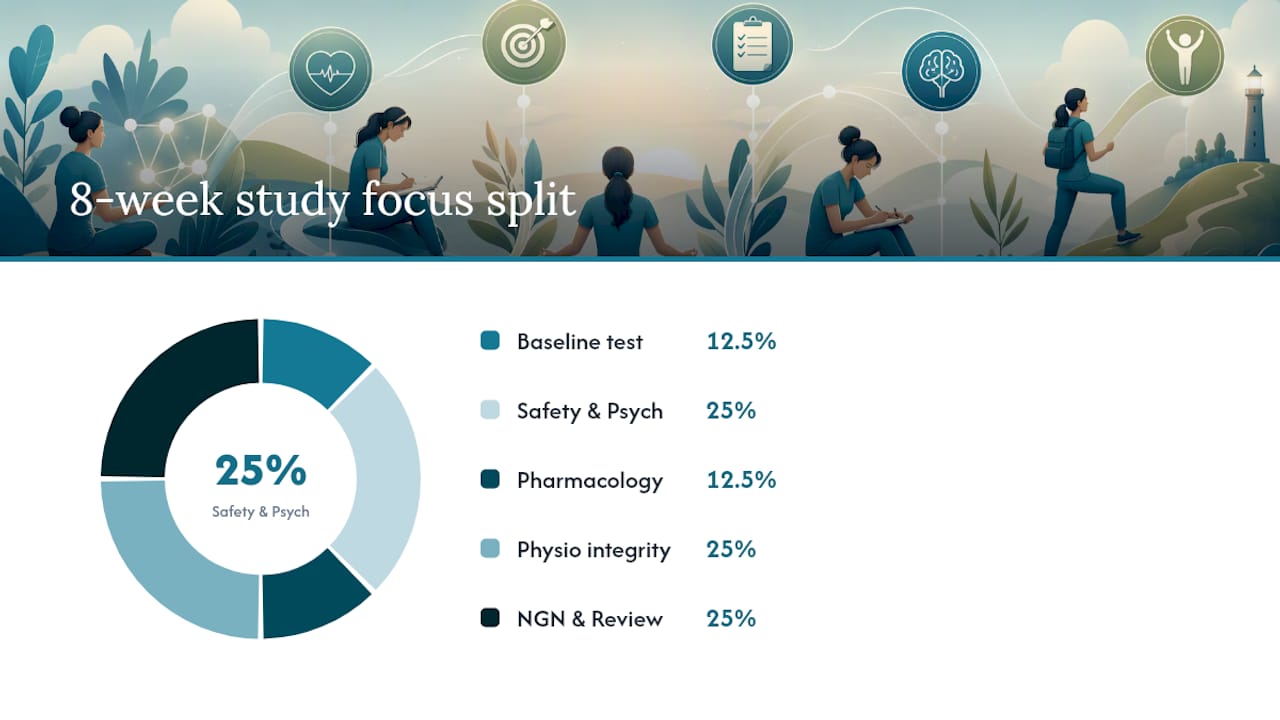
If you have two months, this template gives you a structured path. If time is shorter, compress Weeks 1–4 into two weeks and keep Weeks 5–8 as written.
8-week calendar
| Week | Focus |
|---|---|
| 1 | Baseline diagnostic test; map weak topics; review NCSBN test plan |
| 2 | Safety and Infection Control; Management of Care; delegation rules |
| 3 | Pharmacology fundamentals; dosage calculation drills |
| 4 | Physiological Integrity: cardiac, respiratory, neuro |
| 5 | Physiological Integrity: renal, GI, endocrine, musculoskeletal |
| 6 | Psychosocial Integrity; Health Promotion; therapeutic communication |
| 7 | NGN formats; SATA practice; full-length mock exam |
| 8 | Mixed review; error-log remediation; light review only in final 72 hours |
Weekly and daily structure
A realistic daily block looks like this:
- Morning (60–90 min): 50–75 timed practice questions, then immediate rationale review.
- Afternoon (30–45 min): Update error log; run spaced-repetition review on flagged topics from prior days.
- Evening (20–30 min): Light content review on the week's focus topic only.
Weekly goals to track include overall accuracy, topic-specific accuracy with attention to weaker areas, average time per question within a reasonable range, and a meaningful portion of NGN item types practiced.
Identifying weak areas from baseline tests and mapping them onto a weekly remediation schedule is the most reliable way to avoid studying what you already know at the expense of what will cost you points.
High-impact study techniques that raise your pass probability
Practice questions with active recall, spaced repetition on weak topics, and deliberate rationale review move scores faster than any other combination. Here is how to run each one.
Active recall during question practice
Most students read a question, guess, then read the rationale passively. That is the slow path. Instead:
- Cover the answer choices and write or say your answer before looking at the options.
- Then read all four choices and select the best one.
- After checking the answer, explain in one sentence why the correct option is right and why each wrong option fails.
That last step is where the learning happens. Passive reading of a rationale leaves almost no trace. Explaining it in your own words forces encoding.
Spaced repetition for weak topics
Spaced repetition means reviewing a topic at increasing intervals so it moves into long-term memory. For an 8-week plan, a practical cadence is:
- Day 1: First exposure (practice questions on the topic).
- Day 3: Short review of flagged rationales from Day 1.
- Day 7: Another question block on the same topic.
- Day 14: Final reinforcement before the exam.
If you miss a topic again at Day 7, reset the interval back to Day 3. Error logs plus spaced repetition convert practice-test exposure into durable competence faster than untargeted study.
Dosage calculation protocol
Run a timed 10-question dosage drill every other day throughout Weeks 2 and 3, then weekly after that. Focus on IV drip rates, weight-based dosing, and unit conversions. The most common errors involve trailing zeros and decimal placement.
Pro Tip: Never write a trailing zero after a decimal (write "2 mg," not "2.0 mg") and always write a leading zero before a decimal (write "0.5 mg," not ".5 mg"). These dosage calculation conventions are tested directly and are the source of avoidable errors on the exam.

How to read stems, eliminate distractors, and choose the right answer
Use a reproducible four-step flow on every item. Nursingeducation maps directly onto how NCLEX items are constructed:
- Assess the stem. Read the entire question once without looking at the choices. What clinical situation is described?
- Identify keywords and priority. Look for words like "first," "priority," "most appropriate," "immediately," and "except." These words change the answer.
- Reword the lead-in. Turn the question into a plain statement: "The nurse should do ___ because ___."
- Pre-answer before reading choices. Form your answer, then check which option matches it most closely.
- Eliminate distractors. Cross out options that address a different problem, use absolute language incorrectly, or repeat information from the stem without adding clinical action.
- Apply NCLEX-style rules. Safety comes before comfort. Assessment comes before intervention unless the patient is in immediate danger. "Call the physician" is rarely the first action.
Common wrong-answer patterns to recognize
- Absolute language traps: options with "always," "never," or "all" are usually wrong. The NCLEX rarely deals in absolutes.
- Repeat-the-stem distractors: an option that restates what the question already told you adds no clinical value and is almost never correct.
- Unrelated distractors: if an option addresses a different body system or a different patient problem than the stem describes, eliminate it.
- Call-the-physician traps: "notify the provider" is correct only when you have already assessed and the situation is beyond nursing scope. If assessment or a nursing intervention is an option, do that first.
- WWTS (What Would the Textbook Say): when stuck, ask what the textbook-perfect nurse would do, not what a rushed nurse in a real unit might do.
Timing under CAT
Blueprint Prep recommends budgeting roughly 60–90 seconds per question as a general target. If you are spending more than two minutes on a single item, make your best choice and move. The CAT algorithm does not penalize you for a wrong answer the way a fixed-length test does; it simply adjusts the next item. Lingering on one question costs you time on the ones that follow.
How to use practice questions and mock exams to close your gaps
Treat every practice question as an active learning cycle: answer, check rationale, log the error, remediate, repeat. That loop is what separates students who improve from students who just accumulate question counts.
Error log template
Keep a simple log with these fields for every question you miss:
- Date of the practice session.
- Topic (e.g., cardiac pharmacology, delegation, SATA).
- Why you got it wrong (misread the stem, didn't know the content, eliminated the right answer).
- Correct rationale in your own words.
- Action step (e.g., "review ACE inhibitor side effects on Day 7").
Reviewing this log weekly is more valuable than doing 50 extra questions you already know.
Practice-test cadence
- Daily: 50–75 questions, timed, topic-specific in Weeks 1–6.
- Weekly: one half-length mock (50–75 mixed questions) under test conditions.
- Biweekly: one full-length mock (150 questions) starting in Week 5.
Simulate real test conditions: no phone, no music, no pausing. Simulating test conditions during practice reduces the cognitive shock of the actual exam environment.
Mini metric dashboard
Track these four numbers weekly:
- Accuracy by topic: any topic below 60% gets added to next week's spaced-repetition queue.
- Trendline of time per question: if your average is dropping below 45 seconds, you may be rushing; above 100 seconds, you need pacing practice.
- Percentage of NGN item exposure: by Week 7, at least 20–25% of your practice items should be NGN formats (case studies, matrix, extended drag-and-drop).
- SATA accuracy separately: SATA items trip up most students. Blueprint Prep advises treating each SATA option as an independent true/false statement rather than comparing options against each other. Track your SATA accuracy as its own metric.
Managing test anxiety and your test-day checklist
Anxiety before the NCLEX is normal. It becomes a problem only when it is unmanaged. Short, preplanned rituals and break strategies keep it from derailing your performance.

Test-day checklist
Confirm every item the night before:
- Valid government-issued photo ID (name must match your registration exactly).
- Authorization to Test (ATT) number from NCSBN.
- Testing center address and parking plan; arrive at least 30 minutes early.
- No prohibited items: no phones, no notes, no food in the testing room.
- Earplugs are typically provided; confirm with your testing center.
Review NCSBN's candidate rules page the week before your exam. Rules around acceptable ID, break procedures, and what you can bring into the room are updated periodically, and the official page is the only source you should trust.
Fast anxiety practices
- Box breathing before you begin: inhale 4 counts, hold 4, exhale 4, hold 4. Two cycles before you start the exam takes 30 seconds and measurably lowers heart rate.
- Two-minute reset after a hard question: if a question rattles you, take two slow breaths before reading the next stem. You cannot change the previous answer; the next question is a clean slate.
- Scheduled breaks: the NCLEX allows optional breaks. Use one at the midpoint if you feel your concentration slipping. Stand up, stretch, and drink water. Do not review content in your head during the break.
- After the exam: check NCSBN's quick results page for preliminary results, typically available two business days after your exam for a small fee.
How Nursingschoolpro fits this study plan and speeds improvement
Using an analytics-backed question bank with instant rationales shortens the feedback loop and focuses remediation on the topics that actually cost you points.
Here is how to plug Nursingschoolpro into the 8-week plan:
- Week 1: Take a baseline diagnostic test in the Study Center to establish your starting accuracy by topic. This replaces guesswork about where to begin.
- Weeks 2–6: Schedule daily question blocks by topic. Nursingschoolpro's instant rationales let you complete the active-recall loop immediately after each question, without switching between tabs or waiting for an explanation.
- Throughout: Use the platform's real-time analytics dashboard to monitor accuracy trends by topic. When a topic stays below 60% after two rounds, add it to your spaced-repetition queue.
- Week 7: Switch to mixed NGN-format sets to simulate the actual exam's item variety.
The analytics make that progress visible instead of invisible.
Nursingschoolpro's content is aligned to leading nursing textbooks and national curriculum standards, so the rationales you read match what your program taught. The 48-hour free trial costs nothing to test, and the subscription runs $20/month, which is less than a single nursing textbook.
What to do in the final 72 hours before your exam
The last three days are not for learning new content. They are for consolidating what you already know and protecting your performance.
Short verdict: do a light, mixed question review, revisit your error log highlights, confirm all logistics, and stop studying by the evening before the exam.
72-hour checklist
- 72 hours out: run one untimed mixed set of 50 questions. Review rationales only for items you miss. No new topics.
- 48 hours out: read through your error log. Focus on the action steps you wrote, not the full rationale text. Spend no more than 60 minutes on content.
- 24 hours out: confirm your testing center location, ID, and ATT number. Pack your bag. Eat a normal dinner. Sleep at least seven hours.
- Morning of the exam: eat a real breakfast. Arrive 30 minutes early. No cramming in the parking lot.
- One thing to do right now: pull up the NCSBN candidate rules page and verify your ID requirements and break policy. Five minutes now prevents a disqualifying surprise at the door.
A note from Autumn on what actually moves the needle
Most students who struggle with the NCLEX are not struggling because they lack knowledge. They struggle because they studied the wrong way: passive reading, highlight-and-hope, and untimed question banks they never reviewed deeply. The strategies in this article are not complicated, but they require consistency and honesty about where your gaps actually are.
The students who pass on the first attempt tend to share one habit: they treat every wrong answer as information, not failure. Build that habit early, and the exam becomes a problem you can solve.
Nursingschoolpro gives you the question cadence this plan needs
Every strategy in this article depends on one thing: a reliable source of quality practice questions with instant, textbook-aligned rationales and analytics that show you where you stand. That is exactly what Nursingschoolpro delivers.
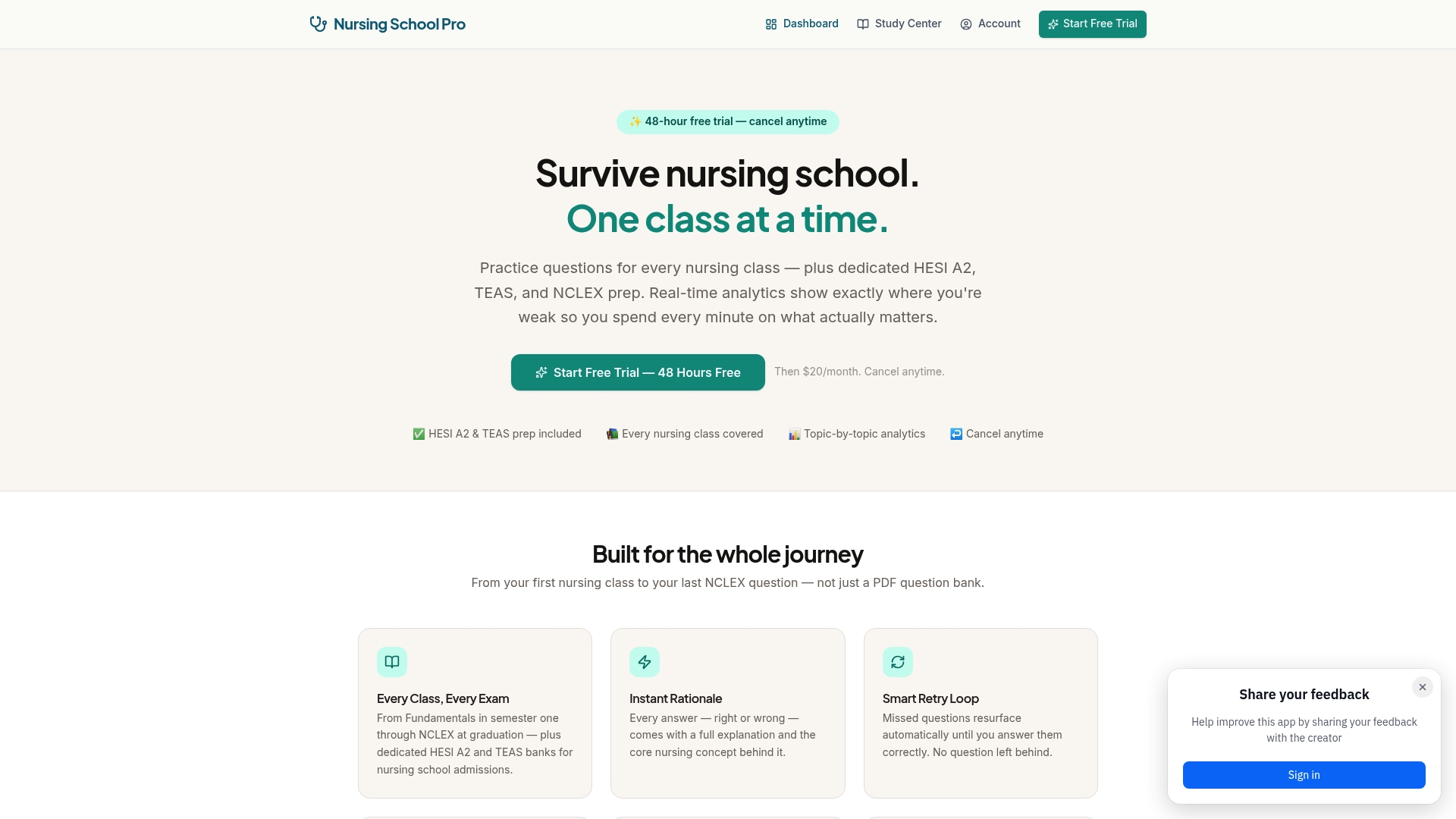
Here is what you get with a Nursingschoolpro subscription:
- Timed question sets organized by NCLEX topic and Client Needs category, ready to drop into your daily blocks.
- Instant rationales for every answer, written to match the clinical reasoning the NCLEX rewards.
- Real-time analytics dashboard that tracks accuracy by topic, flags weak areas, and shows your trendline over time.
- NGN item exposure so you practice case studies, matrix grids, and extended formats before test day.
- Downloadable templates for error logs and study calendars, aligned to the 8-week plan above.
Start with the 48-hour free trial and run your Week 1 baseline diagnostic at no cost. If the workflow fits, the full subscription is $20/month. Visit the Study Center to begin your first timed question block today.
Sources
Check these pages directly for official rules, format updates, and supplemental guidance:
- Ncsbn
- Four Steps for Dissecting NCLEX® Questions | NursingEducation
- Top NCLEX Test Taking Strategies | Nursing Blog | Blueprint Prep
Before your exam: visit the NCSBN candidate rules page one final time to confirm nothing has changed. Policy updates happen, and the official page is always current.