
Nursingschoolpro offers free, editable drug card templates built specifically for nursing students — download them now from the Nursing School Study Center in the format that fits your workflow. Whether you need a full-page reference sheet for deep study, a compact flashcard for active recall, or a 4-per-page printable for clinical rotations, each template covers every field the NCSBN expects nursing students to know for NCLEX pharmacology questions. Fill one card per drug, and you have a portable, scannable safety snapshot ready for both your study desk and the bedside.
Safety note: These templates are study and quick-reference tools. Always verify medications against the current MAR, facility policy, and pharmacist or provider guidance before administration.
Key Takeaways
A well-built nursing drug card template covers 13 essential fields, places hold criteria and high-alert flags at the top, and functions as a study drill tool as much as a clinical quick-check.
| Point | Details |
|---|---|
| Download the right format first | Use full-page for deep study, 4-up for clinical pockets, flashcard for active recall drills. |
| Prioritize safety-critical fields | Put high-alert flag and hold criteria at the top so they catch your eye before administration. |
| Write one-sentence mechanisms | A single nursing-language mechanism line improves recall and connects pharmacology to clinical action. |
| Drill with active recall | Cover the card and recite hold criteria and monitoring points from memory — every time, until automatic. |
| Cards are quick-check tools only | Always verify against the current MAR, facility policy, and pharmacist or provider guidance before giving any medication. |
| Nursingschoolpro templates | Free editable templates in four formats, paired with NCLEX-style practice questions and instant rationales at the Study Center. |
Table of Contents
- What drug card template formats work best for nursing students?
- What fields belong on every nursing drug card?
- How do you use drug cards to study for NCLEX and clinicals?
- How to customize, print, and organize your cards
- A sample filled drug card: metoprolol succinate
- Why Nursingschoolpro templates work alongside your course and NCLEX prep
- The mistake most students make with drug cards
- Nursingschoolpro gives you the templates and the practice questions in one place
- Sources
What drug card template formats work best for nursing students?
Editable medication card collections are available in multiple printable formats to match different study and clinical workflows. Nursingschoolpro provides four core file types:
- Full-page (8.5 × 11): One drug per page with room for every field, annotations, and personal notes. Best for initial card creation, deep pharmacology study, and building your first set from scratch.
- Flashcard format: Front/back layout with drug name and class on one side, key nursing considerations on the other. Use these for active recall drills and spaced repetition sessions the week before an exam.
- 4-per-page (4-up): Four cards printed on a single sheet, then cut apart. Ideal for clinical rotations when you want a pocket-sized quick-check without printing a full page per drug.
- Editable PDF: Fillable fields you type directly into before printing. Saves time when you have a long med list and want consistent formatting across every card.
The right format depends on where you are in your rotation. Full-page cards work best at your desk when you are building knowledge. The 4-up printable is the one to laminate and carry in your scrub pocket during med pass.
Pro Tip: If you prefer a digital workflow, import the editable PDF into Notability or GoodNotes on a tablet, fill fields with a stylus, and tag each card by drug class. You can search by keyword in seconds — faster than flipping through a physical binder during a study sprint.
What fields belong on every nursing drug card?
A well-structured clinical drug card captures generic and brand names, drug class and action, dose and frequency, high-alert status, indications, contraindications, side effects, nursing considerations, and patient education in a layout you can scan in under 30 seconds. Here is the full field checklist, in priority order:
| Field | What to write | Why it matters |
|---|---|---|
| Generic name / brand name(s) | metoprolol / Lopressor, Toprol-XL | MAR uses generic; orders may use brand |
| Drug class / mechanism | Beta-1 selective blocker; slows HR by blocking catecholamines at the SA node | One-sentence mechanism improves recall and connects pharmacology to nursing action |
| Indication(s) | HTN, angina, HF, post-MI | Tells you why the patient is receiving it |
| Typical adult dose & route | 5 mg IV every 5 minutes up to 3 doses | Anchors your dose-range check |
| High-alert flag | ✓ (cardiovascular; hold criteria apply) | Flags insulin, opioids, anticoagulants, concentrated electrolytes for extra verification |
| Onset / peak / duration | PO: onset 1 hour, peak 4 hours, duration 6–12 hours | Critical for timing assessments and patient teaching |
| Contraindications | Bradycardia, cardiogenic shock, 2nd/3rd-degree heart block | Hold criteria live here |
| Major interactions | NSAIDs reduce effect; verapamil increases bradycardia risk | Catches polypharmacy flags |
| Frequent / serious side effects | Bradycardia, hypotension, fatigue, bronchospasm (high doses) | Drives your assessment priorities |
| Monitoring / lab checks | HR before each dose, BP, signs of HF, blood glucose in diabetics | Tells you what to assess before and after giving the drug |
| Nursing considerations | Hold if HR <60 or SBP <90; do not stop abruptly; monitor for rebound HTN | The actionable bedside checklist |
| Patient teaching | Do not skip doses; rise slowly; report dizziness or SOB | Teach-back prompts for discharge |
Write the mechanism as a single nursing-language sentence — what the drug does to the body in one line. This approach improves recall and helps you translate pharmacology into nursing actions during both exams and clinical checks.
Medication cards built this way function as a safety snapshot: they link the medication to what to verify, what to monitor, and what to teach. Always start with the current order and MAR, then consult an approved drug guide to populate each field accurately.
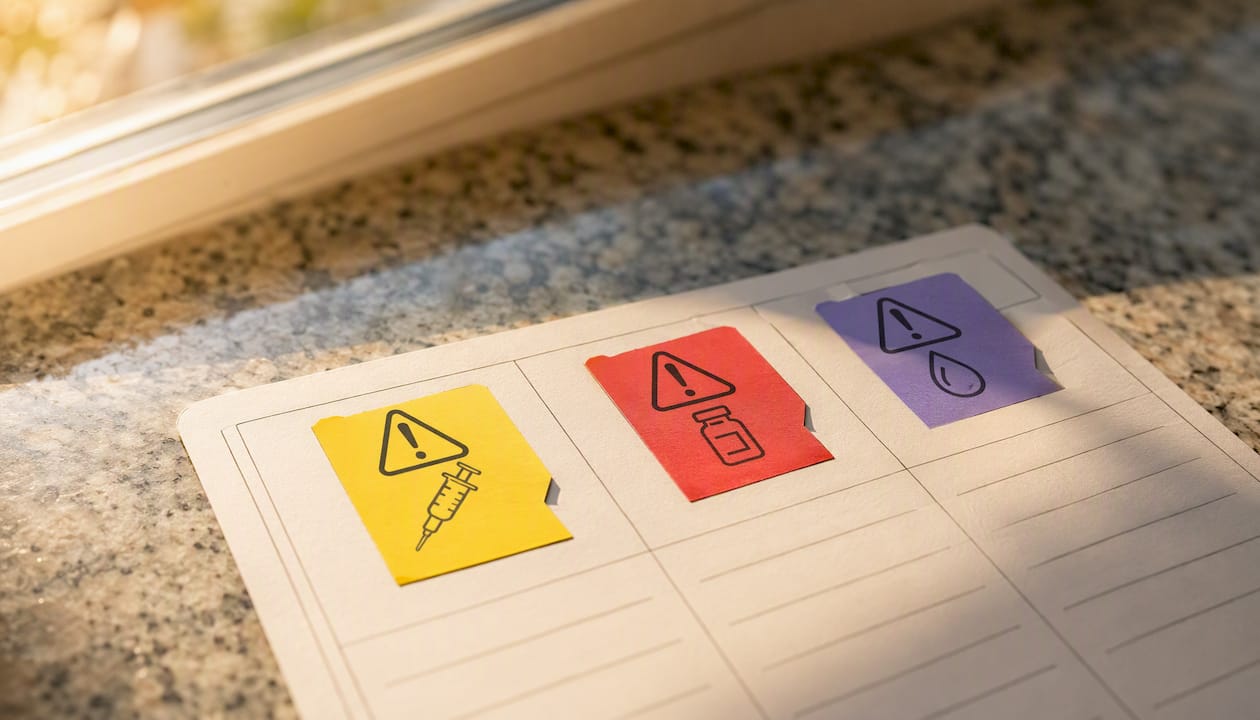
Flagging high-alert drugs explicitly — insulin, opioids, anticoagulants, concentrated electrolytes — reduces the chance of a dosing error during med-pass practice. Put that flag at the top of the card so it catches your eye before anything else.
How do you use drug cards to study for NCLEX and clinicals?
The card is only as useful as the routine built around it. Here is a step-by-step workflow that works for both exam prep and bedside use:
- Pull the source. Start with the medication order or your course drug list. Open the FDA label or an approved drug guide (Davis's Drug Guide, Nursing Drug Handbook) alongside the MAR.
- Fill the card field by field. Write the mechanism in one sentence. Populate hold criteria before side effects — safety-critical items belong where your eye lands first.
- Drill with active recall. Cover the card and recite the mechanism, hold criteria, and monitoring points from memory. Flip to check. Repeat until you can do it cold.
- Apply spaced repetition. Review new cards daily for three days, then every three days, then weekly. Apps like Anki let you import card content and automate the schedule — pair this with NCLEX-style flashcard resources for high-yield pharmacology.
- Pair drug + lab. For every drug with a monitoring field, create a mental link: metoprolol → HR before dose; warfarin → INR; digoxin → potassium and drug level. This concept pairing is exactly how NCLEX pharmacology questions are written.
- Run exam-style practice. Turn each card into a question stem: "A patient's HR is 54 before their scheduled metoprolol dose. What is your first action?" Use NCLEX practice question sets aligned with NCSBN content domains to test whether your card knowledge transfers to clinical reasoning.
- Use the card at the bedside. Before administration, scan hold criteria and monitoring points. After giving the drug, document verification and any patient teaching using teach-back prompts from the patient education field.
Aligning your study tools with NCLEX content domains helps you prioritize high-yield medication topics rather than trying to memorize every drug in the formulary.
How to customize, print, and organize your cards
Getting the format right before you print saves a lot of wasted paper. A few practical rules:
For legibility, use a minimum 10-point font for body text and 12-point for field labels. High contrast matters more than color — black text on white prints cleanly and copies well. Keep optional fields (pharmacokinetics, pregnancy category) in a smaller font or a secondary column so they do not crowd the safety-critical fields.
Full-page cards work on standard 20 lb paper. If you are laminating cards for clinical use, print on cardstock first, laminate, then trim — the laminate edge holds better on a thicker substrate. A dry-erase marker on a laminated card lets you update patient-specific notes between shifts.
For organizing, three systems work well depending on your learning style:
- Alphabetical binder: Fast to find a specific drug by name; works best when you already know what you are looking for.
- By physiologic system: Groups drugs by how they act (cardiovascular, respiratory, CNS), which mirrors how nursing pharmacology courses organize editable medication cards and how NCLEX content domains are structured.
- By high-alert status: A red-tabbed section for insulin, opioids, anticoagulants, and concentrated electrolytes keeps your highest-risk drugs front and center.
A digital library in Notion or OneNote lets you search across all cards instantly and tag by class, system, or rotation.
Pro Tip: Use the same template across your entire study set. Copy the blank template for each new drug class rather than reformatting from scratch. When every card has identical field placement, your eye goes straight to the right spot under pressure — during an exam or a fast-moving med pass.
A sample filled drug card: metoprolol succinate
Here is a fully populated example using a drug that appears frequently in nursing school and on NCLEX pharmacology questions:
| Field | Entry |
|---|---|
| Generic name | Metoprolol succinate |
| Brand name(s) | Toprol-XL |
| Drug class / mechanism | Cardioselective beta-1 blocker; reduces HR and BP by blocking sympathetic stimulation at the SA node |
| Indication | HTN, stable angina, HF with reduced EF, post-MI |
| Dose / route / frequency | Extended release PO once daily; do not crush |
| High-alert flag | ✓ Cardiovascular — hold criteria apply |
| Onset / peak / duration | Onset 1–2 hours; peak 6–12 hours; duration varies |
| Contraindications | Low heart rate, low blood pressure, cardiogenic shock, 2nd/3rd-degree AV block |
| Major interactions | NSAIDs (reduced antihypertensive effect); verapamil/diltiazem (additive bradycardia) |
| Side effects | Bradycardia, hypotension, fatigue, cold extremities, bronchospasm at high doses |
| Monitoring | Apical HR and BP before each dose; signs of HF (weight gain, edema, dyspnea); blood glucose in diabetics |
| Nursing considerations | Hold if HR <60 or SBP <90; never stop abruptly (risk of rebound angina/HTN); use with caution in asthma |
| Patient teaching | Take at same time daily; do not skip doses; rise slowly; report dizziness, SOB, or weight gain >2 lb/day |
The hold criteria and monitoring rows are the ones NCLEX questions are built around. A question stem that says "the patient's apical pulse is 52 before the scheduled dose" is testing exactly what lives in those two rows.
NCLEX tip: Turn each card into a practice prompt before your exam. Cover the nursing considerations row and ask yourself: "What would make me hold this drug?" If you can answer without looking, you are ready for the pharmacology questions on test day.
Why Nursingschoolpro templates work alongside your course and NCLEX prep
Nursingschoolpro templates are designed to slot directly into the study workflow nursing programs already expect:
- Ready-to-download formats in full-page, flashcard, and 4-up layouts, with editable PDF fields aligned to common nursing program requirements.
- Integration with practice questions: After filling a card on metoprolol, you can immediately run NCLEX-style questions on beta blockers in the Nursingschoolpro platform and read the instant rationale explaining why the hold criteria matter — not just what they are.
- Adaptive analytics track which drug classes you are missing on practice questions, so you know which cards to review next rather than cycling through drugs you already know cold.
- Alignment with leading textbooks means the field structure on every template matches what your clinical instructors and drug guides use, so there is no translation step between your card and your course materials.
Pair the templates with the dosage calculation resources on Nursingschoolpro to catch the arithmetic errors that trip students up during med-pass practice. And always verify clinical medications against the MAR and facility policy — the card is a study and quick-check tool, not a substitute for those primary sources.
The mistake most students make with drug cards
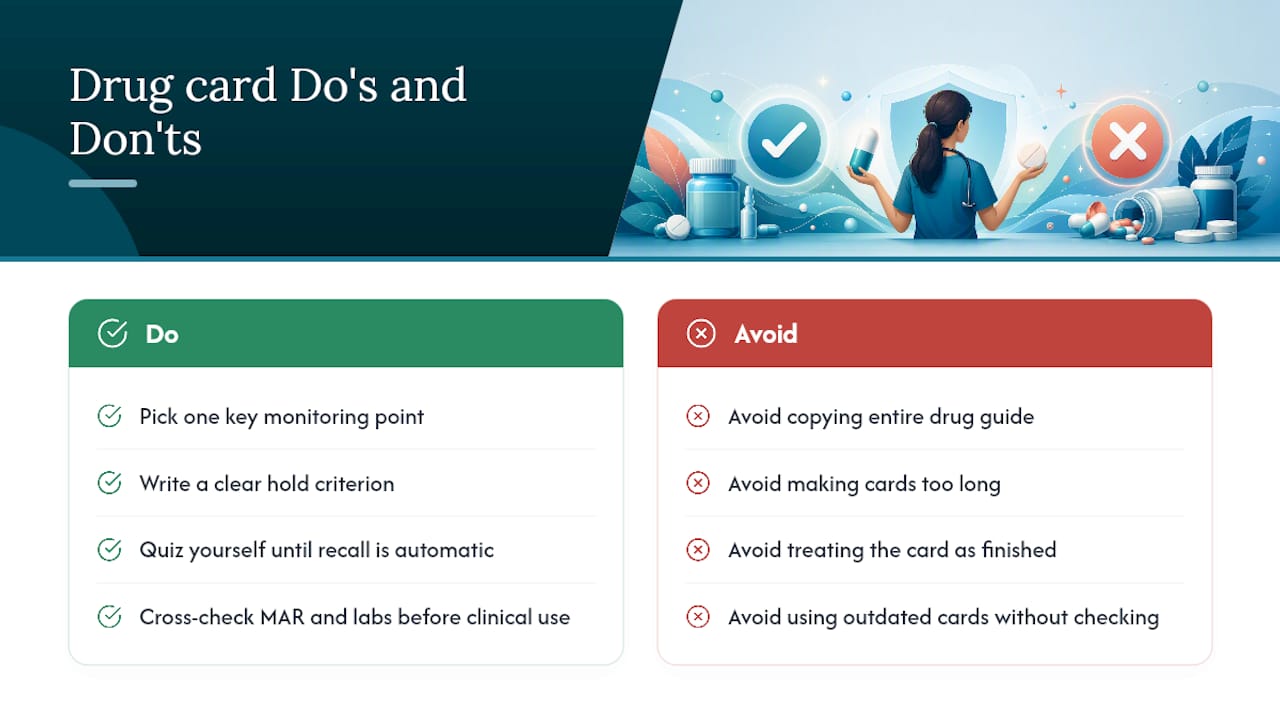
Most nursing students build drug cards that are too long. They copy every line from the drug guide, end up with a card that takes four minutes to read, and then never actually use it at the bedside because it is faster to look the drug up again from scratch.
The template format exists to force discipline. When you have twelve fields and a fixed box, you cannot paste in three paragraphs of pharmacokinetics. You have to decide: what is the one monitoring point that matters most for this drug? What is the hold criterion I need to act on in the next 30 seconds? That constraint is the whole point.
The other common error is treating the card as a finished product after you write it. A card you never quiz yourself on is just a pretty note. The students who retain pharmacology are the ones who flip the card over, recite the hold criteria from memory, and check themselves — every single time, until it is automatic. That habit, more than any particular template design, is what closes the gap between knowing a drug on paper and catching a problem at the bedside.
Always cross-check labs and hold criteria against the current MAR before relying on a card during clinicals. A card built last semester may not reflect a patient's current orders.
Nursingschoolpro gives you the templates and the practice questions in one place
Pharmacology is the subject nursing students most often cite as the hardest to retain — and the one NCLEX tests most relentlessly. Nursingschoolpro addresses both problems at once: free, editable drug card templates you can download today, paired with NCLEX-style practice questions and instant rationales that explain the clinical reasoning behind every answer.
The 48-hour free trial gives you full access to the Study Center, including downloadable templates in every format, practice questions for every nursing class, and real-time analytics that show exactly which drug classes need more work. After the trial, full access runs $20/month. Start at the Nursing School Study Center to download your first template and run your first practice set — no commitment required to see whether it fits your workflow. As always, verify every clinical medication against the current MAR and facility policy before administration.
Sources
- Medication Card Template for Nursing Students | Nurse Shift Survival
- Drug card template: Free PDF for nurses and clinicians - Free PDF Download | Pabau
- Medication Cards (Editable) – Nursing Pharmacology
- NCLEX pass rates and publications | NCSBN