
The HESI A2 Reading Comprehension section rewards one habit above all: tying every answer to a specific line in the passage. You do not need to be a fast reader so much as a disciplined one, and that discipline comes from practicing passages and reading the reasoning behind every answer, right or wrong. That is the approach we built Nursing School Pro around: practice questions with an instant rationale for each answer, so you see why a choice is correct and not only that it is.
Below you will find what the section covers, how each question type works, the mistakes that cost points, and a two-week practice routine you can adjust to your test date.
TL;DR
- Reading Comprehension has 50 scored questions plus 5 unscored pilot items, and covers main idea, supporting details, words in context, author's purpose, fact versus opinion, conclusions and inferences, summarizing and tone (TSTC study guide).
- Every correct answer is supported by the passage. If you cannot point to the line, you are guessing from outside knowledge.
- Practice with timed passages in conditions that match the real online proctored exam (FSU Academic Center for Excellence).
- Review every miss by naming the question type you missed, then drill that type until the pattern disappears.
Table of Contents
- What the Reading Comprehension section tests
- The eight question types and how to answer each
- A reading routine for each passage
- Practice that actually raises your score
- A two-week plan
- Mistakes that cost points
- Where Nursing School Pro fits
- Our perspective
- FAQ
- Sources
What the Reading Comprehension section tests
The HESI A2 is the admission assessment many U.S. nursing programs use, and Reading Comprehension is one of its academic sections. According to the library guide from Texas State Technical College, the subtest has 50 questions plus 5 pilot items, which are experimental questions that do not count toward your score but look identical to the rest. Treat every question as scored. The same guide lists the skills assessed: main idea, supporting details, words in context, author's purpose or intent, fact and opinion, drawing conclusions and making inferences, summarizing, and author's tone (TSTC).
Germanna Community College's preparation guide describes the same core skills in plainer terms: find the main idea and supporting details, use context clues for word meanings, separate fact from opinion, summarize part of a passage, and make inferences (Germanna).
The passages are medium-length and written at a college level, and the questions ask about main idea, logical inferences, author's purpose and how strong an argument is (RegisteredNursing.org). Topics tend to be general interest, and some are health related. You do not need medical knowledge to answer. Everything you need is on the screen.
Which sections count, and what score you need, is set by each school. Check your program's admissions page, and read our guide on which HESI A2 sections applicants should prioritize and on what counts as a good HESI score to set your target.

The eight question types and how to answer each
Main idea
The main idea is what the passage says overall. The University of Nevada, Reno Writing & Speaking Center notes that it is usually carried by the thesis or argument, and that summarizing helps when you are stuck: mark key points as you read, then bullet a quick summary that is neither too general nor too specific (UNR).
Where it goes wrong: wrong answers are often true statements that cover only one paragraph (too narrow) or stretch past the passage (too broad). Before you look at the choices, finish the sentence "This passage is mainly about..." in your own words. Then pick the choice that matches.
Supporting details
Detail questions ask what the passage says about a specific thing. Examples, analogies and statistics are the details to mark as you read, a tip the UNR guide gives as well. The answer is stated almost word for word in the text, so go back and find it rather than relying on memory.
Where it goes wrong: a distractor that sounds reasonable but swaps one word, such as "always" for "often", or attributes a detail to the wrong person or event. Match the exact claim.
Words in context
These ask what a word means as the author uses it. UNR points out that authors choose words that often have several definitions, so you consider how and why the word is used in that sentence. Reread the sentence before and after, then substitute each answer choice into the sentence. The one that keeps the meaning intact is the answer.
Where it goes wrong: choosing the most common meaning of a word you know. If "bear" or "charge" is on the screen, the everyday meaning is often the trap.
Author's purpose and tone
Purpose is why the author wrote the passage: to inform, persuade, argue, propose or advertise. Tone is the attitude: neutral, concerned, enthusiastic, critical. UNR suggests asking what the author wants from the audience and whether the writing is purely factual or leans on emotional appeals.
Where it goes wrong: confusing the topic with the purpose. A passage about sleep can be written to inform, to warn or to persuade. Look at the verbs and adjectives the author chooses.
Fact and opinion
A fact can be checked or measured. An opinion expresses a judgment, often with words such as "best", "should" or "unfortunately". The trap is an opinion dressed up with a number, or a fact introduced by "experts believe". Ask whether the statement could be proven true or false without anyone's judgment.
Conclusions and inferences
An inference is an educated guess about something the passage does not state outright, and UNR advises checking that the passage supports it. That last step is the whole skill. The correct inference is the one that must be true, or is very strongly implied, given the text. A choice that merely could be true is wrong.
Where it goes wrong: bringing in your own experience. If you are thinking "in real life, that would depend...", you have left the passage. Return to it and find the sentence that supports your choice.

Summarizing
Summary questions ask which choice best restates part of a passage. The right answer is shorter than the original, keeps the order of ideas, and adds nothing new. Eliminate any choice that includes a claim you cannot find in the text.
A reading routine for each passage
The same sequence works for every passage, and it keeps you from rereading in circles.
- Skim the questions first. Knowing whether you will be asked about tone, a vocabulary word or a detail tells you what to watch for.
- Read once, actively. Note the main point of each paragraph in a few words. Mark examples, analogies and any shift in direction, such as "however".
- Answer in your own words. Form a short answer before you read the options so the distractors have less pull.
- Eliminate with evidence. Cross out choices that contradict the passage, go beyond it, or are true but irrelevant.
- Confirm with a line. Point to the sentence that supports your answer. If you cannot, reconsider.
- Move on. Mark a hard item, give your best answer and return only if time remains.
Florida State University's Academic Center for Excellence lists the same building blocks for this section: timed passage interpretation, main idea versus detail, author purpose, vocabulary in context, and evidence-based inference and elimination (FSU ACE).
Practice that actually raises your score
Reading is a skill, and it improves through feedback, not through repetition alone. Reading ten passages and checking only whether you got them right teaches little. The gain comes from understanding why a wrong answer was tempting.
FSU's ACE recommends an eight-step plan: get familiar with the exam, take a diagnostic practice test, start early, build a study plan, spend more time on weak areas, review with a tutor, take timed practice exams, and look after yourself. Two parts matter most for reading:
- Diagnose first. A short untimed set tells you which question types cost you points. Many students find they miss inference and tone, not vocabulary.
- Practice under the real conditions. FSU recommends timed practice set up like the online proctored exam. Taking two official practice tests under timed conditions is a habit that standardized-test prep in general rewards, because it shows how you pace yourself before the stakes are real.
For how your reading prep fits with the rest of the exam, see our complete HESI A2 study guide. If your program also asks for HESI A2 critical thinking, the inference skills above carry over directly.
An error log that fixes patterns
Keep a simple list. For every missed question, write down:
- The question type (main idea, inference, vocabulary and so on).
- Why you chose your answer, in one sentence.
- The line in the passage that proves the right answer.
- The trap you fell for: too broad, too narrow, outside knowledge, wrong word meaning.
After a week, the log shows your two or three recurring traps. Those are what you drill, which is the same logic as FSU's advice to spend more time on weak areas.
A two-week plan
Adjust the length to your test date. If you have longer, repeat the cycle. If you have less, shrink the sets but keep the review.
| Days | Focus | What to do |
|---|---|---|
| 1 | Diagnostic | One short passage set, untimed. Label each miss by question type. |
| 2-4 | Main idea, details, summarizing | Two passages a day. Write the main idea in your own words before looking at choices. |
| 5-7 | Vocabulary in context, fact and opinion | Substitute each choice into the sentence. Circle opinion words as you read. |
| 8-10 | Inference, purpose, tone | Name the supporting line for every answer. Practice with timed sets. |
| 11-13 | Mixed timed sets | Practice in the same format as exam day. Update the error log. |
| 14 | Light review | Reread your error log. Rest. |
Bring the same planning to your other sections too. Our nursing study plan shows how to schedule practice questions and rationale review across subjects, and the HESI A2 math guide covers timed practice for a section many applicants fear more.
Mistakes that cost points
- Answering from what you know. A passage on a health topic is not a test of what you learned in a biology class. Answer from the text only.
- Picking the first true statement. Several choices may be true in general. Only one answers the question asked.
- Spending too long on one passage. A hard passage costs the same as an easy one. Give your best answer and move on.
- Skipping review. Finishing a set is half the work. The other half is learning what the misses say about your habits.
- Ignoring the pilot items. About five questions do not count, but you cannot tell which, so give each one full effort.
Where Nursing School Pro fits
The hardest part of reading prep is the feedback loop: you need a clear explanation after every question, and a way to see which question types keep slipping. Nursing School Pro is an online platform with practice questions for HESI A2, TEAS and NCLEX, an instant rationale for every answer, and real-time analytics that track your progress and highlight weak areas. When the analytics show inference is your weak spot, you can spend your next session there instead of rereading what you already know.
The plan is $20 per month and starts with a 48-hour free trial. You can see the details on the pricing page.
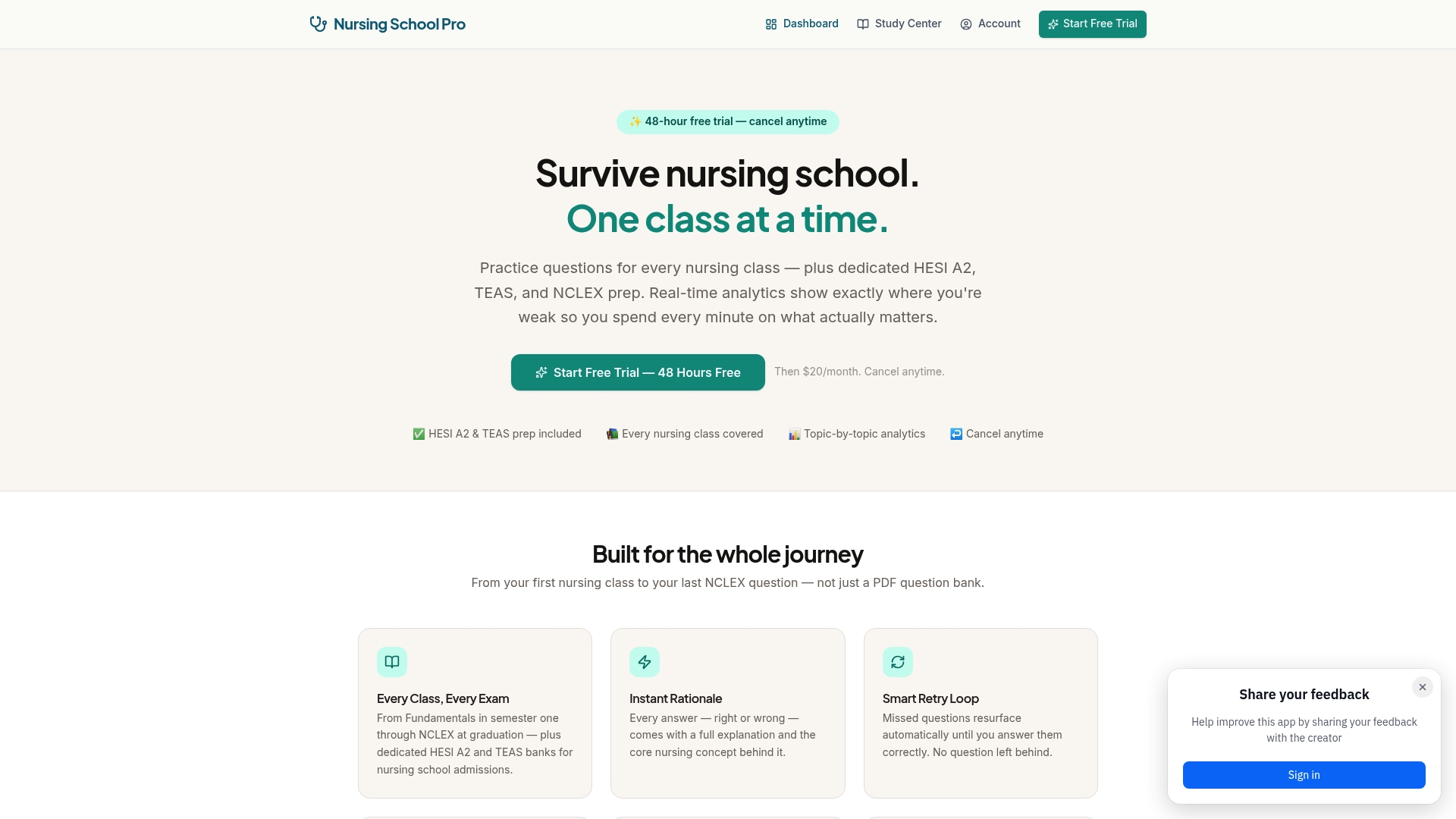
If you are also working through coursework, the Study Center gives you practice material for your nursing classes, so the same platform can support you from the entrance exam through graduation.
Our perspective
Students tell themselves reading is the easy section, because they have been reading all their lives. Then the inference questions arrive and the confidence goes. The gap is rarely ability. It is that nobody has shown them how a test writer builds a wrong answer.
We designed Nursing School Pro around that idea. An instant rationale after each question explains the reasoning behind the correct choice, and our adaptive retry loops bring weak areas back until they are solid. Real-time analytics show you which skills need attention, so your study time goes where it earns the most.
Our curriculum is aligned with respected nursing textbooks and national standards, and it is meant to carry you past the entrance exam into your coursework and the NCLEX. Reading closely, supporting a claim with evidence, and noticing what a text does and does not say are the habits you will use every day in nursing school.
Autumn
FAQ
How many questions are on HESI A2 Reading Comprehension?
The Reading Comprehension subtest has 50 questions, plus 5 pilot items that do not count toward your score. You cannot tell which are the pilot items, so treat every question as scored (TSTC). Your school sets which sections you must take, so confirm on its admissions page.
What are HESI reading passages like?
They are medium-length, college-level texts, often on general-interest or healthcare-related topics. Questions ask about main idea, inferences, author's purpose and how convincing an argument is (RegisteredNursing.org). Everything needed to answer is in the passage.
How do I pass the HESI A2 reading section?
Learn the eight question types, practice passages under timed conditions, and review every miss. Support each answer with a line from the text. Pair this with a diagnostic early on so that you spend extra time on weak areas, as FSU's prep plan advises.
How do I find the main idea quickly?
Note the point of each paragraph as you read, then state the overall message in one sentence before looking at the choices. UNR suggests summarizing with a few bullet points when you are unsure (UNR). The best answer covers the whole passage without going beyond it.
Sources
- Texas State Technical College, HESI A2 study guide
- Germanna Community College, HESI A2 Nursing Entrance Exam Preparation Guide
- University of Nevada, Reno Writing & Speaking Center, HESI A2 Reading Comprehension
- Florida State University Academic Center for Excellence, HESI A2 Prep
- RegisteredNursing.org, Nursing School Entrance Exams guide