
A good nursing care plan links one patient's assessment findings to a nursing diagnosis, a measurable goal, interventions with a reason for each, and an evaluation. The fastest way to learn that chain is to read finished examples, then practice the reasoning behind them until it is automatic. Below you get a full sample plan, the writing steps, the format checks schools use, charting examples and a clinical skills checklist. Nursing School Pro pairs this kind of reasoning practice with instant rationales on every answer, so you see why an answer is right, not only that it is.
TL;DR
- Every care plan follows the nursing process: assessment, diagnosis, outcomes, planning, implementation, evaluation.
- Student plans usually add a rationale for each intervention, and your instructor grades that reasoning.
- Write goals that are measurable and time-bound, and individualize each plan. Copying a textbook plan is the most common mistake.
- Check your school's format (APA, NANDA wording, page limits) before you submit.
- Practice questions with rationales build the clinical reasoning that care plans and the NCLEX both test.
Table of Contents
- What a nursing care plan contains
- How to write a care plan, step by step
- Worked example: post-operative patient
- Make the plan yours: avoid copy and paste
- Format and submission checks
- Charting examples for nursing students
- Clinical skills checklist for students
- Our perspective
- Practice the reasoning behind your care plans
- FAQ
- Sources
What a nursing care plan contains
The American Nurses Association standards describe the nursing process in six components: assessment (collecting health data), diagnosis (analyzing data to name actual or potential problems), outcomes identification, planning (strategies to reach measurable outcomes), implementation (carrying out the plan, including care coordination and health teaching) and evaluation (progress toward the goals).
On paper, many plans collapse this into five parts. One nursing career guide lists assessment with subjective and objective data, a nursing diagnosis as a clinical judgment, an expected outcome with a time frame, interventions with rationales, and evaluation.
Here is what each part does in plain terms:
| Part | What it answers | Student tip |
|---|---|---|
| Assessment | What do I see, hear, measure and was I told? | Separate subjective data (what the patient says) from objective data (what you measure or observe). |
| Nursing diagnosis | What problem can nursing care address? | Use NANDA wording. Do not write a medical diagnosis here. |
| Outcome (goal) | What will be different, by when? | Make it measurable and patient-centered. |
| Interventions | What will I do? | Be specific: what, how often, where. |
| Rationale | Why will this work? | Tie it to physiology or evidence, not to habit. |
| Evaluation | Did it work? | State met, partially met or not met, then revise. |
NANDA is the organization whose standard list of nursing diagnoses schools expect you to use. Most diagnoses are written in PES format: the problem, its etiology (related factors) and the signs and symptoms.
How to write a care plan, step by step
College nursing programs publish their own directions, and they agree on the sequence. Mt. SAC's nursing program has students get the patient report, complete a patient database, list every medication with its nursing implications, note treatments and activity level, review labs and diagnostic tests, and only then analyze the data to build the plan.
- Collect and organize the data. Gather vital signs, history, labs, medications and what the patient tells you. Where it goes wrong: starting with a diagnosis you already like and collecting only data that fits it. If you want a refresher on the baseline numbers you will chart, the basic nursing assessment guide covers vital signs, GCS and the edema scale.
- Pick the priority diagnoses. Rank problems by urgency, using the ABCs (airway, breathing, circulation) or Maslow's hierarchy. Most schools want at least two diagnoses, and some require one that is not physiological. Where it goes wrong: choosing five weak diagnoses instead of two well-supported ones.
- Write the diagnosis in PES format. Problem, related to the cause, as evidenced by the cues you assessed. Every cue must trace back to step 1.
- Set SMART goals. Specific, measurable, achievable, relevant and time-bound, and written about the patient, not about you. "Patient will rate pain 3/10 or less within 1 hour of intervention" works. "Nurse will relieve pain" does not.
- List interventions with rationales. Mt. SAC's version asks for three interventions per diagnosis, each with its reason. Your rationale is where your instructor sees whether you understand the physiology.
- Evaluate. Compare the patient's response to the goal, state whether it was met, not met or partially met, and say what you would change.
Steps 2 through 5 are clinical judgment, and judgment improves with repetition. Nursing School Pro's practice questions cover every nursing class and show an instant rationale after each answer, so you rehearse picking the priority problem and the right action before you have to do it on paper. Our nursing care plan template guide walks through the layout, and the concept map guide helps if your program grades a concept map instead of a table. Mt. SAC notes that concept mapping has been used for over 20 years to help students connect diagnoses, symptoms, treatments and interventions.
Worked example: post-operative patient
This is an illustrative teaching case, not a real patient. Use it to see the structure, then swap in your own patient's data.

Situation: A 45-year-old man, 6 hours after a laparoscopic appendectomy. He reports incisional pain of 7/10, winces when he moves, and is guarding his abdomen. His incisions have clean, dry dressings. He is on a prescribed analgesic schedule.
Diagnosis 1 (PES): Acute pain related to surgical incision as evidenced by self-report of 7/10, guarding behavior and grimacing with movement.
| Element | Plan |
|---|---|
| Goal | Patient will report pain of 3/10 or less within 1 hour of analgesic administration, and will walk to the chair by the end of the shift. |
| Intervention | Assess pain (location, quality, intensity) before and after each analgesic, and at regular intervals. |
| Rationale | Consistent reassessment shows whether the treatment is working and guides the next dose or the call to the provider. |
| Intervention | Give the analgesic as ordered, before activity when possible. |
| Rationale | Treating pain ahead of movement makes walking tolerable, which supports recovery. |
| Intervention | Teach splinting the abdomen with a pillow when coughing or turning. |
| Rationale | Support reduces strain on the incision during movement. |
| Evaluation | Pain 3/10 at 45 minutes after medication; walked to chair with assistance. Goal met. Continue the plan and reassess every shift. |
Diagnosis 2 (PES): Risk for infection related to surgical incisions.
| Element | Plan |
|---|---|
| Goal | Patient's incisions will stay clean, dry and free of redness, warmth, drainage or swelling through discharge. |
| Intervention | Perform hand hygiene before and after every patient contact; inspect incisions each shift. |
| Rationale | Hand hygiene limits transmission, and routine inspection catches early signs of infection. |
| Intervention | Monitor temperature and report changes per unit protocol. |
| Rationale | A rising temperature can be an early sign that infection is developing. |
| Intervention | Teach the patient and family dressing care and the signs to report. |
| Rationale | Patients who know what to watch for report problems sooner after discharge. |
| Evaluation | Incisions clean and dry, no signs of infection this shift. Goal met. Continue monitoring. |
Notice what makes this a care plan and not a task list. Every intervention answers a cue in the assessment, every goal has a number, and every rationale says why. Note that "risk for" diagnoses have no signs and symptoms yet, so they are written with risk factors instead.
Make the plan yours: avoid copy and paste
Online sample plans are a starting point, not a submission. Instructors can tell when the interventions do not match the patient's data. Individualize in three ways:
- Use your patient's numbers. Your patient's pain score, labs and history belong in the plan, not the sample's.
- Include personal and cultural factors. Preferences, beliefs, language and home support change what is achievable.
- Treat the plan as living. Reassess each shift and revise goals that were met or are no longer realistic.
The same habit matters at work. A nursing education article warns that copy and paste in documentation makes it easy to miss changes in patient condition or record care given at an earlier time.
Format and submission checks
Format rules differ by school, so the syllabus beats any template. Two published examples show the range. CSU Channel Islands asks for an APA-format care plan paper that opens with a brief patient introduction (admission date, admitting diagnosis, recent history, age, gender), then assessment findings in paragraph form, pathophysiology, lab values, medications, at least two nursing diagnoses, outcomes, interventions with rationale and references, evaluation and a reflection. The University of North Carolina Wilmington specifies a 6 to 8 page database, double-spaced in 12-point font, with diagnoses on a separate page in NANDA format and a printed five-column plan.
Before you submit, run this check:
- Does every diagnosis cite cues from your assessment?
- Is every goal measurable, with a time frame?
- Does every intervention have a rationale and, if required, a reference?
- Did you attach the lab and medication sheets if your instructor asks for them?
- Is the evaluation honest about met, partially met or not met?
Charting examples for nursing students
Care plans live in your coursework. Charting is how the work is recorded on the unit, and the standard is the same: be specific and objective. Purdue's writing guide for nurses contrasts vague and clear entries. Instead of "Did dressing change," it models an entry that names what was done, with what and how the patient responded: cleaned the wound with normal saline and gauze, applied calcium alginate, covered and secured it, and noted the patient tolerated it well. Instead of a judgment like "acting crazy," it describes observable behavior: pacing, fast breathing, clenched fists and what the patient said.
A nursing education journal says entries should be clear, concise, comprehensive, accurate, objective and timely, and suggests starting with the time and date, then materials used, the intervention, its rationale and method, post-intervention assessment and the patient's response.
A short sample in that style: "1430: Assessed incisional pain 7/10, guarding abdomen. Administered ordered analgesic by mouth. Taught pillow splinting. 1515: Pain reported 3/10, patient turned in bed independently."

Clinical skills checklist for students
Many programs track skills the same way they track care plans, so keep your own running list. A technical college's clinical skills validation checklist groups skills into categories you can copy as a structure:
- Vitals: height and weight, temperature by several routes, pulse, respirations, blood pressure, oxygen saturation.
- Hygiene and safety: hand hygiene, PPE, bedmaking, bed bath, oral care, head-to-toe observation.
- Comfort and mobility: positioning, ambulation, transfers, range of motion.
- Tissue integrity: dressing changes, sterile field, pre-op checklist.
- Nutrition and hydration: oral and tube feeding, intake and output, fingerstick glucose.
- Oxygenation: incentive spirometer, suctioning, nasal cannula, face mask.
- Medication administration: oral, intramuscular, subcutaneous, topical, eye and ear drops, IV piggyback.
That program also requires skills marked in bold to be performed in the clinical setting before graduation. A community college's precepted skills checklist uses a three-level self-rating: confident, need assistance, no experience. Rating yourself that way each term shows you where to ask for clinical opportunities.
Our perspective
Most students do not struggle because they cannot fill in a care plan table. They struggle because they cannot yet see which problem comes first, or why one intervention beats another. That is a reasoning skill, and it grows with repetition and immediate feedback.
That is why we built Nursing School Pro around instant rationales. Every answer shows you the why, so a missed question becomes a lesson in the moment. Our adaptive retry loops bring weak topics back, and our real-time analytics show where your gaps are, so you spend your hours on the concepts that cost you points.
The same reasoning carries from the first class through the HESI A2, TEAS and NCLEX. A student who can justify an intervention in a care plan can justify the best answer on an exam. Our content is aligned with respected nursing textbooks and national standards so that what you practice matches what you are taught.
Autumn
Practice the reasoning behind your care plans
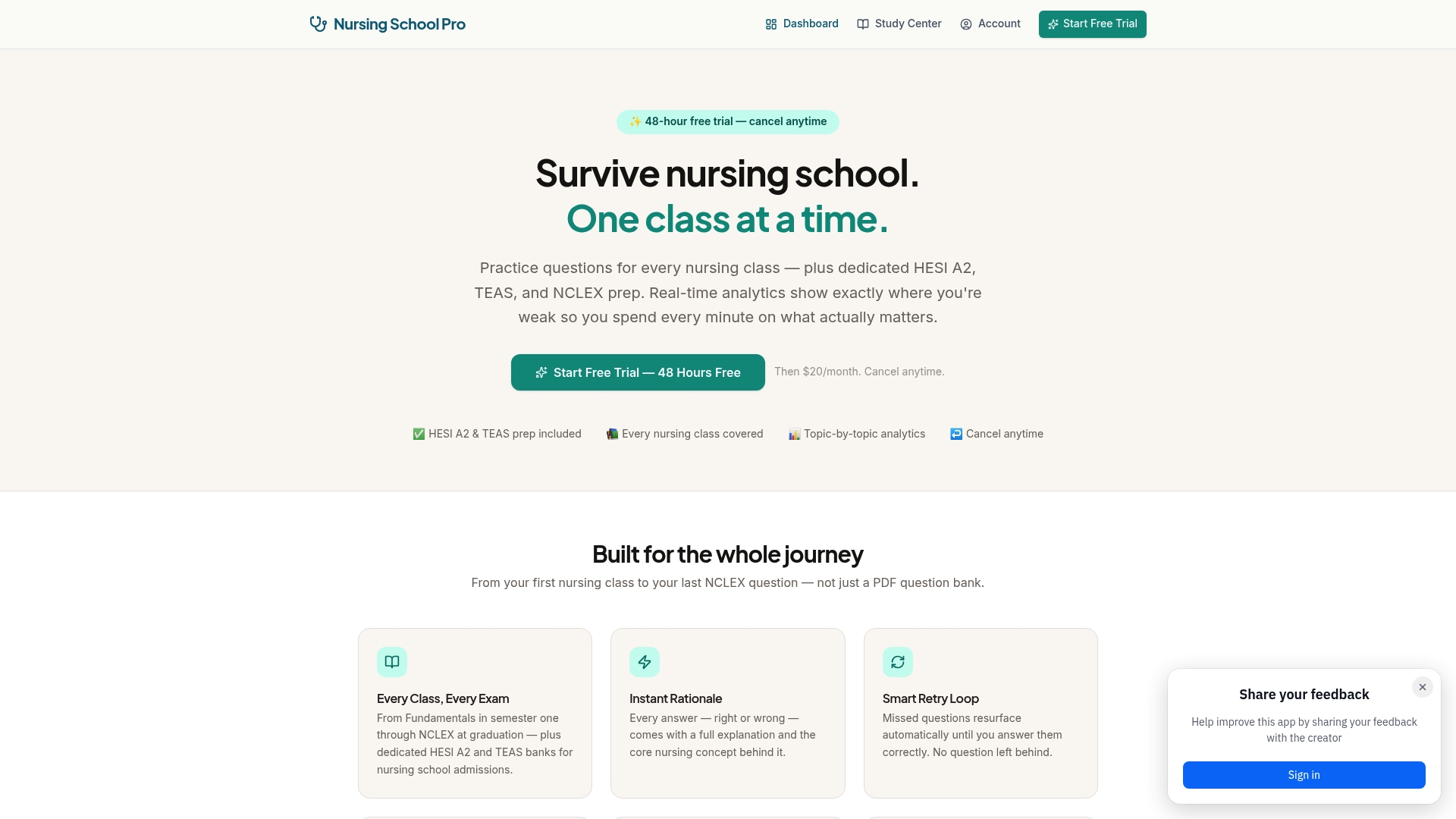
Nursing School Pro gives you practice questions for every nursing class and for the HESI A2, TEAS and NCLEX, with an instant rationale for each answer and analytics that point to your weak areas. The plan is $20 per month after a 48-hour free trial. You can start on the pricing page or explore the Study Center.
If you are building a routine around it, the nursing study plan guide shows how to combine practice questions and rationales, and the NCLEX rationales guide explains how to study the explanations for better scores.
FAQ
What is the easiest nursing care plan format for students?
A table with columns for nursing diagnosis, goal, interventions, rationale and evaluation is the most common. Many schools use four or five columns, and student versions add the rationale column. Always check your syllabus first, because some programs require a concept map or a narrative paper instead.
How many nursing diagnoses should I include?
That depends on your assignment. CSU Channel Islands, for example, requires at least two diagnoses, one of them non-physiological. Choose the highest-priority problems using the ABCs or Maslow's hierarchy rather than listing every possible diagnosis.
What is the difference between a goal and an outcome?
In most student care plans the two words are used for the same thing: what the patient will achieve, stated in measurable terms with a time frame. Write it about the patient's behavior or condition, not about what you will do.
Can I use a sample care plan for my assignment?
Use samples to learn the structure, not to submit. Your plan must reflect your own patient's assessment data, history and preferences, and your instructor will expect rationales in your own reasoning.
Sources
- ANA Standards of Professional Nurse Practice, Berkeley College
- How to Write a Nursing Care Plan in 5 Steps, Nurse.Org
- Concept Map Care Plan Directions and Rubrics, Mt. SAC
- Documentation skills for nursing students, Nursing Made Incredibly Easy
- Nursing 201 care plan guide, CSU Channel Islands
- Nursing Care Plans, UNC Wilmington
- Writing as a Professional Nurse, Purdue OWL
- Nursing Clinical Skills Validation Checklist, HGTC
- Clinical Skills Checklist, MCCC