
Use the 3-column template (Diagnosis, Outcomes, Interventions) for most classroom assignments and quick clinical prep. Switch to the 5-column format (Assessment, Diagnosis, Outcomes, Interventions, Evaluation) whenever an instructor wants proof that every intervention traces back to a specific assessment cue, which is most med-surg clinicals and capstone paperwork. The 4-column version sits in between, dropping the raw assessment data but keeping evaluation, and works well for shorter shift-based assignments.
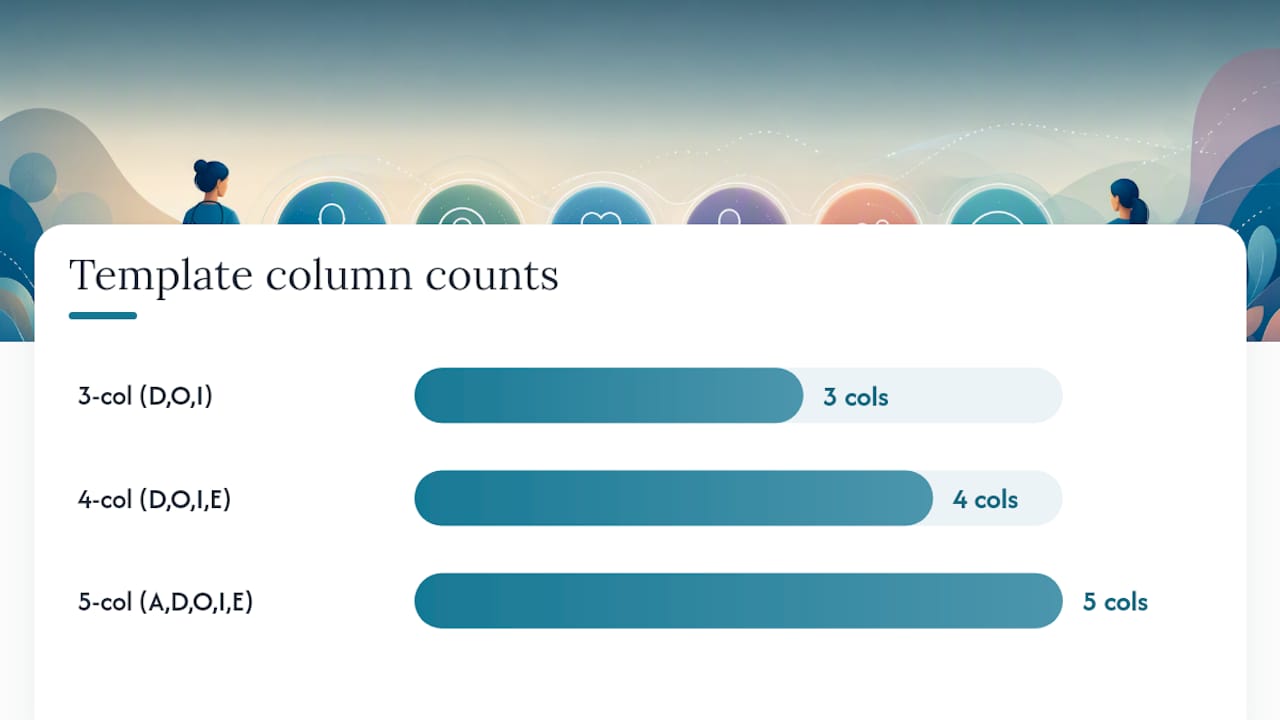
Editable files in .docx, PDF, and Google Doc format are below, along with the free templates from NCBI's downloadable care plan document and Nursingschoolpro's own study center, which pairs templates with practice questions and instant rationales.
Before you download anything, know this:
- Clinical rotations usually want the 5-column version because instructors are grading your clinical reasoning, not just your writing.
- Classroom case-study assignments often accept the leaner 3-column format.
- A custom nursing care plan built around your specific rubric always beats a generic template you didn't adjust.
Key Takeaways
A well-built nursing care plan works when the assessment data, diagnosis, outcome, and evaluation all trace back to the same patient in a single, unbroken line of reasoning.
| Point | Details |
|---|---|
| Match the format to the assignment | Use 3-column for classroom work, 5-column when clinical faculty require assessment-to-evaluation traceability. |
| Write diagnoses the NANDA-I way | Structure every diagnosis as problem related to etiology as evidenced by signs and symptoms. |
| Make outcomes measurable | Attach a number, condition, and timeframe to every goal so evaluation is possible. |
| Never skip evaluation | Document met, partially met, or not met, plus a specific next step for unmet goals. |
| Build rationale skills with Nursing School Pro | Its instant-rationale practice questions train the same evidence-based reasoning that strong care plan rationales require. |
Table of Contents
- Nursing Care Plan Template Downloads: 3-Column, 4-Column, and 5-Column Files
- How Do You Write a Nursing Care Plan Using ADPIE?
- Three Worked Nursing Care Plan Examples You Can Adapt
- What Makes a Nursing Goal Actually SMART?
- Common Mistakes Students Make on Care Plans (and the Fix)
- A Printable Checklist and Blank Template for Your Charting
- How Nursing School Pro Supports Care Plan Learning
- What Actually Separates a Passing Care Plan From a Great One
- Where to Practice the Reasoning Behind Every Care Plan
- Frequently Asked Questions
- Sources
Nursing Care Plan Template Downloads: 3-Column, 4-Column, and 5-Column Files
Picking the wrong format wastes more time than picking no format at all. Here's the actual difference between the three, based on what nursing faculty consistently ask for.
1. The 3-column care plan template
This is the fastest format to complete and the one most first-semester students meet first. It covers Nursing Diagnosis, Expected Outcomes, and Interventions, skipping the raw assessment data and evaluation columns. Format descriptions vary by program, but the three-column and five-column layouts remain the two most widely taught versions in nursing curricula, with the shorter version reserved for cases where the assessment already lives in a separate section of your paperwork.
Use it when:
- Your instructor already collected assessment data in a separate history and physical form.
- You're working a timed in-class case study with a strict word count.
- You need a quick draft before expanding into a full clinical write-up.
2. The 5-column care plan template
This is the format most clinical instructors actually grade against, because it forces you to show your work. The columns run Assessment, Nursing Diagnosis, Expected Outcomes, Interventions, and Evaluation, and the added assessment and evaluation columns are what let a reader trace your clinical reasoning from raw data to final outcome. The NCBI Bookshelf's Template for Creating a Nursing Care Plan uses this structure as its teaching model, and it's a solid one to copy if your program hasn't issued its own.
Use it when:
- Clinical faculty require rationale and outcome criteria tied to specific data.
- You're documenting a real patient during a hospital rotation.
- You need to show revision history (met, partially met, not met) across a shift.
3. The 4-column care plan template
Some programs use a middle-ground version: Diagnosis, Outcomes, Interventions, and Evaluation, minus the dedicated assessment column. It's common in shorter written assignments where you'll reference assessment findings in prose above the table rather than as its own column.
File formats and editing notes:
- .docx — best if you're comfortable in Microsoft Word and want full control over table formatting and font.
- PDF — good for a locked, printable version once your plan is final, but not ideal for drafting since editing requires separate PDF software.
- Google Doc — the easiest to share with a clinical partner or instructor for feedback, and it autosaves as you go.
Whichever format you download, build in these fields before you start filling anything else:
- Patient identifiers (initials or ID number only, never full legal name, per HIPAA)
- Date and time of assessment
- Target date or expected timeframe for each outcome
- Your name and credential line (e.g., "SN" for student nurse)
- Instructor or preceptor signature block
Pro Tip: Save a blank master copy before you start typing. You'll reuse the same template dozens of times this semester, and nothing is more frustrating than hunting through old assignments for an empty version.
How Do You Write a Nursing Care Plan Using ADPIE?
ADPIE (Assessment, Diagnosis, Planning, Implementation, Evaluation) isn't just a mnemonic for a test question. It's the actual sequence you follow while filling out the template, column by column, left to right.
1. Assessment: collect and prioritize your cues
Start with what you can observe or measure. Subjective data comes from the patient's own words ("I feel short of breath when I walk to the bathroom"). Objective data comes from your own observation or equipment (SpO2 88% on room air, respiratory rate 26). Write these as short, specific bullet points rather than paragraphs. Reviewing vital signs, Glasgow Coma Scale scoring, and edema grading before your shift makes this step faster because you already know what a normal versus abnormal reading looks like.

Prioritize using Maslow's hierarchy or the ABC framework (airway, breathing, circulation) when you have more than one problem. Faculty worksheets like the one from Florida International University specifically grade whether you picked the right priority problem first, not just whether your diagnosis is technically correct.
2. Diagnosis: phrasing it the NANDA-I way
This is where most students lose points, and it's almost always the same mistake: writing a medical diagnosis instead of a nursing one. "Pneumonia" is a medical diagnosis. A nursing diagnosis describes the patient's response to that condition, using the NANDA-I three-part structure:
Problem related to Etiology as evidenced by Signs/Symptoms
Example: Ineffective airway clearance related to increased mucus production as evidenced by coarse crackles bilaterally and productive cough.
Notice the diagnosis names a nursing-sensitive problem (airway clearance), ties it to a cause your interventions can actually target (mucus production), and backs it with the exact data you collected in step one.
3. Planning: converting the diagnosis into SMART outcomes
Your outcome statement should read like a goal you could actually check off. Weak: "Patient will breathe better." Strong: "Patient will maintain SpO2 at or above 94% on room air by end of shift."
Every outcome needs a subject (usually the patient), a measurable indicator, a condition, and a timeframe. That structure comes directly from SMART goal frameworks taught across nursing education programs, and it's non-negotiable if you want your evaluation column to mean anything later.
4. Implementation: choosing interventions with rationales
List three to five interventions, and for each one, specify frequency and add a one-sentence rationale. "Monitor respiratory rate and oxygen saturation" is incomplete. "Monitor respiratory rate and SpO2 every 2 hours; early detection of desaturation allows prompt intervention before respiratory distress worsens" gives another nurse enough information to actually carry out your plan.
A short evidence citation elevates a rationale from opinion to nursing science. You don't need a full APA reference in a student care plan, just a parenthetical nod to the textbook or guideline behind the action.
5. Evaluation: documenting what actually happened
At the end of your shift or assignment, revisit each outcome and mark it met, partially met, or not met. This step gets skipped or rushed more than any other part of the care plan, and it's exactly the step clinical educators say separates strong critical thinkers from students who are just filling in boxes. An outcome that wasn't met should trigger a real question: was the timeframe unrealistic, was the intervention wrong, or did the diagnosis need revising?
Digital charting tools and AI-assisted documentation can speed up the writing itself, but they can't replace the judgment call of matching a specific patient's cues to the right diagnosis. That reasoning step still belongs to you, no matter how good the software gets.
Three Worked Nursing Care Plan Examples You Can Adapt
Reading a blank template rarely teaches you as much as seeing one filled in correctly. Here are three common scenarios, written the way an instructor actually wants to see them.
1. Acute post-operative pain
Assessment: Patient reports incisional pain 7/10 on numeric scale, guarding abdomen, grimacing with movement, BP 142/88, HR 98.
Diagnosis: Acute pain related to surgical tissue trauma as evidenced by patient report of 7/10 pain and guarding behavior.
Outcome: Patient will report pain at or below 3/10 within 30 minutes of intervention, reassessed each shift.
Interventions:
- Administer prescribed analgesic per order; timely pain control prevents escalation to poorly controlled pain that's harder to treat later.
- Reposition patient every 2 hours and support incision during movement; reduces mechanical strain on the surgical site.
- Teach splinting technique with pillow during coughing or deep breathing; minimizes pain-related avoidance of necessary respiratory exercises.
- Reassess pain 30 to 60 minutes after medication administration; confirms effectiveness and informs whether the order needs revisiting.
Evaluation: Outcome met; patient reported 2/10 pain 45 minutes post-medication.
An instructor grading this plan is checking one thing above all else: does every intervention connect back to the specific words "guarding" and "7/10 pain" in the assessment? A generic pain plan with no tie to this patient's actual presentation loses points even if the interventions are technically correct.
2. Decreased cardiac output (heart failure)
Assessment: Bilateral crackles, 3+ pitting edema in lower extremities, weight gain of 4 pounds in 2 days, SpO2 91% on room air, patient reports fatigue with minimal exertion.
Diagnosis: Decreased cardiac output related to altered contractility as evidenced by pulmonary crackles, peripheral edema, and rapid weight gain.
Outcome: Patient will exhibit stable vital signs and no increase in peripheral edema within 24 hours.
Interventions:
- Monitor daily weight at the same time each morning; a 2-to-3-pound overnight gain signals fluid retention before other symptoms appear.
- Assess lung sounds and edema every 4 hours; tracks disease progression and response to diuretic therapy.
- Administer diuretics as ordered and monitor potassium levels; loop diuretics commonly cause hypokalemia requiring close monitoring.
- Elevate lower extremities when seated; promotes venous return and reduces dependent edema.
Evaluation: Partially met; weight stable but edema unchanged, plan continued with diuretic dose reassessment flagged for provider.
3. Ineffective breathing pattern (COPD)
Assessment: Respiratory rate 28, pursed-lip breathing, use of accessory muscles, SpO2 89% on room air, patient reports increased dyspnea with talking.
Diagnosis: Ineffective breathing pattern related to air trapping and decreased lung elasticity as evidenced by accessory muscle use and respiratory rate of 28.
Interventions:
- Administer supplemental oxygen per order, typically low-flow to avoid suppressing hypoxic drive; monitor SpO2 continuously.
- Position patient in high Fowler's or tripod position; maximizes lung expansion and reduces work of breathing.
- Encourage pursed-lip breathing technique; slows respiratory rate and improves gas exchange by keeping airways open longer.
- Monitor for signs of respiratory fatigue or worsening hypoxia every hour; early detection prevents respiratory failure.
What Makes a Nursing Goal Actually SMART?
A goal that can't be measured can't be evaluated, which means your entire evaluation column collapses at the end of the shift. SMART goals are the standard nursing education actually teaches, and each letter fixes a specific weakness students bring into their first care plan.
- Specific — name the exact behavior or measurement, not a general improvement.
- Measurable — attach a number, scale, or observable sign.
- Attainable — realistic for this patient's condition and your care timeframe.
- Relevant — tied directly to the nursing diagnosis, not a random wellness goal.
- Time-bound — states when the outcome should be achieved.
Weak goal: "Patient will have less pain." Improved: "Patient will rate pain at or below 3/10 within 30 minutes of analgesic administration."
Weak goal: "Patient will breathe better."
The improved versions all share the same structure: a number, a condition, and a deadline. SMART phrasing isn't a suggestion from one textbook; it's the framework nursing programs consistently teach because it's the only version of a goal an instructor or preceptor can actually check off as met or not met.
Common Mistakes Students Make on Care Plans (and the Fix)
Most points lost on care plan assignments come down to five repeat offenders, and every one of them has a fast fix.
- Confusing medical and nursing diagnoses. Rule of thumb: if you could write it on a chart as the reason for admission, it's medical. If it describes how the patient is responding, it's nursing. "COPD exacerbation" is medical; "ineffective breathing pattern related to air trapping" is nursing.
- Vague, unsupported rationales. "This helps the patient" isn't a rationale. Tie the intervention to a specific physiologic mechanism, and add a parenthetical citation to your textbook or a guideline when possible.
- Evaluation left blank or copy-pasted. When an outcome isn't met, write what you'd actually do next: revise the timeframe, escalate to the provider, or reassess the diagnosis itself. "Not met" with no follow-up plan reads as unfinished work.
- Interventions with no frequency. "Monitor vital signs" tells another nurse nothing. "Monitor vital signs every 4 hours" tells them exactly what to do on their shift.
Pro Tip: If you're stuck on whether something is a medical or nursing diagnosis, ask yourself: "Can I treat this with a prescription alone?" If yes, it's probably medical. Nursing diagnoses describe what you, as the nurse, are actually managing.
A Printable Checklist and Blank Template for Your Charting
Keep this list on your clipboard or pinned inside your clinical binder. It covers the minimum fields most instructors expect before they'll call a care plan complete.
Minimum fields checklist:
- Patient identifier (initials/ID only) and date
- At least two assessment cues (subjective and objective)
- NANDA-style diagnosis with related factor and evidence
- One SMART outcome with a measurable indicator and timeframe
- Three to five interventions with frequency and rationale
- Evaluation status (met/partially met/not met) with next-step note
Compact blank template structure:
- Assessment: _________________
- Diagnosis: _________ related to _________ as evidenced by _________
- Outcome: Patient will _________ by _________ (timeframe)
- Interventions: (list with frequency and rationale)
- Evaluation: Met / Partially Met / Not Met, next steps: _________
If your school's rubric or your facility's EHR uses different field labels, map your template's assessment cues and outcome indicators directly onto those discrete fields rather than rewriting your whole plan from scratch. The goal is that when someone reviews the chart later, they can trace your evaluation directly back to the data field it came from.
How Nursing School Pro Supports Care Plan Learning
Writing a strong rationale is the hardest part of any care plan, and it's exactly where Nursingschoolpro's approach helps most directly. Its practice questions come with instant rationales explaining not just the correct answer but the physiologic or evidence-based reasoning behind it, which is the same skill you need to justify an intervention in a care plan.
- Practice questions organized by nursing course, so you can drill the exact content area behind a diagnosis you're struggling to justify.
- Real-time analytics that flag your weak areas, useful if care plan rationales keep coming back marked "needs more evidence."
- Curriculum-aligned content built around the same textbooks your instructors already assign.
- Downloadable study resources, including the Basic Nursing Assessment guide, for building stronger assessment skills before you even open a template.
The more comfortable you get explaining why an answer is correct on a practice question, the easier it becomes to write a rationale column that actually holds up under instructor review.
What Actually Separates a Passing Care Plan From a Great One
The conventional advice tells students to "follow the nursing process" like that alone guarantees a good grade. It doesn't. Plenty of care plans move correctly through Assessment, Diagnosis, Planning, Implementation, and Evaluation and still read like they were assembled from a checklist rather than thought through.
What actually separates a passing plan from a strong one is the tightness of the connection between columns. Does the diagnosis quote the exact assessment finding? Does the outcome's number match a realistic timeframe for that specific patient? Does the rationale name a mechanism instead of restating the intervention in different words? Instructors notice this immediately, even when they can't always articulate why one plan feels stronger than another.
The other thing conventional advice underplays: evaluation is not busywork tacked onto the end. It's the step that proves you can think like a nurse under pressure, not just fill in a form. A student who writes "not met, will continue to monitor" learned nothing from the shift. A student who writes "not met, reassessing pain scale timing given patient reports delayed relief" is showing exactly the clinical judgment this whole exercise is meant to build.
Start with the diagnosis-to-assessment link. Everything else in the plan gets easier once that connection is airtight.
Where to Practice the Reasoning Behind Every Care Plan
Templates solve the formatting problem. They don't solve the harder problem: knowing which assessment cues actually matter and why one intervention is more evidence-based than another. That's the gap Nursingschoolpro was built to close, with practice questions across every nursing course paired with instant rationales that explain the reasoning behind each correct answer, not just the answer itself.
If care plan rationales keep coming back marked "needs more support," that's usually a sign the underlying content area needs more practice, not the writing itself. Nursingschoolpro's real-time analytics flag exactly which topics are weakest, so your study time goes toward the concepts actually showing up on your rotations and exams. The platform's content aligns with the same textbooks and national standards your instructors already reference, which makes the jump from practice question to care plan rationale a short one.
Start a 48-hour free trial and see whether a stronger grasp of the "why" behind each answer changes how confidently you write your next care plan.
Frequently Asked Questions
What is the best nursing care plan template format for beginners? The 3-column format (Diagnosis, Outcomes, Interventions) is easiest for first-semester students since it skips the raw assessment data column. Move to the 5-column version once your clinical rotations require full traceability from assessment to evaluation.
Where can I download a free nursing care plan template PDF? NCBI offers a free editable template built on ANA and NANDA standards, and Nursingschoolpro's study center also hosts downloadable templates alongside practice questions.
How do I write a nursing diagnosis correctly? Use the three-part NANDA-I structure: Problem related to Etiology as evidenced by Signs/Symptoms. Never substitute a medical diagnosis (like "pneumonia") for the nursing diagnosis, which should describe the patient's response to that condition instead.
What's the difference between nursing diagnosis, medical diagnosis, and outcomes? A medical diagnosis names the disease or condition a physician treats. A nursing diagnosis describes the patient's response to that condition, something nursing interventions can directly address. Outcomes are the measurable goals you set to resolve or improve that nursing diagnosis.
How specific do care plan outcomes need to be? Specific enough that any instructor or nurse could look at the patient and immediately determine whether the goal was met. Include a number, a condition, and a timeframe every time.
Can I use an AI tool to write my nursing care plan? Digital tools can speed up formatting and documentation, but they can't replace your own critical thinking when it comes to matching a specific patient's assessment cues to the right diagnosis and rationale. That judgment call still has to come from you.
Sources
- Nursing-Care-Plan-Template.docx
- Nursing Care Plan: Guide with Example & Writing Tips
- FIU clinical worksheet: Nursing process care plan