
The most effective med-surg study method is to study by body system while working targeted, NGN-style practice questions with instant rationales, not passively rereading chapters. Pair that with study guides tied to Ignatavicius, Lewis, or Davis, plus a pocket guide like the AMSN reference for clinicals. Start by picking one body system, reading a single chapter section, then answering a moderate set of practice questions on that exact topic before moving on.
TL;DR:
- Practicing targeted questions with rationales on body systems improves retention and judgment more effectively than passive chapter rereading.
- A structured four-week plan covers major systems in blocks, emphasizing review, spaced repetition, and analytics to identify weak areas early.
- Studying by body system enhances cross-topic understanding critical for real patient scenarios and exam questions that span multiple systems.
- Using practice questions mapped to core textbooks and frequent NGN case studies develops both content knowledge and clinical reasoning skills essential for the NCLEX and med-surg exams.
- Consistent daily question routines, short study blocks, and peer explanations significantly boost mastery and reduce burnout during intensive study periods.
Table of Contents
- Building a 4-Week Med Surg Study Guide and Checklist
- Study Med Surg by Body System: A Practical Roadmap
- How Do You Use Practice Questions to Close Knowledge Gaps?
- What Belongs on a Head-to-Toe Assessment Cheat Sheet?
- NCLEX and NGN Exam Strategy for Med Surg Questions
- How Nursing School Pro Fits Into Your Med Surg Study Plan
- What Study Habits Actually Move Your Exam Score?
- Start Studying Smarter With Nursing School Pro
- Trusted Med Surg Study Guide Resources Worth Using
- Sources
- FAQ
Building a 4-Week Med Surg Study Guide and Checklist
A four-week runway is enough to cover the major body systems tested on most medical surgical nursing exams and the NCLEX, provided you work in structured blocks instead of marathon cramming sessions. Cramming fails med-surg specifically because the exam rewards judgment across overlapping systems, not memorized facts from one chapter.
Here is a template you can adapt starting this week:
- Week 1: Cardiac, respiratory, and hematology. Spend time reading and summarizing one topic, then practice with a focused question set covering that same topic, followed by a review of every rationale, right and wrong.
- Week 2: Renal, endocrine, and GI. Repeat the same rhythm, adding NGN-style case studies to practice cue recognition across multiple related conditions.
- Week 3: Neuro, musculoskeletal, and perioperative care. Shift 20% of your time to review sessions covering weeks 1 and 2, since spaced repetition is what moves facts into long-term recall.
- Week 4: Full-length practice exams and weak-area drilling. Use analytics from your question bank to identify lowest-scoring topics and focus targeted questions in those areas.
Structure study sessions in short blocks with breaks to reduce fatigue and improve retention during review, which is exactly when most students start skimming instead of actually reading rationales.
Your weak areas should drive the schedule, not the calendar. Waiting until week 4 to discover a gap in fluid and electrolyte management is a mistake you can avoid by checking your analytics weekly, not just at the end.
Keep your materials list tight. You need one comprehensive study guide aligned with a major textbook, one pocket guide for quick clinical reference, and one question bank with rationales. Adding a fourth or fifth resource usually just fragments your attention across sources that repeat the same content in different language.

Study Med Surg by Body System: A Practical Roadmap
Studying by body system beats studying by textbook chapter order because real patients and real exam questions don't respect chapter boundaries. A patient with heart failure often has renal involvement, fluid overload, and medication interactions that cross three chapters at once. Building your review around systems trains the same cross-topic thinking the NGN actually tests.
For each system, run through the same seven-part checklist:
- Anatomy and physiology basics. Just enough to explain why a symptom happens, not exam-level detail on cellular mechanisms.
- Common exemplars. The three or four conditions that show up most often (heart failure and myocardial infarction for cardiac, COPD and pneumonia for respiratory).
- Key labs and diagnostics. What values matter, what they mean when abnormal, and what action follows.
- Priority nursing actions. What you do first when a patient in this system decompensates.
- Common medication classes and monitoring parameters. Not every drug, just the classes you'll see repeatedly and what to watch for.
- Patient teaching points. What discharge instructions matter most for that condition.
- One NGN-style case question. Applying everything above to a scenario with multiple correct-seeming options.
Cardiac. Focus on heart failure, myocardial infarction, and dysrhythmias. Know your BNP, troponin, and electrolyte values cold, especially potassium in the context of digoxin or diuretics. Priority action for chest pain is always oxygen, aspirin, nitroglycerin, and morphine in that general sequence, but the exam wants you to know why aspirin comes before morphine, not just the order.
Respiratory. COPD, pneumonia, and pulmonary embolism dominate this system. ABGs and pulse oximetry drive most priority decisions here. A COPD patient with rising CO2 and falling responsiveness needs airway management before anything else, and that's the kind of layered cue the NGN loves to test.
Renal. Acute kidney injury and chronic kidney disease exemplars connect directly to your fluid and electrolyte knowledge, so this system rewards a strong grasp of sodium, potassium, and fluid balance. Creatinine and BUN trends matter more than single values.
Endocrine. Diabetes management, particularly DKA and HHS, generates a disproportionate share of med-surg exam questions relative to how much class time it usually gets. Know your insulin types, onset and peak times, and the signs that separate hypoglycemia from early DKA.
GI. GI bleeds, pancreatitis, and bowel obstruction exemplars test your ability to prioritize airway and circulation before addressing the underlying GI problem itself, a pattern that repeats across nearly every system.
Neuro. Stroke and increased intracranial pressure are the two heavyweights. The NIH Stroke Scale and Glasgow Coma Scale aren't just facts to memorize, they're tools you'll be asked to apply to a described patient.
Musculoskeletal and perioperative. Fracture complications like compartment syndrome and fat embolism, plus pre and postoperative priorities, round out most med-surg course content.
Convert each chapter into three concrete tasks: a one-page summary written from memory, a small concept map linking pathophysiology to nursing priorities, and a batch of 15 to 20 practice questions on that exact chapter. Study guides built around Ignatavicius's Medical-Surgical Nursing map their chapters and case studies directly to this kind of structure, which is exactly why aligning your notes with a major textbook saves time instead of costing it.
How Do You Use Practice Questions to Close Knowledge Gaps?
Pairing content review with practice questions and immediate rationale checking accelerates mastery more than either method alone, according to Pearson's Reviews & Rationales series, which pairs large mapped question banks with rationale explanations for this reason. The rationale is where the actual learning happens, not the question itself.
Run every question session the same way:
- Attempt a focused block of 25 to 50 questions on one topic without checking answers as you go.
- Review every rationale, including the ones you got right, because a correct guess built on wrong reasoning will fail you on a harder version of the same question later.
- Log every miss in a running list organized by topic, not by question number.
- Build a targeted review set from that log and revisit it within 48 hours, while the gap is still fresh.
NGN case studies test a different skill than standard multiple choice. Instead of picking one right answer, you're asked to identify relevant cues from a mass of patient data, generate hypotheses about what's happening, prioritize actions, and sometimes decide what to delegate. Practice this by working through case study examples and forcing yourself to narrate your reasoning out loud before selecting an answer. If you can't explain why the other options are wrong, you're not ready to move on.
Pro Tip: Track three specific numbers in your analytics: accuracy by topic, average time per question, and how you perform specifically on NGN case-study items versus standard questions. A student who's fast and accurate on standalone questions but slow and wrong on cases has a clinical-judgment gap that more standard questions won't fix.
Daily question sets with same-day rationale review, plus regular NGN case debriefs, produce steadier gains than sporadic large question sets.
What Belongs on a Head-to-Toe Assessment Cheat Sheet?
Every assessment follows the same sequence: confirm safety, check vital signs, assess mental status, then move through airway, breathing, and circulation before doing system-specific checks. This order isn't arbitrary. It matches the priority order you'll use to decide what needs action first on both the exam and the floor.
- Scan the room and the patient for immediate danger before touching anything.
- Get a full set of vital signs, and know what's abnormal for that specific patient, not just the textbook range.
- Assess mental status using a quick tool like the Glasgow Coma Scale or the bCAM for suspected delirium.
- Check airway patency, breath sounds, and work of breathing before moving to circulation.
- Assess circulation through pulses, capillary refill, and skin color and temperature.
- Move to system-specific checks relevant to the admitting diagnosis or chief complaint.
- Run a fall-risk check on every patient, not just the ones who look obviously unsteady.
The bCAM delirium screening tool featured in AMSN's pocket guide takes under two minutes and catches confusion that a casual conversation easily misses, especially in older postoperative patients.
Translating an abnormal finding into action is simpler than it looks once you have a shortcut: ask whether the patient is safe, then check airway, breathing, and circulation in order, then address the specific complication. A dropping oxygen saturation isn't just a number to chart, it's an airway or breathing problem that needs action before you finish the rest of your assessment.
Pro Tip: Keep a laminated one-page version of your head-to-toe checklist in your clinical bag. Trying to recall the full sequence from memory during a busy shift is exactly when steps get skipped.
Document findings as you go, not from memory at the end of your shift. Abnormal findings you write down immediately are far more likely to make it into your note accurately than ones you try to reconstruct three hours later.
NCLEX and NGN Exam Strategy for Med Surg Questions
Standard NCLEX items ask you to select one or more correct answers from a fixed list. NGN items add extended drag-and-drop matrices, bowtie questions, and trend analysis that require you to track a patient's condition across multiple points in time. Practicing only standard questions leaves that second skill undeveloped, and it's the skill that trips up most students the first time they see a full case study.
- Practice under timed conditions that match real exam pacing, roughly one minute per standard item and longer for multi-part NGN cases.
- Read every option before selecting one, since NGN items often include several plausible-sounding but incomplete answers.
- Apply a safety-first filter to every prioritization question: airway and breathing problems outrank almost everything else, followed by circulation, then infection control, then comfort and teaching.
- Flag questions you're unsure about and move on rather than losing five minutes on one item.
- Run a full-length simulated exam every one to two weeks once you're past the content-review phase, not before.
After every simulated exam, debrief by topic rather than by score.
How Nursing School Pro Fits Into Your Med Surg Study Plan
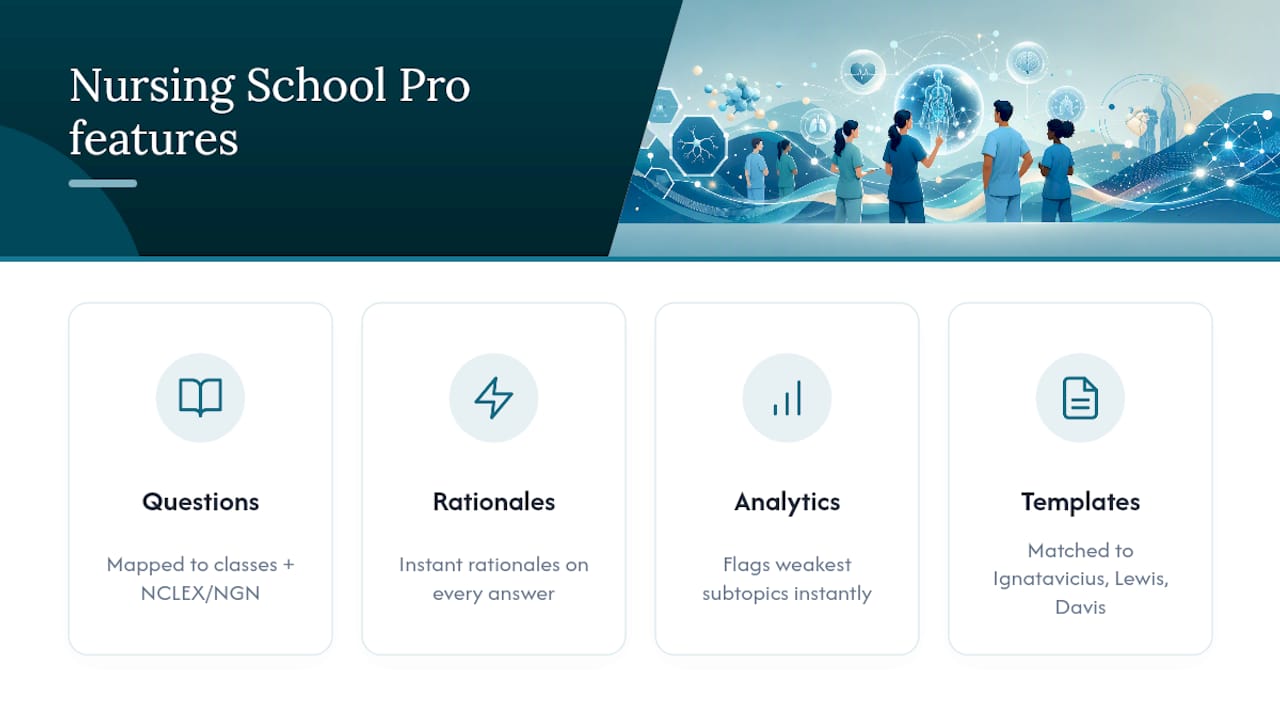
Nursing School Pro builds this exact workflow into one place: practice questions mapped to individual med-surg classes and to NCLEX/NGN content, instant rationales on every answer, and analytics that flag your weakest topics as you go. Inside the four-week plan above, that means you can run your week-one cardiac questions, see your accuracy by subtopic immediately, and know within minutes whether fluid and electrolyte management needs a second pass before week four.
The platform also includes downloadable templates aligned with major nursing textbooks, so your per-system notes stay organized the same way your question bank is. That alignment is the whole point. Study guides tied to Ignatavicius, Lewis, or Davis only pay off when your practice questions are mapped to the same chapters, and that's the gap Nursing School Pro is built to close. It's the publisher's own platform, and it's a genuinely practical option for executing everything covered in this guide, not the only one, but one worth trying while you build your schedule.
What Study Habits Actually Move Your Exam Score?
Two habits show up again and again in students who improve fastest: a daily question streak, even just 20 questions on a busy clinical day, and short peer-teaching sessions where you explain a topic out loud to a classmate. Explaining a concept forces you to notice the gaps that silent reading lets you skip past.
Pace yourself, too. A four-week plan that runs seven days a week without a break tends to collapse around day 18, when fatigue starts outpacing retention. Build one lighter day into each week, not as an afterthought but as part of the schedule itself. Burnout doesn't just feel bad, it actively erases the gains from your hardest study days.
— Autumn
Start Studying Smarter With Nursing School Pro
Reading rationales in a static PDF only gets you so far when you don't know which topics to focus on next. Nursing School Pro solves that specific problem: practice questions mapped to your med-surg coursework and to NCLEX/NGN standards, instant rationales on every answer, and real-time analytics that show exactly where your accuracy is lagging before your exam does.
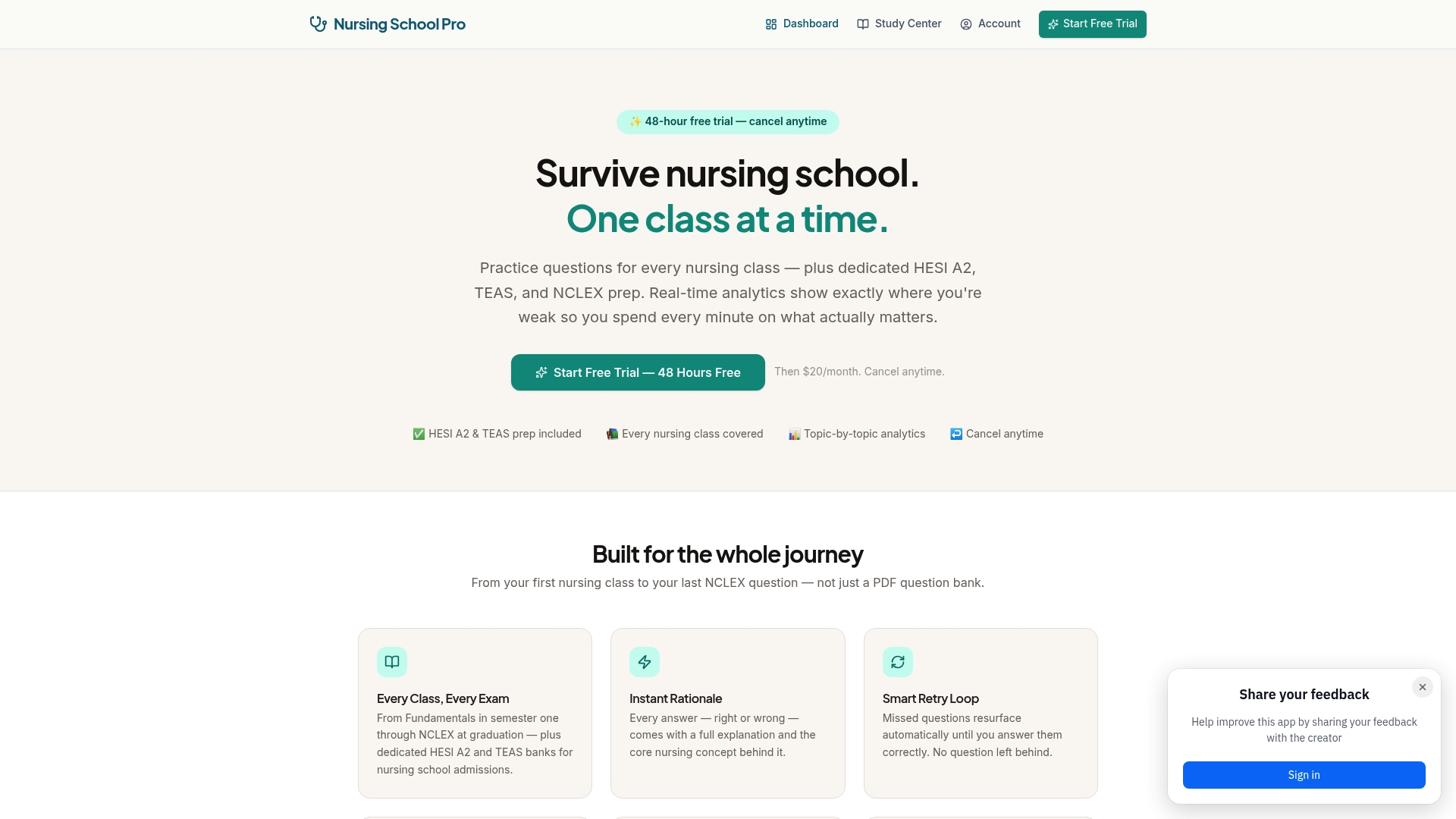
Start at the study center, where you can see how practice questions and analytics are organized by class and by topic. From there, a 48-hour free trial lets you test the workflow against your own weak areas before you commit to a full study cycle. If you're heading into your med-surg rotation this semester, that's the page to open first.
Trusted Med Surg Study Guide Resources Worth Using
A short, well-chosen stack beats a shelf full of overlapping books. The Study Guide for Medical-Surgical Nursing tied to Ignatavicius maps chapters directly to NGN-style case studies and practice items. The Study Guide for Lewis's Medical-Surgical Nursing offers a similar structure with its own case-based practice sets. Davis's Study Guide for Understanding Medical-Surgical Nursing follows the same chapter-aligned model for students using that primary text.
For clinicals, the AMSN medical-surgical nursing pocket guide fits in a scrub pocket and covers assessment tools like bCAM alongside quick reference tables. To supplement your practice questions with free material, Nursestudy hosts hundreds of care plans and drug guides organized by condition, useful for a quick refresher between question sets.
Sources
- Pearson — Reviews & Rationales: Medical-Surgical Nursing
- AMSN medical-surgical nursing pocket guide
- Study Guide for Medical-Surgical Nursing, 11th Edition (Elsevier / Ignatavicius)
- Nursestudy
FAQ
What Is the Best Way to Study for Med Surg?
Study by body system while working practice questions with rationales on that same system, then use analytics to spot and correct your weakest areas before moving forward. Pairing content review with question practice consistently outperforms either method used alone.
Is There a Study Guide Specifically for the Med Surg Certification Exam?
Yes. Study guides tied to Ignatavicius, Lewis, and Davis textbooks include NGN-style case studies and chapter-mapped questions, and the AMSN pocket guide covers high-yield assessment content for clinical and certification-style review.
Why Is Med Surg So Difficult?
Med surg is difficult because it tests judgment across overlapping body systems rather than isolated facts, and conditions like heart failure or acute kidney injury often affect multiple systems at once. That cross-topic reasoning is exactly what NGN case studies are designed to test.
Is Med Surg the Hardest Nursing Class?
Many students rank med-surg among the hardest courses because of its sheer content volume and the clinical-judgment demands of its exams, though difficulty varies by student and program. Breaking the material into a body-system schedule with daily practice questions is the most reliable way to manage that load.