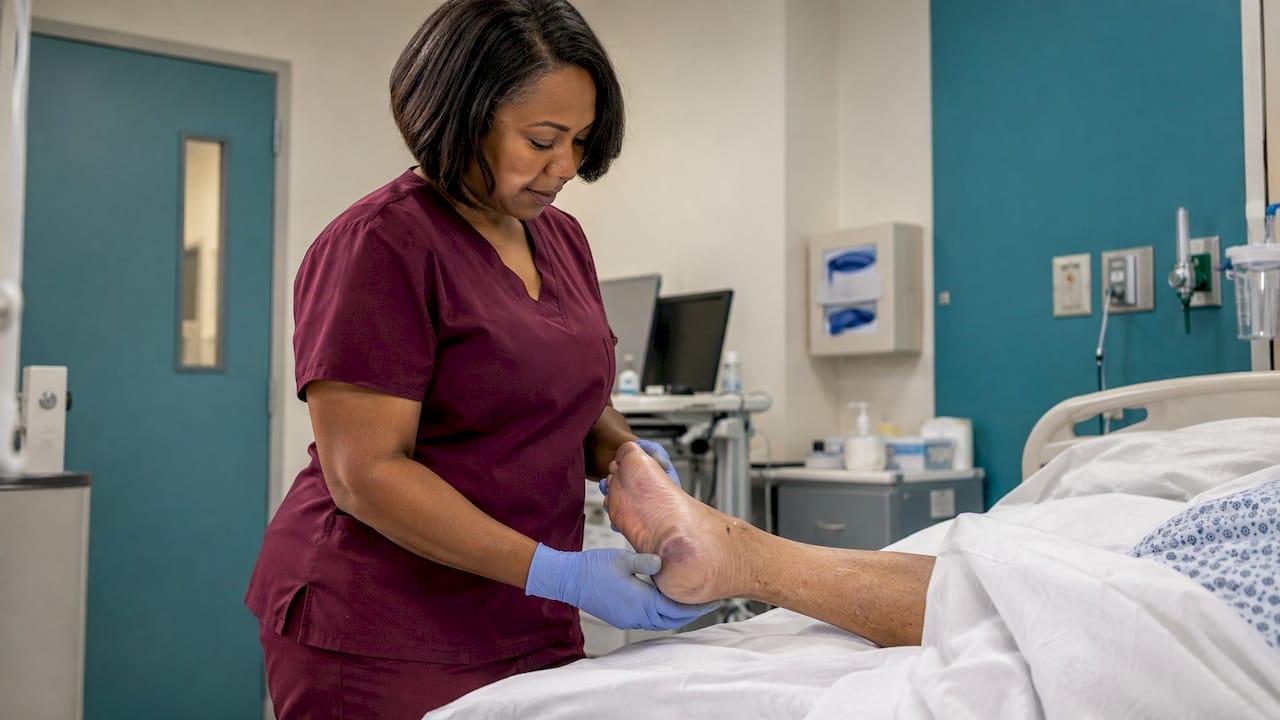
Wound staging in nursing means one thing: classifying a pressure injury by the deepest tissue you can see or feel. Only pressure injuries get these stages. Other wounds are classified with their own tools, and the four phases of wound healing are a separate idea. Learn the stages by tissue type, practice them with rationales, and you will answer staging questions on exams and chart them correctly in clinicals. Nursing School Pro gives you practice questions with instant rationales for every answer, so you learn why a Stage 3 is not a Stage 4, not just which letter to pick.
TL;DR
- Pressure injuries are the only wounds nurses stage. They fall into Stage 1, 2, 3, 4, unstageable and deep tissue pressure injury (DTPI).
- Staging depends on tissue: intact skin, dermis, visible fat, or exposed muscle, tendon and bone.
- Wound healing has four phases (hemostasis, inflammatory, proliferative, maturation). They describe biology, not severity.
- Document size, depth, tissue type, drainage, tunneling, edges and surrounding skin, and never reverse-stage a healing injury.
- Practice with tissue-based scenarios until you can name the stage and defend it.
Table of Contents
- Which wounds are staged
- The pressure injury stages
- The four stages of wound healing
- What to assess and document
- Wound care basics that support healing
- How to study wound staging so it sticks
- Our perspective
- Practice staging with instant rationales
- FAQ
- Sources
Which wounds are staged
Nursing textbooks are clear that pressure injuries are the only wounds that are staged, using the NPIAP/EPUAP/PPPIA guidelines. Other wounds use their own systems: Wagner for diabetic foot ulcers, CEAP for venous leg ulcers, ISTAP for skin tears, and TBSA for burns.
This is a common exam trap. If a question describes a diabetic foot ulcer and offers "Stage 3" as an answer, it is a distractor.
A short vocabulary note. NPIAP is the National Pressure Injury Advisory Panel, the U.S. body that defines the stages. In 2016 it changed "ulcer" to "injury" and Roman numerals to Arabic numerals, so older materials say "Stage III pressure ulcer" while current ones say "Stage 3 pressure injury." You may see both.

The pressure injury stages
Pressure injuries usually occur over a bony prominence (hip, sacrum, heel) or under a medical device. Think of staging as a ladder of tissue depth.
| Stage | What you see | Key tissue clue |
|---|---|---|
| Stage 1 | Intact skin, localized nonblanchable redness | Skin is not broken |
| Stage 2 | Partial-thickness loss, shallow open wound or blister | Dermis exposed, no slough |
| Stage 3 | Full-thickness loss | Fat may be visible; no muscle, tendon or bone |
| Stage 4 | Full-thickness loss with deeper structures | Exposed or palpable muscle, tendon, ligament, cartilage or bone |
| Unstageable | Full-thickness loss hidden by slough or eschar | Depth cannot be seen |
| DTPI | Persistent deep red, maroon or purple discoloration | Damage lies beneath intact skin |
The tissue descriptions follow OpenStax's Medical-Surgical Nursing text.
Stage 1: nonblanchable redness
The skin is intact, and redness does not turn white when pressed. CMS notes that temperature, tissue consistency or sensation may change, and that in dark skin tones the area may look persistently blue or purple. OpenStax adds that changes in sensation, temperature or firmness can come before visible changes, so palpate as well as look. Darker skin is a frequent exam topic: do not rely on redness alone.
Stage 2: dermis exposed
This is a shallow open wound with a red or pink bed, or an intact or open blister. CMS's definition specifies no slough and no bruising. The 2016 revision clarified Stage 2 to separate pressure and shear injury from moisture-associated skin damage, which matters when you see a perineal rash in an incontinent patient.
Stage 3: fat visible, nothing deeper
AHRQ defines Stage 3 as full-thickness tissue loss where subcutaneous fat may be visible but bone, tendon or muscle are not exposed. Slough may be present, and undermining and tunneling may occur. Depth varies by location: a Stage 3 on the bridge of the nose can be shallow because there is little fat there, while one on the buttock can be deep.
This answers a common search: a stage 3 pressure wound is a full-thickness wound you can see fat in, with no muscle, tendon or bone showing.
Stage 4: deeper structures
Stage 4 is full-thickness skin and tissue loss with exposed bone, tendon or muscle, often with undermining and tunneling. The exam question usually hinges on one detail: did the description mention muscle, tendon or bone? If yes, Stage 4. If only fat, Stage 3.

Unstageable
When slough or eschar (dead, dark tissue) covers the wound bed, you cannot see how deep it goes, so you cannot stage it. Staging is also done only after the wound bed has been cleansed so you can see it accurately.
Deep tissue pressure injury
DTPI looks like persistent deep red, maroon or purple discoloration. The damage is underneath. The VA/DoD 2026 guideline notes that when skin ulceration appears after five to seven days, a deep tissue injury has already occurred and is evolving. The TRIUMPH guideline notes that pain and temperature change often precede color change.
Two rules that cost points
- Stage by the deepest tissue seen or felt.
- Do not reverse-stage a healing injury. A Stage 4 that has filled in with granulation tissue is still documented as a healing Stage 4, not a Stage 2.
If you are unsure, OpenStax advises describing the wound as you assess it.
The four stages of wound healing
This is the other half of the keyword, and the one students mix up with staging. Healing phases describe what the body is doing. Pressure injury stages describe how deep the damage is.
- Hemostasis: immediate clotting to close the wound.
- Inflammatory: the body clears debris and bacteria. Redness, swelling and warmth are expected here.
- Proliferative: granulation tissue fills the wound, and edges contract.
- Maturation (remodeling): new tissue strengthens and reorganizes.
The VA/DoD guideline points out that pressure injuries often become arrested in the inflammatory phase rather than moving through normal healing. That is why removing pressure, treating the wound bed and supporting nutrition matter.
A useful clinical skill: telling the expected inflammatory response from true infection, since both show redness, swelling and warmth. AFP lists signs that raise concern for infection: delayed healing, dehiscence, necrotic tissue, warmth, increased exudate, fever, confusion or pain. Report these to the provider.
What to assess and document
A staged wound is not complete without a description. AHRQ's documentation checklist includes:
- Length, width and depth, and location
- Stage
- Exudate amount, color and consistency
- Tunneling or undermining
- Percentage of each tissue type: granulation, epithelial, eschar, slough
- Wound edges: attached, rolled under, irregular or callous
The same source frames assessment with T-I-M-E: tissue, infection, moisture, edges.
At admission, AFP recommends a comprehensive skin assessment right away and periodically after, focused on bony prominences and device contact points. Note blanchable or nonblanchable erythema, firmness, moisture, pain and heat. Add photos to the record where your facility allows. UpToDate advises measuring with a ruler or acetate tracing or photographing at each visit, and recording periwound skin. To track healing over time, AFP names the PUSH tool, DESIGN-R and the Bates-Jensen Wound Assessment Tool.
For a full skin check in context, our head-to-toe assessment checklist shows where skin inspection fits. Clear documentation habits also matter outside the unit: good injury documentation is what later shows what was found and when.
Wound care basics that support healing
Staging leads to care. Core measures from the guidelines:
- Reduce pressure, friction and shear. An older guideline summary recommends keeping the head of the bed at or below 30 degrees, using a 30-degree side-lying position, repositioning regularly, floating the heels and avoiding donut-type devices.
- Manage moisture. Use skin barriers for incontinence. TRIUMPH notes that microclimate, nutrition, perfusion and comorbidities all change how well tissue tolerates pressure.
- Support nutrition. The same summary lists 30 to 35 kcal/kg/day and 1.25 to 1.5 g protein/kg/day for at-risk patients. Follow the dietitian's and provider's plan for your patient.
- Prepare the wound bed. The VA/DoD guideline uses the TIMERS framework (tissue, infection or inflammation, moisture, edge, repair or regeneration, social factors) and lists negative pressure wound therapy and electrical stimulation as adjuncts.
Because causes are multifactorial, AFP stresses an interdisciplinary team with regular review of healing, dressings and pain. Debridement and dressing orders come from the provider or wound team.
How to study wound staging so it sticks
Memorizing a table works until an exam gives you a scenario. A better routine:
- Learn the single tissue clue for each stage (intact, dermis, fat, muscle or bone, hidden, purple).
- Answer scenario questions, then read why each wrong option fails.
- Note which stages you miss. Most students confuse 3 versus 4 and unstageable versus DTPI.
- Repeat the weak ones the next day.
Pairing this with pathophysiology review helps the inflammatory and proliferative phases make sense, and a nursing care plan template turns a staged wound into diagnoses and interventions.
Our perspective
Staging questions look easy until an exam gives you a three-sentence description and four plausible answers. The students who do well are not the ones who memorized the most, but the ones who can say why the wrong answers are wrong.
That is how we built Nursing School Pro. Every practice question comes with an instant rationale, so a missed Stage 3 versus Stage 4 question teaches you the tissue rule right then. Our analytics show which topics keep tripping you up, so your next session goes to weak areas instead of what you already know.
Our content is aligned with respected nursing textbooks and national standards, which matters for a topic where terms changed in 2016 and old materials still circulate.
Autumn
Practice staging with instant rationales
Nursing School Pro offers practice questions for every nursing class plus HESI A2, TEAS and NCLEX preparation, with instant rationales and real-time progress analytics. It costs $20 per month after a 48-hour free trial. You can see the details on the pricing page or browse the Study Center.

Start with skin integrity and wound care questions, and let the analytics tell you whether staging is a real weak spot or already solid.
FAQ
What are the stages of a pressure injury in nursing?
There are six categories: Stage 1, Stage 2, Stage 3, Stage 4, unstageable, and deep tissue pressure injury. Each is defined by the deepest tissue visible or palpable, from intact skin to exposed bone or tendon.
What is the difference between wound staging and wound healing stages?
Staging classifies the depth of a pressure injury. Healing stages (hemostasis, inflammatory, proliferative, maturation) describe the biological process any wound goes through. A pressure injury can be Stage 3 and be in the proliferative phase at the same time.
Can you stage a diabetic foot ulcer or a burn?
No. NPIAP staging applies only to pressure injuries. Diabetic foot ulcers use the Wagner system, venous ulcers use CEAP, skin tears use ISTAP and burns use TBSA.
Should a healing Stage 4 be re-staged as Stage 3?
No. AHRQ instructs that a healing pressure injury not be reverse-staged. You document it as a healing injury of its original stage and track progress with measurements or a healing tool such as PUSH.
Sources
- 28.3 Pressure Injury, Medical-Surgical Nursing, OpenStax
- Wound Classification, AHRQ
- Pressure Ulcer/Injury Coding Pocket Guide, CMS
- Revised NPUAP Pressure Injury Staging System, Edsberg et al. 2016
- Pressure Injuries: Prevention, Evaluation, and Management, AFP 2023
- Local care of pressure injury, UpToDate
- VA/DoD Clinical Practice Guideline for Pressure Injuries 2026
- Granulation Tissue: Wound Healing's Secret Weapon, Net Health
- Healthy vs. Infected Wounds: A Clinician's Guide, Net Health
- TRIUMPH guideline, UAMS 2022
- Guideline for prevention and management of pressure ulcers, summary