
Pathophysiology explains how disease disrupts normal body function, and nurses who learn it as a mechanism, not a memorization list, catch deterioration faster and write sharper care plans. The payoff shows up at the bedside: you interpret a falling PaO2 or a climbing lactate as a signal, not a number, and you can explain why an intervention works. The sections ahead cover the exact study tactics and system-based walkthroughs that make that shift stick.
TL;DR:
- Understanding disease mechanisms allows nurses to interpret trends like lactate and PaO2 changes, predicting decompensation before obvious clinical deterioration occurs.
- Applying the four-part framework—etiology, pathogenesis, manifestations, and nursing implications—helps predict disease progression and select targeted interventions.
- Study methods like concept maps, blank-sheet recall, and spaced active recall improve retention and transfer of pathophysiology knowledge to real or exam situations.
- Recognizing patterns such as inflammation, ischemia, and fluid shifts makes complex diseases more predictable and reduces reliance on memorization.
- Linking pharmacology to disease mechanisms enhances understanding of drug actions, monitoring needs, and side effects, refining clinical reasoning.
Table of Contents
- What Is Pathophysiology for Nurses?
- Why Pathophysiology Drives Clinical Judgment
- The Four-Part Framework Every Disease Follows
- How to Study Pathophysiology Without Drowning in It
- System-Based Walkthroughs You Can Copy
- Turning Pathophysiology Into Exam Answers and Notes
- Resources Worth Building Your Study Plan Around
- Common Clinical Interventions and the Mechanism Behind Them
- Where Pharmacology Meets Pathophysiology
- Reading Lab Values Through a Pathophysiology Lens
- Patient Teaching That Actually Sticks
- Author Perspective: A Short Note on Mastering Pathophysiology
- Study Smarter With Nursing School Pro's Practice Questions
- Sources
What Is Pathophysiology for Nurses?
Pathophysiology is the study of how a disease changes normal body function, traced through four connected pieces: etiology, pathogenesis, manifestations, and compensation. Etiology is the cause, whether that is a virus, a genetic mutation, or chronic pressure on a joint. Pathogenesis is the sequence of cellular and tissue-level events that cause triggers, the actual mechanism of harm. Manifestations are what you can see, measure, or hear the patient report, the signs and symptoms that show pathogenesis is underway. Compensatory responses are the body's attempts to correct the imbalance, like tachycardia offsetting a failing heart's reduced output.
This is where anatomy and physiology stop being background material and become diagnostic tools. You cannot recognize an abnormal breath sound if you never learned what normal lung compliance sounds like. Understanding Pathophysiology, one of the field's standard textbooks, organizes every chapter around this exact etiology to pathogenesis to manifestations to treatment structure, which is no accident. It mirrors how clinical reasoning actually works: you observe a manifestation, work backward to the mechanism, and choose an intervention that addresses the cause, not just the symptom.
Why Pathophysiology Drives Clinical Judgment
A dropping PaO2 does not just mean "the patient needs oxygen." It tells you gas exchange at the alveolar-capillary membrane is failing, which points toward specific causes: fluid in the alveoli, airway collapse, or a ventilation-perfusion mismatch. Nurses who understand that distinction check different things next. One who only knows "low oxygen equals bad" reaches for a nasal cannula and stops thinking.
Decompensation rarely announces itself. It shows up as trends: a heart rate creeping from 88 to 104 over three hours, a slight drop in urine output, a patient who is "just a little more tired than yesterday." Recognizing those trends as compensation failing, rather than isolated data points, is what separates a nurse who catches sepsis at hour two from one who catches it at hour eight. That mechanism-based thinking also mirrors how the Next Generation NCLEX case studies are built. NGN items reward test-takers who can trace a clinical picture back to its underlying process, not just recall a fact. Students who lean on memorization tend to underperform on these items precisely because rote recall breaks down the moment a question presents an unfamiliar combination of findings. Understanding disease as a logical, cause-and-effect sequence transfers to situations you have never seen before, which is the entire point of both nursing practice and the exam that certifies it.
The Four-Part Framework Every Disease Follows
Every disease process, no matter how complex, breaks down into the same four components. Applying this checklist consistently turns an overwhelming textbook chapter into a repeatable exercise.
- Etiology: What caused this? (Infection, ischemia, autoimmune attack, genetic defect, trauma)
- Pathogenesis: What is happening at the cellular and tissue level? (Inflammation, hypoxia, fluid shift, cellular injury)
- Manifestations: What will the patient show, and what will labs and vitals reveal?
- Nursing implications: What do you monitor, and what intervention addresses the actual mechanism?
Three patterns show up across an enormous share of nursing pathophysiology: inflammation (the body's response to injury or infection, useful until it becomes systemic), ischemia (tissue starved of oxygen, whether from a clot, a spasm, or compression), and fluid shifts (water and electrolytes moving between compartments, often driven by pressure or protein imbalances). Once you can spot which of these three is driving a disease, half the chapter becomes predictable rather than new.
When you open a new chapter, run this quick pass before you read a single paragraph: skim the headings to identify the etiology, glance at any included diagram for the pathogenesis sequence, and read the manifestations table first, backward, asking "what mechanism would cause this symptom?" That single habit, reading manifestations before pathogenesis, forces active reasoning instead of passive absorption.
How to Study Pathophysiology Without Drowning in It
Rote memorization is the slowest, least durable way to learn this material, and it shows up in exam performance. Research on nursing education has found that students who memorize facts in isolation perform worse than those who understand disease as a connected sequence, because sequence-based understanding transfers to novel questions and memorized facts do not. The methods below work because they force your brain to build and retrieve connections instead of storing isolated flashcards.
- Concept maps and flowcharts. Draw the etiology at the top, then branch downward through pathogenesis to manifestations, marking compensatory mechanisms as side branches. Visual mapping techniques outperform linear notes for exactly this kind of branching, cause-and-effect content, because they make the ischemic cascade or a compensatory loop visually obvious instead of buried in a paragraph. Use a flowchart when a disease has multiple branching outcomes (like sepsis) and a simpler linear map when the sequence is straightforward (like a single-cause anemia).
- The blank-sheet method. After reading a chapter, close the book and draw the entire disease pathway from memory on a blank page. The gaps you cannot fill are exactly what you have not actually learned, and the blank-sheet method works because it exposes those gaps immediately, while passive rereading hides them. Do this once per new disease, then again a week later.
- Active recall on a spaced schedule using tools like the Exam Study Planner helps quiz yourself at increasing intervals: same day, three days later, one week later, then again before the exam. Quiz yourself (or use practice questions) at increasing intervals: same day, three days later, one week later, then again before the exam. This beats cramming because spaced retrieval builds durable memory rather than short-term recognition.
- Practice questions with rationales, used early. Do not save question banks for exam week. Working questions while you learn creates an immediate feedback loop, showing you which mechanisms you have not actually grasped, and instant rationales tied to practice questions turn every wrong answer into a targeted lesson instead of a lost point.
Pro Tip: After finishing a system, run a timed 20-minute blank-sheet recall, then immediately answer 10 practice questions covering that same system. Repeat weekly. That one-two combination catches gaps your reading missed and drills them while they're still fresh.
A reasonable weekly cadence: roughly 2 to 3 hours of active review for every hour of lecture, split between mapping new material and revisiting older systems with practice questions. Faculty and strong students consistently point to the same pattern: start early, review anatomy and physiology before each new system, and treat every disease as a problem to solve, not a list to memorize.
System-Based Walkthroughs You Can Copy
Applying the four-part framework to real diseases is how the method sticks. These three walkthroughs cover a meaningful share of NCLEX-style content and show the pattern you can repeat for any system.
Respiratory: COPD and pneumonia. Etiology is chronic irritant exposure (COPD) or infection (pneumonia). Pathogenesis involves alveolar damage or fluid-filled alveoli, either way reducing the surface area available for gas exchange. Manifestations include a rising respiratory rate, use of accessory muscles, and a falling oxygen saturation before the patient reports feeling short of breath. Nursing priorities: position the patient upright, monitor oxygen saturation trends rather than single readings, and watch for the point where increased work of breathing starts to exhaust the patient.
Cardiovascular: heart failure. Reduced cardiac output triggers the renin-angiotensin-aldosterone system (RAAS), which retains sodium and water to boost blood pressure. That compensation backfires over time, causing fluid overload, edema, and pulmonary congestion. What to monitor: daily weight (a better fluid indicator than intake and output alone), lung sounds, and jugular venous distension. Interventions like diuretics work precisely because they interrupt that fluid-retention loop.
Infection and inflammation: sepsis. Early signs, sometimes called SIRS criteria, include tachycardia, tachypnea, and temperature instability, often before a patient looks obviously sick. As the inflammatory cascade escalates, organ dysfunction markers appear: rising lactate, falling urine output, altered mental status. Nursing escalation matters here more than almost anywhere else in practice, because mapping the pathogenesis chain and marking compensatory mechanisms as you study lets you predict which lab values will move next, and act before a physician orders the test that confirms it.
Turning Pathophysiology Into Exam Answers and Notes
NGN case studies present a cluster of findings and ask you to identify the underlying process, then choose an action consistent with that mechanism. Running the four-part checklist against the stem, etiology, pathogenesis, manifestations, nursing implications, eliminates distractors that address a symptom without addressing the cause.
A useful format for both exam answers and real documentation is a one-sentence, mechanism-based rationale: "Administering furosemide reduces preload by promoting diuresis, which decreases the fluid overload driving this patient's pulmonary edema." That sentence names the intervention, the mechanism, and the manifestation it targets, in that order.
Build your practice-question routine around the same loop every time:
- Attempt the question without hints or notes open.
- Read the full rationale, even for questions you answered correctly.
- Map the mechanism the rationale describes back to your concept map or blank-sheet diagram.
- Retry a similar question within the same system a day or two later to confirm the concept transferred.
Reviewing how to study NCLEX rationales in more depth helps if you find yourself reading rationales passively instead of interrogating them for the underlying mechanism.
Resources Worth Building Your Study Plan Around
Not every resource earns the same role in your week. Textbooks, lecture recordings, and question banks each do something different, and using them interchangeably wastes time.
- Understanding Pathophysiology (Huether & McCance) is built for deep explanation, with chapters structured around etiology, pathogenesis, and manifestations plus NGN-style case studies for exam practice.
- Pathophysiology, another major Elsevier text, leans more heavily on algorithms and diagrams, useful when you need a visual reference to build your own concept map from.
- Lecture recordings are best rewatched at 1.5x speed specifically to extract diagrams and sequences you can convert into a map, not to relisten to the entire lecture passively.
- Question banks with instant rationales, like Nursing School Pro's study center, pair naturally with mapping: work a set of questions, then use the analytics to see which system is actually weak, and go build a map for that system specifically rather than guessing. If fluid and electrolyte questions keep tripping you up, a focused primer like this fluid and electrolytes guide closes that gap faster than rereading an entire textbook chapter.
Common Clinical Interventions and the Mechanism Behind Them
Every intervention a nurse performs is a response to a specific mechanism, and understanding that mechanism is what separates following an order from understanding one.
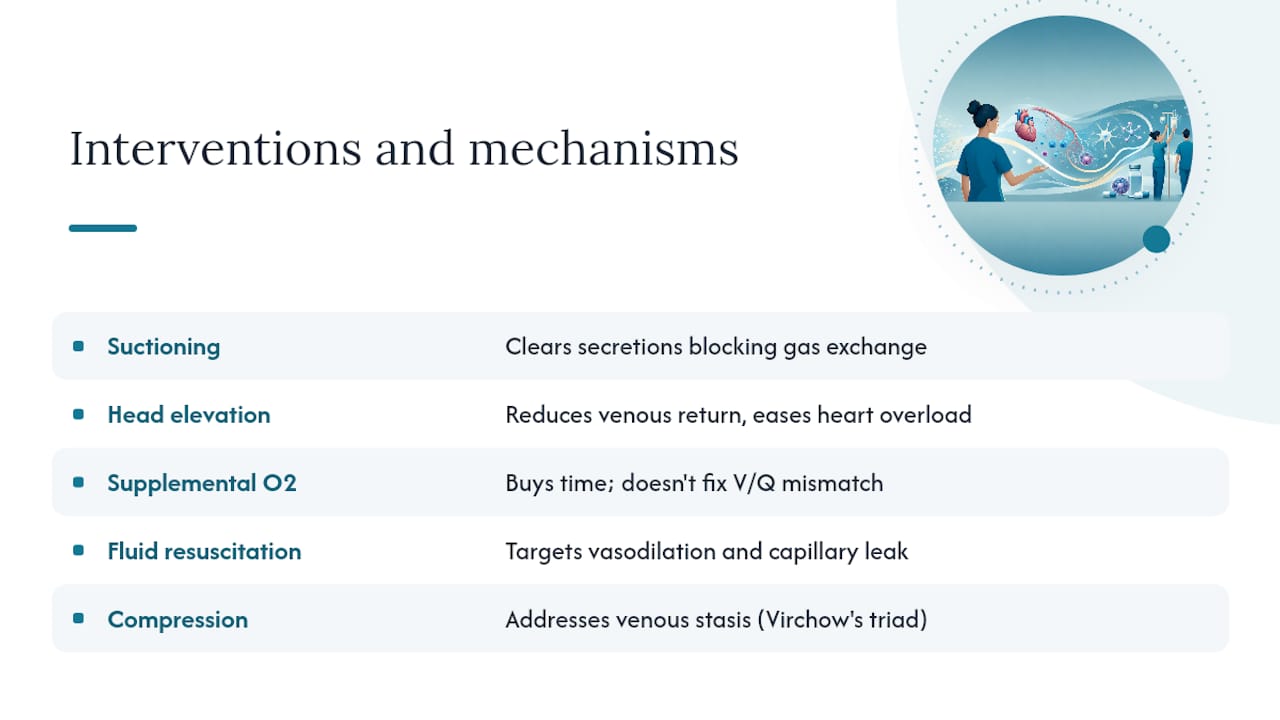
Suctioning an airway clears secretions that are physically blocking gas exchange, restoring the surface area pathogenesis had reduced. Elevating the head of the bed for a patient in heart failure reduces venous return to an already overloaded heart, easing the workload RAAS-driven fluid retention created. Administering supplemental oxygen does not fix the underlying ventilation-perfusion mismatch in pneumonia, but it buys time while antibiotics address the etiology directly.
Fluid resuscitation in early sepsis targets the vasodilation and capillary leak driving hypotension, aiming to restore perfusion before hypoperfusion causes irreversible organ damage. Applying compression to a limb after a clot diagnosis addresses venous stasis, one of the three classic contributors to clot formation alongside vessel injury and hypercoagulability.
Notice the pattern: the intervention always maps to a specific point in the pathogenesis chain, not to the diagnosis as a whole. That is why two patients with the same diagnosis can receive different interventions if their underlying mechanism (say, systolic versus diastolic heart failure) differs. Learning interventions this way, tied to mechanism rather than memorized by diagnosis, means you can reason through an unfamiliar combination of findings instead of freezing when the textbook case does not match the patient in front of you.
Where Pharmacology Meets Pathophysiology
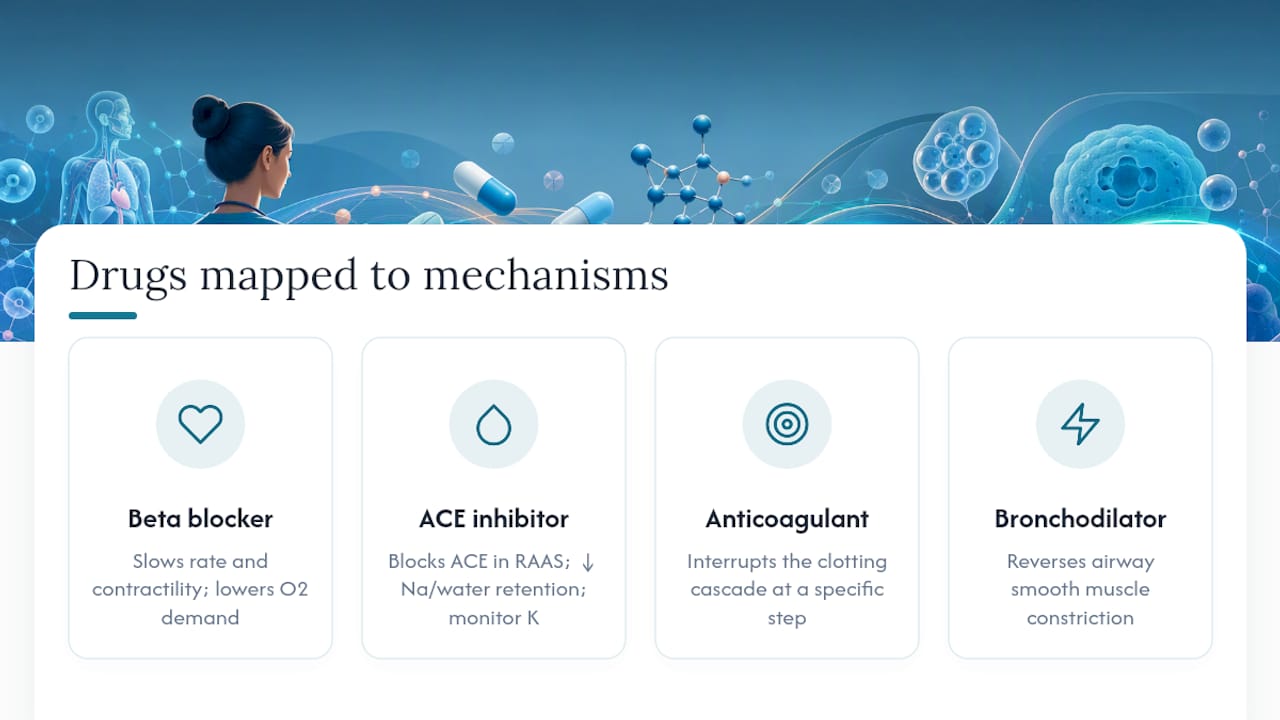
Pharmacology only makes sense once you know what a drug is correcting. A beta blocker slows heart rate and reduces contractility, which sounds counterproductive for a failing heart until you understand it also reduces the oxygen demand and workload that chronic compensation has been driving upward. The drug is not fighting the disease directly. It is interrupting a compensatory response that has become harmful over time.
This is why memorizing drug classes and side effects in isolation from mechanism produces shaky clinical judgment. A patient on an ACE inhibitor is not just "on a blood pressure medication." The drug blocks angiotensin-converting enzyme, interrupting the RAAS pathway responsible for the same sodium and water retention driving that patient's edema. Knowing that connection tells you exactly why you monitor potassium levels afterward, since RAAS suppression also reduces aldosterone-driven potassium excretion.
Every time you learn a new drug, ask which point in the pathogenesis chain it targets, not just what body system it affects. Anticoagulants interrupt the clotting cascade at a specific step. Bronchodilators reverse smooth muscle constriction in the airway, addressing one piece of the airflow limitation seen in COPD without touching the underlying tissue damage. Corticosteroids dampen the inflammatory cascade broadly, which explains both their effectiveness in acute exacerbations and their long list of side effects tied to suppressing a normally protective process. Mapping pharmacology onto your pathophysiology concept maps, rather than studying the two subjects separately, cuts your review time and builds the kind of integrated reasoning NGN case studies are designed to test.
Reading Lab Values Through a Pathophysiology Lens
A lab value without context is just a number. The same elevated white blood cell count means something different in a patient with early sepsis versus one recovering from surgery three days ago, and pathophysiology is what supplies that context.
Take lactate. A rising lactate level signals anaerobic metabolism, which happens when tissues are not getting enough oxygen to meet demand. In sepsis, that usually points to poor perfusion from vasodilation and capillary leak. Falling sodium in a heart failure patient often reflects dilution from fluid retention rather than actual sodium loss, an important distinction because the treatment for each is different. Rising BUN and creatinine together suggest reduced kidney perfusion or filtration, while a BUN rise with stable creatinine points more toward dehydration or gastrointestinal bleeding.
Potassium deserves particular attention because so many mechanisms converge on it: kidney dysfunction, RAAS activity, certain medications, and acid-base shifts all move potassium in predictable directions once you know the underlying process. Reading a basic metabolic panel becomes far faster once you stop treating each value as an isolated fact and start asking which mechanism, in this specific patient, would explain this specific number. That habit, tying every lab back to a mechanism rather than a memorized normal range, is one of the fastest ways pathophysiology knowledge pays off in a real shift.
Patient Teaching That Actually Sticks
Patients follow instructions better when they understand why the instruction exists, and pathophysiology is what makes that explanation possible instead of a vague warning.
Telling a heart failure patient to weigh themselves daily lands differently once they understand that weight gain reflects fluid retention happening before visible swelling or shortness of breath appears. Telling a COPD patient to avoid overexertion makes more sense once they grasp that damaged alveoli cannot expand oxygen delivery the way healthy lungs can, so pushing past a certain point causes real deterioration, not just discomfort.
Diabetes teaching improves the same way. Explaining that high blood sugar damages small blood vessels over years, not just in a single spike, helps patients understand why consistent control matters more than any single reading. A patient recovering from a clot benefits from understanding venous stasis specifically, because it explains why movement and compression stockings matter even when the leg does not hurt anymore.
Teaching rooted in mechanism also earns trust faster than teaching rooted in rules. "Take this medication with food" is a rule. "This medication can irritate your stomach lining directly, and food creates a buffer" is an explanation a patient can apply to situations you never covered. That transferability, the same quality that makes mechanism-based learning valuable for NGN exam questions, is exactly what makes it valuable at the bedside too.
Author Perspective: A Short Note on Mastering Pathophysiology
The hardest shift in pathophysiology is not learning more facts, it is trusting mechanism over memorization when you're under pressure. A daily 20-minute blank-sheet review, done consistently rather than perfectly, builds that trust faster than any amount of highlighting. Try it for two weeks alongside a Nursing School Pro trial and see which gaps it exposes.
— Autumn
Study Smarter With Nursing School Pro's Practice Questions
Nursing School Pro turns the study methods above into a repeatable weekly routine instead of a scramble before exam week. Every practice question comes with an instant, mechanism-based rationale, so when you get a heart failure or sepsis item wrong, you see exactly which pathogenesis step you missed, not just the correct letter.
The real-time analytics do the work of identifying weak systems for you, so instead of guessing which chapter needs another concept map, you can see it directly and drill it with a focused question set. A practical weekly setup: one mixed-question quiz across active systems, one focused drill on whatever the analytics flag as weak, and one blank-sheet mapping session for a new topic. The question bank is aligned with the same textbooks referenced throughout this guide and with national exam standards for HESI A2, TEAS, and NCLEX. Start with the 48-hour free trial or head straight to the study center to see which system needs your attention first.
This article is general information, not a substitute for advice from a qualified doctor. Consult a qualified healthcare professional about your own circumstances before acting on anything here.
Sources
- Healio — student/educator perspective on learning methods
- Ovid / Nurse Educator Online — visualization method of pathophysiology
- Penn State nursing blog — NURS 225 pathophysiology formula for success
- Understanding Pathophysiology, 8th Edition (Elsevier listing)
- Corelabs