
Pediatric developmental milestones are the skills most children can do by a given age, grouped into social/emotional, language/communication, cognitive and movement domains. For nursing exams you need three things: the age-by-age benchmarks, the growth figures that go with them, and what to do when a child misses one. This guide gives all three, then shows how to turn them into points on HESI A2, TEAS and NCLEX-style questions with the practice questions and instant rationales on Nursing School Pro, which has a 48-hour free trial.
TL;DR
- Growth is physical size (height, weight, head circumference). Development is skills and function. Exams test you on telling them apart.
- The CDC and AAP checklists cover 2, 4, 6, 9, 12, 15, 18 months, 2, 30 months, 3, 4 and 5 years across four domains.
- Formal developmental screening happens at 9, 18 and 30 months, with autism screening at 18 and 24 months.
- Any missed milestone calls for further screening or referral, and loss of a skill (regression) is an urgent red flag.
- Learn the milestones as clusters per age, then drill them with questions that explain every answer.
Table of Contents
- Growth versus development: the distinction exams love
- Growth benchmarks to memorize
- Milestones by age: birth to 5 years
- Monitoring versus screening
- When a milestone is missed
- Turning this into exam points
- Perspective
- Practice it with Nursing School Pro
- FAQ
- Sources
Growth versus development: the distinction exams love
Growth is an increase in physical size: height, weight, head circumference, skeletal growth and muscle mass. Development is gaining skills and functions: cognitive, psychosocial, communication and motor abilities. OpenStax Fundamentals of Nursing draws this line, and it is the first thing to settle when a question asks what a nurse should assess.
The NCI defines growth and development milestones as the expected sizes of infants and children and the activities they should manage at specific ages, such as sitting, standing, playing, speaking and interacting. Genetics, culture, nutrition, education and environment all influence the timing, according to the Illinois State Board of Education.
Motor development follows a cephalocaudal pattern, head to toe: a baby holds the head up before sitting, and sits before walking. OpenStax also notes that individuals vary, so read a chart as a population norm, not a rigid cutoff for one child.

Growth benchmarks to memorize
OpenStax gives these figures, which turn up in stem after stem:
| Measure | Benchmark |
|---|---|
| Newborn averages | 7 lbs (3.4 kg), 20 in (50 cm) long, head circumference 14 in (35 cm) |
| Early weight loss | About 10% of body weight in the first 7 days |
| Birth weight regained | By 10 to 14 days |
| Weight doubles | About 5 months |
| Weight triples | 12 months |
| Weight quadruples | During the toddler stage (1 to 3 years) |
| Height | About half adult height by age 2 |
The stages OpenStax uses are newborn (0 to 28 days), infant (0 to 12 months), toddler (1 to 3 years) and preschool (3 to 5 years). Cleveland Clinic adds that by age 5 a child should have doubled their height from birth, and that adolescent growth spurts happen around puberty, at ages 9 to 15 in females and 12 to 17 in males.
Milestones by age: birth to 5 years
The CDC's Milestone Moments booklet lists milestones at 12 ages: 2, 4, 6, 9, 12, 15 and 18 months, then 2 years, 30 months, 3, 4 and 5 years. The AAP's version matches. Here is a condensed study table of representative skills from those checklists.
| Age | Representative milestones |
|---|---|
| 2 months | Holds head up on tummy, coos, reacts to loud sounds, smiles at you, calms when picked up |
| 9 months | Babbles "mamamama," looks for dropped objects, shy around strangers, laughs at peek-a-boo |
| 12 months | Waves bye-bye, says "mama" or "dada," drinks from a held cup |
| 18 months | Walks independently, says three or more words, scribbles |
| 2 years | Two-word phrases, points to body parts |
| 30 months | About 50 words, follows two-step instructions, jumps with both feet |
| 3 years | Holds a conversation, asks "why" questions |
| 4 years | Pretend play, comforts others |
| 5 years | Counts to 10, tells a two-event story, hops on one foot, buttons |
For the numbers between those checkpoints, the Merck Manual gives median timings: 3 months, holds head steady when sitting; 7 months, sits without support and responds to own name; 9 months, crawls and pulls to stand; 12 months, cruises and may take 1 to 2 steps; 18 months, walks well, stacks 4 cubes and says about 10 words; 3 years, rides a tricycle and copies a circle; 5 years, skips and draws a person in 6 parts. The Administration for Children and Families describes 5-year-olds as wanting to please friends and speaking very clearly.
How to memorize them
Don't learn a list per domain. Learn one picture per age: what the child does with the body, hands, voice and others. At 9 months that picture is a crawler who is wary of strangers, babbles and hunts for the dropped toy. At 18 months it is a walker with a handful of words and a crayon. A question stem usually gives you two or three of these clues and asks you to name the age or the next expected skill.
The same logic applies to Erikson. Pair each age band with its psychosocial task and the play you would expect, and you can answer questions that blend psychosocial and motor clues.
Monitoring versus screening
These two words are not interchangeable, and exams test the difference. The CDC describes monitoring as informal observation by families and anyone working with young children using free checklists. Screening is a formal, validated tool given by trained professionals.
The AAP recommends general developmental screening at well-child visits at least at 9, 18 and 30 months, and autism-specific screening at 18 and 24 months. A missed screen is completed at the next visit, and extra screening happens whenever a concern arises. Validated tools include the Ages and Stages Questionnaire, PEDS and SWYC, according to an AFP editorial. The usual autism screen is the M-CHAT-R/F, used between 16 and 30 months.

The same editorial notes that in the 2022 revision the CDC added 15- and 30-month checklists, cut the number of milestones and set them at the 75th percentile. That means a typical child may still be a few weeks from a milestone, but a miss still matters.
When a milestone is missed
According to the AFP editorial, a child missing any revised CDC milestone should be considered for additional screening or referral for evaluation and early intervention. A peer-reviewed review reports developmental delays in 10% to 15% of preschool children and global developmental delay in 1% to 3%.
The nursing reasoning has three levels:
- Regression, the loss of a skill already gained, is an unequivocal red flag and calls for urgent specialist referral.
- Mild, isolated delay without red flags can be managed with stimulation advice and a review in about 3 months.
- High-risk children (preterm infants, children with chronic conditions, those in challenging circumstances) warrant a lower referral threshold, and follow-up should confirm the referral actually happened.
The AAP's autism guidance, summarized here, stresses universal screening at 18 and 24 months because autism can be diagnosed as early as 18 months. In practice, a nurse documents what was observed, shares it with the provider and supports the family's next step. Your scope and your state's rules decide who orders the evaluation, so follow your facility's protocol.
Turning this into exam points
Questions in this area tend to follow four patterns:
- Age match: a stem describes skills and asks which age or which expected next skill fits.
- Safety and teaching: you pick the toy, activity or safety teaching that suits the stage.
- Priority: you decide which finding is a red flag (regression) versus a normal variation.
- Growth math: you check weight gain against the doubling and tripling benchmarks.
The mistake most students make is rereading the chart. Recognition feels like knowledge, but exam questions require retrieval. Test yourself, read the rationale, and note why the wrong options were wrong. If you are tackling adaptive testing, our piece on adaptive NCLEX practice covers how to practice in the exam's style. For pediatric clinical math, see pediatric maintenance fluids, and for assessment fundamentals, the basic nursing assessment guide.
Perspective
We built Nursing School Pro around one idea: a correct answer you cannot explain will not survive a rephrased question. Milestones are the best example. Nobody fails a pediatric item because they never saw the word "cruising." They miss it because the stem described a 10-month-old in new words.
That is why every question on our platform comes with an instant rationale, so you learn why an option is right and why the others are not. Our adaptive retry loops bring back what you missed, and real-time analytics show whether your weak spot is growth benchmarks, age matching or red-flag priority. Our content is aligned with respected nursing textbooks and national standards, so the study time you spend goes to what is tested.
Study the chart once, then let the questions do the repetition.
Autumn
Practice it with Nursing School Pro
Nursing School Pro gives you practice questions for every nursing class and for HESI A2, TEAS and NCLEX prep, each with an instant rationale and analytics that highlight weak areas. The plan is $20 per month after a 48-hour free trial. You can also browse the Study Center for free study guides and articles.
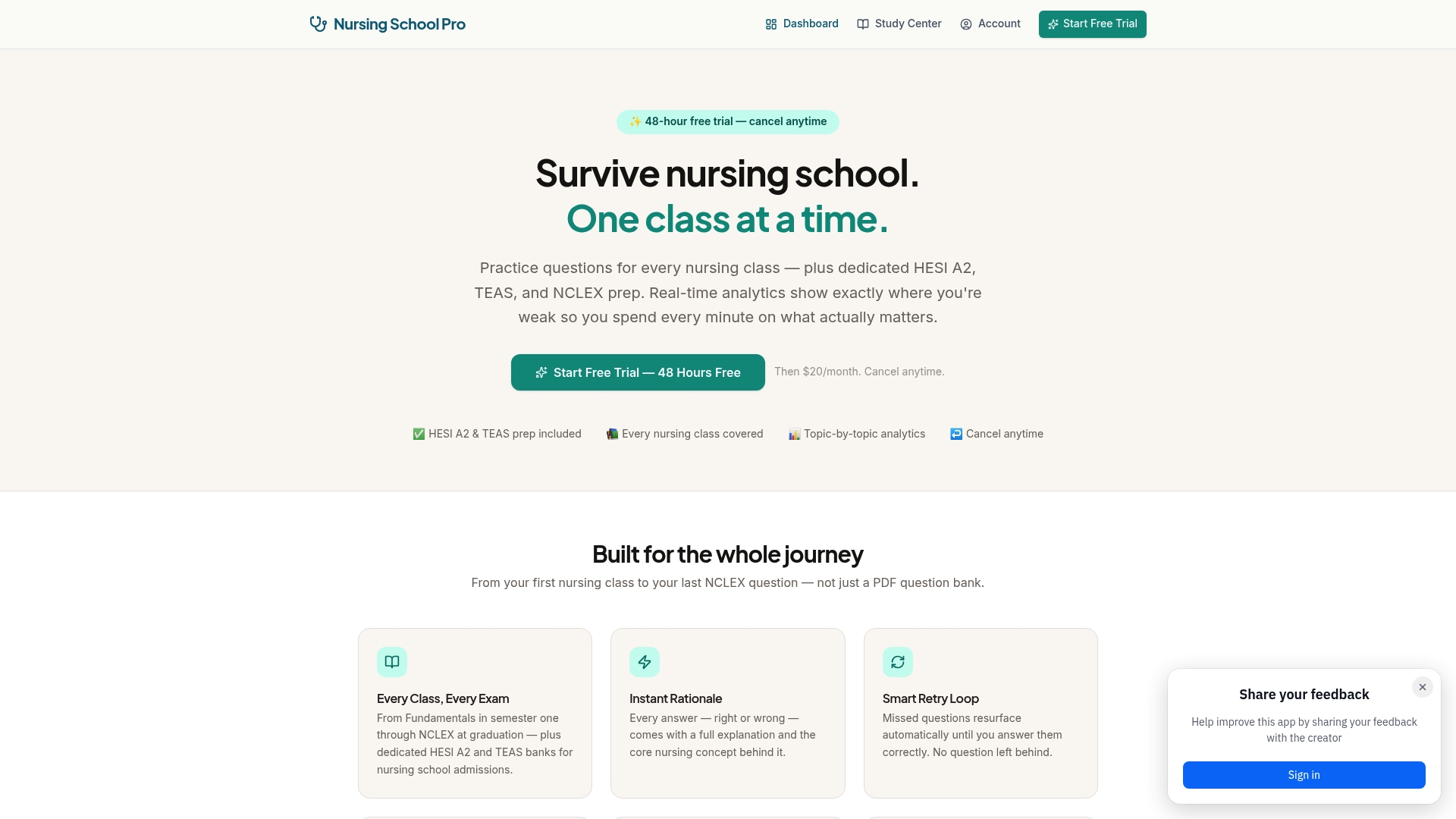
If you are earlier in the journey, our guide to nursing school requirements shows what admissions committees value, and the head-to-toe assessment checklist pairs well with pediatric assessment practice. Start on the Nursing School Pro home page.
FAQ
What is the difference between growth and development?
Growth is physical size: height, weight and head circumference. Development is the gaining of skills such as walking, talking and playing with others. Both are tracked against age-based norms, but they are assessed differently.
How often are developmental milestones checked?
The CDC checklists cover 12 ages from 2 months to 5 years. The AAP recommends formal screening at 9, 18 and 30 months, plus autism screening at 18 and 24 months, with monitoring at every other visit.
What is the biggest red flag in pediatric development?
Regression, meaning loss of a previously acquired skill, is an unequivocal red flag that calls for urgent specialist referral. Any missed CDC milestone also calls for further screening or referral for evaluation.
How do I study milestones for the NCLEX?
Learn one clinical picture per age, then practice questions that describe that picture in new words. Review each rationale, especially for wrong options, and track which question types you miss most.
Sources
- OpenStax Fundamentals of Nursing: Stages of Growth and Development
- NCI Dictionary: growth and development milestones
- Illinois State Board of Education: Developmental Milestones
- Cleveland Clinic: Growth Spurt Ages
- CDC Milestone Moments Booklet
- AAP: Developmental Milestones
- Merck Manual: Childhood Development
- ACF: Child Development Resources for Parents and Providers
- CDC: Developmental Monitoring and Screening
- AFP: CDC's Revised Developmental Milestone Checklists
- LA AAP: Developmental Screening & Surveillance
- Developmental delay: identification and management
- AAP ASD clinical report summary