
Pick the longest timeline you can realistically stick to, then build your NCLEX study schedule around it. If your exam date is flexible and your diagnostic scores are shaky, that means 9 to 12 weeks. If you're already scoring well on practice questions or your test date is locked in three weeks out, a tighter 2 to 4 week plan works, provided you can put in the hours daily.
Start today with three moves:
- Take a timed, mixed-content diagnostic test that mirrors the real exam's category spread.
- Block off daily question practice, even if it's just 30 focused questions on day one.
- Reserve calendar slots now for at least two full-length CAT simulations before test day.
Here's how to size your daily commitment by timeline:
- 2 weeks: 4 to 6 hours a day, near full-time intensity.
- 4 weeks: 3 to 4 hours a day, five to six days a week.
- 6 to 9 weeks: 2 to 3 hours a day with two rest days built in weekly.
- 12+ weeks: 1.5 to 2 hours a day, spaced to prevent burnout.
Key Takeaways
The most reliable NCLEX study schedule is the longest timeline a student can follow consistently, built around a diagnostic test and weekly analytics-driven adjustments.
| Point | Details |
|---|---|
| Choose timeline by constraints | Match your exam date, diagnostic score, and weekly hours to a 2, 4, 6, 9, or 12+ week plan. |
| Diagnose before you plan | Take a mixed, timed baseline test and tag misses by category and clinical-judgment step. |
| Structure every session the same way | Combine content review, timed questions, rationale remediation, and spaced review each time. |
| Schedule mock exams deliberately | Space two to three full-length CAT simulations across your final two to three weeks. |
| Use analytics to cut remediation time | Nursingschoolpro's instant rationales and real-time progress tracking turn error logs into automatic weekly focus areas. |
Table of Contents
- Building A Study Plan For NCLEX Around The Test Format
- How Do You Choose The Right NCLEX Study Timeline?
- How Do You Assess Your NCLEX Strengths And Gaps?
- What Should A Study Session For NCLEX Look Like?
- Sample NCLEX Study Schedules By Timeline
- When Should You Take Full-Length Practice Exams?
- How Do Question Banks And Analytics Sharpen Your Plan?
- How Do You Avoid Burnout While Studying For The NCLEX?
- What I've Learned About NCLEX Study Habits That Stick
- Let A Question Bank Do The Remediation Math For You
- Sources
Building A Study Plan For NCLEX Around The Test Format
The NCLEX-RN is a computer adaptive test, which means the exam adjusts question difficulty based on your previous answers, rather than serving a fixed set to everyone. It runs anywhere from 85 to 150 questions and can take up to five hours to complete, depending on how quickly the algorithm zeroes in on your competency level. That variability is exactly why cramming a single content area rarely pays off: you don't know which categories the exam will lean on until you're sitting in the chair.
The Next Generation NCLEX format weights clinical judgment heavily, testing whether you can recognize cues, analyze data, and prioritize hypotheses in realistic patient scenarios, not just recall facts. Question counts also include unscored pretest items mixed in without identification, which is one more reason to treat every question in practice like it counts.
The eight Client Needs categories and NGN clinical-judgment item types set by the NCSBN test plan should directly shape how you divide your weekly study hours, not just what topics you happen to feel confident about.
Study priorities that ignore this structure waste time. Categories like Physiological Integrity typically carry more weight than others, so your NCLEX study plan should allocate proportionally more practice questions there rather than spreading hours evenly across all eight categories.
How Do You Choose The Right NCLEX Study Timeline?
Your timeline decision comes down to five honest questions, not a gut feeling about how "ready" you feel.
- Is your exam date fixed, or can you push it back if your diagnostic results are weak?
- How did you perform in your final nursing courses, particularly med-surg and pharmacology?
- What did your baseline diagnostic actually show, category by category?
- How many hours per week do you realistically have outside work, clinicals, or family obligations?
- Are you already running on fumes from nursing school, or do you have bandwidth for an intense push?
Match your answer to a timeline:
- 2 weeks fits someone with a strong recent GPA, a solid diagnostic score, and a test date that can't move.
- 4 weeks suits students with moderate gaps and enough flexibility to study most days.
- 6 to 9 weeks works for anyone rebuilding foundational knowledge in two or more categories.
- 12+ weeks is right if you're studying part time around a job, or your diagnostic revealed weaknesses across the board.
Consistency beats cramming almost every time. A student who studies two hours daily for nine weeks typically retains more than one who tries to force ten-hour days into a two-week sprint, mainly because spaced repetition needs, well, space. Compressed bootcamps can work, but they demand dramatically higher daily question volume and carry a real burnout risk if you push too hard too fast.
How Do You Assess Your NCLEX Strengths And Gaps?
Run a timed, mixed diagnostic before you build a single study block. A useful baseline test approximates the real exam's category distribution rather than pulling random questions, and it should include at least 75 to 100 items to give you a confidence level worth acting on.
- Take the diagnostic under real testing conditions: no notes, no pausing, a quiet room.
- Tag every missed question two ways: by Client Needs category and by clinical-judgment step (recognizing cues, analyzing, prioritizing, generating solutions, taking action, or evaluating outcomes).
- Convert those tags into a weekly allocation. If 40% of your misses cluster in Physiological Integrity, that category should claim roughly 40% of your practice question volume that week.
Statistic Callout: The exam draws from 85 to 150 items total, including 15 unscored pretest items on shorter exams. Since you can't tell scored from unscored questions in the moment, every item deserves full effort during practice too.
Pro Tip: Build a simple error log with four columns: category, specific topic, question type, and remediation action. Reviewing that log weekly turns scattered misses into a visible pattern you can actually study toward.
What Should A Study Session For NCLEX Look Like?
A session that mixes passive reading with occasional questions rarely moves the needle. Structure each block around four parts:
- Focused content review (20 to 30 minutes): active recall through self-quizzing or spaced flashcards, not rereading notes.
- Timed question set (40 to 60 minutes): 25 to 50 questions pulled from a mix of categories, not just the day's topic.
- Rationale remediation (20 to 30 minutes): read every rationale, right or wrong, and note why the correct answer wins.
- Quick spaced review (10 minutes): revisit yesterday's error log before closing the session.
A sample weekly rhythm might rotate categories like this: Monday on pharmacology, Tuesday on med-surg, Wednesday on mental health, Thursday on pediatrics, Friday on maternal newborn, with mixed-question practice woven into every single day regardless of the day's focus topic. Never let a "focus day" mean you only see questions from that one category. The adaptive exam won't organize itself that neatly, and your brain needs the interleaving to build real recall under pressure.
For daily timing, Pomodoro-style chunks work well: 45 minutes of focused work, a 10-minute break, repeat. Cap most sessions at three to four hours total, with a short evening review of flagged questions rather than a second full study block.
Pro Tip: Do calculation and drug-dosage practice earlier in your session, while your mental math is sharpest, not at the tail end when fatigue sets in and careless errors creep into number-heavy questions. The dosage calculation mistakes that trip students up on test day usually come from rushed math, not missing knowledge.

Sample NCLEX Study Schedules By Timeline
Below are the daily structures for five common timelines. Adjust the specific categories to match your own diagnostic results, but keep the rhythm intact.
2-week bootcamp (4 to 6 hours daily): Days 1 to 2 cover diagnostic testing and error-log setup. Days 3 to 10 rotate two categories per day with 100 to 150 questions daily, split morning and afternoon. Days 11 to 12 run full-length CAT simulations. Days 13 to 14 focus purely on flagged weak areas and light review.
4-week consolidation (3 to 4 hours daily): Week 1 is diagnostic plus foundational review of your two weakest categories. Weeks 2 and 3 rotate through all eight Client Needs categories, 75 to 100 questions daily. Week 4 shifts to two full-length CATs and NGN case-study drills, tapering question volume in the final two days.
6-week balanced build (2 to 3 hours daily, five days a week): Weeks 1 to 2 build content foundations with 50 questions daily. Weeks 3 to 4 increase to 75 questions daily with heavier NGN case practice. Weeks 5 to 6 add a full-length simulation each week and dedicate the final three days to error-log review only.
9-week steady ramp (2 to 3 hours daily, four to five days a week): Weeks 1 to 3 focus on content review with 50 questions daily. Weeks 4 to 6 push to 75 questions daily and introduce your first full-length CAT at week 6. Weeks 7 to 9 layer in a second and third simulation, tapering to lighter review the final three days before the exam.
12-week spaced plan (1.5 to 2 hours daily, four days a week): Months build progressively: weeks 1 to 4 at 30 to 50 questions daily covering foundational content, weeks 5 to 8 at 50 to 75 questions with category rotation, and weeks 9 to 12 at 75 to 100 questions with three full-length CATs spaced roughly two weeks apart.
| Timeline | Daily study hours | Daily question target |
|---|---|---|
| 2 weeks | 4–6 hours | 85 to 150 questions |
| 4 weeks | 3–4 hours | 75–100 questions |
| 6 weeks | 2–3 hours | 50–75 questions |
| 9 weeks | 2–3 hours | 50–75 questions |
| 12+ weeks | 1.5–2 hours | 30–100 questions (ramping up) |
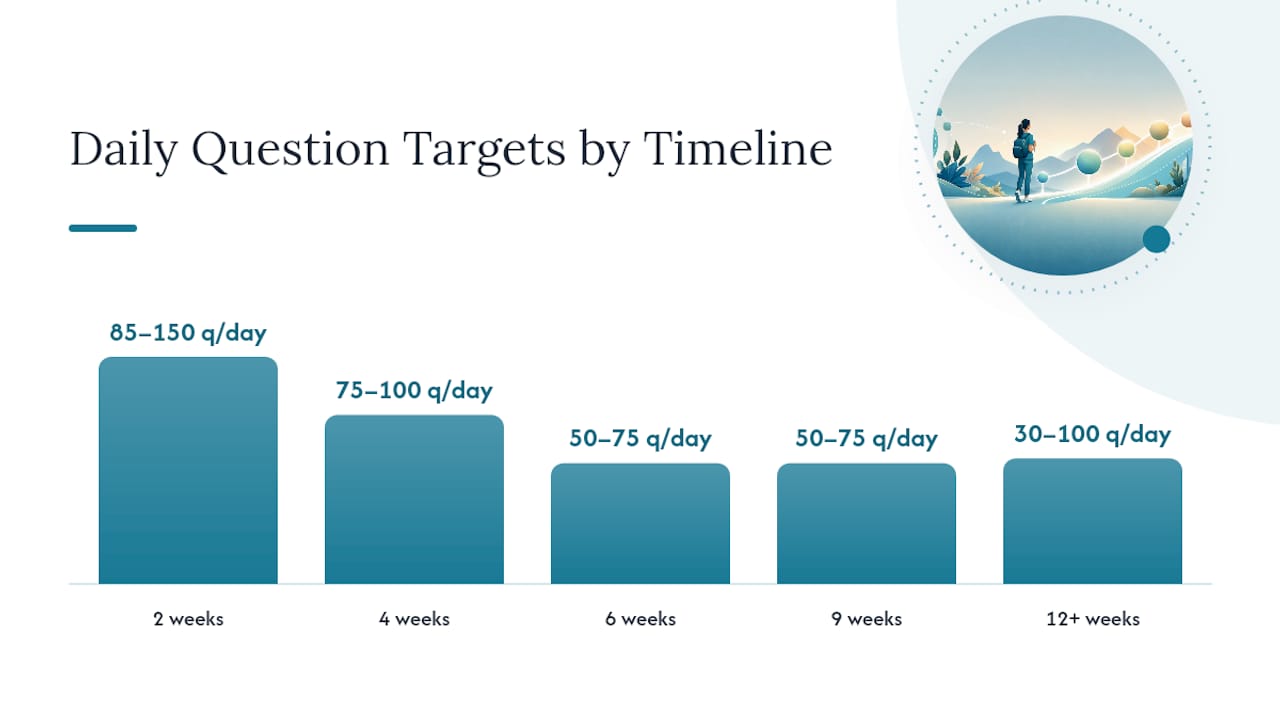
These question-volume ranges assume you're also doing rationale review after each set, not just clicking through answers to hit a number.
When Should You Take Full-Length Practice Exams?
Full-length CAT simulations do two jobs: they build the mental stamina you need for a multi-hour adaptive exam, and they surface category weaknesses that shorter question sets miss.
- Schedule your first full simulation once you've covered most content categories at least once, roughly the midpoint of your plan.
- Space out two to three full-length mock exams in your final two to three weeks rather than clustering them all at the end.
- After each simulation, review category-level performance, not just your overall pass or fail projection. A borderline score with one weak category is a very different problem than the same score spread evenly across all eight.
For NGN case studies specifically, practice reading the full clinical scenario before jumping to the questions, then tag each miss by which clinical-judgment step tripped you up. If you keep missing "prioritize hypotheses" items but nailing "recognize cues," that's a specific, fixable skill gap rather than a vague sense you're "bad at NGN."
Pro Tip: Build exam stamina gradually. Don't attempt your first five-hour simulation cold. Work up through 90-minute, then three-hour practice blocks so your focus doesn't collapse in hour four on test day.
How Do Question Banks And Analytics Sharpen Your Plan?
A question bank is only as useful as what you do with the data it hands back. The daily workflow that actually moves scores looks like this:
- Answer a targeted set of 25 to 50 questions in a chosen category.
- Read every rationale immediately, including for questions you got right, since a lucky guess hides a gap.
- Tag each miss in your error log and note whether it's a knowledge gap or a test-taking error.
- Adjust next week's category weighting based on the trend, not a single bad session.
Pro Tip: Watch four metrics closely: percent correct by category, average time per question, how often you flag items for review, and whether your learning curve on a specific topic is actually climbing week over week. A platform with real-time analytics makes this loop far faster than tallying results in a spreadsheet by hand, since the pattern shows up automatically instead of requiring manual tracking.
The remediation loop itself is simple: diagnose the gap, review the specific content, return to mixed practice, then reassess in a week. Skipping the reassessment step is the most common reason students repeat the same mistakes for a month straight.
How Do You Avoid Burnout While Studying For The NCLEX?
Your brain needs recovery to consolidate what you've studied, and skipping rest days tends to backfire within two to three weeks.
- Take one full day off per week, even during a compressed 2-week plan.
- Aim for seven to eight hours of sleep, especially the night before a full-length simulation.
- Build lighter recovery days into longer plans: 30 minutes of flashcard review instead of a full session.
Buffer days matter too. If week 3 gets derailed by a work shift or a bad week emotionally, a built-in catch-up block keeps one rough patch from collapsing your entire schedule. Small wins count for more than they seem to: closing out a 50-question set with an improved score, even by a few points, is often what keeps momentum alive through week seven of a nine-week plan.
Pro Tip: Schedule your rest day the same day every week so it becomes a fixed anchor, not something you negotiate away when you feel behind.
What I've Learned About NCLEX Study Habits That Stick
Consistency beats intensity almost every time I've seen this play out. Students who study moderately but daily tend to outperform students who binge for a weekend and vanish for a week, because retention depends on spacing, not just total hours logged.
Expect setbacks. A rough week doesn't mean your plan failed, it means the plan needs a small correction, not an overhaul. Go back to your diagnostic data, see what shifted, and adjust the next week's category weighting instead of scrapping the whole schedule out of frustration.
The students who adapt their NCLEX study guide week to week based on actual error patterns, rather than a fixed plan they wrote on day one and never revisited, are the ones who walk into test day with real confidence instead of borrowed optimism.
Let A Question Bank Do The Remediation Math For You
Building the error log, tagging every miss by category and clinical-judgment step, and recalculating your weekly focus by hand is exactly the kind of manual tracking that eats hours you'd rather spend answering questions. Nursingschoolpro pairs every practice question with an instant rationale and real-time analytics that flag your weak categories automatically, so the remediation loop described throughout this guide happens in minutes instead of a spreadsheet session.
Whether you're running a tight 2-week bootcamp or a spaced 12-week build, the platform adjusts to the timeline you've chosen rather than forcing a one-size schedule on you. It covers every nursing course alongside dedicated NCLEX prep, so the same account that helped with your med-surg exams carries you straight through to test day. Start with the 48-hour free trial to see your baseline analytics before committing to a full study plan.
Sources
- How to Build a Step-by-Step Study Plan for the NCLEX-RN | West Coast University
- NCSBN — About nursing regulatory bodies