
NGN case studies are multi-tab unfolding patient scenarios scored against the NCSBN Clinical Judgment Measurement Model, and each one typically spawns six linked questions across the patient's changing status. This article walks through a worked example, points you to vetted practice repositories, and lays out a 4-week plan built around instant rationales and progress analytics.
TL;DR:
- Practice NGN cases by focusing on key exhibits like nurse notes and vitals before analyzing slow or fast-changing cues.
- Use structured methods like the ABCDE framework and filtering by recent data trends to prioritize hypotheses quickly.
- Review well-constructed cases thoroughly, emphasizing rationales and exhibit cues rather than just increasing question volume.
- Grow your skills over four weeks with a mix of untimed, timed, and full simulation practice, tracking NCJMM step-specific progress.
- Use dedicated platforms with instant rationales and analytics to identify and strengthen weak clinical judgment steps effectively.
Table of Contents
- What NGN Case Study Examples Actually Look Like
- A Worked NGN Case Study Walkthrough
- Where to Find Trustworthy NGN Practice Cases
- Strategies That Actually Move Your Score
- A 4-Week Plan for Practicing NGN Case Studies
- Where Nursing School Pro Fits Into This Plan
- What the Research Actually Supports
- Try the Nursing School Pro Study Center
- Sources
What NGN Case Study Examples Actually Look Like
Every unfolding case opens with a set of exhibits, and where you look first determines how fast you find the right cue. Expect a vitals chart, a nurse's note, a medication administration record, a lab panel, and sometimes a trend graph showing values over several hours. Each exhibit hides a different type of clue: vitals show acute change, the nurse's note carries subjective detail easy to skim past, and lab trends reveal a slower decline that a single snapshot would miss.
The Clinical Judgment Measurement Model that NCSBN built for the exam breaks clinical reasoning into six steps: recognize cues, analyze cues, prioritize hypotheses, generate solutions, take action, and evaluate outcomes. A single unfolding case usually asks one question per step, so the patient's story updates as you answer, and your prior response can change what the next question is really asking.
Bow-tie and trend items work differently. A bow-tie question asks you to pick a likely condition, its supporting cues, and expected outcomes in one shot, while a trend item shows values over time and asks you to spot a pattern. Both test isolated judgment steps rather than the full six-question sequence.
- Vitals and MAR exhibits usually carry the acute, time-sensitive cues.
- Nurse's notes hold context and subjective detail that changes prioritization.
- Lab trends and graphs reveal slow-moving problems a single value would hide.
- Bow-tie items test one NCJMM step in isolation; unfolding cases test all six.
A Worked NGN Case Study Walkthrough
Here's a compressed version of the kind of case you'll see, run through all six NCJMM steps.
The case: A 68-year-old man is admitted for pneumonia. Initial vitals: temperature 101.8°F, heart rate 96, respiratory rate 22, blood pressure 132/84, oxygen saturation 93% on room air. Four hours later, a nurse's note documents new confusion and the patient pulling at his IV line. A repeat vitals check shows heart rate 118, respiratory rate 28, oxygen saturation 88% on 2L nasal cannula.
- Recognize cues. The confusion, rising respiratory rate, and dropping oxygen saturation are the cues that matter. Age and fever alone are background noise at this point since they haven't changed.
- Analyze cues. Falling oxygenation plus new mental status change points toward worsening respiratory failure or early sepsis rather than simple anxiety or delirium from a strange hospital room.
- Prioritize hypotheses. Respiratory decompensation outranks a UTI-related confusion workup because the airway and breathing findings are acute and trending down right now.
- Generate solutions. Reasonable options include increasing supplemental oxygen, obtaining a stat arterial blood gas, and notifying the provider. Ordering a routine chest X-ray in six hours fails because it doesn't match the urgency.
- Take action. Increase oxygen delivery and notify the provider immediately. This is the only option that addresses the trend instead of waiting on it.
- Evaluate outcomes. Recheck oxygen saturation and mental status in 15 to 30 minutes. If saturation doesn't climb, escalation to a higher level of care follows.
Pro Tip: Write down which exhibit gave you each cue as you work through a case. That habit stops you from anchoring on one data point and speeds up prioritization when the same information reappears in a later question.
Educator guidance backs this approach: NGN success tracks with synthesizing data in real time and separating signal from noise, not memorizing disease facts in isolation.
Where to Find Trustworthy NGN Practice Cases
Not every practice case online reflects how NCSBN actually builds these items, so where you practice matters almost as much as how much you practice.
The NextGen NCLEX Library at the University of Maryland is the strongest public starting point. It organizes instructor-reviewed cases into Family, Fundamentals and Mental Health, and Medical Surgical categories, plus shorter mini reviews, all built around the six-question NCJMM structure. Some faculty folders in that library include answer keys and rationales meant for instructor use, so treat it as a guided self-study tool rather than a pure test bank, ideally alongside a faculty member or study group.
For official guidance on how the exam itself is structured, NCSBN's own resource pages host exam previews, videos, and NCJMM explainer materials directly from the organization that writes the test.
- University-hosted libraries like Maryland's often skew academic and instructor-facing.
- Practitioner test banks such as Nurseslabs offer more casual, high-volume practice with worked rationales.
- NCSBN's own materials are the authority on how items are actually scored.
Use university repositories for depth and rationale quality, and lean on high-volume test banks when you just need reps.
Strategies That Actually Move Your Score
Random clicking through tabs wastes exam time you don't have. A fixed scanning order fixes that.
Open the nurse's note first, then vitals, then the MAR, then labs or trends. This order surfaces the subjective story before the numbers, so you're not staring at a heart rate of 118 with no context for why it matters. Once you've scanned every tab, filter for cues that changed from baseline. A stable low-grade fever isn't a cue worth acting on; a fever that spiked 3 degrees in two hours is.
Mapping the ABCDE framework (airway, breathing, circulation, disability, exposure) onto NCJMM's "analyze cues" and "prioritize hypotheses" steps cuts decision time, because it gives you a ranked filter instead of an open-ended judgment call every time.
- Scan nurse's note, vitals, MAR, then labs, in that order, on every case.
- Ask "what changed from baseline?" before asking "what's abnormal?"
- Rank airway and breathing findings above everything else unless a cue directly contradicts that.
- Watch for options that treat a future risk instead of the current trend, which is a common wrong-answer trap.
Pro Tip: If two answer choices both look defensible, pick the one that addresses the most recent trend in the data, not the one that treats the patient's admitting diagnosis. Our guide to NCLEX test strategies covers more of these general traps if you want the fuller list.
A 4-Week Plan for Practicing NGN Case Studies
Case study practice only pays off when it's structured, so build it into blocks with a specific goal each week.
- Week 1: Foundation and untimed practice. Work through 3 to 4 unfolding cases without a clock, focusing on correctly identifying cues on the first pass. Review every rationale, right or wrong, before moving to the next case.
- Week 2: Timed single cases. Add a clock (roughly 90 seconds per question) and work 5 to 6 cases, then spend twice as long reviewing wrong answers as you did answering them.
- Week 3: Mixed practice. Blend unfolding cases with bow-tie and trend items, aiming for 8 to 10 cases across the week, and track accuracy by NCJMM step to see which step is dragging your score.
- Week 4: Full simulation. Run timed blocks that mix all item types under exam-like conditions, and use whatever analytics tool you're tracking progress with to confirm your weak step from Week 3 has actually improved.
Instant rationales matter more than raw volume here. A student who reviews 40 well-explained cases usually outperforms one who grinds through 100 with no rationale review, because the second student repeats the same reasoning error without knowing it. For more on building that habit, see our study plan built around rationales.
Where Nursing School Pro Fits Into This Plan
Running the plan above by hand, across scattered PDFs and test banks, is where most students lose momentum. Practice questions with instant rationales for NGN-style items enable Week 1 and Week 2 review to happen directly on a study platform instead of a separate document. Progress analytics can flag which NCJMM step is weak, which is useful for diagnostic purposes in Week 3 of study. Foundational assessment resources, like vital signs and GCS references, back up the exhibit-reading skills the case studies test.
What the Research Actually Supports
Most NGN prep advice still leans on volume: do more questions, cover more content, memorize more disease processes. That's backwards for this exam format. The educator research on NGN is consistent that synthesis, not recall, decides whether you pass, and synthesis doesn't improve by repetition alone. It improves by reviewing why an answer was wrong, every time, until the reasoning pattern sticks.
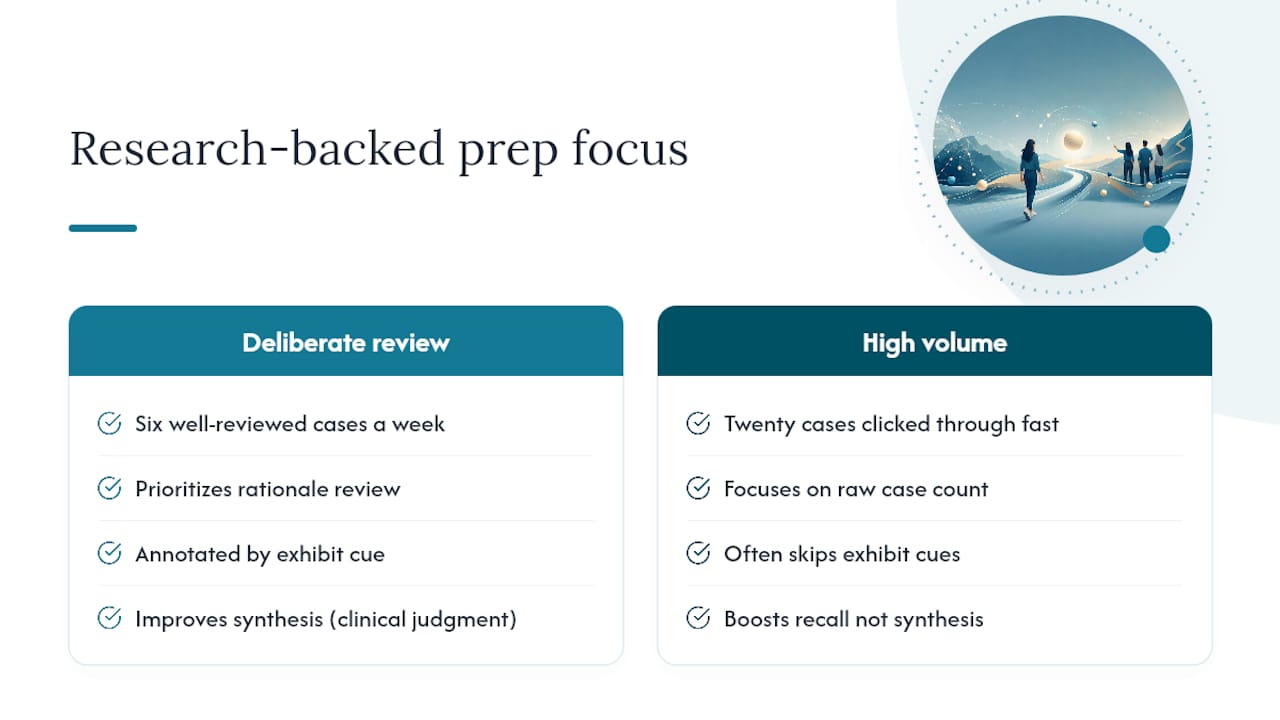
The conventional wisdom also underrates how much the exhibit format itself trips students up. A student who knows pneumonia cold can still miss the question because they never opened the nurse's note tab. That's not a knowledge gap. It's a habit gap, and it's fixable in a week of deliberate scanning practice.
If you take one thing from this guide, prioritize rationale review over raw case count. Six well-reviewed cases a week, annotated by which exhibit produced each cue, will move your clinical judgment further than twenty cases clicked through fast. The exam rewards the habit of slowing down at the right moment, not the habit of finishing quickly.
— Autumn
Try the Nursing School Pro Study Center
Using a dedicated study platform can offer a streamlined path to NGN readiness compared to piecing together university PDFs, free test banks, and a spreadsheet to track your own weak spots. Practice questions with instant rationales, combined with analytics that show which NCJMM steps may be weak, help direct review time more effectively.
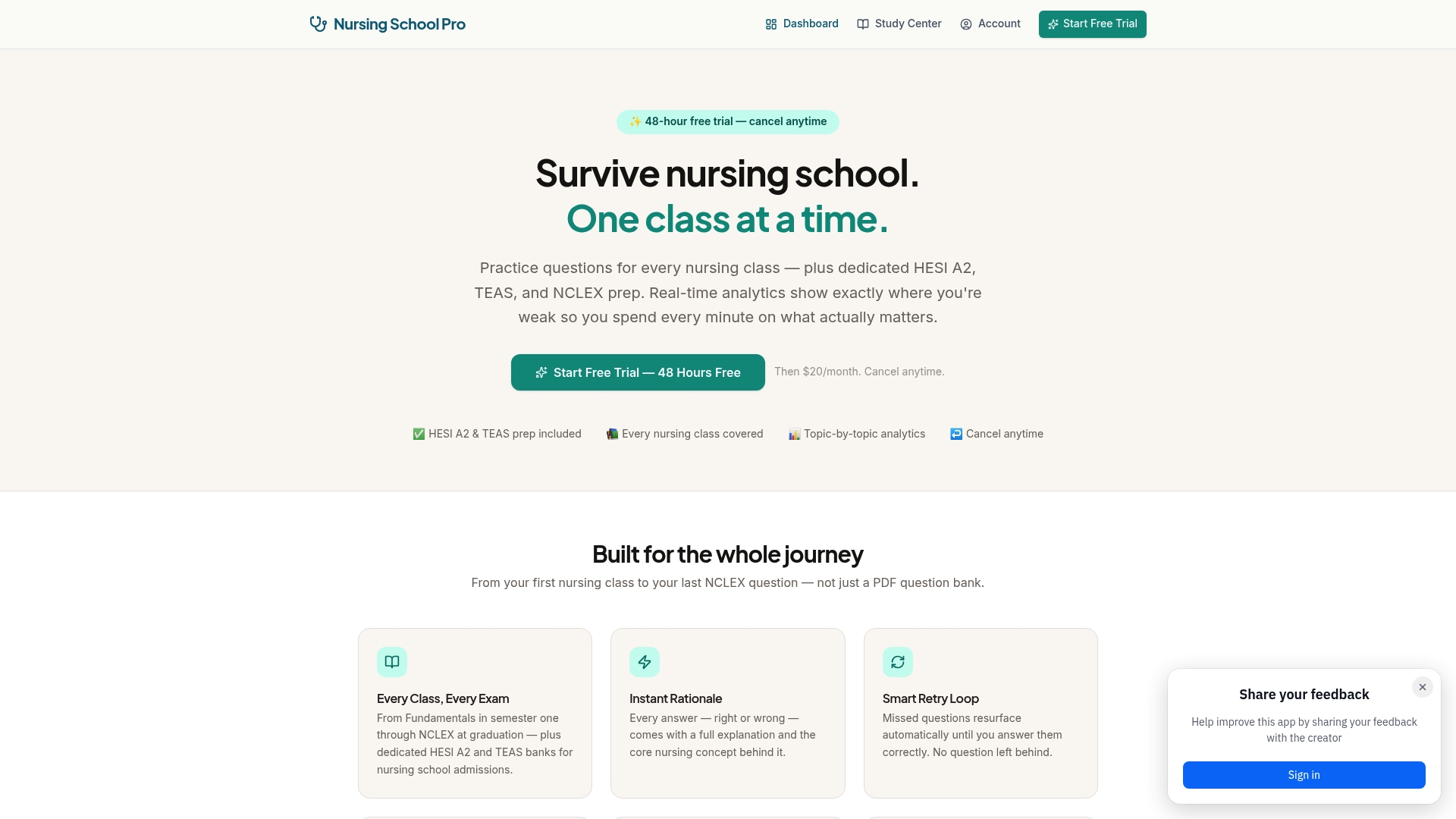
Start with case-style practice questions and use an analytics dashboard to identify weaker clinical judgment steps after initial sessions. From there, the rationale review becomes your Week 1 and Week 2 routine straight out of the plan above. You can try the full Study Center during the 48-hour free trial, and the pricing page lays out what continued access costs once the trial ends at $20 a month. If you want the broader picture of what the platform covers before committing, the main Nursing School Pro site walks through HESI A2, TEAS, and NCLEX prep in one place.
Sources
- NextGen NCLEX Library
- Next Generation NCLEX article for educators
- Nurseslabs NGN unfolding case studies practice bank