
Treat each option as a standalone true or false statement and defend every selection. That single habit raises SATA accuracy more than almost any other tactic available to you. Pair it with knowledge of how NGN scoring awards partial credit, and start today by forcing a yes or no decision on every option instead of scanning for ones that "sound right."
TL;DR:
- Focusing on defending each answer choice individually helps maximize accuracy, especially given that NGN-style questions can award partial credit for correct options.
- Careful, repeated prediction and testing of each option based on safety, scope, and support filters prevent overselecting and reduce errors from assumptions or familiarity.
- Rereading stems twice and applying strict rules to change answers only with new evidence minimizes second-guessing and rushing mistakes.
- Regular, structured practice with rationales and error logging improves pattern recognition and cuts overselect errors by half within four weeks.
- The number of SATA questions on the NCLEX does not indicate exam difficulty or your chances of passing, as the test adapts to your performance regardless of question count.
Table of Contents
- The Core NCLEX SATA Strategy: Option-by-Option Testing
- How Does NCLEX Scoring Affect SATA Answer Choices?
- Three Worked SATA Examples With Rationales
- Common SATA Mistakes and How to Fix Them
- Building a SATA Practice Plan That Actually Improves Accuracy
- What I've Noticed About How Students Actually Answer SATA Questions
- Practice SATA Questions With Instant Rationales
- Sources
- FAQ
The Core NCLEX SATA Strategy: Option-by-Option Testing
Read the stem twice before looking at a single answer choice. The first read tells you what's happening with the client; the second tells you what the question actually wants. Watch for command words like "further teaching needed," "priority," or "immediate," and note any timeframe (24 hours post-op, day 3, "this morning"). Predict the topic in your head before your eyes ever hit the options. That prediction becomes your filter.
Then work through each option individually:
- Reword it in plain language. Turn medical phrasing into something you'd say to a coworker.
- Ask: Is this true or false for this specific client, in this specific stem?
- Justify your answer in one sentence, out loud or in your head. If you can't defend it, don't select it.
- Move to the next option without looking back until you've judged all of them.
Run every surviving option through three filters before locking in your final selections:
- Safety — Would this help, harm, or do nothing for this client?
- Scope — Is this something a nurse actually does, or is it a provider-only action (ordering a scan, changing a prescription)?
- Support — Is this directly backed by something stated in the stem, or are you assuming information that isn't there?
Eliminate options that are vague ("monitor the patient closely" with no specifics), absolute ("always," "never" with no clinical nuance), unrelated to the stem's actual scenario, or outside nursing's independent scope. The NurseZee approach to SATA questions backs this exact sequence: predict, then test each option on its own merits rather than comparing them against each other.
Pro Tip: Before submitting your answer, reread each selected option in reverse order. Reversing the order breaks the momentum of your first pass and catches the "this sounds familiar so I picked it" trap almost every time.
One more micro-habit worth building: lock your answer mentally once you've defended it, and don't second-guess without new evidence. Changing a choice because it suddenly "feels wrong" with no new reasoning is how correct answers get swapped for wrong ones. For a broader look at test mechanics beyond SATA, the NCLEX test strategies guide covers the rest of the exam's question types.
How Does NCLEX Scoring Affect SATA Answer Choices?
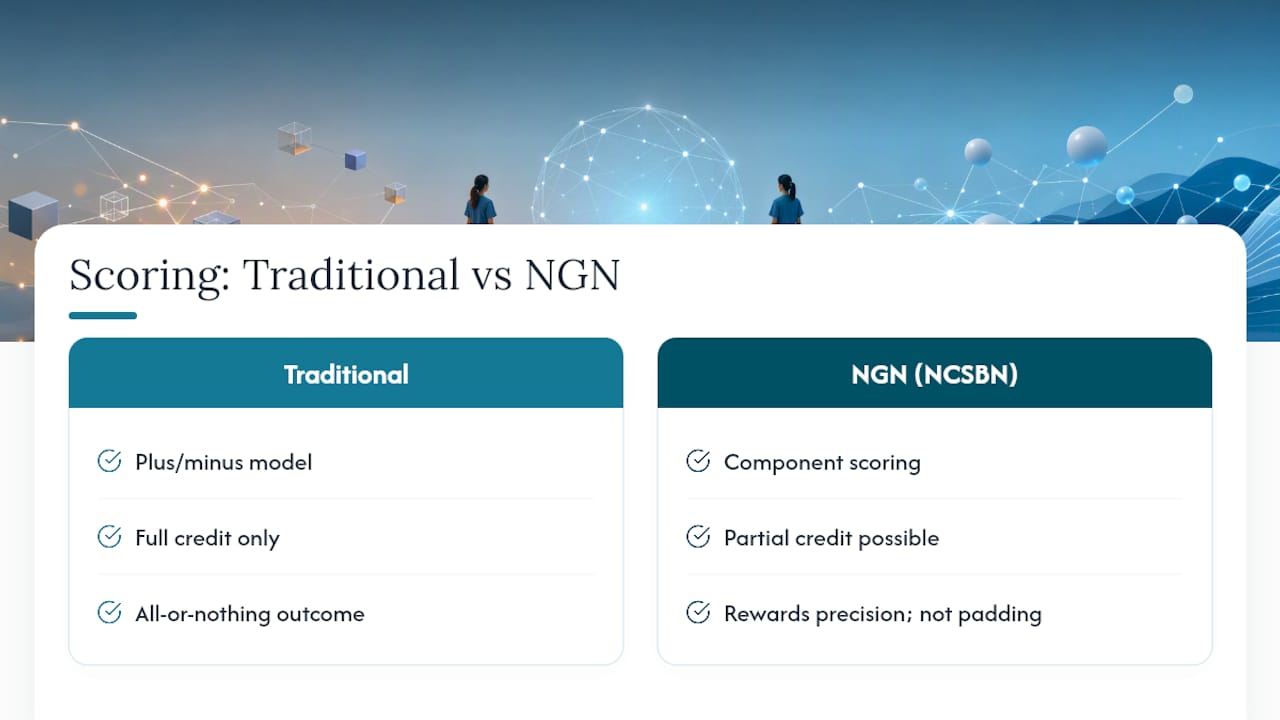
Traditional multiple-response items use a plus/minus scoring model, meaning you either get full credit for a perfect selection or you don't. NCSBN's own scoring guidance confirms that NGN-style items can award partial credit, scoring individual component decisions rather than an all-or-nothing outcome.
That changes your calculus slightly. Partial credit rewards precision over guessing, but it doesn't reward padding your answer with "maybe" options just to hedge. Defend every choice as if it's the only one being scored. For the full breakdown of how raw scores translate to pass or fail, see the NCLEX scoring explainer.
Three Worked SATA Examples With Rationales
Example 1, safety and priority. A client with dementia wanders at night. Options include reorienting frequently, using a bed alarm, restraining the client, dimming hallway lights, and administering a sedative without a provider order. The bed alarm and frequent reorientation pass the safety filter; the light change is reasonable and evidence-supported. Restraints fail because they're not first-line and carry their own risk. Sedation without an order fails the scope filter entirely, since nurses don't independently prescribe medication.
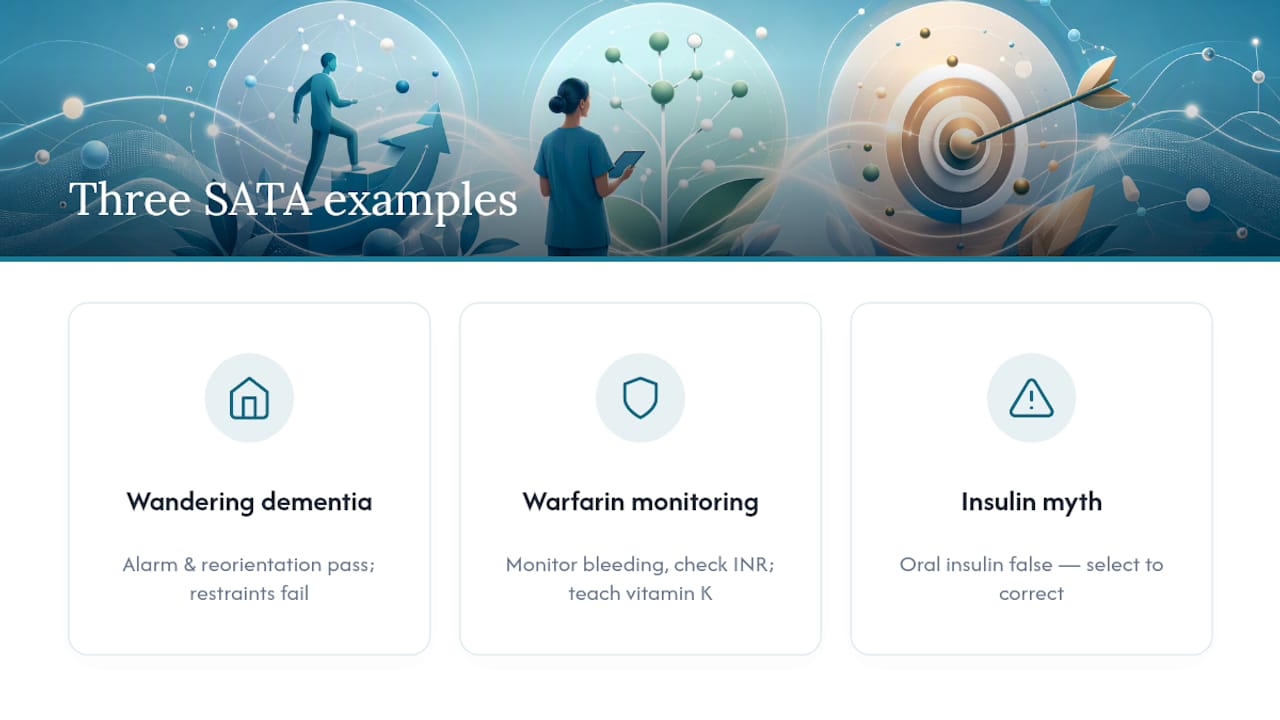
Example 2, medication safety. A client starts warfarin. Correct selections typically include monitoring for bleeding gums, checking INR per the stem's timeframe, and teaching consistent vitamin K intake. An option about doubling the next dose if one is missed fails outright, since that's unsafe regardless of context. This is where the NGN case study format gets tricky, because timeframe details buried in the stem often determine whether a monitoring option is correct.
Example 3, further teaching needed. This flips your entire approach. You're now selecting statements that show a misunderstanding, not correct knowledge. A client says insulin can be taken orally when doses are small. That statement is wrong, meaning it needs correcting, meaning you select it.
Roughly one recommended heuristic from NCLEX coaching guides is the "help, harm, or do nothing" question applied to each option before you commit. Run through it fast, but run through it every time.
Common SATA Mistakes and How to Fix Them
Overselecting because an option sounds familiar from class or clinical is the single most common trap. The fix: apply the defend-it test from the UNMC academic coaching guide, where you must justify a selection with something the stem actually says, not something you remember from a lecture.
Other frequent errors and their countermeasures:
- Misreading the command word or timeframe. Read the stem twice and rephrase the command aloud before scanning options.
- Selecting provider-only actions. Apply the scope filter every single time, no exceptions.
- Changing an answer with no new evidence. Adopt a strict rule: only revise a choice if you spot something in the stem you missed the first time.
- Assuming missing information rather than working from what's stated. If the stem doesn't say it, don't select based on it.
Pro Tip: Run a 15 second mental checklist before submitting any SATA item: Did I predict the topic? Did I test each option alone? Did I apply safety and scope filters? If any answer is no, slow down and redo that step.
Building a SATA Practice Plan That Actually Improves Accuracy
Consistency beats cramming. A four to six week cadence works well: 20 to 30 minutes of focused SATA practice daily, one mixed-case NGN session weekly, and a weekly review where you reread every rationale, not just for questions you missed.
- Log every error by category, overselect, underselect, scope mistake, or command-word misread, rather than just tracking right versus wrong.
- Prioritize whichever category shows up most often in your log, and drill that type specifically for a week.
- Use instant rationales to understand why an option failed, since reviewing rejected options builds pattern recognition just as much as reviewing correct ones does.
- Track percent-correct by SATA subtype (assessment, teaching, medication safety, priority) so you know exactly where to focus next week.
A realistic target: cut your overselect errors by half within four weeks if you're logging consistently. The NCLEX practice with rationales guide walks through how to structure these review sessions in more detail.
What I've Noticed About How Students Actually Answer SATA Questions
Most students treat SATA questions like a matching game, scanning for the option that "feels most correct" among the group. That's backwards. Forcing a true or false decision on each option, one at a time, kills the second-guessing that wrecks confidence mid-exam. Accuracy comes from repetition with rationales, not from a trick that shortcuts the thinking. Start applying the defend-it test on your very next practice set, before you touch another full block of questions.
— Autumn
Practice SATA Questions With Instant Rationales
A tailored educational platform can give you a faster path to SATA mastery than flashcards or generic question banks, especially when every question comes with an instant rationale explaining why each option is right or wrong.
That maps directly onto the practice plan above. Analytics tracking your percent-correct by question type can help you see in real time whether your overselect errors are dropping week over week, instead of guessing at your own progress. Practice question sets can align with leading nursing textbooks and cover nursing exam prep from early classes through graduation.
Start with the 48-hour free trial and run your first SATA practice set tonight using the option-by-option method from this article. If you want the full breakdown of plans and pricing first, the Nursing School Pro pricing page has the details.
Sources
- Are traditional NCLEX Multiple Response Select all that Apply (SATA) items scored with partial credits? – NCSBN
- Ultimate guide to SATA questions (UNMC academic coaching)
FAQ
Is Getting a Lot of SATA Questions on the NCLEX a Good Sign?
Not necessarily. The NCLEX uses computerized adaptive testing that adjusts question difficulty and format based on your performance, so the number of SATA items you see says little about whether you're passing or failing.
Will the NCLEX Be Harder in 2026?
The exam's difficulty is calibrated to a fixed passing standard rather than a moving target, so it isn't "harder" year to year in a meaningful sense. What changes is the continued rollout of Next Generation NCLEX item types, which reward the option-by-option reasoning and scope filters covered in this article.
Which State Is Easiest to Pass the NCLEX In?
The NCLEX is a single national exam administered through NCSBN, and pass standards don't vary by the state where you test. Pass rates can differ by nursing program, but the exam itself is identical no matter which state you sit for it in.
Can You Get Partial Credit for SATA Questions on the NCLEX?
Traditional multiple-response SATA items use plus/minus scoring, which is all or nothing. Newer NGN-style case items can award partial credit for individually correct selections, which is exactly why defending each option on its own merit matters more than ever.