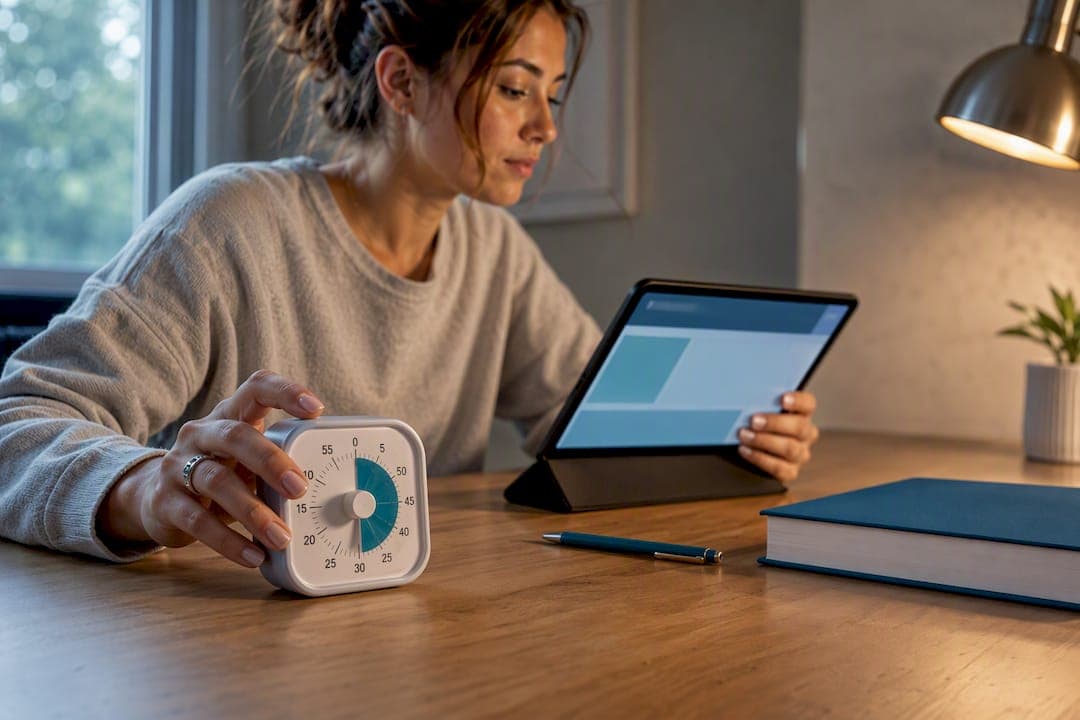
A bow tie item puts one nursing problem in the center, connects it to two priority actions on the left, and two monitoring parameters on the right. The single best move on any bow tie question: find the primary problem first, then work outward, choosing the two actions that fix it and the two parameters that prove it's working. This tests clinical judgment, not recall, so speed comes from method, not memorization.
TL;DR:
- Practice the fixed sequence of identifying the primary problem, choosing two relevant actions, and selecting monitoring parameters within two minutes.
- Focus on real-time physiological trends like oxygen saturation and respiratory rate over slow lab values to catch acute issues quickly.
- Avoid distractors such as support actions, documentation-only choices, and tests for symptoms instead of root causes.
- Repetition with timed practice and immediate rationales accelerates skill development more effectively than content review alone.
- The main goal is to improve speed and consistency in recognizing the primary problem, not just memorizing answers.
Table of Contents
- What Are NCLEX Bow Tie Questions?
- How Do You Answer a Bow Tie Question Step by Step?
- Worked Example: A Full Bow Tie Walkthrough
- Common Traps in Bow Tie Items and How to Avoid Them
- Build a Four-Week Bow Tie Practice Plan
- Why Bow Tie Items Are a Better Test Than the Old NCLEX
- Get Timed Bow Tie Practice With Instant Rationales
- Sources
What Are NCLEX Bow Tie Questions?
A bow tie item is a Next Generation NCLEX (NGN) format that looks exactly like its name suggests: a center box for the primary problem, flanked by two boxes on the left for immediate actions and two on the right for monitoring parameters. Draw a line between them and you get a bow tie shape, which is where the format gets its name.
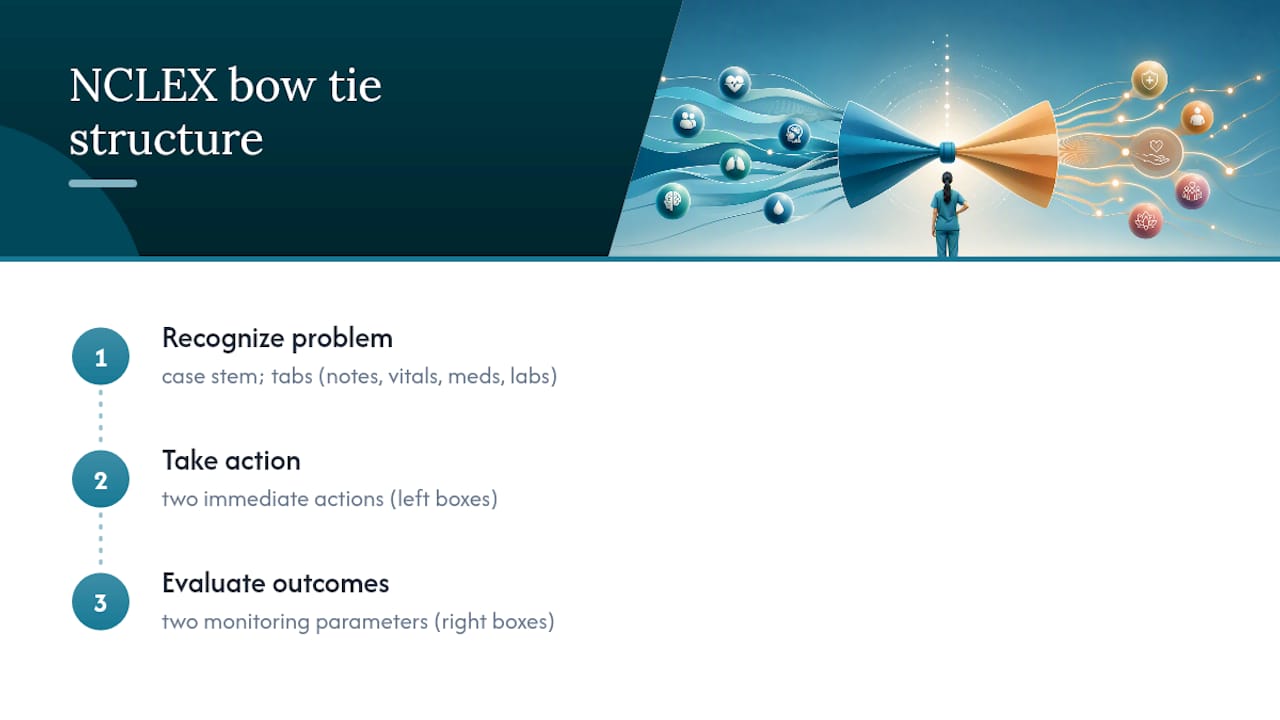
Most bow tie items give you a case stem plus a set of tabs, usually nurse's notes, vital signs, medications, and lab results. You'll pull from all of them, though rarely equally. The NCSBN's exam resources confirm the NGN was built specifically to test clinical judgment through formats like this rather than isolated fact recall.
That structure maps directly to a simplified clinical judgment cycle: recognize cues and identify the problem, take action, then evaluate outcomes. According to a step-by-step breakdown from Blueprint Prep, understanding this three-part flow before you sit for the exam changes how you read the question. Instead of scanning for a "correct answer" hiding somewhere in the tabs, you're building a chain: problem, response, proof. Students who walk in expecting a single right answer per box often panic when they see partial credit scoring. Students who understand the structure treat it like a puzzle with a fixed logic, which cuts down on wasted rereads.
How Do You Answer a Bow Tie Question Step by Step?
Bow tie items reward a fixed sequence more than raw nursing knowledge. Here's the routine to run on every one you see:
- Skim all tabs once for red flags. Don't read line by line yet. Scan vitals for anything outside normal range, scan the nurse's notes for a symptom that changed recently, and note any medication given in the last hour.
- Identify the primary problem. Ask yourself what's actually threatening the patient right now, not what's simply abnormal. A slightly elevated temperature matters less than a dropping blood pressure with rising heart rate.
- Choose two immediate priority actions. These should directly treat the primary problem, not support the patient generally.
- Choose two monitoring parameters. Pick the values that will change first and fastest if your actions are working or failing.
- Run a causal sanity check. Read the center, then the left, then the right, out loud in your head: "Because the problem is X, I did A and B, so I'm watching for C and D." If that sentence doesn't make sense, something's wrong.
On timing: aim for about a couple of minutes per bow tie during practice, and treat that as your ceiling on test day too. If you're rereading the same tab for the third time, you've lost the thread of the primary problem, not the details. Step back and reread the stem instead of the tabs.
Pro Tip: Read the nurse's notes tab before the lab tab. Notes usually contain the timeline and symptom progression that tells you what's urgent; labs mostly confirm what you already suspected.
Worked Example: A Full Bow Tie Walkthrough
A 68-year-old patient is three days post-op after a hip replacement. The nurse's notes tab shows new confusion and restlessness over the past two hours. The medication tab shows a dose of oral oxycodone given four hours ago.
The center choice here is acute hypoxia, not opioid oversedation and not simple post-surgical delirium. Here's why the data points there:
- Oxygen saturation of 89% is the most physiologically urgent number on the page. It explains the confusion, the tachycardia, and the low blood pressure better than any other single finding.
- Opioid oversedation is a tempting distractor because oxycodone appears in the medication tab, but respiratory rate is elevated at 24, not suppressed. Oversedation typically drops respiratory rate.
- Post-surgical delirium is another common distractor. It's a real risk in this population, but delirium doesn't explain the oxygen saturation reading, so it can't be the primary problem.
For the left side, the two priority actions are applied supplemental oxygen and notify the provider immediately. Both address the hypoxia directly rather than treating a symptom like the confusion.
For the right side, the monitoring parameters are oxygen saturation trend and respiratory rate. These are the two values that will confirm whether your intervention is working within minutes, not hours. A distractor like "recheck complete blood count in four hours" fails the test because it's too slow to reflect an acute change and doesn't track the actual problem.
Common Traps in Bow Tie Items and How to Avoid Them
Bow tie distractors follow predictable patterns once you've seen enough of them. The ANA's NCLEX guidance points out that reviewing rationales for every practice question, right or wrong, trains you to recognize these patterns faster than repetition alone ever could.
- Supportive but nonessential actions. Comfort measures, patient education, and reassurance are almost always wrong on the action side when the patient is acutely unstable. Save them for stable-patient scenarios.
- Documentation-only choices. "Chart the finding" is rarely a priority action. It's something you do, not something that changes the outcome.
- Routine labs over physiological trends. A parameter that changes in real time, like oxygen saturation or heart rate, almost always beats a lab value that takes hours to process, unless the scenario is specifically about a lab-driven problem like electrolyte imbalance.
- Treating the sign instead of the cause. Giving an antipyretic for a fever without asking what's causing the fever misses the actual clinical judgment being tested.
When two answers both seem plausible, default to airway, breathing, and circulation first. If neither option touches ABCs, favor the one that addresses the root cause over the one that only manages a symptom.
Build a Four-Week Bow Tie Practice Plan
Speed on bow tie items comes from repetition with feedback, not from reading more content. A Kaplan Test Prep recommendation echoed across NCLEX prep guidance is to pair timed practice with immediate rationale review, since that combination builds automaticity faster than untimed study.
Here's a four-week structure that works for most schedules:
- Week one: Ten untimed bow tie items daily. Focus on getting the center choice right and reading every rationale, right or wrong using a resource like NCLEX rationale review.
- Week two: Add a 90-second timer per item. Track your correct center-choice percentage separately from your overall score.
- Week three: Mix bow tie items with other NGN formats so you're not pattern-matching on format alone. A structured NGN practice plan helps here.
- Week four: Full timed sets with a reflection log. After each miss, write one sentence explaining the causal chain you missed.
Track time per item and center-choice accuracy weekly. Both matter more than raw percentage correct, since they show whether you're improving the actual skill or just getting lucky.
Pro Tip: Ten focused minutes a day beats one two-hour session on the weekend. Bow tie reasoning is a habit, and habits need daily repetition, not cramming.
Why Bow Tie Items Are a Better Test Than the Old NCLEX
Most students assume harder means more content to memorize. Bow tie items flip that assumption. They're harder because they force you to defend a reasoning chain instead of recognizing a fact, and that shift exposes gaps that multiple choice never could. A student can pass a content quiz on sepsis and still pick the wrong center box on a sepsis bow tie, because the item is testing whether you can prioritize under ambiguity, not whether you know the definition.
The improvement signal to watch for isn't your score. It's whether your first instinct on the center box gets faster and more consistent over two or three weeks of practice. That's clinical judgment forming, not test-taking luck. Clinical rotations build the raw pattern recognition behind this skill, and NGN practice is where that pattern recognition gets sharpened into speed.
— Autumn
Get Timed Bow Tie Practice With Instant Rationales
Reading about the method only gets you so far. What moves the needle is repetition against real NGN-style items with a rationale waiting the second you submit an answer, so you're not stuck wondering why your center choice was wrong.
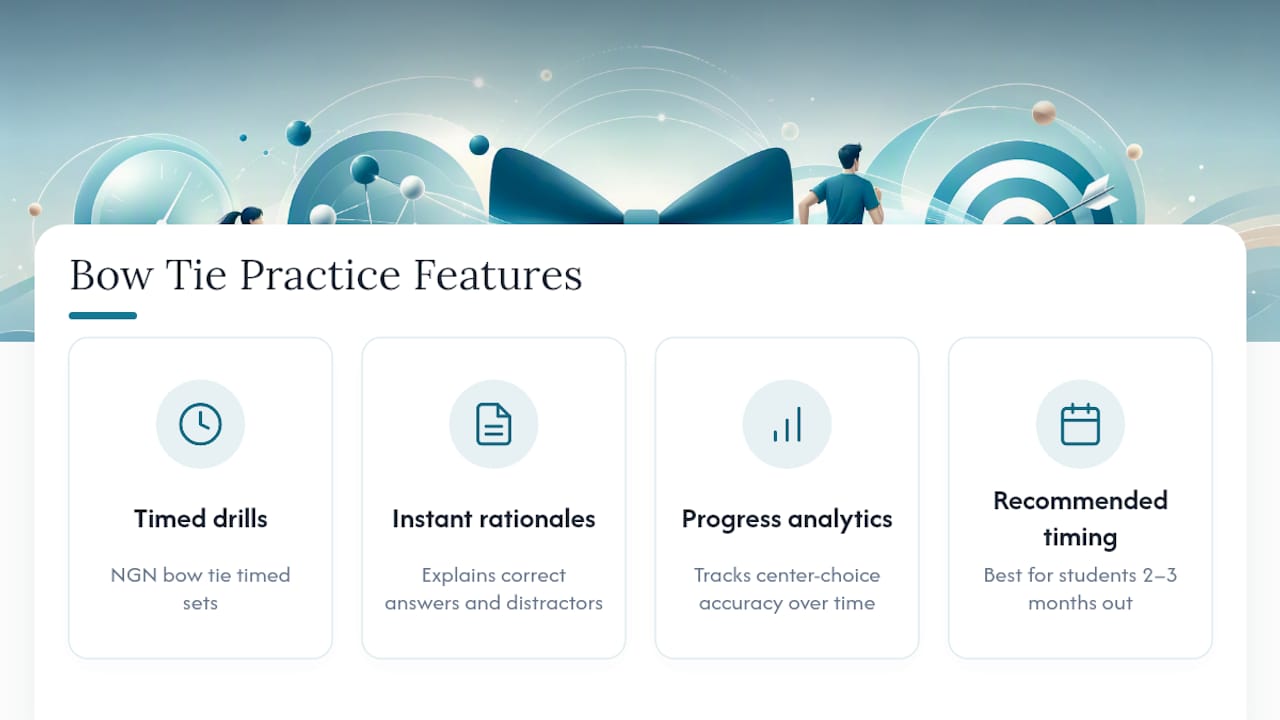
This service offers NGN sets designed with timed bow tie drills, instant rationales explaining both correct answers and distractors, and progress analytics that track center-choice accuracy over time instead of just overall score. That last part matters, since raw percentage correct hides whether you're actually getting faster at identifying the primary problem or just memorizing individual scenarios.
This fits best for students within two to three months of their test date who need volume and speed, not another content review. Start with the 48-hour free trial to see how the bow tie sets are built, then check the study center for the full NGN practice library or the pricing page if you're ready to commit to a full study cycle.
Sources
For official test structure details, see the NCSBN's exam resources. For strategy grounded in professional guidance, review the ANA's NCLEX tips. For more worked examples, explore NGN case study walkthroughs.
- NCSBN — NCLEX exam resources and pass rates
- NCLEX Bowtie Questions: A Step-by-Step Breakdown | Blog | Blueprint Prep