
For 2026, start with the Nurse Corps Scholarship Program and the major association awards through AACN, plus corporate programs like the Johnson & Johnson "A Nurse I Am" Scholarship. These three categories carry the largest awards and the clearest deadlines of any nursing scholarships 2026 has to offer.
The Nurse Corps Scholarship pays tuition and fees directly to your school, adds a monthly living stipend, and covers books and clinical supplies. In exchange, you commit to full-time service at a Critical Shortage Facility after graduation. If that tradeoff doesn't fit your plans, association and corporate scholarships, like the AACN partner awards, fill the gap without a service requirement.
Here's where to focus first:
- Nurse Corps Scholarship Program — tuition, fees, stipend, and supplies in exchange for a service commitment.
- AACN partner scholarships (Certiphi-GNSA, QGenda, NurseThink®) — $5,000 to $10,000 awards, no service obligation.
- Johnson & Johnson "A Nurse I Am" Scholarship — corporate funding for undergraduate and graduate nursing students.
- THEDREAM.US National Scholarship — for DACA and undocumented students who need alternatives to federal aid.
- March of Dimes and diversity-focused awards — targeted funding tied to maternal-child health and underrepresented groups.
Your first move: check the Nurse Corps application status for the current cycle, then pull your school's financial aid scholarship list and the AACN deadlines before you draft a single essay.
Key Takeaways
Nursing scholarships 2026 favor students who apply early to federal and association programs first, then layer in specialty awards with less competition.
| Point | Details |
|---|---|
| Start with Nurse Corps | It funds tuition, fees, stipend, and supplies in exchange for two years of service at a shortage facility. |
| Layer in AACN awards | Certiphi-GNSA, QGenda, and NurseThink® offer $5,000 to $10,000 with no service obligation. |
| Calendar your deadlines | National programs cluster April to September; some state funds run rigid January to May windows. |
| Target specialty awards | Critical care and diversity-focused scholarships draw smaller applicant pools than general awards. |
| Strengthen your numbers first | Nursingschoolpro's practice questions and analytics help you meet GPA and test-score eligibility before you apply. |
Table of Contents
- Curated National Nursing Scholarships 2026: At-a-Glance Comparison
- How to Filter and Choose Which 2026 Scholarships to Apply For
- Building Your 2026 Application: Checklist, Timeline, and Recommendation Letters
- Can You Get a Full-Ride Nursing Scholarship in 2026?
- Specialty and Lower-Competition Scholarships Worth Targeting
- Taxability and Obligations: What Happens When You Win
- Publisher Perspective: Prioritize Depth Over Volume
- Strengthen Your Application Before You Submit It
- Frequently Asked Questions
- Sources
Curated National Nursing Scholarships 2026: At-a-Glance Comparison
The scholarships below represent the highest-value national and association options active for the 2026 cycle. Some cover nearly everything; others are smaller but require far less paperwork and carry no strings attached.
Each row above deserves a closer look before you commit hours to an application.
Nurse Corps Scholarship Program. This is the single largest federal nursing scholarship, and it functions almost like a job offer with school attached. HRSA pays tuition and required fees directly to the school, so you never front the cost or wait on reimbursement. The 2026 cycle accepted applications through April 9, 2026, with notifications by September 30. Your payback is two years of full-time work at a facility HRSA classifies as a Critical Shortage Facility, which you can look up through the HPSA shortage-area tool before you apply.
Johnson & Johnson "A Nurse I Am" Scholarship. A corporate program with national reach that funds both undergraduate and graduate nursing students. It carries no service obligation, which makes it a lower-risk application than Nurse Corps, though the applicant pool is large given the brand recognition.
AACN partner scholarships. The Certiphi-GNSA awards fund a small number of graduate students with up to $10,000 each. The QGenda/AACN scholarship distributes $5,000 awards several times a year, and NurseThink® runs the same $5,000 amount twice annually through 2026. Scrubin Uniforms and Uniform Advantage also sponsor GNSA-linked awards in the same range. None of these carry a payback requirement, but all require enrollment at an AACN member school, so confirm your program's membership status first.
THEDREAM.US National Scholarship. If you're a DACA recipient or undocumented student, this is one of the only national programs built specifically around your eligibility gap, since most federal aid excludes you. Awards can reach full tuition at partner institutions, though the list of eligible schools is fixed.
Diversity and specialty-focused awards. March of Dimes targets students focused on maternal-child health outcomes. The Hispanic Health Professional Student Scholarship and the National Association of Hispanic Nurses Scholarship both support Hispanic students specifically. None require a service commitment, which makes them attractive add-ons to a Nurse Corps application rather than substitutes for it.
How to Filter and Choose Which 2026 Scholarships to Apply For
With dozens of programs live at once, the trick isn't finding scholarships. It's deciding which ones are worth your time.
Run every option through this filter before you start writing:
- Degree level match. Confirm the award covers your actual program (ADN, BSN, MSN, DNP, or NP track) before reading further.
- Citizenship and residency rules. Nurse Corps requires U.S. citizenship or national status; THEDREAM.US requires the opposite. Check this first, always.
- Specialty or mission fit. Awards tied to maternal health, critical care, or diversity goals often have smaller applicant pools than general nursing scholarships.
- School affiliation. Several AACN-linked awards only apply if your school holds AACN membership.
- Award size versus effort required. A $10,000 award with a two-page essay beats a $500 award with the same workload.
Prioritize in this order: federal programs first (Nurse Corps), then large association and corporate scholarships (AACN partners, Johnson & Johnson), then specialty and local foundation awards last. The first tier moves the needle financially. The last tier rounds out your funding with less competition per dollar.
Pro Tip: Specialty scholarships tied to a niche, like critical care or nurse educator tracks, often draw far fewer applicants than general nursing awards, and they double as an introduction to the professional network in that specialty. Check hospital foundation pages and specialty nursing association sites, not just the big scholarship databases.
Building Your 2026 Application: Checklist, Timeline, and Recommendation Letters
Most nursing scholarships ask for the same core documents, so build one master file and reuse it across applications.
- FAFSA or SAI documentation — many programs, including need-based awards, ask for your Student Aid Index as a baseline eligibility check.
- Official transcripts — request these early since registrar processing can take one to two weeks.
- Enrollment verification — your financial aid office issues this, usually within a few business days of request.
- Personal statement — tailor this per program rather than reusing one generic draft.
- Current résumé or CV — keep clinical hours, volunteer work, and honors current.
- Letters of recommendation — request these at least three weeks before any deadline, never days before.
For the 2026 cycle, plan around two windows: national programs cluster deadlines between April and September, while several state nursing incentive funds run rigid windows, often January through May. Miss a state window and you're locked out for the entire academic year, so calendar those dates the moment you find them.
Two short templates make requesting recommendation letters far less awkward:
To a clinical instructor: "I'm applying for [scholarship name], due [date], and I'd be grateful if you could write a letter speaking to my clinical performance in [course/rotation]. I can send my resume and a summary of the program's focus if that helps."
To a professor: "I'm applying for [scholarship name] and wondered if you'd be willing to write a recommendation focused on my academic performance and work ethic. The deadline is [date], and I can provide any materials you need."
Pro Tip: Ask people who can speak to specifics, not just titles. A clinical instructor who watched you handle a difficult patient writes a stronger letter than a department chair who barely knows your name.
Can You Get a Full-Ride Nursing Scholarship in 2026?
Yes, but the closest thing to a full ride comes with strings attached. The Nurse Corps Scholarship Program covers tuition, fees, a monthly stipend, and books and supplies, which functionally makes it a full-ride award for accepted students. The tradeoff is two years of service at a Critical Shortage Facility after you graduate.
Compare that against loan-forgiveness alternatives through NHSC, which repay debt after you've already taken out loans rather than funding your education upfront. THEDREAM.US can also cover full tuition at partner schools for eligible students, with no service requirement attached.
Before you apply to any full-funding program, weigh these three factors:
- Size of award versus length of obligation. Two years of service for a fully funded BSN is a different calculation than two years for a smaller stipend.
- Career alignment. If you already want to work in a shortage-area facility, Nurse Corps costs you nothing you weren't already planning to give.
- Tax exposure. Full funding is still reported income, which changes your effective take-home value.
Map your five-year career plan against the service requirement before you sign anything.
Specialty and Lower-Competition Scholarships Worth Targeting
Beyond the big national names, specialty awards in critical care, nurse education, geriatrics, and neonatal nursing tend to draw smaller applicant pools. The AACN2: Pathway to Critical Care Nursing Scholarship, the Foundation for Neonatal Research and Education Scholarship, and the Senator Patricia K. McGee Nursing Faculty Scholarship all fit this category.
Diversity-focused options widen the field further:
- National Association of Hispanic Nurses Scholarship
- Armenian American Medical Society Scholarship
- American Indian Medical Scholarship
- Minority Nurse Faculty Scholarship
- Golden Door Scholars (for immigrant students)
Search hospital foundation pages and specialty nursing association sites directly. These awards rarely surface in general scholarship search engines, which is exactly why competition stays low.
Taxability and Obligations: What Happens When You Win
Scholarship stipends and living allowances are generally taxable income, and HRSA reports Nurse Corps awards to the IRS. Tuition payments made directly to your school typically have different treatment than stipend cash you receive, so this isn't a flat rule across every dollar.
Save your award letter, any tax forms the program issues, and your service-obligation contract in one folder. Consult a tax advisor or IRS guidance before you file, since your specific award structure determines what's owed.
Publisher Perspective: Prioritize Depth Over Volume
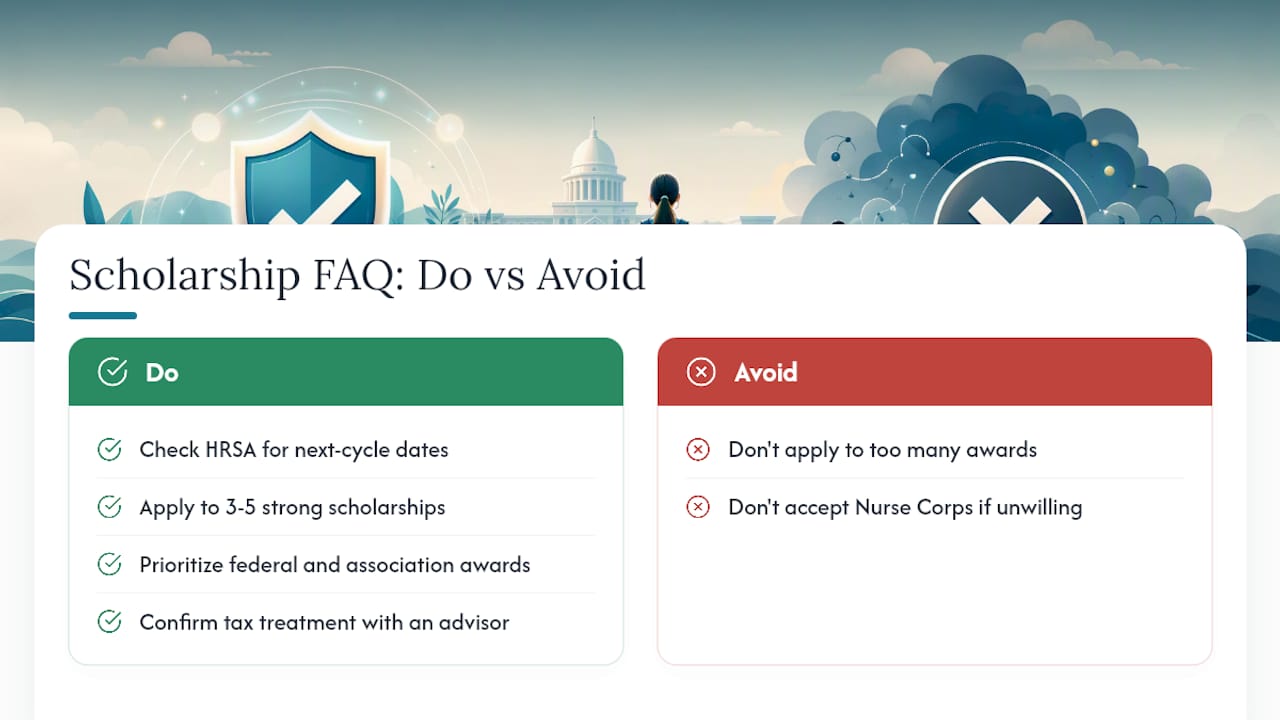
Finish three to five strong applications instead of scattering effort across twenty half-completed ones. Start with Nurse Corps and the largest association awards, then layer in specialty scholarships where competition thins out. A well-prepared application with GPA and test scores that clear the bar beats a rushed one every time, and that's exactly where focused practice through the Nursing School Study Center earns its place in your prep.
Strengthen Your Application Before You Submit It
A strong scholarship application rests on more than a good essay. Committees look at your GPA, your standardized test scores, and your academic trajectory, and those numbers come from how well you actually know the material, not how polished your personal statement sounds. Nursingschoolpro gives you practice questions for every nursing class plus dedicated prep for the HESI A2, TEAS, and NCLEX, with instant rationales that explain why an answer is correct instead of just marking it right or wrong.
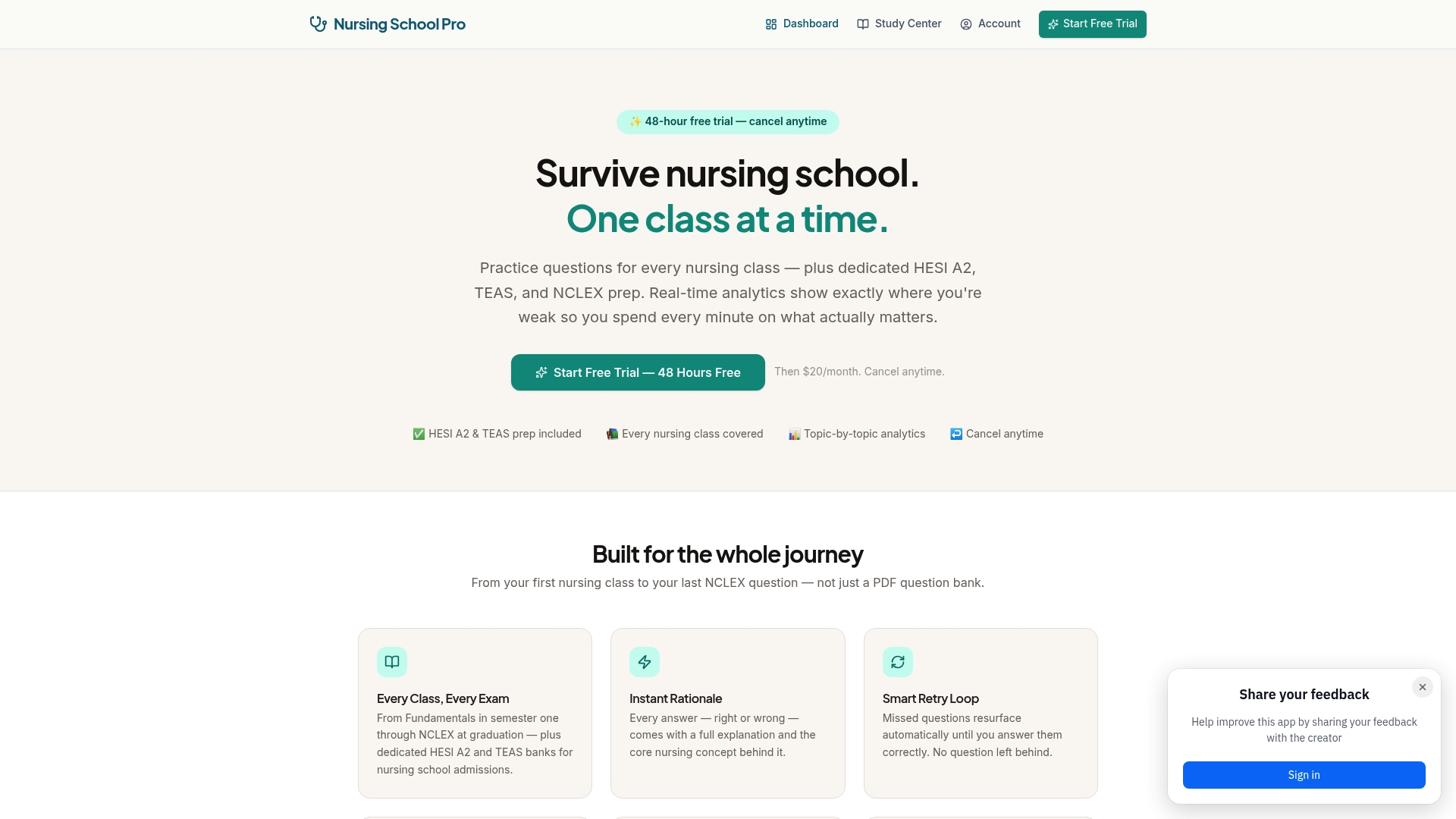
That matters for scholarship eligibility specifically: many programs set GPA floors or ask about standardized test performance, and real-time analytics on Nursingschoolpro flag your weak areas before a low score costs you a shortlist spot. Start with the 48-hour free trial and see where your practice scores stand before your next application deadline. Monthly access runs at an affordable flat rate, with no long-term contract required.
Frequently Asked Questions
Is the Nurse Corps Scholarship Program still accepting applications for 2026? The 2026 cycle accepted applications through April 9, 2026, with award notifications by September 30, 2026. Check the official HRSA page directly for the next cycle's dates.
Do nursing scholarships count as taxable income? Generally, yes. Stipends and living allowances are typically taxable and reported to the IRS, though tuition paid directly to your school may be treated differently. Confirm your specific award's tax treatment with a tax advisor.
Are there nursing scholarships specifically for international or undocumented students? THEDREAM.US National Scholarship supports DACA and undocumented students, and several university-specific awards, like the University of Illinois Chicago Laurette Kirstein Scholarship, target international students directly.
How many scholarships should I apply to for the 2026 cycle? Three to five well-prepared applications generally beat a scattershot approach across a dozen or more. Prioritize federal and large association awards first, then add specialty scholarships where competition is lighter.
What happens if I don't complete the Nurse Corps service obligation? Failing to complete the required service term at a Critical Shortage Facility can trigger repayment of scholarship funds plus penalties, so only apply if you're genuinely willing to commit to the placement.
This article is general information, not a substitute for advice from a qualified financial advisor. Consult a qualified financial professional about your own circumstances before acting on anything here.
Sources
Go straight to these pages before trusting any third-party summary:
- Apply to the Nurse Corps Scholarship Program
- 2026 Nurse Corps Scholarship Program - Current Students
- Nursing Scholarships & Financial Aid Resources | AACN
- Data