
The NCLEX-RN tests broader clinical judgment, prioritization, and management skills; the NCLEX-PN tests practical nursing tasks within a supervised, collaborative framework. Both are national licensure exams developed by the National Council of State Boards of Nursing (NCSBN) and delivered via computerized adaptive testing, but they lead to meaningfully different careers.
Here is the short version of what separates them:
- Scope of practice: RNs assess, plan, and independently direct care. PNs assist with care under RN or physician supervision.
- Clinical judgment depth: The NCLEX-RN places heavier emphasis on complex decision-making, prioritization, delegation, and leadership. The NCLEX-PN focuses on foundational care, basic assessment, and practical skills.
- Career outcomes: RNs qualify for critical care, management, and advanced practice pathways. PNs typically work in long-term care, rehabilitation, and structured clinical settings.
Nursingschoolpro aligns its practice question banks and analytics directly to the NCSBN test plans for both exams, so whichever path you choose, you can study with content built for your specific license.
Key Takeaways
The NCLEX-RN tests broader clinical judgment and independent practice; the NCLEX-PN tests practical, supervised nursing skills within a more defined scope.
| Point | Details |
|---|---|
| Core difference | NCLEX-RN covers broader clinical judgment and management; NCLEX-PN focuses on foundational, supervised care. |
| Exam format | Both run 85–150 items in a five-hour window using computerized adaptive testing. |
| Study emphasis | RN candidates need delegation and NGN case-study practice; PN candidates should anchor in foundational care and safety. |
| Eligibility reminder | Authorization to Test comes from your state board of nursing; verify requirements directly before applying. |
| Recommended starting point | Nursingschoolpro offers a diagnostic, analytics by Client Needs category, and instant rationales for $20/month with a 48-hour free trial. |
Table of Contents
- How do NCLEX-RN and NCLEX-PN actually compare?
- What does each exam actually test?
- How are the exams delivered and scored?
- Is NCLEX-RN harder than NCLEX-PN?
- Who can sit each exam, and how do you register?
- Which exam should you choose?
- A practical study plan for NCLEX-RN and NCLEX-PN
- What most candidates get wrong about these exams
- Nursingschoolpro makes NCLEX prep specific to your exam
- Sources
How do NCLEX-RN and NCLEX-PN actually compare?
The table below maps the most important decision dimensions side by side.
| Dimension | NCLEX-RN | NCLEX-PN |
|---|---|---|
| Who it licenses | Registered Nurse (RN) | Licensed Practical/Vocational Nurse (LPN/LVN) |
| Scope of practice | Independent assessment, care planning, delegation, leadership | Supervised, collaborative; assists with care under RN/MD direction |
| Exam purpose | Tests broad clinical judgment, prioritization, management | Tests practical nursing tasks and foundational care skills |
| Item count | 85–150 items | 85–150 items |
| Time limit | 5 hours | 5 hours |
| Question emphasis | Clinical judgment, NGN case studies, delegation, complex scenarios | Basic care, medication administration, practical skills, safety |
| Relative difficulty | Broader scope; higher-level reasoning required | More focused; foundational competency emphasis |
| Eligibility | Graduate of accredited RN program (ADN or BSN) | Graduate of accredited PN/LVN program |
Best for NCLEX-RN: Candidates who want autonomous practice, critical care, management roles, or a clear path to a BSN or advanced practice.
Best for NCLEX-PN: Candidates who want to enter the workforce quickly, work in structured settings like long-term care, or plan to bridge to RN later.
If you want to lead a care team and make independent clinical decisions, choose the RN path. If you want to start working in nursing within a year and build from there, the PN path gets you there faster.
What does each exam actually test?
The NCSBN 2026 NCLEX-RN Test Plan organizes content around Client Needs categories, and the NCLEX-PN follows a parallel structure. Both exams share foundational territory, but the RN goes deeper and wider.
Content areas shared by both exams:
- Basic care and comfort
- Pharmacological and parenteral therapies
- Reduction of risk potential
- Safety and infection control
- Psychosocial integrity
- Health promotion and maintenance
Areas where NCLEX-RN goes further:
- Complex health problems and multi-system complications
- IV therapy and blood administration
- Management of care, delegation, and supervision
- Leadership, prioritization, and ethical decision-making
- Advanced clinical judgment across multiple patient scenarios
The NCSBN test plans are reviewed on a regular cycle using practice analyses and expert input, which means the content you study should track the current official plan, not older editions.
One of the biggest structural differences since the Next Generation NCLEX (NGN) update is the addition of case-study clinical judgment items. These multi-item case studies ask you to recognize cues, analyze findings, prioritize hypotheses, and evaluate outcomes across a single patient scenario. The NCLEX-RN features these prominently. The NCLEX-PN includes clinical judgment items too, but the scenarios are less complex and the decision-making depth is lower.

What that looks like in practice:
An NCLEX-RN case study might present a 68-year-old post-op patient with declining urine output, rising creatinine, and a new fever, then ask you to identify the priority concern, select appropriate interventions, and evaluate which findings indicate improvement. An NCLEX-PN item on a similar patient would more likely ask you to identify a single abnormal finding or select the correct action to report to the supervising RN.
Pro Tip: Study directly from the current NCSBN test plan for your exam. The 2026 NCLEX-RN Test Plan includes sample items and item-writing guidance that show exactly what clinical judgment looks like in practice.
How are the exams delivered and scored?
Both exams use computerized adaptive testing. The CAT algorithm selects each item based on your performance on the previous one, continuously updating its estimate of your ability. NCSBN explains that the computer stops when it reaches 95% confidence that you are either above or below the passing standard.
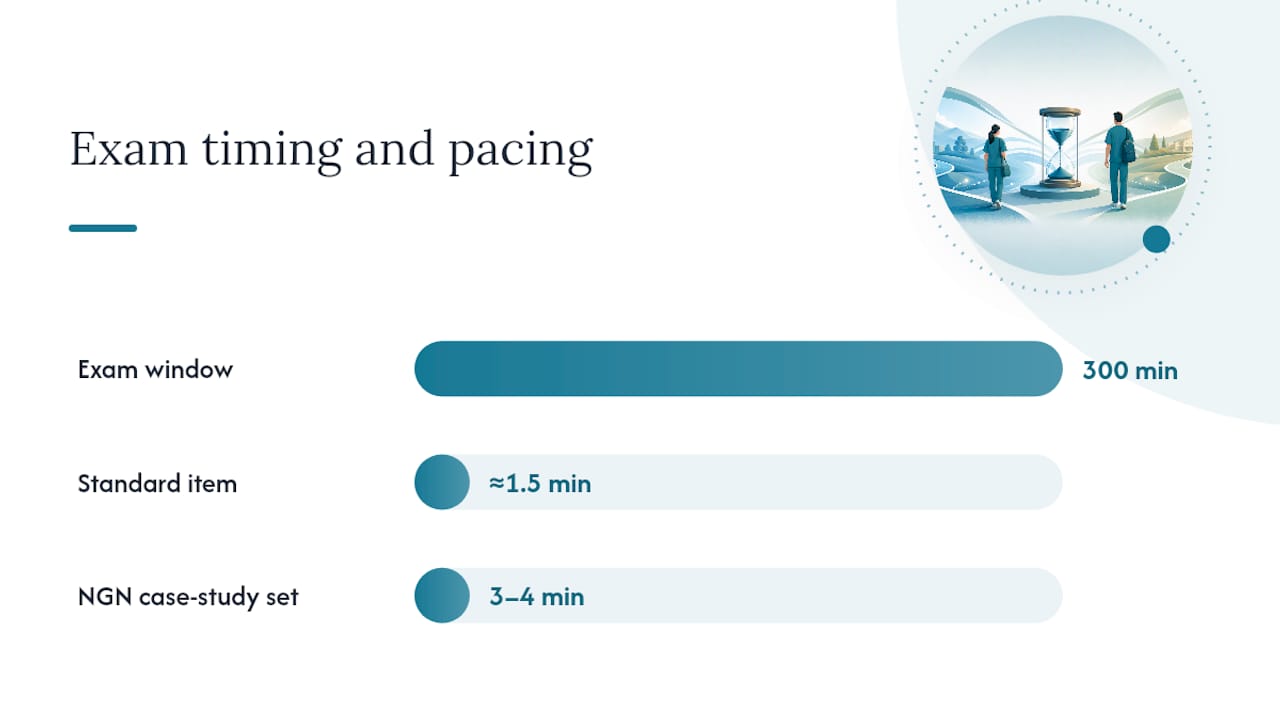
Per the NCLEX Candidate Bulletin, both the RN and PN exams run between 85 and 150 items within a five-hour window. That window includes the tutorial and any breaks you take, so the clock never pauses.
Item types you will encounter:
- Multiple-choice (single best answer)
- Multiple response (select all that apply)
- Drag-and-drop / ordered response
- Fill-in-the-blank (calculation)
- Hot spot (image-based)
- NGN case-study items (bow-tie, trend, matrix formats)
Reaching the maximum item count does not automatically mean failure. The CAT evaluates your final ability estimate at that point and makes a pass/fail decision based on where you land relative to the passing standard. Some candidates pass at 85 items; others need all 150. Neither outcome tells you how close the call was.
A portion of every exam consists of pretest items, which are unscored questions being evaluated for future use. You cannot identify them during the exam, so treat every item as if it counts.
Pro Tip: NGN case-study items take longer than standard multiple-choice questions. Budget roughly 90 seconds per standard item and up to 3–4 minutes per case-study set. Practicing under timed conditions before exam day is the only way to build that pacing instinct.
Is NCLEX-RN harder than NCLEX-PN?
Yes, in most meaningful ways. The NCLEX-RN covers a broader scope of content, demands higher-level clinical reasoning, and includes more complex multi-system scenarios. Nurse License Guide notes that the RN exam tests broader clinical judgment, prioritization, and management skills, while the PN exam focuses on practical nursing within a supervisory framework — a distinction that shows up directly in how candidates need to prepare.
For pass-rate context, NCSBN publishes official pass-rate statistics that track first-time candidate performance across jurisdictions. These figures shift year to year, so checking the current NCSBN data before your exam gives you the most accurate benchmark.
Study implications by exam:
For NCLEX-RN candidates:
- Prioritize management-of-care and delegation questions
- Practice NGN case-study sets under timed conditions
- Work through complex multi-system scenarios (sepsis, post-op complications, respiratory failure)
- Drill prioritization frameworks (ABC, Maslow, SATA reasoning)
For NCLEX-PN candidates:
- Anchor your prep in foundational care and basic assessment
- Focus on medication administration, safety, and infection control
- Practice recognizing when to report findings to a supervising RN
- Build confidence with practical skills and standard procedures
Career outcomes: what the license actually unlocks
RNs can independently assess patients, develop and implement care plans, delegate tasks to LPNs and nursing assistants, and work in critical care, emergency, and perioperative settings. They qualify for management and charge nurse roles and can pursue NP or CRNA licensure with additional education.
PNs work within a defined scope under RN or physician supervision. They administer medications, monitor patients, and perform skilled nursing tasks, but care planning and delegation are outside their independent scope. Long-term care, rehabilitation, and physician office settings are the most common practice environments.
Who can sit each exam, and how do you register?
Eligibility for both exams runs through your state board of nursing, not NCSBN directly. The core steps are the same regardless of which exam you are taking.
Eligibility checklist:
- Graduate from a state-approved nursing education program (ADN or BSN for RN; diploma or associate-level PN program for PN)
- Apply to your state board of nursing and receive Authorization to Test (ATT)
- Register with Pearson VUE, which administers both exams at testing centers nationwide
- Schedule your exam within the ATT validity window (typically 90 days)
- Bring valid, government-issued photo ID on exam day
State boards set their own application requirements, fees, and processing timelines, and those details vary more than most candidates expect. Some states require background checks, fingerprinting, or additional documentation. Always verify your specific requirements directly with your state board of nursing before you apply.
One practical note: the NCLEX exam fee is paid to Pearson VUE, and state board application fees are separate. Budget for both when planning your timeline.
Which exam should you choose?
This comes down to three things: how fast you want to work as a nurse, how much autonomy you want long-term, and how much time and money you can invest in your education now.
Map your priorities:
- Get to work within 12–18 months: A PN program is typically 12–18 months, compared to 2–4 years for an ADN or BSN. If speed to employment matters most, the PN path delivers it.
- Want critical care, management, or advanced practice: These roles require RN licensure. Starting as a PN and bridging later is possible, but it adds time and cost. If you know you want those outcomes, the RN path is the direct route.
- Plan to pursue a BSN eventually: RN-to-BSN bridge programs are widely available and often employer-supported. LPN-to-RN bridge programs exist too, but they are less common and vary significantly by state and institution. If a BSN is your end goal, starting in an ADN-to-BSN pipeline is often more efficient than the LPN-to-RN route. The ADN vs. BSN decision has more nuance than most people realize.
- Cost is a major constraint: PN programs cost less and take less time, which means less tuition and a faster return on investment. RN programs cost more upfront but typically lead to higher starting salaries.
Pro Tip: If you have clinical exposure through a CNA role, patient care tech position, or volunteer work, pay attention to what the RNs around you actually do versus what the LPNs do. That real-world picture is often more clarifying than any comparison article.
A practical study plan for NCLEX-RN and NCLEX-PN
Retrieval practice outperforms passive review for retention, which means doing practice questions from day one, not after you finish reviewing content. The Godden & Baddeley research on context-dependent memory supports studying in conditions that mirror the actual test environment, including timed question blocks and adaptive feedback.
Here is a 6–8 week framework. Adjust the RN vs. PN emphasis based on your exam.
Weeks 1–2: Baseline and content mapping
- Take a full diagnostic practice exam to identify your weakest Client Needs categories.
- Review the current NCSBN test plan for your exam and map your weak areas to specific content domains.
- Begin targeted question blocks in your two lowest-scoring categories.
Weeks 3–4: Focused content and question practice 4. Work through 75–100 practice questions daily, split between your weak areas and moderate-strength areas. 5. Read every rationale, including the ones you got right. Understanding why an answer is correct matters as much as getting it right. 6. RN candidates: Add delegation, prioritization, and management-of-care question sets. PN candidates: Focus on medication safety, basic assessment, and reporting thresholds.
Weeks 5–6: NGN and clinical judgment practice 7. Practice NGN-style case studies under timed conditions. Aim for at least one full case-study set per day. 8. Use your analytics dashboard to identify which Client Needs categories still show below-average performance and redirect your question blocks there. 9. Review 2026 NCLEX-RN practice questions to calibrate your readiness against current item formats.
Weeks 7–8: Full-length timed exams and remediation 10. Run two to three full-length timed practice exams (85–150 items) to build pacing and stamina. 11. After each exam, remediate only the categories where your performance is still below your target threshold, not everything you missed. 12. In the final week, reduce new content and focus on confidence-building with shorter, targeted question sets.
How Nursingschoolpro maps to this plan:
The Nursingschoolpro study center organizes practice questions by Client Needs category and provides instant rationales for every answer, which makes the remediation steps in weeks 3–8 much faster. The real-time analytics show exactly which categories need attention, so you are not guessing where to spend your time. For NGN prep specifically, the question bank includes clinical-judgment style items aligned to the current test plan.
Pro Tip: Run your analytics report after every 50-question block, not just after full exams. Catching a weak category at week 3 and redirecting your study is far more efficient than discovering it in week 7.
What most candidates get wrong about these exams
Most people treat the NCLEX-RN vs. NCLEX-PN decision as a difficulty question when it is really a scope question. The RN exam is harder, yes, but "harder" is not the right frame for deciding which path to take. The right frame is: what kind of nurse do you want to be, and what does that role actually require?
The other mistake is treating the PN license as a consolation prize or a stepping stone that everyone eventually abandons. That undersells what PNs do. In long-term care and rehabilitation settings, experienced LPNs often carry significant clinical responsibility and develop deep expertise in their patient populations. The license fits the role. If that role fits your life, the PN path is the right choice, not a lesser one.
For RN candidates, the most common prep mistake is spending too much time on content review and not enough on clinical judgment practice. The NGN update shifted the exam meaningfully toward applied reasoning. You can know every pharmacology fact and still struggle with a bow-tie item that asks you to connect assessment findings to a priority nursing action. Practice questions with strong rationales fix that gap faster than any textbook chapter.
Nursingschoolpro makes NCLEX prep specific to your exam
Choosing between the RN and PN paths is one decision. Preparing efficiently for the exam you chose is another, and that is where most candidates lose weeks of study time.
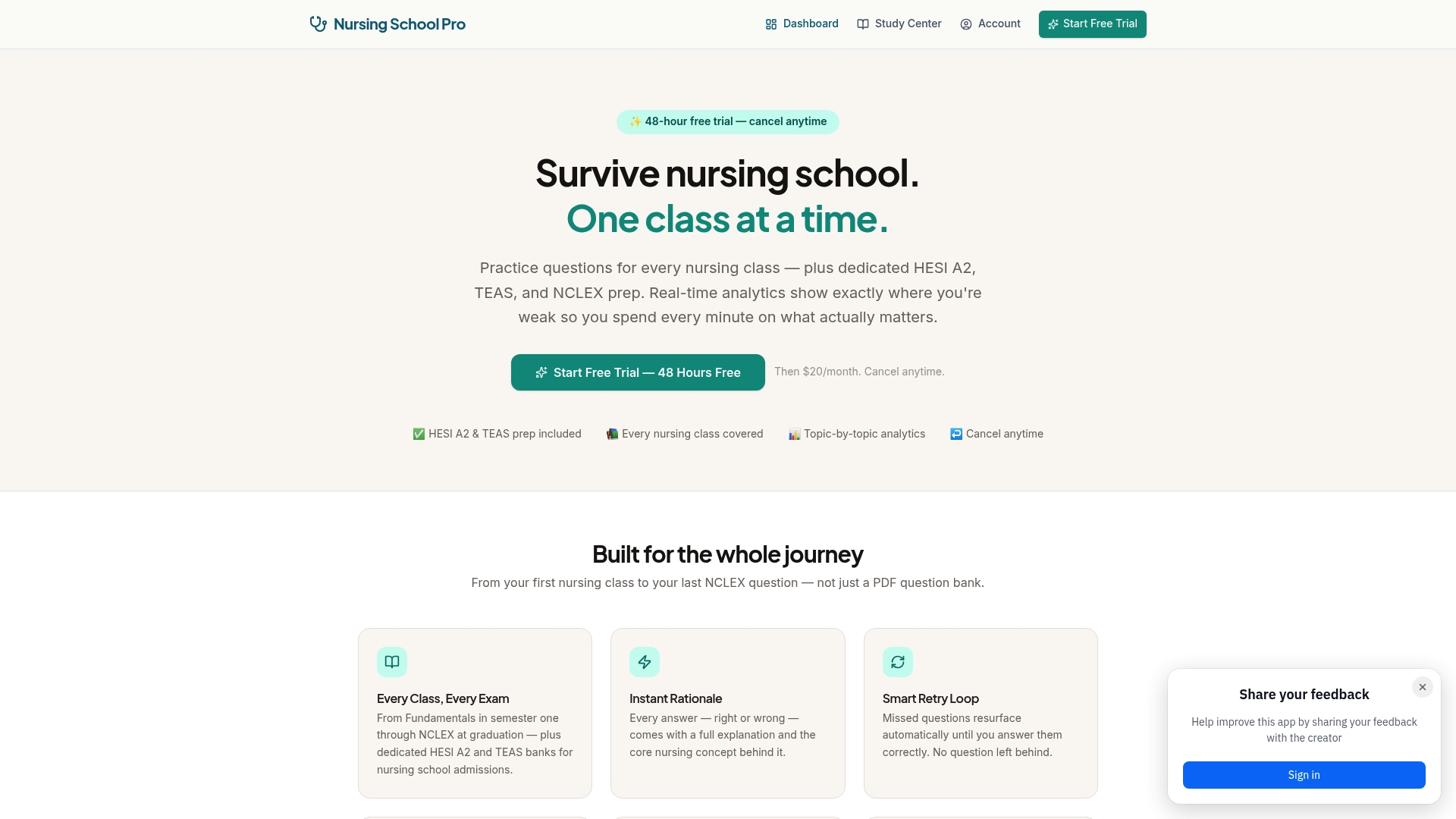
Nursingschoolpro is built specifically for nursing students preparing for NCLEX-RN and NCLEX-PN, with practice questions aligned to the current NCSBN test plans, instant rationales that explain the reasoning behind every answer, and real-time analytics that show exactly which Client Needs categories need work. At $20/month with a 48-hour free trial, you can run a full diagnostic, see your weak areas, and start targeted remediation before you spend a dollar.
Start with the Nursingschoolpro study center to take your baseline diagnostic and let the analytics tell you where to focus first.
Sources
- NCLEX & Other Exams | NCSBN
- NCLEX-PN vs NCLEX-RN: Key Differences | Nurse License Guide
- NCLEX explained
Recommended
- Pricing — Nursing School Pro | $20/month, 48-Hour Free Trial
- Too Old for Nursing School? Why an ADN Is a Smart First Step | Nursing School Pro
- The Dosage Calculation Mistake That Almost Failed Me | Nursing School Pro
- Nursing School Pro — Practice Questions for HESI A2, TEAS & NCLEX | 48-Hour Free Trial