
Yes, you can retake the NCLEX. The national baseline set by the National Council of State Boards of Nursing (NCSBN) requires a minimum wait between attempts and allows several attempts per year. Your state nursing regulatory body (NRB) may impose stricter limits on top of that, and Pearson VUE handles the actual scheduling once you have a valid Authorization to Test (ATT). The practical sequence is: contact your NRB first, reapply, register with Pearson VUE, receive a new ATT, then schedule. NRB processing alone can add one to two weeks before you can even book a seat.
The 45-day window is the floor, not the finish line. Most candidates wait longer once NRB reprocessing and ATT issuance are factored in. Build your study plan around a realistic six-to-eight-week window, not the minimum.
Table of Contents
- Who decides your retake rules, and how do state boards differ?
- How do you re-register and schedule your NCLEX retake?
- What are the specific retake rules, fees, and ATT details?
- How should you actually study differently for a retake?
- Common "what if" questions after failing the NCLEX
- Your seven-day checklist after a failed result
- Key Takeaways
- The part most candidates get wrong about failing the NCLEX
- Nursingschoolpro gives retake candidates a real study edge
- Where to find official guidance and state board contacts
Who decides your retake rules, and how do state boards differ?
NCSBN writes the national floor. Every state's NRB sits above it and can tighten the rules however it sees fit. That two-layer structure is why two candidates from different states can have very different experiences after the same failed attempt.
Common variations you will run into:
- Attempt caps per calendar year: Some NRBs cap retakes below the NCSBN's eight-per-year guideline.
- Remediation requirements: After multiple failed attempts, certain boards require documented remedial coursework or a board review before you can reapply.
- Additional documentation: Some states ask for a new application, updated transcripts, or proof of continued eligibility each time you reapply.
- Unlimited attempts with the 45-day wait: A number of NRBs follow the NCSBN baseline without adding extra restrictions, provided you meet the wait and pay the fees.
State boards publish their own retake rules, and those rules can change. The only reliable source for your specific limits is your own NRB, not a forum post or a classmate's experience.
Pro Tip: When you call your NRB, ask three specific questions: (1) What is the maximum number of attempts allowed per year in this state? (2) Are there any remediation or documentation requirements after multiple failures? (3) What is the current processing time for a retake application? Getting those answers in writing, even via email, protects you.
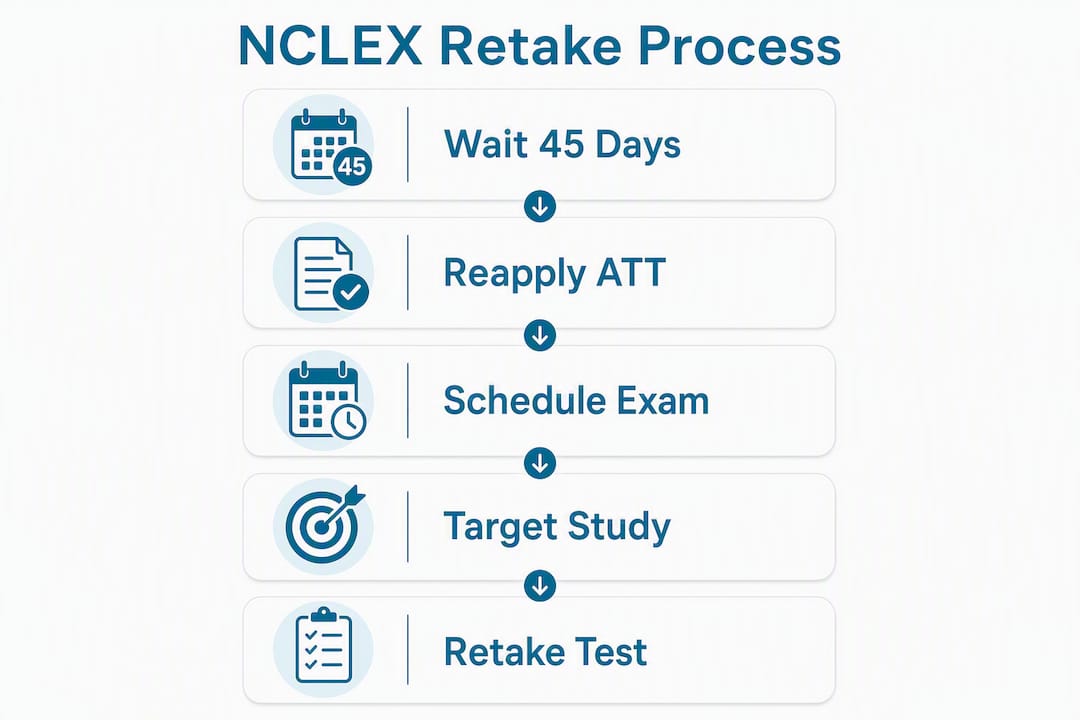
How do you re-register and schedule your NCLEX retake?
The five-step process NCSBN outlines is straightforward, but each step has its own processing time. Rushing one step does not speed up the next.
- Receive your official results. NCSBN states candidates typically receive official results from their NRB within about six weeks of testing. Do not rely on unofficial "quick results" as your trigger for reapplication.
- Contact your NRB. Notify them of your intent to retake and confirm any state-specific requirements before spending money on registration.
- Complete NRB requirements. This may mean submitting a new application, paying a state fee, or completing remediation if your board requires it.
- Register with Pearson VUE. Once your NRB confirms eligibility, register at pearsonvue.com/nclex and pay the exam fee.
- Receive your new ATT. Pearson VUE issues the ATT after NRB approval. Your ATT has a fixed validity window; you must schedule and sit the exam before it expires.
- Schedule your test date. Book within your ATT window, keeping the 45-day minimum in mind from your last test date.
| Stage | Who handles it | Typical time |
|---|---|---|
| Official results issued | NRB | Up to 6 weeks post-exam |
| NRB reapplication review | NRB | 1–2 weeks |
| Pearson VUE registration | Candidate + Pearson | 1–3 business days |
| ATT issuance | Pearson VUE | 1–3 business days after NRB approval |
| Scheduling availability | Pearson VUE test centers | Varies by location |
Plan for the full administrative chain, not just the 45-day wait. When NRB processing and ATT issuance are stacked together, many candidates find their earliest realistic test date lands six to eight weeks out, not 45 days.
What are the specific retake rules, fees, and ATT details?
The NCLEX Examination Candidate Bulletin is the definitive reference for policy details. Here is what candidates most often need to know before they reapply.
Wait period and attempt limits:
- The national minimum is 45 test-free days between attempts, counted from the date you last tested.
- NCSBN allows up to eight attempts per year as a baseline; your NRB may allow fewer.
- There is no national lifetime cap on total attempts, but state boards can set one.
Fees:
- The Pearson VUE exam fee applies every time you register, regardless of how many times you have attempted.
- Your NRB may charge a separate reapplication or licensure fee on top of the Pearson fee.
- NCLEX fees are non-refundable for any reason, including illness, scheduling conflicts, or administrative errors.
ATT mechanics:
- Your ATT is valid for a specific window set by your NRB; if it expires before you test, you must reapply and pay again.
- A missed appointment does not automatically restart the 45-day wait, but you will lose the exam fee and need a new ATT.
- Scheduling an appointment and then canceling inside the Pearson VUE cancellation window also forfeits the fee.
How should you actually study differently for a retake?
A failed attempt gives you data. The worst thing you can do is repeat the same study approach and expect a different result.
- Pull your performance report. NCSBN provides a candidate performance report after a failed attempt. It shows your relative performance across content areas. Start there, not with a generic review book.
- Map your weakest content areas. Identify the two or three NCLEX client needs categories where you scored below the passing standard. Those get the most study time.
- Build a timed, structured schedule. A realistic retake window is six to eight weeks. Divide it into two phases: targeted content review (weeks 1–4) and full-length practice testing (weeks 5–8). Adjust based on your actual test date.
- Practice with analytics, not just volume. Doing 200 random questions tells you less than doing 50 targeted questions and reviewing every rationale. Track which subtopics you keep missing and return to them weekly.
- Simulate real test conditions. In the final two weeks, run timed practice blocks that mirror the NCLEX format. Pacing matters; many candidates know the content but lose time managing anxiety on longer question sets.
Pro Tip: Spaced repetition works. Instead of reviewing a topic once and moving on, schedule a second pass three to four days later. That second exposure is where retention actually sticks, especially for pharmacology and priority questions.
Key habits that separate candidates who pass on a retake:
- Reviewing rationales for every question, including the ones you got right
- Targeting dosage calculation and priority/delegation questions specifically, since these trip up a disproportionate number of retakers
- Using a study center with structured content rather than scattered YouTube videos and random PDFs
- Keeping study sessions to 60–90 minutes with breaks; fatigue degrades retention fast
Nursingschoolpro's analytics-driven question bank maps directly to this approach. The platform tracks your performance by NCLEX content category, flags weak subtopics in real time, and provides instant rationales so you understand the reasoning, not just the answer. A 48-hour free trial gives you enough time to run a focused diagnostic block and see where you actually stand before you commit to a full prep schedule.

Common "what if" questions after failing the NCLEX
How soon can I retake the NCLEX? The earliest possible date is 45 days after your last test, but NRB processing and ATT issuance typically push the realistic window to about six weeks. Contact your NRB immediately after receiving official results to start the clock on reapplication.
What happens if I fail three or more times? The NCSBN national baseline still allows retakes up to eight times per year, but some state boards require remediation, a board review, or additional documentation after multiple failures. Check with your NRB before assuming you can simply reapply.
What if I retake after a long gap? Eligibility does not automatically lapse, but your NRB may require updated documentation or a new application if significant time has passed. Some states have rules about nursing education currency. Call your board and ask directly.
What if my ATT expires before I schedule? You lose that ATT and must reapply through your NRB and Pearson VUE. The 45-day wait applies from your last test date, not from the ATT expiration. You will also pay the exam fee again.
Does the exam "shut off" at a certain question count? The NCLEX uses computerized adaptive testing (CAT). It stops when it has determined with statistical confidence whether you are above or below the passing standard, or when you hit the maximum question count. The number of questions you receive is not a reliable indicator of pass or fail.
- A missed appointment is not the same as a failed attempt; it does not count against your annual attempt limit but does cost you the fee.
- An expired ATT is an administrative issue, not a policy violation; reapply and move forward.
Your seven-day checklist after a failed result
Days 0–2:
- Confirm the official result through your NRB (not just the quick results service).
- Note the exact date of your last test; your 45-day window starts there.
- Check your current ATT status: is it still valid, or has it expired?
- Pull your NCSBN candidate performance report and identify your two weakest content areas.
- Email or call your NRB to ask about reapplication requirements and current processing time.
Days 3–7:
- Submit your NRB reapplication and any required documentation or fees.
- Register with Pearson VUE once your NRB confirms eligibility.
- Block out your study schedule for the next six to eight weeks, accounting for NRB and ATT processing time before you can book a test date.
- Set up your practice question bank and run a diagnostic session to baseline your current performance.
Administrative reminders before test day:
- Verify that the name on your government-issued ID exactly matches the name on your Pearson VUE registration. A name mismatch can result in denied entry and loss of the exam fee.
- Confirm your ATT expiration date and make sure your scheduled test date falls within it.
- Review Pearson VUE's cancellation and rescheduling policy so you know the cutoff for avoiding a forfeited fee.
Key Takeaways
The NCLEX retake process follows a fixed national baseline from NCSBN, but your state NRB controls the details that actually determine your timeline and eligibility.
| Point | Details |
|---|---|
| 45-day minimum wait | NCSBN requires 45 test-free days between attempts; NRBs may add stricter limits. |
| Eight attempts per year | The national baseline allows up to eight attempts annually; confirm your state's cap with your NRB. |
| Contact your NRB first | NRB reapplication and processing (1–2 weeks) adds time beyond the 45-day minimum before you can schedule. |
| ATT validity matters | An expired ATT requires reapplication and a new fee; schedule your test date well within the validity window. |
| Nursingschoolpro for retake prep | Nursingschoolpro's analytics-driven question bank and instant rationales support the targeted, data-guided study approach this article recommends. |
The part most candidates get wrong about failing the NCLEX
The conventional advice after a failed NCLEX is to "study harder." That framing is almost always wrong, and it is worth saying plainly.
Failing the NCLEX rarely means you do not know enough nursing content. More often, it means you studied the wrong things in the wrong proportions, or you practiced answering questions without genuinely understanding the reasoning behind correct answers. The NCLEX is not a content recall test; it is a clinical judgment test. Candidates who pass on a retake almost universally report one shift: they stopped trying to memorize and started practicing how to think through a question.
The performance report NCSBN provides after a failed attempt is genuinely useful, and most candidates ignore it or glance at it once. That report tells you exactly where the exam found you below the passing standard. Two or three targeted content areas, studied with real rationale review and spaced repetition, will do more for your next attempt than six weeks of unfocused question grinding.
One more thing worth saying: the administrative side of retaking trips up more candidates than it should. Missing an ATT deadline, showing up with a name mismatch on your ID, or assuming your NRB processes applications in 48 hours are all avoidable errors that cost real money and real time. Treat the paperwork with the same seriousness as the studying.
Nursingschoolpro gives retake candidates a real study edge
Failing once and passing the next time is a common outcome, and the difference usually comes down to how targeted the prep was. Nursingschoolpro is built for exactly this situation: a question bank mapped to NCLEX content categories, real-time analytics that surface your weak subtopics after every session, and instant rationales that explain the clinical reasoning behind each answer.
The 48-hour free trial gives you enough time to run a full diagnostic block, identify your two or three weakest areas, and start a focused review before you even have your new ATT in hand. After the trial, the subscription runs $20 per month, which covers your entire prep window without a long-term commitment. Start your trial now and use the first two sessions to benchmark exactly where your performance stands.
Where to find official guidance and state board contacts
Use these sources to confirm rules for your specific situation. No third-party article, including this one, replaces official NRB guidance.
- NCSBN retake policy FAQ: The national baseline on attempt limits and the 45-day wait.
- NCSBN retake process steps: The official five-step operational flow from results to scheduling.
- NCLEX Examination Candidate Bulletin: Full policy detail including fees, no-refund rules, and ATT mechanics.
- NCSBN NCLEX info flyer: Administrative details on result timelines, ID requirements, and fee policies.
- Pearson VUE NCLEX registration: Visit pearsonvue.com/nclex directly to register, manage your ATT, and review scheduling and cancellation policies.
- Your state NRB: Search "nursing board [your state]" or use the NCSBN's board directory at ncsbn.org to find your NRB's contact page and confirm your specific retake limits, fees, and documentation requirements.
- Nursingschoolpro study center: Structured guides and practice resources to support targeted retake preparation.