
The official source for NCLEX pass rates is the NCSBN pass-rate dashboard, which publishes national, state, and program-level figures for both NCLEX-RN and NCLEX-PN candidates. These numbers report pass/fail outcomes — they do not reflect a fixed exam difficulty percentage. The passing standard is set to measure minimum entry-level competence, which means if every candidate demonstrated that competence, every candidate could pass. Pearson VUE delivers the exam; Nursingschoolpro provides the prep tools — instant rationales and real-time analytics — that help you build the clinical reasoning those standards actually measure.
Quick orientation before you dig in:
- NCSBN dashboard: national, state, and program-level pass rates, filterable by year and candidate type
- State boards of nursing: program-specific annual reports for your jurisdiction
- Individual program disclosures: cohort-level data schools publish (or are required to publish) on their websites
- Pearson VUE: test delivery and scheduling, not a source of aggregate pass-rate data
Pro Tip: Bookmark the NCSBN dashboard now. When a program quotes you a pass rate, pull up the dashboard and verify the figure against NCSBN's own program-level tables before you take that number at face value.
Table of Contents
- Where can you find current NCLEX pass rates?
- What do first-time, repeat, and ultimate pass rates actually mean?
- Why do pass rates vary so much between schools and states?
- How should you use pass-rate data when choosing a program?
- Practical steps to improve your own chances of passing
- Key administrative details: registration, results, and retakes
- How the NCLEX pass/fail decision actually works
- Key Takeaways
- What most students get wrong about pass-rate data
- Nursingschoolpro maps directly to what this guide recommends
- Useful sources for verifying NCLEX pass rates
Where can you find current NCLEX pass rates?
The NCSBN NCLEX Pass Rates page is the single most reliable starting point. Its interactive dashboard lets you filter by year, candidate type (first-time vs. repeat, domestic vs. internationally educated), and individual nursing program. That last filter is the one most students overlook — you can pull a specific school's cohort data directly rather than relying on what the admissions office tells you.
State boards of nursing publish their own annual reports, and those are worth checking alongside the NCSBN dashboard. Some states post program-level tables with cohort sizes; others publish only aggregate state figures. Florida, California, and Texas, for example, maintain publicly accessible annual NCLEX reports that include school-by-school breakdowns.
Individual programs are also required in most states to disclose their NCLEX pass rates, often on their accreditation or outcomes pages. The catch: programs sometimes report their "ultimate" pass rate (all attempts, all candidates) rather than the first-time rate, which inflates the number. Always confirm which metric a school is quoting.
- NCSBN dashboard: best for national trends, program comparisons, and candidate-type filtering
- State board annual reports: necessary for jurisdiction-specific program verification
- Program websites: useful starting point, but cross-check against NCSBN data
Pro Tip: When verifying a program's published rate, match the reporting window (calendar year vs. academic year) and candidate type. A mismatch between those two variables is the most common reason a program's number and NCSBN's number look different.
What do first-time, repeat, and ultimate pass rates actually mean?
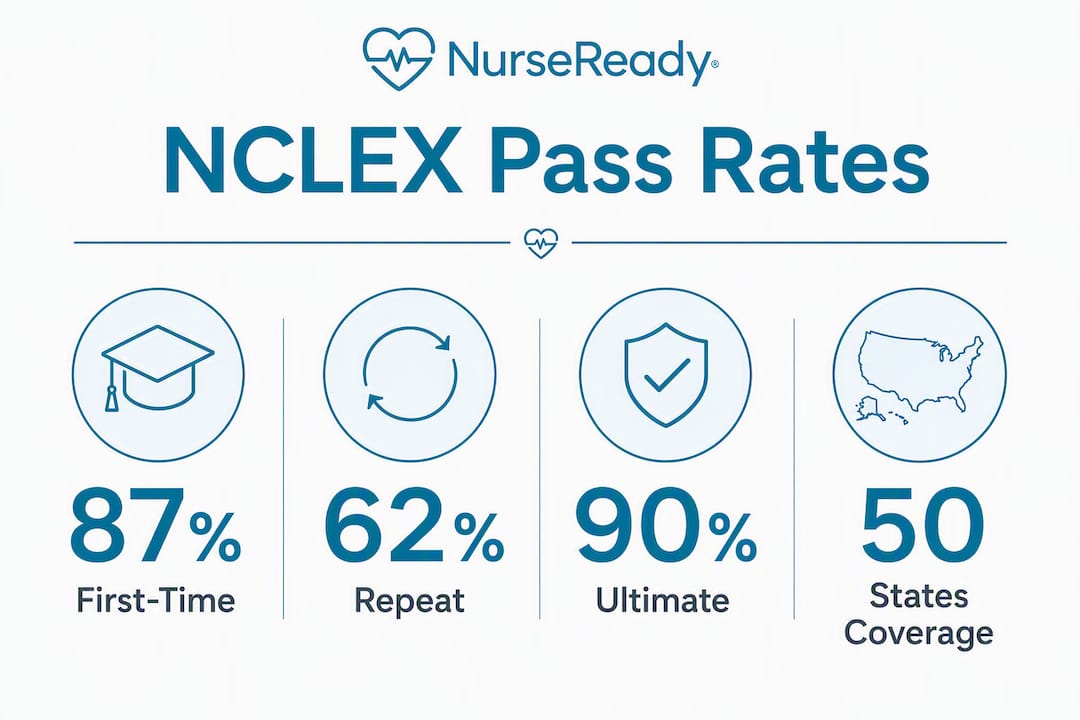
First-time pass rate counts candidates sitting for NCLEX for the first time after completing a nursing program. This is the most widely cited metric and the one NCSBN emphasizes in its annual statistics. It strips out repeat attempts, so it reflects how well a program prepares graduates for their initial shot.

Repeat pass rate covers candidates retaking the exam after a prior failure. These candidates typically score lower as a group, which is why mixing them into a reported figure pulls the headline number down.
Ultimate pass rate tracks a cohort through all attempts over a defined window (often one or two years). A program might report a 95% ultimate rate while its first-time rate sits at 78% — both numbers are technically accurate, but they tell very different stories.
The NCLEX-RN and NCLEX-PN are separate exams with separate candidate pools and separate pass-rate baselines. NCLEX-RN candidates are generally baccalaureate or associate degree graduates; NCLEX-PN candidates complete practical/vocational nursing programs. Their preparation depth and program length differ, so comparing RN and PN pass rates directly is not meaningful.
By the numbers: The 2026 Q1 NCLEX-RN report recorded an overall first-time pass rate of 86.75% across more than fifty-five thousand delivered exams. State-level figures in the same period ranged moderately, showing meaningful jurisdiction variance between states such as Florida and California.
Why do pass rates vary so much between schools and states?
Raw pass-rate differences rarely mean one program is simply "better" than another. Several structural factors drive the variance.
- Admission standards and student mix: Programs with selective admissions tend to enroll candidates who are already stronger test-takers. That raises the cohort's baseline before a single lecture is taught.
- Curriculum alignment: Programs that map coursework directly to NCLEX client needs categories and clinical judgment frameworks tend to produce graduates who recognize the question format and reasoning style.
- Internationally educated candidates: Country-level pass rates vary dramatically — some countries show rates below 50% in NCSBN tables. Programs that enroll a higher proportion of internationally educated candidates will show lower aggregate rates even if their domestic-educated cohort performs well.
- Cohort size: A program graduating 12 students per year can swing 20 percentage points from one year to the next based on two or three outcomes. That is statistical noise, not a signal about program quality.
- Standard-setting cycles: NCSBN reviews the passing standard approximately every three years. When the standard shifts, pass rates across all programs move — sometimes significantly — independent of anything a school did differently.
Pro Tip: Look at three to five years of first-time pass rates for a program, not just the most recent year. A single-year dip followed by recovery is normal variation. A sustained downward trend across multiple cohorts is worth asking about.
How should you use pass-rate data when choosing a program?
Pass rates are a risk-assessment tool, not a ranking. Here is how to use them without over-interpreting a single number.
What to prioritize:
- Multi-year first-time pass rate trend (three or more years)
- Cohort size disclosed alongside the rate
- Whether the reported figure is first-time, ultimate, or a blend
- Verification against NCSBN program-level data
Red flags:
- A sudden unexplained drop of 10+ points in a single year
- Cohort sizes under 20 with no multi-year context
- A program that only publishes its ultimate rate and won't disclose first-time figures
- No publicly available data at all
Questions worth asking admissions directly:
- What is your three-year first-time NCLEX pass rate for domestic-educated graduates?
- What remediation supports are available for students who fail a practice benchmark?
- What is your faculty-to-student ratio in clinical rotations?
- How does your curriculum map to the current NCLEX test plan?
- What percentage of your graduates sit for NCLEX within six months of graduation?
Pass rates should weigh alongside cost, clinical partnership quality, schedule flexibility, and accreditation status. A program with an 88% first-time rate and strong clinical placements often beats one with a 91% rate and no meaningful remediation infrastructure.
Practical steps to improve your own chances of passing
The average NCLEX-RN test in 2024 ran about 100 items and took 2 hours 14 minutes. About 65.4% of candidates finished at the minimum item count, and 16.7% reached the maximum. That distribution tells you something useful: efficient clinical reasoning — knowing why an answer is correct, not just which answer — gets most candidates to a decision faster and with higher confidence.
A six-week study framework:
- Run a baseline diagnostic. Identify your weakest NCLEX content categories before you write a single study schedule. Gut feelings about weak areas are usually wrong; data is not.
- Build a weekly rhythm. Three to four timed practice blocks per week, each 25–50 questions, followed by a focused rationale review session. Do not skip the review — that is where the learning happens.
- Use rationales to build reasoning, not memory. When you get a question wrong, read the rationale for every answer choice, not just the correct one. Understanding why the distractors are wrong is what transfers to novel questions.
- Track category-level metrics. Percent correct by content area, average time per item, and confidence ratings across question sets. These three numbers tell you where to spend the next week.
- Simulate CAT conditions. At least once per week, run a timed block without pausing, skipping, or reviewing mid-set. The exam does not let you go back; your practice shouldn't either.
- Remediate by system, not by topic. If cardiovascular is weak, work through it fully before moving on. Scattered remediation across five systems simultaneously rarely moves the needle.
- Spaced repetition: revisit flagged questions 48–72 hours after first exposure
- Prioritization questions: practice the "most urgent" and "first action" question types specifically — they appear frequently and require a distinct reasoning pattern
- Dosage calculation accuracy: one of the highest-stakes NCLEX topics; targeted practice here pays disproportionate dividends
Pro Tip: After any timed block, review your time-per-item data. Candidates who average more than 90 seconds per question often struggle to finish efficiently. If your pace is slow, the problem is usually hesitation on clinical judgment questions — not knowledge gaps.
Key administrative details: registration, results, and retakes
Pearson VUE handles all NCLEX scheduling and test delivery. You register through the Pearson VUE website after your state board of nursing approves your eligibility. The two steps — board approval and Pearson VUE registration — must both be complete before you can book a test date.
- Result timing: Most candidates in the US can access unofficial results through the "Quick Results" service on the Pearson VUE website approximately 48 hours after testing (for a fee). Official results come from your state board of nursing and may take two to four weeks.
- Retake rules: Waiting periods and attempt limits vary by state board. Most jurisdictions require a 45-day waiting period between attempts, but confirm with your specific board — some states have additional requirements.
- Test day checklist: Valid government-issued ID, your Pearson VUE authorization to test, and knowledge of the testing center's personal item policy. Arrive early; late arrivals are typically turned away.
Pro Tip: Save your Authorization to Test email and your Pearson VUE confirmation. If there is any discrepancy between your name on file and your ID, resolving it before test day is far easier than at the testing center door.
How the NCLEX pass/fail decision actually works
The NCLEX uses computerized adaptive testing (CAT) to make a pass/fail decision with 95% statistical certainty before the maximum item count is reached. The exam continuously estimates your ability level and compares it to the passing standard. Once it can say with 95% confidence that you are clearly above or clearly below that standard, it stops.
If you reach the maximum item count without that 95% threshold being met, the exam makes a final decision based on your ability estimate at that point. This is why the number of questions you receive tells you almost nothing about whether you passed — it reflects the precision of the measurement, not your performance level.
NCSBN reviews the passing standard on roughly a three-year cycle, adjusting it to reflect current entry-level competence expectations. That means a pass rate from five years ago and a pass rate from last quarter are not directly comparable without knowing whether the standard changed in between.
Data quality checklist for any pass-rate source:
- Source provenance: is it NCSBN, a state board, or a program self-report?
- Cohort size: is it disclosed, and is it large enough to be statistically meaningful?
- Reporting window: calendar year, academic year, or rolling 12 months?
- Candidate type: first-time domestic, repeat, or internationally educated?
- Standard-setting context: did the passing standard change during the reported period?
The 2025 NCLEX Examination Statistics publication includes historical data back to 1994 and full standard-setting methodology — the most thorough single document for understanding what the numbers actually measure.
Key Takeaways
The most reliable way to use NCLEX pass rates is to verify program figures against NCSBN's own dashboard, focus on multi-year first-time rates with disclosed cohort sizes, and convert that data into a targeted study plan built around clinical reasoning, not memorization.
| Point | Details |
|---|---|
| Go to the primary source | The NCSBN dashboard filters by year, candidate type, and program — always verify against it. |
| First-time rate is the right metric | Ultimate rates include repeat attempts and inflate the headline number; always ask which figure a program is quoting. |
| 86.75% national first-time rate (Q1 2026) | State-level figures in the same period ranged moderately, showing meaningful jurisdiction variance. |
| Passing standard is competence-based | NCSBN sets the bar at entry-level competence and reviews it roughly every three years — chasing averages misses the point. |
| Nursingschoolpro aligns prep to the standard | Instant rationales and real-time analytics build the clinical reasoning the NCLEX actually measures, not pattern memorization. |
What most students get wrong about pass-rate data
Students spend hours comparing school pass rates and almost no time asking what those rates actually measure. A program reporting 91% sounds better than one reporting 86% — until you find out the 91% is an ultimate rate with a cohort of 14, and the 86% is a first-time rate with 200 graduates over three years. The larger, first-time figure is the more meaningful number by a wide margin.
The deeper issue is that pass rates describe populations, not individuals. Your outcome depends on your preparation, not your program's aggregate. A student who builds genuine clinical reasoning through rationale-based practice and tracks weak areas with analytics will outperform the program average. A student who memorizes content and avoids timed practice will underperform it. The data is useful for choosing a program and benchmarking your readiness — but it is not a prediction about you specifically.
Nursingschoolpro maps directly to what this guide recommends
The study framework in this article has three pillars: rationale-based practice, analytics-driven remediation, and timed CAT-style simulation. Nursingschoolpro is built around exactly those three.
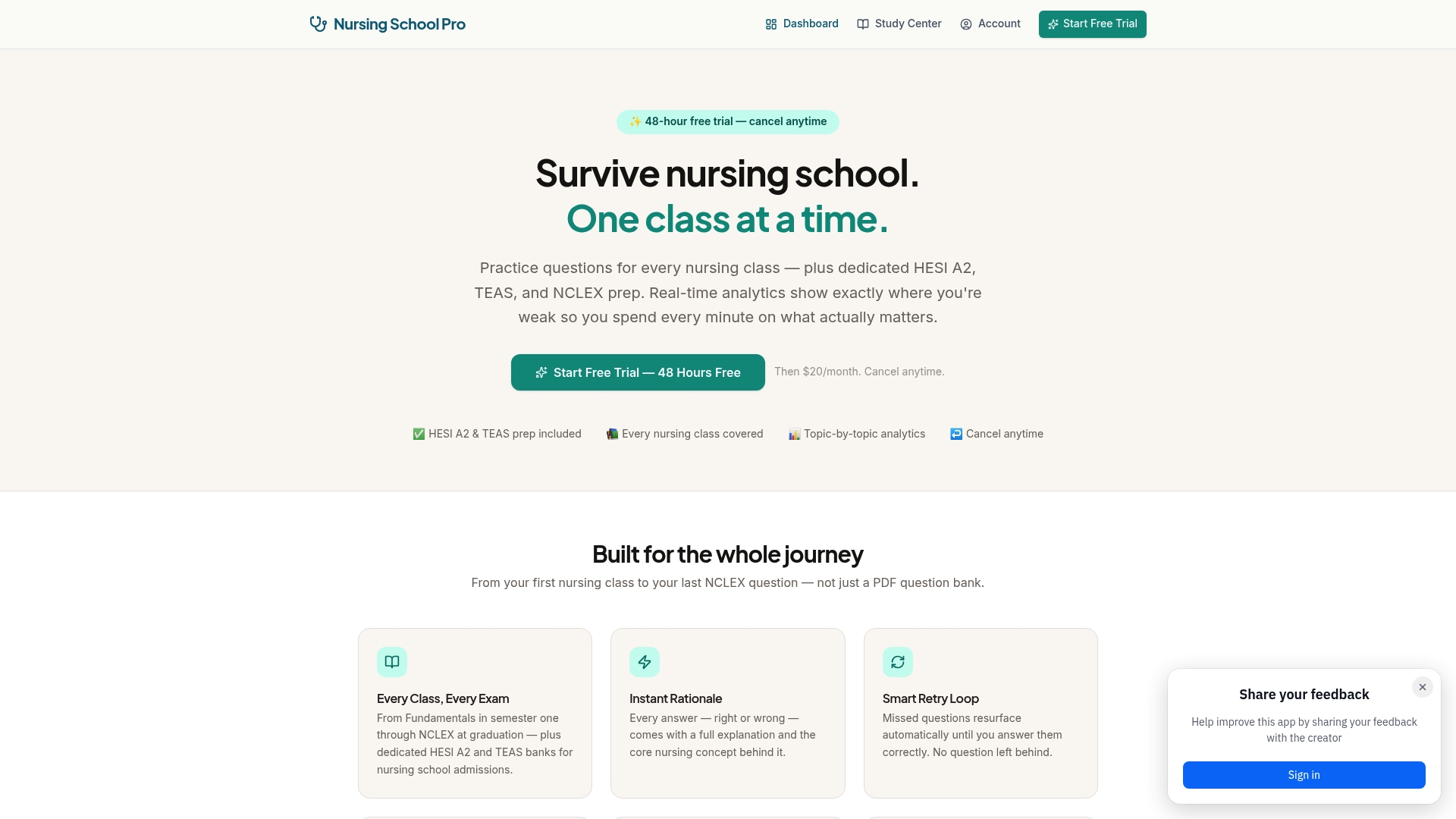
Every practice question on the platform includes instant rationales for all answer choices — not just the correct one — so you build the "why" reasoning the NCLEX tests. Real-time analytics track your percent correct by content category and flag the systems where your performance is weakest, so your next study session has a specific target instead of a vague plan. Timed question sets replicate the pressure of the actual exam environment.
The platform covers every nursing class from your first semester through graduation, plus dedicated NCLEX prep. A 48-hour free trial gives you full access before you commit to the $20/month subscription. Start with the Study Center to run your baseline diagnostic and build your first targeted question set.
Useful sources for verifying NCLEX pass rates
- NCSBN NCLEX Pass Rates dashboard: interactive tool for filtering national and program-level pass rates by year and candidate type; the first place to verify any figure a program quotes you
- 2025 NCLEX Examination Statistics: NCSBN's full annual publication with historical data since 1994, CAT methodology, and standard-setting background
- 2024 NCLEX Examination Statistics (PDF): downloadable version with detailed candidate-type breakdowns, testing behavior data, and passing-standard history
- Nurse Licensure and NCLEX Exam Statistics | NCSBN: the parent page for all annual publications, including prior years back to the CAT era
- State boards of nursing: each state board publishes its own annual NCLEX report with program-level tables; search "[your state] board of nursing NCLEX annual report" to locate the current version
When you ask a program or advisor about their pass rate, cite the NCSBN dashboard as your reference point. It keeps the conversation grounded in verifiable data rather than marketing language.